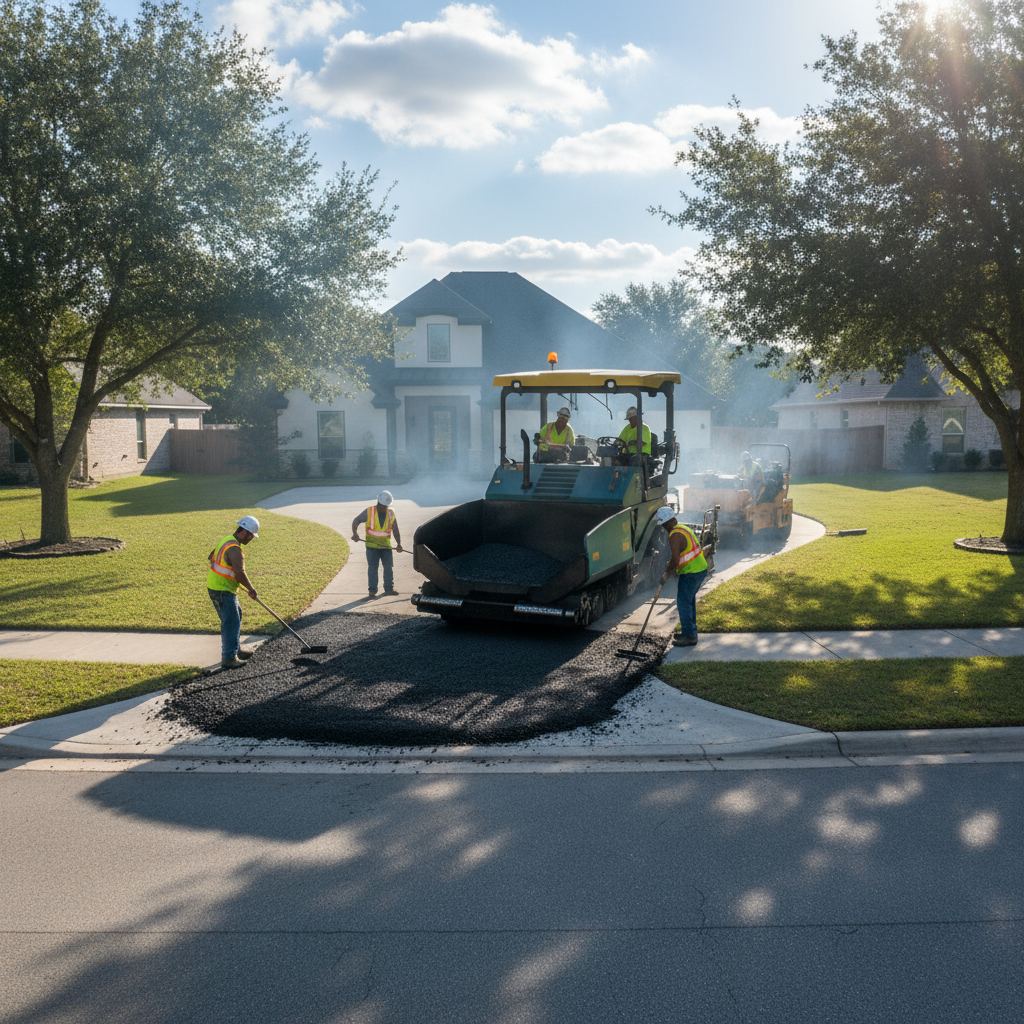
Driveway paving options and costs in Fruitvale
Driveway paving in Fruitvale comes down to choosing a surface that can handle interior BC’s freeze–thaw reality. With a population of 1,958 (Statistics Canada, 2021 Census) and 690 homeowner households, most driveways here are tied to single-detached homes—these represent 72.7% of dwellings, so the demand for durable private access is steady year-round. At the same time, Fruitvale has a different cost profile than the coast: the Kootenay region commonly sees frost depths around 45–60 inches depending on elevation and micro-climate. That means your contractor will typically design for frost heave control using a deeper, well-compacted granular base and dependable drainage, which increases excavation, imported road base, and labour time.
On top of that, the paving season is shorter in colder interior pockets. Hot-mix asphalt generally needs air temperatures above 10°C, so schedules tighten from late spring through early fall—mobilization and weather risk get priced into the work. You’ll also see contractors prioritize jobs in areas like the Creekside/Station Avenue corridor, where older housing (69.0% of homes built before 1981) often means existing gravel or failing asphalt needs tear-out and rebuild before the new surface can perform.
Below is a practical comparison of the main options you’ll see in Fruitvale, including typical lifespan and cost ranges tied to Kootenay base preparation and winter durability. Use the table to compare upfront costs, then match the material to how you want to maintain the driveway over time.
| Material |
Lifespan |
Maintenance |
Best For |
Price per sq ft |
Price Range |
| Asphalt (new installation, proper base) |
15–25 years |
Seal coating every 3–5 years; crack filling as needed |
Best value where access is straightforward and you want a smooth ride |
$6.00–$10.00 |
$7,000–$13,000 |
| Asphalt (overlay on existing gravel base) |
10–18 years |
More frequent crack sealing; monitor base settlement |
When you’re upgrading a mostly stable gravel base without full reconstruction |
$5.50–$9.00 |
$6,500–$11,500 |
| Interlocking concrete pavers |
25–40 years |
Replace individual pavers as needed; periodic joint stone top-up |
Premium curb appeal and easy localized repairs after winter heave events |
$8.50–$14.00 |
$9,000–$16,000 |
| Poured concrete (broom finish) |
20–30 years |
Seal if desired; joint/edge crack monitoring |
Clean lines, plow traffic-friendly surface, and a lower-maintenance finish |
$9.00–$15.00 |
$11,000–$18,000 |
| Exposed aggregate concrete |
20–30 years |
Occasional sealing; maintain edges and drainage |
Slip resistance and a textured look in winter conditions |
$12.00–$17.00 |
$13,500–$20,500 |
| Gravel / crushed stone (budget option) |
3–10 years |
Regrade and top up annually; weed control and dust reduction |
Temporary access or very tight budgets while planning a rebuild |
$2.00–$4.50 |
$2,500–$6,500 |
Prices are estimates only and vary by project scope, site access and material selection.
What affects the price of paving in Fruitvale
It’s common to see the “same” driveway quote swing by 30–50% across the Kootenay and other parts of BC, even when the surface looks similar. In Fruitvale, the drivers aren’t just material choice—they’re the engineered base and drainage needed to survive frost depth and repeated freeze–thaw cycles. Where frost penetration is commonly in the 45–60 inch range, your contractor has to build a deeper, well-drained, compacted granular foundation to limit heave and long-term cracking. That’s very different from milder coastal conditions, where contractors can sometimes use less granular thickness because freeze–thaw loading is less severe.
Timing matters too. Asphalt work is typically constrained to late spring through early fall because hot-mix needs adequate air temperatures (often above 10°C). When scheduling windows shrink, crews and equipment availability tighten, and contractors carry weather risk—so asphalt projects can land toward the higher end of the $7,000–$13,000 band, especially when there’s a full tear-out and rebuild.
For concrete, frost and water control still govern performance. For example, a driveway built on older fill or an uneven slope may require extra grading and undercutting, pushing poured concrete closer to the $11,000–$18,000 range. On the other hand, if your existing base is stable and crowned correctly for drainage, an overlay-type asphalt plan can be cheaper—but only if the subgrade isn’t pumping during spring melt. With Fruitvale’s housing stock—69.0% of homes built before 1981—many sites start with drainage issues that must be corrected before any finished surface can last.
| Price Factor |
Why It Matters |
Cost Impact |
| Driveway area in sq ft |
Labour, base, fabric, and surface quantities scale directly with area |
Typically the biggest swing; can account for 50–70% of total |
| Base depth required |
Frost line governs granular thickness to reduce heave and cracking |
Deeper/adjusted base can add significant excavation and supply costs |
| Grading and drainage work |
Proper slope and drainage prevent water pooling during melt |
Can add days of labour and extra material (road base, drain rock) |
| Tear-out of existing surface |
Breaking, hauling, and disposal adds cost and affects base condition |
Often a major add-on when old asphalt/concrete is failing |
| Edge restraints and curbing |
Prevents paver spread and keeps asphalt/concrete from migrating |
Higher materials and layout time, especially on curved entrances |
| Sealing requirement |
Asphalt needs seal coating after installation window to slow oxidation |
Added cost in year 1–2; helps extend lifespan and manage cracking |
| Site access |
Narrow lots slow equipment movement and can increase labour hours |
Can add truck time, extra crew time, or smaller production rates |
| Asphalt mix specifications |
Freeze–thaw-rated mixes can cost more but resist rutting and cracking |
Moderate-to-high increase depending on required binder/gradation |
Permits & regulations in British Columbia
In British Columbia, paving a private driveway within your own property typically does not require a building permit when you’re simply replacing an existing surface or constructing a driveway in the driveway area (not altering major public infrastructure). However, work in the municipal right-of-way is where approvals can come into play—this includes new or modified curb cuts, changes to boulevard grading, or any modification that affects storm drainage along the road. Some areas also apply lot-grading rules that restrict how close a hard surface can be to property lines and how water must be directed away from foundations.
In Fruitvale, your safest path is to verify three things before excavation: (1) whether any portion of the work touches the road allowance or requires a curb/boulevard adjustment, (2) whether your plan keeps surface water flowing to an approved drainage path, and (3) whether there are lot-grading limitations on hardscape placement.
For utility safety, call for utility locates before any digging—BC 1 Call is the standard in the province. Then, when you hire your contractor, confirm their British Columbia licensing if applicable for the work scope, and review liability insurance plus workers’ coverage documentation. Ask for a certificate of insurance showing active coverage for the contract period and confirm workers’ compensation coverage (the applicable WCB/workers’ coverage number and clearance letter can typically be requested from the contractor). Always match the paperwork to the exact address and dates listed in your quote.
Asphalt vs pavers vs concrete for Fruitvale driveways
For Fruitvale driveways, the “best” choice depends on what you value most: lowest upfront cost, the ability to repair without tearing everything out, or the clean, long-wearing look. Asphalt usually has the lowest upfront price and a smooth finish, but it needs consistent maintenance—especially seal coating—to slow oxidation and manage cracking. In interior freeze–thaw conditions, asphalt also benefits enormously from correct base depth and good drainage, because water trapped under the surface can turn into heave as spring melt cycles repeat.
Interlocking concrete pavers cost more upfront, but they’re highly repairable: if a section settles or shows frost-related movement, an installer can remove and re-set affected units without replacing the whole driveway. That can matter in older Fruitvale neighbourhoods where you may encounter variable subgrade conditions. Poured concrete often lands mid-range, but it is still susceptible to cracking if joints, air content, and subgrade preparation aren’t done for freeze–thaw. Exposed aggregate adds slip resistance, which is helpful in winter traction routines, while drainage-focused options like permeable pavers or drainage grids can reduce trapped water—though they still require proper base specification.
In the Kootenay market, a realistic way to justify the price difference is to compare outcomes. For example, a basic asphalt driveway often falls within the $7,000–$13,000 band, while interlocking pavers commonly land in the $9,000–$16,000 range. If you expect plow traffic and want fewer “full replacement” scenarios after a localized base issue, the extra upfront cost can pay back through simpler repairs and longer overall service life.
| Material |
Frost Resistance |
Curb Appeal |
Repair Method |
Lifespan |
Price Band |
| Asphalt (sealed regularly) |
Good with thick, compacted base and drainage |
Moderate (smooth, clean lines) |
Crack sealing + localized patching |
15–25 years |
$7,000–$13,000 |
| Interlocking concrete pavers |
Very good; units accommodate minor movement |
High (custom patterns/colours) |
Remove and replace individual pavers |
25–40 years |
$9,000–$16,000 |
| Poured concrete (air-entrained) |
Good when properly air-entrained and jointed |
Moderate to high (clean, solid look) |
Crack repair or patching at joints/edges |
20–30 years |
$11,000–$18,000 |
| Exposed aggregate concrete |
Good; texture helps surface traction |
High (premium texture) |
Localized patching; re-finish limited areas |
20–30 years |
$13,500–$20,500 |
| Permeable pavers (drainage grid) |
Excellent for water management when base is designed correctly |
High (modern look) |
Replace affected units; keep drainage pathways clear |
20–35 years |
$10,500–$19,000 |
| Chip seal / tar-and-chip |
Moderate; can rut in high traffic if base is weak |
Low to moderate (more utilitarian) |
Spot repairs + re-surfacing over time |
6–12 years |
$6,000–$10,500 |
How to choose a paving contractor in Fruitvale
Choosing the right contractor in Fruitvale is mostly about verifying coverage, matching the quote to your site conditions, and getting a scope you can hold them to. In British Columbia, ask for confirmation of the contractor’s licensing when their work scope requires it, plus liability insurance (certificate naming your property and contract period). For workers’ coverage, request documentation showing workers’ compensation coverage and a clearance letter/coverage status if they typically provide it for projects. Don’t guess—review the certificate details and ensure dates line up with your start window.
Next, get 2–3 itemised written quotes. You want a breakdown that separates excavation, granular base, geotextile (if used), drainage components, base compaction, surface material, paver setting/stone, and mobilization. Avoid “lump sum” quotes without quantities; in Kootenay climates, small base-depth differences can be the difference between a surface that lasts 10–15 years versus 20+.
Read exclusions: Is disposal included for removed asphalt or concrete? Is permit/approval effort included if curb/boulevard work touches right-of-way? What’s the warranty length for workmanship, and does it match the product expectations for freeze–thaw? For payment, use a staged plan—never pay more than 10–15% upfront; keep a holdback until completion and close-out documentation are delivered. Also get a written timeline with start and completion estimates, because spring melt delays are common and crews may be booked early in the season.
- Confirm the company’s BC licensing status (if applicable to the scope) and legal business name.
- Request a certificate of liability insurance and verify it covers the contract period.
- Ask for proof of workers’ compensation coverage (clearance letter/status) before work starts.
- Require an itemised quote with quantities (sq ft, base thickness, drainage components).
- Make sure frost-related base design is stated: granular depth and compaction method.
- Check what’s included for tear-out: breaking, hauling, and disposal fees.
- Confirm edge restraint type and thickness (especially for pavers).
- For asphalt, confirm seal coating timing and who applies it (year 1 or year 2).
- Ask about jointing strategy for concrete (saw cuts, spacing, and finish type).
- Verify slope/crown and drainage plan—how water is directed away from the house.
- Get warranty details in writing: workmanship duration, exclusions, and transferability.
- Use a payment schedule with holdback and no large upfront deposits.
If a contractor in Fruitvale is vague on base thickness, won’t discuss drainage/crowning, promises “no need for seal coating” on asphalt, gives a non-itemised total price, or can’t provide insurance/coverage proof before excavation, treat it as a red flag and request revisions to their quote.
Frequently asked questions — paving in Fruitvale
What is a driveway apron and do I need one in Fruitvale?
A driveway apron is the paved transition area where your driveway connects to the road or where the curb line is adjusted—basically the “approach” piece designed to handle vehicles entering and leaving without breaking up at the edge. In Fruitvale, whether you need an apron depends on whether your driveway tie-in touches the road allowance, involves a new curb cut, or requires boulevard/storm-drain adjustments. If the work is purely within your property footprint and you’re resurfacing an existing connection, many homeowners don’t need anything beyond standard edge work and proper grading. But if you’re changing the curb/boulevard area or drainage path, municipal approval and an apron detail often become part of the plan. Your contractor should identify this up front in the quote scope.
How do I maintain my driveway through Fruitvale winters?
In British Columbia’s interior freeze–thaw conditions, maintenance is about reducing water and stress on the surface. Start in late fall by keeping the driveway crowned so meltwater doesn’t pool; pooled water is what contributes to heave and accelerated cracking. Use sand or traction materials carefully—if you use de-icing salts heavily, it can affect concrete surface durability over time (especially on non-air-entrained or poorly finished pours). For asphalt, plan on crack filling as soon as small cracks appear, then seal coating in the first year window after installation (often scheduled between 6 and 12 months depending on the product and weather). Also keep plough contact consistent: sharper blade angles and repeated impacts can ravel asphalt or chip edges if restraints aren’t properly built.
Is it worth sealing a new driveway right away in Fruitvale?
Usually, yes—but timing matters. In Fruitvale, asphalt sealing is most effective when the pavement has properly cured and can accept the coating. Many contractors aim to apply sealing after the initial season of weather exposure—commonly around 6–12 months—so the binder has stabilized and you get better adhesion. Sealing helps slow oxidation and reduces how quickly water penetrates surface micro-cracks, which is important during repeated interior melt/refreeze cycles. If your asphalt budget is within the typical driveway band of $7,000–$13,000, the sealing cost is relatively small compared to the benefit of extending service life. If you skip sealing, you’ll often end up paying more later through earlier crack repairs and larger patch areas.
What is a chip seal driveway and is it suited to Fruitvale?
Chip seal (tar-and-chip) is a layered surface where asphalt binder is applied and topped with aggregate. It’s used in some areas because it’s relatively economical and can provide a textured, slip-resistant surface. In Fruitvale, it can be suited when—and this is the key—the base is engineered correctly for frost depth and drainage, and the driveway isn’t heavily stressed at the edges where turning and plough impacts occur. If the granular base is weak or drainage is poor, chip seal can rut or break down sooner under freeze–thaw movement. For a true budget approach, chip seal might fall into a lower cost band (often around $6,000–$10,500 depending on scope), but many homeowners find it requires more watchful maintenance than asphalt or pavers. It’s worth discussing with your contractor as a “temporary upgrade” versus a long-term finish.
How much does driveway crack repair cost in Fruitvale?
Crack repair in Fruitvale typically includes cleaning the crack, routing if needed, and filling with an appropriate crack sealant or patch product. In the Kootenays, costs commonly land in the $600–$3,000 range depending on the number of cracks, total linear footage, and whether there’s localized base movement. A single short crack on a small driveway may be at the lower end, while multiple cracks that indicate water intrusion or movement can require a more involved approach. If the driveway is still relatively new asphalt, crack filling is usually the most cost-effective step to prevent water from reaching deeper layers during spring melt cycles. If cracks have already widened and there’s settlement, you may need patching or partial reconstruction rather than sealant alone.
What base thickness do I need for pavers in Fruitvale?
Base thickness for pavers in Fruitvale must be designed for frost heave resistance, which in the Kootenays often means building a deeper, properly compacted granular base and ensuring drainage away from the home. Many driveway builds in the interior use roughly 6–10 inches of compacted granular base, and in weaker or clayier soils contractors often increase it within the 6–10 inch or higher range to manage movement. The exact thickness depends on your existing subgrade condition, whether there’s any pumping or soft spots, and the planned slope/drainage corrections. Your installer should specify: undercut depth, granular type, compaction method (thin lifts), and edge restraint details. If your quote doesn’t clearly state base thickness and drainage, ask—this is where freeze–thaw performance is won or lost.