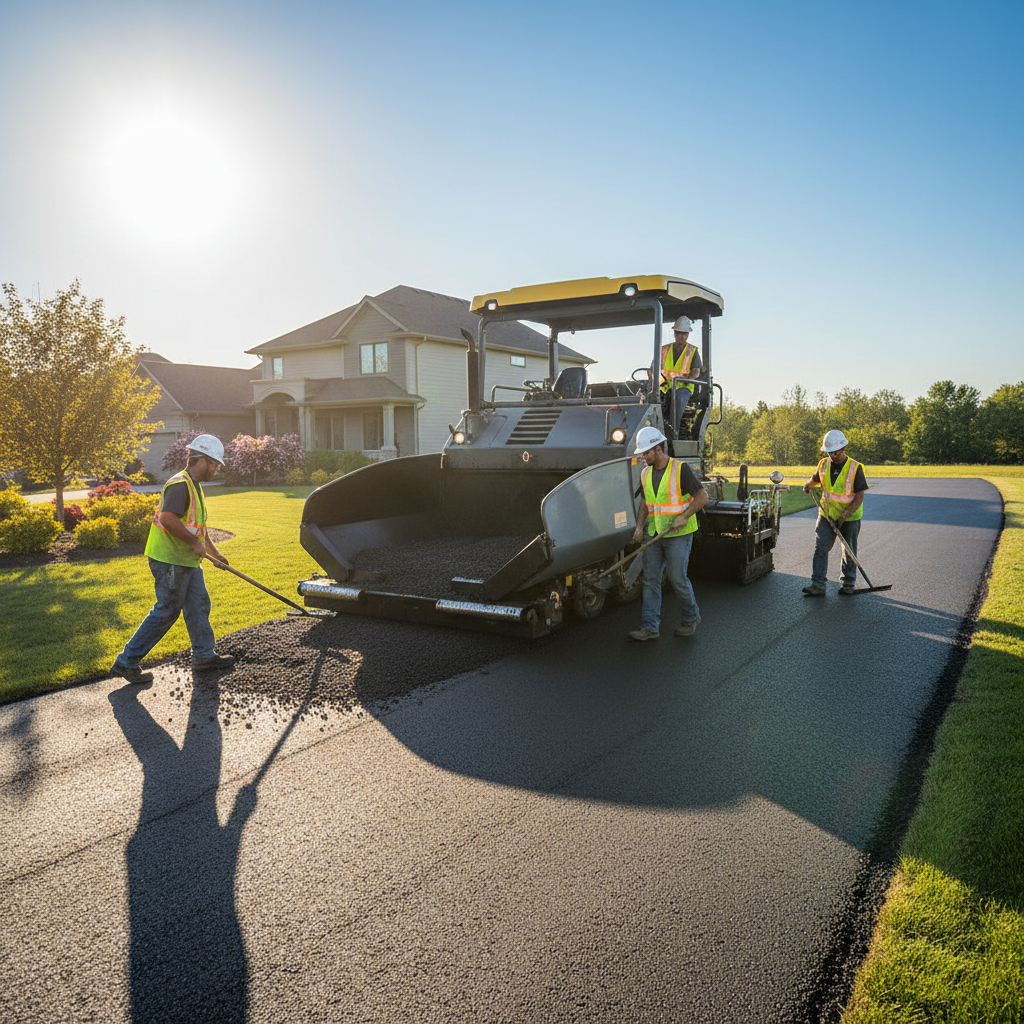
Driveway paving options and costs in Chase
In Chase, driveway paving is a common project because most homes are attached to detached properties—single-detached houses make up about 74.9% of dwellings (Statistics Canada, 2021 Census). With roughly 970 homeowner households in town, you’ll see steady demand for durable surfaces that can handle winter conditions without breaking the bank (Statistics Canada, 2021 Census). If your driveway runs long or sees frequent ploughing, the way the contractor builds the granular base and manages drainage often matters as much as the surface material.
In the Thompson–Okanagan, freeze–thaw cycles drive up the need for frost-resistant sections. While the building-code frost depth for structures may be near the interior minimum (around 18" for many locations), paved surfaces sit under higher moisture exposure and traffic loading—so we typically build thicker, well-compacted base layers to reduce heaving and early cracking. The paving season is also tighter than on the Coast because hot-mix asphalt needs warm air temperatures (generally above 10°C), so crews concentrate work into the drier, warmer months. That scheduling pressure affects availability and mobilization, especially around popular local areas like the downtown/river-adjacent core where access can be tight and truck deliveries are slower.
Below is a realistic cost comparison for common driveway scopes in Chase, assuming proper base preparation and normal access. Use it to sanity-check your quote before you start comparing itemized details.
| Material |
Lifespan |
Maintenance |
Best For |
Price per sq ft |
| Asphalt (new installation, proper base) |
15–25 years |
Seal every 3–5 years; patch as needed |
Best value, smooth ride, good for regular traffic |
$6 – $12 |
| Asphalt (overlay on existing gravel base) |
10–18 years |
Seal every 3–5 years; plan upgrades if base weak |
Lower-cost path when base is already stable |
$5 – $9 |
| Interlocking concrete pavers |
25–35 years |
Re-compact joints as needed; spot repairs |
Curb appeal and easy section-by-section repairs |
$10 – $22 |
| Poured concrete (broom finish) |
20–30 years |
Seal as recommended; joint/patch repairs |
Long-lasting flatwork if air-entrained and properly jointed |
$11 – $26 |
| Exposed aggregate concrete |
20–30 years |
Seal periodically; clean and repair spalls |
Premium appearance and anti-slip surface texture |
$13 – $30 |
| Gravel / crushed stone (budget option) |
3–8 years (varies with grading) |
Top-up, re-grade, re-slope; weed control |
Short budget window or interim access |
$2 – $6 |
Prices are estimates only and vary by project scope, site access and material selection.
What affects the price of paving in Chase
In the Thompson–Okanagan, it’s normal to see driveway quotes for what looks like the “same” job swing by 30–50% across British Columbia. The main reason is that contractors can’t build durable pavement using a minimum thickness—freeze–thaw and moisture levels force more granular base, better drainage details, and careful asphalt/concrete specifications. For asphalt, the material must be designed for interior freeze–thaw conditions, and crews need adequate warm weather; hot-mix asphalt generally requires air temperatures above 10°C, which compresses the workable window and raises scheduling risk. When weather or supply changes, mobilization and labour costs move fast.
Base thickness is decisive. In colder interior builds, we often install around 6" of compacted base within a total ~8.5–9" asphalt structure (typical for residential driveways), rather than thinner sections. Deeper frost and higher moisture exposure translate to a thicker compacted granular layer to help prevent heaving and cracking. Concrete prices shift similarly: if your subgrade is clayey or pumping water, the job may need deeper excavation, granular stabilization, or additional base even before we pour.
Concrete examples in Chase: if your driveway is older (nearly half of local housing stock was built before 1981), you may encounter buried organics, settled base, or prior patching that increases tear-out and re-build labour—commonly pushing jobs upward from the lower end of the $7,000–$15,000 concrete band. On the other hand, simple, well-drained sites with straight access can keep asphalt closer to the $4,500–$9,000 range, while complex drainage corrections or significant slope repairs can move you toward the top end.
| Price Factor |
Why It Matters |
Cost Impact |
| Driveway area in sq ft |
Most materials and production time scale directly with area |
High (primary driver) |
| Base depth required |
Frost line conditions determine granular thickness and compaction |
High (more excavation and hauled base) |
| Grading and drainage work |
Slope and water routing prevent saturation and winter damage |
Medium to High |
| Tear-out of existing surface |
Breaking and hauling concrete or old asphalt takes labour and equipment |
Medium to High |
| Edge restraints and curbing |
Prevents paver spread and asphalt raveling at the perimeter |
Medium |
| Sealing requirement |
Asphalt needs sealing after cure (commonly 6–12 months, depending on conditions) |
Low to Medium (adds scheduled cost) |
| Site access |
Narrow lots slow equipment movement and may add labour hours |
Low to Medium |
| Asphalt mix specifications |
Freeze–thaw-rated mix designs can cost more but perform better locally |
Medium |
Permits & regulations in British Columbia
In British Columbia, paving a private driveway within your own property usually does not require a building permit. Where permits or approvals come into play is when your work touches municipal infrastructure or changes how water and vehicles interact with the street. For Chase homeowners, the work that typically does require municipal approval includes new curb cuts, changes to a boulevard area, alterations to storm drainage, and any changes that affect roadside drainage or municipal right-of-way. If your driveway ties into a municipal ditch, culvert, or culvert crossing, don’t assume it’s “just paving”—confirm requirements with the municipality before you start excavation.
Here’s a practical step-by-step process you can follow in Chase. First, call to locate utilities before any digging (BC 1 Call). Second, ask your contractor whether the scope includes excavation within any municipal right-of-way and whether permits/approvals are part of their responsibility (or yours). Third, verify contractor standing: check the contractor’s British Columbia licensing status online, request a current certificate of liability insurance, and confirm their workers’ coverage (WSIB/WCB coverage, depending on how they’re registered and organized). Ask for the clearance letter or coverage proof and make sure the certificate lists the correct business name and service area. Finally, confirm any lot-grading rules—many municipalities have restrictions on how close a hard surface can be to property lines and how water must be managed.
Asphalt vs pavers vs concrete for Chase driveways
For Chase driveways, asphalt, interlocking pavers, and concrete all work—what changes is how they handle freeze–thaw moisture, how repairs are done, and how much curb appeal you want. Asphalt is usually the lowest upfront option, but it depends on good base prep and regular sealing. With Thompson–Okanagan temperature swings, sealed asphalt (typically started after the initial cure period and then renewed every 3–5 years) holds up better against oxidation and winter water intrusion.
Interlocking concrete pavers cost more upfront, but they’re excellent in our climate when installed on a properly compacted base with correct edge restraint and jointing sand. If you ever need to access utilities or you get a localized settlement, pavers can be lifted and re-laid without replacing the entire surface. Poured concrete falls into the mid-range to higher range depending on finishes; it can be durable, but it must be air-entrained and properly jointed to handle freeze–thaw cycles and avoid random cracking. In practice, for many Chase homeowners who get ploughing and regular tire traffic, the best-performing driveway is the one with correct drainage and a frost-resistant granular section, regardless of the top layer.
As a dollar example, a typical asphalt driveway often lands in the $4,500–$9,000 band, while pavers commonly run $6,500–$14,000. That extra $2,000–$5,000 (or more on complex driveways) can be justified if you value curb appeal, want easier spot repairs, or anticipate future work near the driveway edge. If your priority is lowest long-term fuss and you’re on a straightforward, well-drained site, asphalt plus maintenance is often the smart choice.
| Material |
Frost Resistance |
Curb Appeal |
Repair Method |
Lifespan |
Price Band |
| Asphalt (sealed regularly) |
Good with proper base and drainage |
Medium |
Patch/re-surface localized areas |
15–25 years |
$4,500 – $9,000 |
| Interlocking concrete pavers |
Very good; stable base prevents movement |
High |
Remove and replace individual units |
25–35 years |
$6,500 – $14,000 |
| Poured concrete (air-entrained) |
Good when air-entrained and jointed |
Medium to High |
Patch spalls; crack repair in sections |
20–30 years |
$7,000 – $15,000 |
| Exposed aggregate concrete |
Good with correct finishing and sealing |
Very High |
Limited patching; match finish and seal |
20–30 years |
$8,500 – $16,500 |
| Permeable pavers (drainage grid) |
Excellent moisture management if detailed correctly |
High (modern look) |
Replace sections; inspect drainage layer |
25–35 years |
$9,000 – $18,000 |
| Chip seal / tar-and-chip |
Moderate; maintenance cycles matter |
Low to Medium |
Re-chip or overlay when worn |
7–12 years |
$4,000 – $8,000 |
How to choose a paving contractor in Chase
Start by verifying proper contractor coverage in British Columbia. Ask for the company’s BC licensing details (where applicable for the work), then request a current certificate of liability insurance—make sure it’s for the exact legal business name doing the work. For labour coverage, confirm workers’ compensation status (WSIB/WCB coverage) and ask for the clearance letter or proof of account status. In a driveway job, these documents protect you if someone is hurt on-site or if damage occurs during excavation and compaction.
Next, get 2–3 itemised written quotes. Don’t accept vague “lump sums” only. You want a breakdown that shows excavation and disposal, granular base depth and compaction, any geotextile/stabilization, asphalt or concrete quantities, labour, and traffic control. Confirm what’s included: permit pull (if any), utility locates coordination, haul distance assumptions, and whether they’ll replace topsoil or re-grade disturbed areas.
For warranty, look for a clear workmanship warranty (how many years) and know the difference between workmanship and product/manufacturer coverage. Ask whether the warranty is transferable to a new owner if you sell the house.
Payment schedule matters too. Avoid large deposits—never more than about 10–15% upfront. Hold back a portion until the surface is complete and quality checks are done. Then insist on a written start date and a completion estimate; in Chase, weather can affect hot-mix work, so timelines should include weather contingencies.
- Verify BC licence/registration status and ask for the document reference in the quote
- Require a certificate of liability insurance with correct company name and address
- Request proof of workers’ compensation coverage (WSIB/WCB) and clearance letter
- Get at least 2–3 itemised quotes (materials + labour, not just a total)
- Ask for base depth in inches and compaction method (roller type/compaction expectations)
- Confirm drainage/grading responsibilities (who sets slope and where runoff goes)
- Require disposal details for excess material and old asphalt/concrete tear-out
- Clarify edge restraints/curbs—pavers need restraints to prevent spreading
- For asphalt, ask about cure time and when sealing is recommended (often 6–12 months)
- Ask how they handle frost-risk areas: low spots, soft clay, and driveway transitions
- Get a workmanship warranty term in writing and what it covers
- Use a payment schedule with a holdback until final grading, cleanup, and inspection
In Chase, red flags I see often include: (1) quotes that skip base depth details or compaction specs, (2) contractors who won’t put drainage and grading scope in writing, (3) refusing to show insurance/coverage documents, (4) heavy discounting that doesn’t match the stated material spec for freeze–thaw performance, and (5) demanding large upfront payments before excavation even starts.
Frequently asked questions — paving in Chase
Asphalt vs interlocking pavers vs concrete — which is best in Chase?
In Chase (Thompson–Okanagan), the “best” choice usually depends on how your property drains and whether you want easier future repairs. Asphalt is typically the best value upfront and, with a properly built granular base and sealing every 3–5 years, it performs well through interior freeze–thaw cycles. Interlocking concrete pavers cost more (often within the $6,500–$14,000 band for typical driveways) but are highly repairable—individual sections can be lifted and re-set without tearing out the whole driveway. Poured concrete can also be excellent if it’s air-entrained, properly jointed, and built on a stable base, but it’s usually less forgiving if water infiltration and subgrade softness exist. If you’re unsure, prioritize drainage and base design over surface material.
How long does a paved driveway last in Chase?
Driveway life in Chase is mostly about base quality, water management, and maintenance—not just the surface name. Asphalt on a well-prepared base commonly lasts around 15–25 years, and sealing helps protect against oxidation and winter water intrusion (a common practice is starting sealing after cure and then repeating every 3–5 years). Interlocking pavers often run 25–35 years because localized movement can be addressed by spot repairs. Concrete often lands around 20–30 years when air-entrained and jointed; however, early cracking can show up sooner if the subgrade is weak or if drainage forces water into the structure. If your home is older (nearly half of local dwellings were built before 1981), expect more variability and plan for possible subgrade upgrades during demolition.
When is the best time of year to pave in Chase?
For permanent work in British Columbia’s interior, the best window is late spring through summer when temperatures are consistently warm and the ground is workable. Hot-mix asphalt generally requires air temperatures above 10°C to place and compact properly, so crews usually focus on drier, warmer months. For concrete, you still want stable weather—rapid cold snaps can affect finishing and curing—so many contractors aim for periods with daytime warmth and nighttime temperatures that won’t stall set-up. If you’re planning asphalt sealing, remember the surface typically needs time to cure first; sealing too early can trap moisture. Your contractor should provide a written schedule and weather contingency, because freeze–thaw cycles can quickly turn excavation sites into unsuitable working ground.
How deep should the base be for Chase's frost?
For Chase driveways, we design beyond the minimum frost depth because pavement sections face more moisture and traffic loading. A common residential approach for asphalt is to target a total structure around 8.5–9" with roughly 6" of compacted granular base, assuming good drainage and typical residential loads. If you have soft or clayey soils, a slope, drainage issues, or known settlement, the excavation and granular depth may need to increase to reduce heaving and rutting. The key is not a single “magic number,” but the combination of base depth, compaction quality, and drainage design. In quotes, ask the contractor to state base depth in inches and describe how they’ll verify compaction and address wet spots before paving.
How often should I seal my asphalt driveway?
In Chase, sealing timing matters because the freeze–thaw cycle accelerates wear when water gets into the asphalt binder. As a practical guideline, many contractors recommend sealing after the new asphalt has cured (often around 6–12 months, depending on weather and product) and then repeating about every 3–5 years. If your driveway sees heavy ploughing, de-icing salts, or frequent turning traffic, you may lean toward the earlier end of that interval. If it’s been a while since your last seal or you see significant drying/oxidation, plan for a patch-and-seal approach before the binder fully breaks down. Sealing doesn’t replace base failure—if the driveway is already heaving or pumping water, address drainage and base first.
Why does my driveway crack and heave in winter?
Cracking and heaving almost always point to water movement and freezing within the pavement structure. In Chase’s Thompson–Okanagan climate, repeated freeze–thaw cycles expand water as it freezes; if water can soak into weak base layers or fine subgrade, it creates pressure that lifts (heaves) the surface and leads to cracking. Common causes include poor grading, low spots where water collects, missing or ineffective drainage, insufficient compacted granular base, or edging that lets material migrate. Older driveways (especially those built decades ago) can also have settled base or buried organic pockets that hold moisture. If your asphalt quote came in far below the usual $4,500–$9,000 band without detailed base depth, that’s often where problems start.