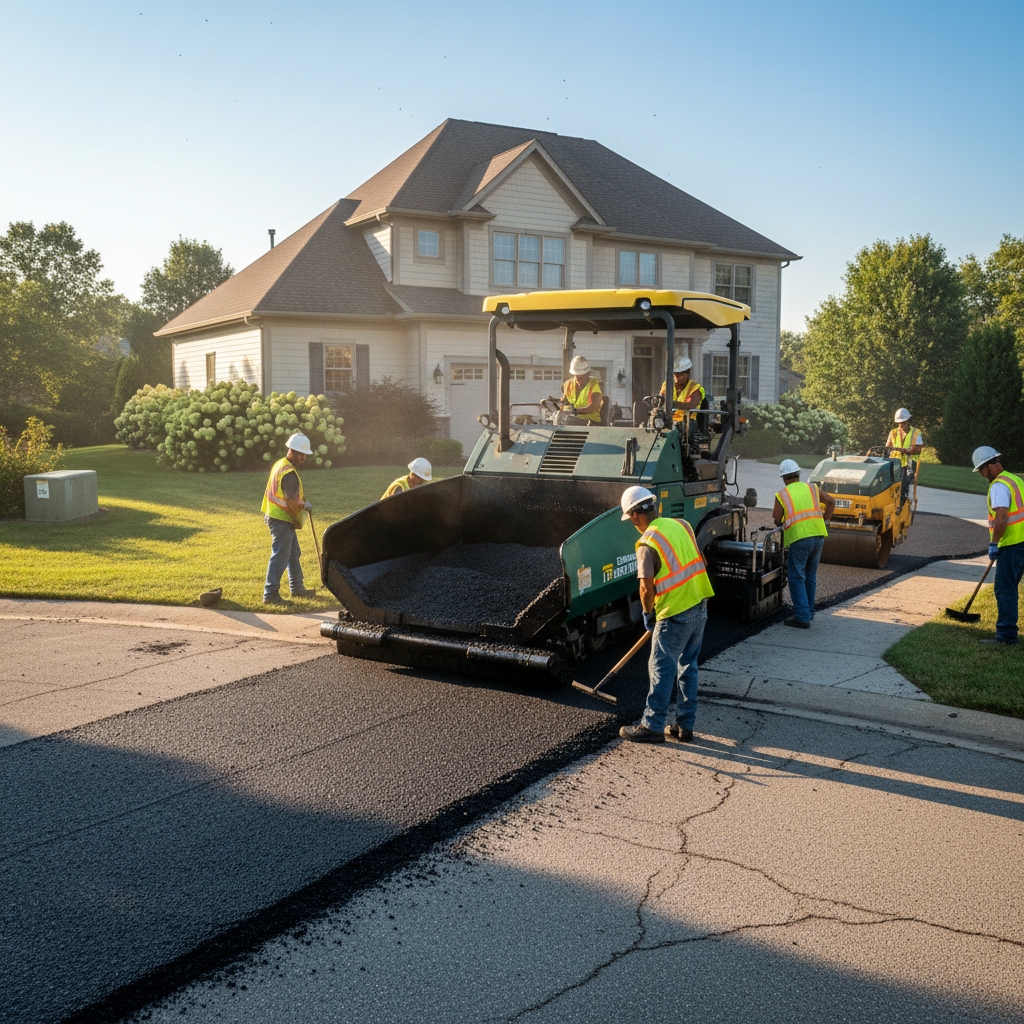
Driveway paving options and costs in Mt Pleasant
In Mt Pleasant, you’ll see most private driveways tied to single-family homes in the Lower Mainland–Southwest, and a lot of that demand centres around the longer, wetter paving season—where drainage and base prep matter more than deep frost. Mt Pleasant has a population of 32,955 (Statistics Canada, 2021 Census), and that steady household growth supports consistent turn-over of older driveways, especially in established pockets where asphalt has aged or where slopes direct runoff onto the driveway. In this region, intense rainfall is a bigger day-to-day stressor than extreme cold, but contractors still design for a frost line on the order of 18 inches for exposed applications. That means excavate, place, and compact granular base to specification, then keep water moving away from the pavement. Pricing is therefore driven by labour-heavy excavation, haul-off, proper granular thickness (often about 6 inches compacted base under asphalt), and asphalt thickness (commonly 2.5–3 inches), rather than just “dropping asphalt on top.” Scheduling also affects cost: wet shoulder-season storms can compress workable windows, and that can tighten availability and increase mobilization charges.
If you’re in the Fairview Crescent or Pinehurst-style neighbourhood areas (the more mature residential blocks with lots of older lots and tighter access), you’ll typically find crews booked for re-grades, drainage corrections, and base rebuilds before resurfacing. From there, the material choice determines both upfront cost and how repairs look later. Use the table below to compare realistic cost ranges and what each option is best at handling in Mt Pleasant.
| Material |
Lifespan |
Maintenance |
Best For |
Price per sq ft |
| Asphalt (new installation, proper base) |
15–25 years |
Seal every 3–5 years |
Balanced value, smooth ride, good drainage-focused performance |
$12 – $20 |
| Asphalt (overlay on existing gravel base) |
10–18 years |
Seal every 3–5 years; monitor base settlement |
Sound base already in place; moderate regrading |
$10 – $16 |
| Interlocking concrete pavers |
25–35 years |
Minimal; replace individual stones as needed |
Curb appeal, easy localized repairs, changing future access needs |
$20 – $40 |
| Poured concrete (broom finish) |
20–30 years |
Light cleaning; repair spalls early |
Clean look, low maintenance, straight-forward drainage |
$18 – $35 |
| Exposed aggregate concrete |
20–30 years |
Sealer (optional); crack monitoring |
Slip resistance and decorative curb appeal |
$22 – $40 |
| Gravel / crushed stone (budget option) |
5–10 years |
Top up and re-level 1–2 times/year |
Temporary surface, tight budgets, permeable drainage |
$6 – $12 |
Prices are estimates only and vary by project scope, site access and material selection.
What affects the price of paving in Mt Pleasant
In Mt Pleasant and across the Lower Mainland–Southwest, two quotes for what looks like the “same” driveway can still differ by 30–50%. The biggest reason is what’s happening underneath the surface: contractors may discover different soil conditions, different drainage problems, or different scope for excavation and base reconstruction. Another driver is timing—wet weather in fall and spring can slow crews down, and asphalt/concrete placement requires workable temperature and site conditions. Labour and equipment availability also varies through the season, so estimates can shift even when the driveway size stays the same. Finally, mix design and construction details matter here: asphalt used in coastal/Lower Mainland conditions is engineered for local freeze–thaw and heavy rain performance, which can change material costs.
Frost line depth and freeze–thaw cycles are decisive cost factors in this region, even though frost penetration is relatively shallow compared with Interior or Northern BC. In exposed applications, builders commonly assume a frost line of about 18 inches for sensitive infrastructure, so the granular base must be thick enough to prevent heaving and cracking. As a rough comparison, interior provinces often need 6–12 inches of compacted granular base for sensitive driveways, while coastal BC installations may be closer to 4–6 inches when conditions are stable—though many Mt Pleasant lots (especially with clay-heavy pockets) still end up needing the higher end of that range. Concrete and asphalt also rely on air-entrainment or freeze–thaw-rated materials, and that affects both performance and price.
Concrete examples in Mt Pleasant: a driveway that’s already flat often costs less than one with ponding near the garage, because drainage correction (regrading and underdrain) adds labour and imported granular. Likewise, tearing out failing edges on paver or asphalt jobs can add breaking/hauling costs. If you’re comparing price bands, a straightforward asphalt driveway at about $12 – $20 per square foot can climb toward the upper range if excavation turns out to be deeper or if drainage must be corrected. Similarly, pavers starting around $20 – $40 per square foot may be justified when the homeowner wants long-term repairability, tight slopes, or a premium curb appeal finish—especially on older, settled lots where localized repair is valuable.
| Price Factor |
Why It Matters |
Cost Impact |
| Driveway area in sq ft |
All major costs scale with square footage: excavation, base material, asphalt/pavers/concrete |
High |
| Base depth required |
Freeze–thaw performance depends on compacted granular thickness and proper compaction |
High |
| Grading and drainage work |
Correct slopes and direct water away from pavement to prevent soft spots and rutting |
Medium to High |
| Tear-out of existing surface |
Breaking and hauling old asphalt/concrete adds disposal, labour, and sometimes additional excavation |
Medium to High |
| Edge restraints and curbing |
Paver and asphalt edges need restraint to prevent spread and maintain alignment |
Medium |
| Sealing requirement |
Asphalt in Mt Pleasant benefits from sealing to reduce moisture intrusion and extend service life |
Low to Medium |
| Site access |
Narrow drives, stairs, or limited equipment paths slow work and increase equipment time |
Medium |
| Asphalt mix specifications |
Freeze–thaw-rated mix design and appropriate binder performance can raise material costs but improve longevity |
Medium |
Permits & regulations in British Columbia
In British Columbia, paving a private driveway within your own property generally doesn’t require a building permit—provided you’re working on your lot and not changing municipal infrastructure. Where approvals are often required is in the municipal right-of-way or anything that affects the city’s infrastructure. That includes new curb cuts or modifications to an existing boulevard access, changes to storm drainage patterns, work that alters catch basins or municipal drainage connections, or any alteration tied directly to municipal sidewalks/boulevards. Some municipalities also have lot-grading bylaws that restrict how close a hard surface can be to certain property features and how drainage must be directed.
For Mt Pleasant homeowners, the practical steps are: (1) book utility locates (BC 1 Call) before excavation so crews can mark gas, power, telecom, and any buried utilities; (2) confirm lot-grading rules with the municipal office before you commit to excavation depth and base thickness near property lines; and (3) ask your contractor to identify whether any portion of the work touches the boulevard/right-of-way.
Before you hire, verify your contractor’s British Columbia licence status (through the provincial contractor registry/website relevant to the trade), and review proof of liability insurance. For work involving labour and job-site risk, request current clearance letters/status that demonstrate appropriate coverage for workers (often aligned with WCB requirements). Ask for a certificate of insurance naming you as the interested party if applicable, then keep copies for your records. If the company is hesitant to provide documentation up front, that’s a warning sign.
Asphalt vs pavers vs concrete for Mt Pleasant driveways
For Mt Pleasant driveways, asphalt, interlocking concrete pavers, and poured concrete all can work well, but each one fits different priorities. Asphalt is usually the lowest upfront cost and offers a smooth surface, but it depends on staying water-resistant: sealing every 3–5 years is what helps it resist moisture intrusion from intense Lower Mainland rainfall. Interlocking concrete pavers cost more initially, but they’re highly repairable—if a section settles or a utility patch is made later, you can remove and relay only the affected area rather than replacing the whole drive. Poured concrete often lands in the middle price-wise, but freeze–thaw and seasonal wetting can crack concrete if it’s not properly air-entrained, reinforced as needed, and properly detailed with control joints.
Base preparation is still the deciding factor in this region: because Mt Pleasant design assumes a frost line on the order of 18 inches for exposed applications, the granular base and drainage must be placed and compacted correctly to prevent heaving and rutting. In clay-heavy or saturated areas, drainage improvements (clean stone, underdrains where required, and correct slope to daylight) can matter as much as the surface choice. When winter maintenance includes sanding/salting near the edges and seasonal ploughing, pavers usually tolerate localized abrasion better because individual units can be replaced; asphalt and concrete can show edge breakdown or surface micro-cracking if water is trapped under or at the perimeter.
Where the price difference is justified: if you’re currently seeing edge failure or you want a long-term, “repairable” finish, pavers can be worth it even at about $20 – $40 per square foot. If your base is sound and you’re comfortable with planned sealing, asphalt at roughly $12 – $20 per square foot is often the best value—especially for driveways that don’t require frequent access changes.
| Material |
Frost Resistance |
Curb Appeal |
Repair Method |
Lifespan |
Price Band |
| Asphalt (sealed regularly) |
Good with proper base and drainage; sealing helps resist moisture |
Medium |
Mill and resurface or patch localized areas |
15–25 years |
$12 – $20 |
| Interlocking concrete pavers |
Very good; flexible surface over well-compacted base |
High |
Remove and replace affected pavers (localized) |
25–35 years |
$20 – $40 |
| Poured concrete (air-entrained) |
Good if properly air-entrained, jointed, and drained |
Medium |
Patch spalls/cracks; may require slab repair |
20–30 years |
$18 – $35 |
| Exposed aggregate concrete |
Good with correct mix and drainage; surface stays slip-resistant |
High |
Localized patching is possible but finish matching varies |
20–30 years |
$22 – $40 |
| Permeable pavers (drainage grid) |
Very good for wet sites; relies on sub-base design for infiltration |
Medium to High |
Replace individual units; maintain jointing material |
20–30+ years (with maintenance) |
$28 – $55 |
| Chip seal / tar-and-chip |
Moderate; can loosen under heavy traffic without strong base |
Low to Medium |
Rechip/reseal; localized patching |
7–15 years |
$10 – $18 |
How to choose a paving contractor in Mt Pleasant
Choosing a contractor in Mt Pleasant comes down to documentation, construction details, and how clearly they price the work. Start by verifying British Columbia licensing for the contractor/trade they represent, then request proof of liability insurance and worker coverage status. Ask for a certificate of insurance (and confirm it covers paving activities), and request current clearance/status information related to workers’ coverage (WCB) so you’re not left holding risk if something goes wrong on-site. These steps are especially important on residential driveways where excavation, heavy equipment movement, and disposal are involved.
Next, get 2–3 itemised written quotes—not a single “lump sum” number. Your quote should break down labour and materials separately, show what base thickness they’re installing, and specify surface thickness (for asphalt, that usually means about 2.5–3 inches for a typical residential driveway). Confirm what’s included: disposal of excavated material, imports/haul of granular, grading to grade, edge restraints, and whether permit-related work or right-of-way requirements are included if they affect the boulevard. Also ask for an explicit timeline—start date and an estimated completion window—and whether rain can change the schedule.
Warranty should be written and clear: workmanship warranty length, product/manufacturer warranty terms, and whether the warranty is transferable if you sell your home. Payment schedule matters too—never pay more than 10–15% upfront. Hold back the remainder until the job is complete and surfaces are clean, edges are correct, and final grading is confirmed.
- Ask for the contractor’s BC licence number and verify it through the correct provincial registry.
- Request a current certificate of liability insurance before the first delivery arrives.
- Confirm worker coverage status (WCB) and keep a copy of clearance/status documentation.
- Require itemised quotes: excavation, hauling, base gravel, asphalt/pavers/concrete, compaction, and finishing.
- Check that base depth and compaction method are spelled out (not just “we’ll prep the base”).
- Make sure drainage/grading is included if the driveway slopes toward the garage or shows ponding.
- Confirm whether edge restraints/curbing are included (especially for pavers).
- Ask how tear-out will be handled and whether disposal is included.
- Verify the asphalt thickness and whether the mix is designed for freeze–thaw in the Lower Mainland.
- Ask when sealing should happen on asphalt (typical guidance is after the surface cures, often within 6–12 months for the first seal).
- Get warranty details in writing: workmanship duration, what it covers, and exclusions.
- Use a payment schedule with a holdback; avoid large upfront payments.
Red flags I’ve seen on Mt Pleasant projects: contractors who won’t show base thickness/compaction steps; quotes that only talk about the top surface and ignore drainage; vague warranties (or “we’ll do our best” wording); refusal to provide insurance/licence/warranty documentation; and schedules that promise “guaranteed completion” regardless of rain—when workable weather and curing conditions still matter.
Frequently asked questions — paving in Mt Pleasant
How much does driveway crack repair cost in Mt Pleasant?
In Mt Pleasant (and across the Lower Mainland–Southwest), crack repair is usually priced by the crack type and whether it’s treated as a surface issue or a base/drainage problem. Hairline surface cracks on asphalt are often sealed or filled, while wider cracks may require routing and patching with a hot mix or similar method. As a planning number, many homeowners see crack repair land in the same general “sealing & repair” band—about $2 – $6 per square foot equivalent for smaller, targeted work. If the cracks indicate settlement or trapped water, the price can jump because contractors may need localized base correction or a small patch expansion. The best way to keep costs predictable is to have the contractor check whether water is ponding or whether the crack is edging outward after rainfall.
What base thickness do I need for pavers in Mt Pleasant?
Paver base thickness in Mt Pleasant is guided by drainage and freeze–thaw performance rather than “one standard number.” In typical residential work here, contractors commonly start with about 6 inches of compacted granular base, then add bedding sand to help the pavers sit level. If your driveway subgrade is clay-heavy, saturated, or already showing settlement, expect deeper excavation and a thicker or improved base build-up. Even though coastal BC frost penetration is milder than Interior regions, local practice still assumes a frost line on the order of 18 inches for exposed conditions, so the base has to sit solidly and drain properly. If you’ve got ponding near the garage or water running under the edge, ask your contractor to include grading and drainage corrections before discussing exact paver depth.
How do I get the most accurate paving quote in Mt Pleasant?
For the most accurate quote in Mt Pleasant, ask for a site visit where the contractor checks drainage, slope, and the current base condition—not just measurements of length and width. Great quotes include an itemised breakdown: excavation depth, granular base thickness, compaction steps, disposal of removed material, and the final surface thickness (asphalt or concrete thickness; paver bedding and restraints). Take clear photos after rainfall if possible, because standing water reveals the real drainage problem that drives heaving and cracking. Make sure the quote states what’s included for tear-out and whether restoration of disturbed landscaping or edges is part of the scope. Also confirm how they’ll handle schedule changes in wet shoulder-season windows, since workable conditions affect curing and installation quality.
How much does it cost to pave a driveway in Mt Pleasant?
Driveway paving costs in Mt Pleasant commonly follow the regional price bands, with the final number depending on base work, drainage correction, tear-out, and access. For asphalt driveway paving, a realistic planning range is about $12 – $20 per square foot for new installation with proper base preparation. Interlocking concrete pavers typically run higher, about $20 – $40 per square foot depending on pattern, base depth, and restraint/curbing details. Concrete is often in between, commonly about $18 – $35 per square foot depending on finish and reinforcement needs. If your existing driveway is failing due to trapped water or weak subgrade, the project can climb toward the upper end because excavation and drainage become part of the solution—not just the surface.
Asphalt vs interlocking pavers vs concrete — which is best in Mt Pleasant?
“Best” depends on how you want the driveway to behave over time in Mt Pleasant’s Lower Mainland–Southwest freeze–thaw and heavy rain reality. Asphalt is usually the best value upfront at about $12 – $20 per square foot, but it needs planned sealing every 3–5 years to stay water-resistant. Interlocking concrete pavers are the curb-appeal winner and tend to be the most flexible for repairs; they’re commonly priced around $20 – $40 per square foot and let you replace small sections if settlement or future access issues happen. Poured concrete (often air-entrained) sits in the middle around $18 – $35, but it must be properly jointed and detailed to manage freeze–thaw movement. If you get ponding or edge breakdown, prioritizing drainage and base quality matters more than the surface name on the quote.
How long does a paved driveway last in Mt Pleasant?
In Mt Pleasant, lifespan is strongly linked to base preparation and drainage—especially because intense rainfall can saturate clay-heavy subgrades and because local design still accounts for a frost line on the order of 18 inches in exposed applications. With proper base, many homeowners plan on 15–25 years for asphalt when it’s sealed regularly and the driveway drains correctly. Interlocking pavers often last 25–35 years and are easier to maintain long-term because you can replace individual stones rather than replacing the whole area. Poured concrete typically targets 20–30 years when it’s air-entrained, properly reinforced/jointed, and built with correct slope and curing. If you skip drainage correction and sealing/maintenance, even “good materials” can crack sooner—often starting at edges where water collects during storms.