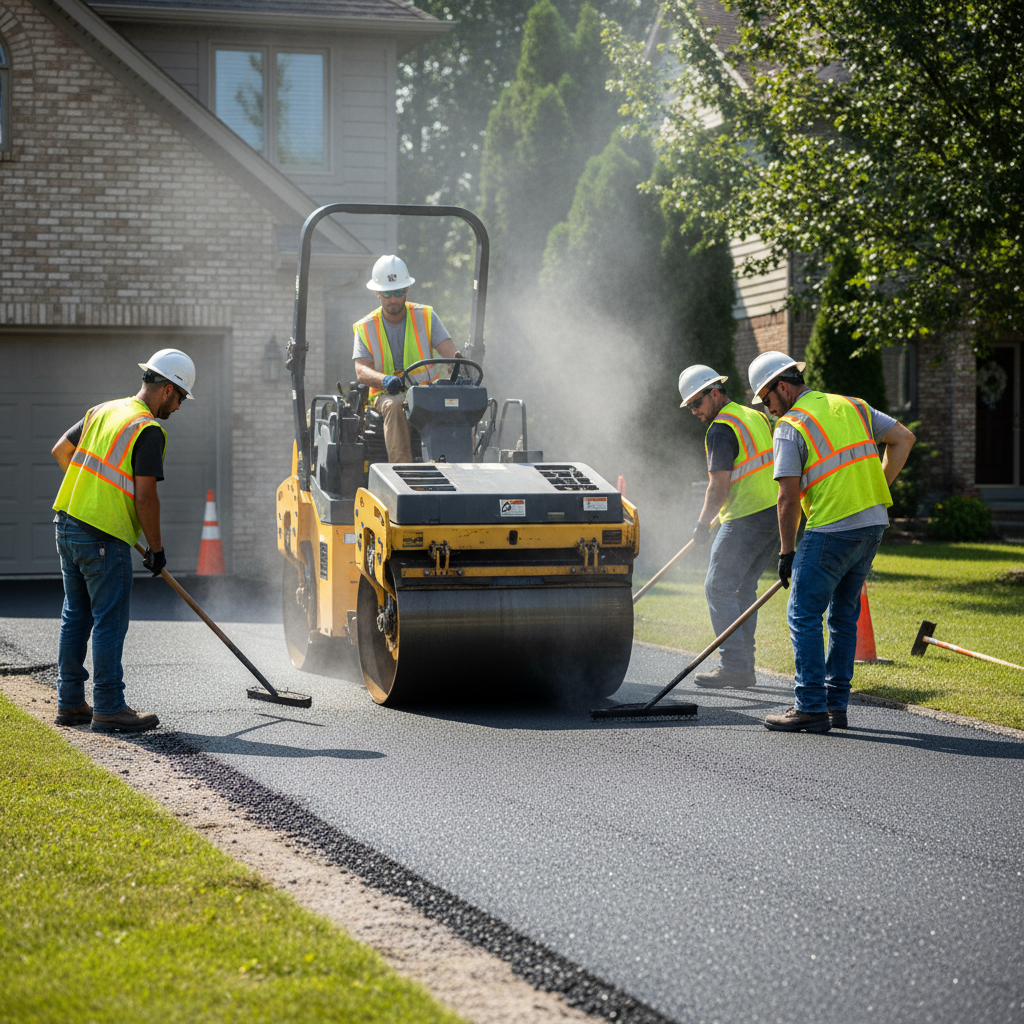
Driveway paving options and costs in Prince George
Prince George homeowners have a few solid driveway paving routes—most commonly asphalt, interlocking pavers, or concrete—each with different upfront costs and different performance through the Cariboo’s freeze–thaw winters. With 58.1% of local dwellings being single-detached homes (Statistics Canada, 2021 Census), there’s a steady demand for private driveways, especially around established residential pockets where long driveways and aging surfaces are common. In fact, 61.7% of homes in the area were built before 1981 (Statistics Canada, 2021 Census), so many jobs start with older granular bases that need rebuilding and proper drainage correction before any new surface goes down.
In the Cariboo region, repeated freezing and thawing is a primary cost driver. To keep the structure stable, contractors typically build thicker, well-graded compacted granular bases and pay closer attention to drainage (ditching, edge drains, and geotextile where soils are frost-susceptible). The paving season is also shorter than coastal BC; hot-mix asphalt generally needs warmer air temperatures (often above about 10°C), so scheduling pressure during spring and early summer can affect labour availability and mobilization costs. This is why similar driveways can price differently between neighbourhoods and job sites—especially where access is tight or where tear-out and base work become more extensive.
Where demand is especially strong in Prince George is the north end of the city and growing residential areas around North Nechako Road, where older driveways get refreshed ahead of winter and during the brief, workable summer window. Use the comparison table below to understand typical materials, expected service life, and realistic per-square-foot pricing for Prince George.
| Material |
Lifespan |
Maintenance |
Best For |
Price per sq ft |
| Asphalt (new installation, proper base) |
15–25 years |
Seal every 3–5 years |
Lowest upfront cost with good base engineering |
$12–$20 |
| Asphalt (overlay on existing gravel base) |
10–18 years |
Seal as needed; monitor soft spots |
Budget refresh when base is still sound |
$10–$16 |
| Interlocking concrete pavers |
25–40 years |
Replace individual stones; occasional re-screeding |
Curb appeal and easy localized repairs |
$20–$35 |
| Poured concrete (broom finish) |
25–35 years |
Crack monitoring; reseal occasionally |
Low-fuss surface with clean finishing |
$18–$30 |
| Exposed aggregate concrete |
25–35 years |
Sealer as recommended by surface type |
Slip resistance and premium curb appeal |
$20–$38 |
| Gravel / crushed stone (budget option) |
3–8 years |
Re-grade and top up annually; re-compact |
Temporary solution or very low budget |
$6–$12 |
Prices are estimates only and vary by project scope, site access and material selection.
What affects the price of paving in Prince George
In Prince George and across the Cariboo, you can see quotes for the “same” driveway vary by 30–50% because the hidden work differs: base reconstruction, drainage corrections, the depth and quality of granular materials, and how much tear-out is required. A 500–700 sq ft driveway may look straightforward, but if the existing base is pumping, draining poorly, or poorly compacted, contractors must rebuild the structure—especially in freeze–thaw conditions where frost heave and surface cracking are relentless.
Frost line depth and freeze–thaw cycles are decisive cost factors in the Cariboo. Deeper frost penetration requires a thicker compacted granular base than milder coastal BC—often driving extra thickness and compaction labour. In practice, that means Cariboo driveway bases commonly need more granular depth to keep the subgrade below the frost-susceptible zone; without that, you get rutting and cracking sooner even with the best asphalt. At the same time, the paving season is shorter. Hot-mix asphalt production and placement are typically constrained by weather because mix compaction and curing need suitable air temperatures; that shortens work windows, concentrates demand, and increases scheduling pressure.
Concrete pricing can swing too. If the driveway area needs subdrainage or if you’re moving a slope or adding edge drainage, expect added excavation and granular replacement. Conversely, if your site already drains well and access is easy, poured concrete can land closer to the mid-range price band (often around $18–$30 per sq ft). Similarly, asphalt can hold closer to $12–$20 per sq ft when the base is evaluated and only minimal reconstruction is required—otherwise, you pay for the engineering work before any surface goes down.
| Price Factor |
Why It Matters |
Cost Impact |
| Driveway area in sq ft |
Surface and base quantities scale directly with area |
Typically the largest share of total cost |
| Base depth required |
Frost conditions determine granular thickness |
More depth can add major excavation and material cost |
| Grading and drainage work |
Slope, ditching, edge drains, and separation reduce saturation |
Can add significant labour and aggregate/pipe costs |
| Tear-out of existing surface |
Breaking, hauling, and disposing add cost |
Often increases price if concrete/asphalt is thick |
| Edge restraints and curbing |
Prevents paver movement/spreading and asphalt raveling |
Adds materials and extra cutting |
| Sealing requirement |
Asphalt needs protection from snowmelt oils/UV |
Usually modest, but delays are costly if skipped |
| Site access |
Long carry distances or narrow gates slow equipment |
Higher mobilization and labour hours |
| Asphalt mix specifications |
Freeze–thaw-rated mix and proper binder matter |
Higher material costs than basic mixes |
Permits & regulations in British Columbia
In British Columbia, paving a private driveway within your own property typically does not require a building permit, provided you’re not altering major infrastructure. However, work in the municipal right-of-way can require approval. In Prince George, that usually means anything involving new or modified curb cuts, changes to the boulevard, or altered storm drainage (such as redirecting flows, changing ditching patterns, or connecting to storm systems). Some municipalities also have lot-grading or drainage-by-law requirements that restrict how close a hard surface can be to property lines and how runoff must be managed.
For a homeowner, the practical step-by-step approach is: (1) confirm whether any part of the driveway ties into boulevard or storm drainage—if yes, ask the city about approval requirements before the contractor starts; (2) always arrange utility locates before excavation—BC 1 Call is the standard call; (3) ask the contractor to provide copies of their plan for drainage (ditch/edge drains and how they handle runoff); and (4) confirm lot-grading rules with the municipality if your work changes drainage direction or increases paved area.
To verify a contractor’s credentials in BC, request and check: their provincial business licensing (if applicable), liability insurance with current certificate of insurance, and their worker protection coverage (often WCB coverage in practice) before work begins. Then compare the certificate details with the contractor’s legal name on written quotes and invoices. For peace of mind, also ask for a clearance letter where available and keep all paperwork in your project file.
Asphalt vs pavers vs concrete for Prince George driveways
For Prince George’s freeze–thaw winters, asphalt, interlocking pavers, and concrete can all perform—but they do it differently based on how they flex, how they’re repaired, and how they’re maintained. Asphalt is usually the lowest upfront option, but it needs sealing every 3–5 years to protect against oxidation and winter wear. With proper base work and drainage, asphalt handles plowing and snow storage reasonably well, though it can still crack if water infiltrates and freezes in the base.
Interlocking concrete pavers cost more upfront, yet they’re often the most forgiving long-term for northern conditions because you can lift and re-lay individual units if there’s future settlement or utility access. That repairability matters in Prince George where older driveways sometimes settle near culvert tie-ins or where drainage wasn’t built correctly at the start. If your priority is curb appeal and a surface that can be repaired without replacing everything, pavers are a strong match—typically within the $20–$35 per sq ft band.
Poured concrete sits in the middle cost range and can look great with a broom finish, but it’s more susceptible to cracking from freeze–thaw and from de-icing salt if it’s not properly air-entrained and finished. Even with air-entrainment, the structural base and drainage design control performance—if the subgrade stays saturated, no finish can fully compensate.
Base prep and drainage are the deciding factors regardless of material. In the Cariboo, contractors commonly design for deeper frost stability with thicker granular bases and careful slope/edge drainage. A concrete driveway might cost closer to $18–$30 per sq ft, and the extra spend can be justified where you want fewer maintenance items and a rigid, clean surface. But if you’re comparing options purely on dollars, asphalt often wins upfront—especially when your existing base is sound and access is good. Pavers typically justify their premium when curb appeal and easy localized repairs matter most.
| Material |
Frost Resistance |
Curb Appeal |
Repair Method |
Lifespan |
Price Band |
| Asphalt (sealed regularly) |
Good when base is engineered and drained |
Medium |
Patch and re-seal zones |
15–25 years |
$12–$20 |
| Interlocking concrete pavers |
Excellent with correct base and compaction |
High |
Remove and replace individual pavers |
25–40 years |
$20–$35 |
| Poured concrete (air-entrained) |
Good with proper air entrainment and base |
Medium–High |
Patch and joint/level repairs |
25–35 years |
$18–$30 |
| Exposed aggregate concrete |
Good when cured and sealed correctly |
Very High |
Localized resurfacing/patching as needed |
25–35 years |
$20–$38 |
| Permeable pavers (drainage grid) |
Excellent for wet subgrades with managed runoff |
High (often premium designs) |
Replace units; service the drainage layer |
20–35 years |
$22–$40 |
| Chip seal / tar-and-chip |
Moderate; best for certain base conditions |
Low–Medium |
Top-ups and re-treatments |
7–12 years |
$10–$18 |
How to choose a paving contractor in Prince George
Choosing the right paving contractor in Prince George is about confirming they can build the structure—not just lay surface. Start by verifying British Columbia business credentials and liability insurance. Ask for a current certificate of insurance and confirm the insured party matches the contractor’s legal name on the quote. For worker coverage, request proof of their coverage through the worker protection system (commonly WCB in BC) so you’re not exposed if an injury occurs. A reputable contractor won’t hesitate to provide documents before scheduling.
Then request 2–3 itemised written quotes rather than a single lump sum. You want the labour and materials breakdown: excavation and disposal, granular base materials (and thickness), geotextile where needed, compaction testing (if included), asphalt/paver/concrete supply, forms/finishing, and any sealing or curing products. Read the scope carefully—what’s excluded (for example: removing deep roots, unexpected soft subgrade areas, or additional disposal fees)? Is permit or right-of-way coordination included if your work touches boulevard/municipal drainage?
Warranty matters too. Look for a clear workmanship warranty length and what it covers (settlement related to base preparation, cracking due to improper curing, etc.). Ask whether the product warranty applies to you and whether it’s transferable if you sell the home. In payment terms, never pay more than 10–15% upfront; use a holdback until completion and final grading/cleanup are done. Finally, get the start date and completion estimate in writing, including weather-based contingencies given Prince George’s short paving windows and early fall frosts.
- Ask for proof of liability insurance and confirm coverage dates are current.
- Request worker protection coverage documentation before work begins.
- Get a detailed itemized quote (base thickness, materials, disposal, and surface type).
- Confirm whether they include geotextile and drainage features if soils are frost-susceptible.
- Ask how they handle soft subgrade—what’s the plan if they discover pumping or saturation?
- Verify equipment access details for your driveway width and gate setbacks.
- Require a written start date and a realistic completion window.
- Check whether sealing is included for asphalt and whether it’s a separate line item.
- Review warranty terms in plain language (workmanship vs product warranty).
- Confirm how edges will be restrained (curbs, sawcuts, or proper paver edging).
- Confirm cleanup and haul-away are included (no “mystery” disposal fees).
- Keep a signed contract and do not proceed without utility locates completed.
Red flags in Prince George: a contractor who quotes without inspecting your existing base and drainage; no written scope for excavation/disposal; a vague warranty (or none at all); insisting on “thin base” to keep costs low despite frost conditions; and asking for a large upfront payment beyond 10–15%.
Frequently asked questions — paving in Prince George
How do I get the most accurate paving quote in Prince George?
To get an accurate quote in Prince George, start by measuring your driveway area (square feet) and sharing photos of the current surface, edges, and any drainage ditches. Then ask for an on-site assessment where the contractor checks the existing base condition—especially for softness, standing water, or pumping near the garage or driveway apron. Freeze–thaw performance depends heavily on base engineering, so a quote should specify base thickness, granular type/gradation, and whether drainage fixes (edge drains, ditching, geotextile) are included. Make sure you request an itemised breakdown instead of a lump sum, and confirm sealing for asphalt (typically every 3–5 years) is discussed. Finally, compare quotes within the same material scope and surface finish so you’re comparing apples to apples (not a “thin base” version vs a properly built one).
How much does it cost to pave a driveway in Prince George?
Driveway paving cost in Prince George usually lands within the regional price bands for this part of northern BC, but the real driver is how much base and drainage work is needed. For asphalt driveway paving, common estimates sit around $12–$20 per sq ft when a proper base is built. If you’re considering concrete, many projects fall around $18–$30 per sq ft depending on thickness, finishing, and site complexity. Interlocking pavers often come in higher, commonly $20–$35 per sq ft, especially when edging and more granular layers are included. If you need tear-out, grading corrections, or drainage additions, your final cost can move up quickly, even if the driveway size is the same.
Asphalt vs interlocking pavers vs concrete — which is best in Prince George?
The “best” choice in Prince George depends on your priorities and how well your site drains. Asphalt is often best if you want the lowest upfront cost and you’re willing to seal regularly; with the right frost-stable granular base and good drainage, it can perform well in deep freeze–thaw cycles. Interlocking pavers are usually the best match when curb appeal and easy repairs matter—if there’s future settlement near a utility trace or drainage tie-in, pavers can be lifted and replaced without redoing the entire driveway (a big advantage in older housing stock, where bases may vary). Poured concrete is a strong mid-range option when it’s air-entrained and properly cured, but cracking can happen if water gets into the base. In practice, the best long-term performance comes from drainage design and base prep, regardless of material.
How long does a paved driveway last in Prince George?
Longevity in Prince George is largely about base thickness, drainage control, and maintenance. Asphalt on a well-built frost-stable base typically lasts about 15–25 years when sealed every 3–5 years, because sealing helps slow oxidation and wear from winter traffic and melt cycles. Interlocking pavers can often last 25–40 years since individual units can be replaced if localized settlement occurs. Poured concrete often aims for 25–35 years, but freeze–thaw success depends on air entrainment, finishing, and a subgrade that doesn’t stay saturated. If drainage was poor before the job, even “good” materials can fail earlier due to heaving and cracking. Tell your contractor about any history of soft spots or water pooling so the design can target the actual failure points.
When is the best time of year to pave in Prince George?
The best time to pave in Prince George is during the period when the subgrade is firm and air temperatures are suitable for construction. Asphalt placements generally need warm, stable conditions (often above about 10°C), which is why spring can be tricky after thaw and why early fall frosts can end projects quickly. For homeowners, that typically means scheduling in late spring through summer—before weather swings and before the ground cools. Concrete also needs suitable curing conditions to avoid premature freezing. The key is that your contractor should plan around weather and build the base immediately so compaction and drainage layers are in place within the workable window. If you’re planning a full driveway rebuild (not just resurfacing), aim for earlier in the season to avoid rushing and to protect quality.
How deep should the base be for Prince George's frost?
Base depth is not one fixed number for every driveway in Prince George because it depends on subgrade condition, soil moisture, and drainage. That said, deeper frost penetration in the Cariboo means you can’t treat it like coastal BC; contractors typically design thicker compacted granular bases to reduce heaving and cracking from repeated freeze–thaw cycles. The right approach is a proper site evaluation and granular design that keeps frost impacts out of the structural layer. A contractor should specify the intended base thickness and include drainage measures (ditching/edge drainage and geotextile where needed) to prevent saturation—because saturated, frost-susceptible soils amplify damage. In quotes, ask directly: what granular thickness are you building to, what compaction method is used, and how is water managed before paving?