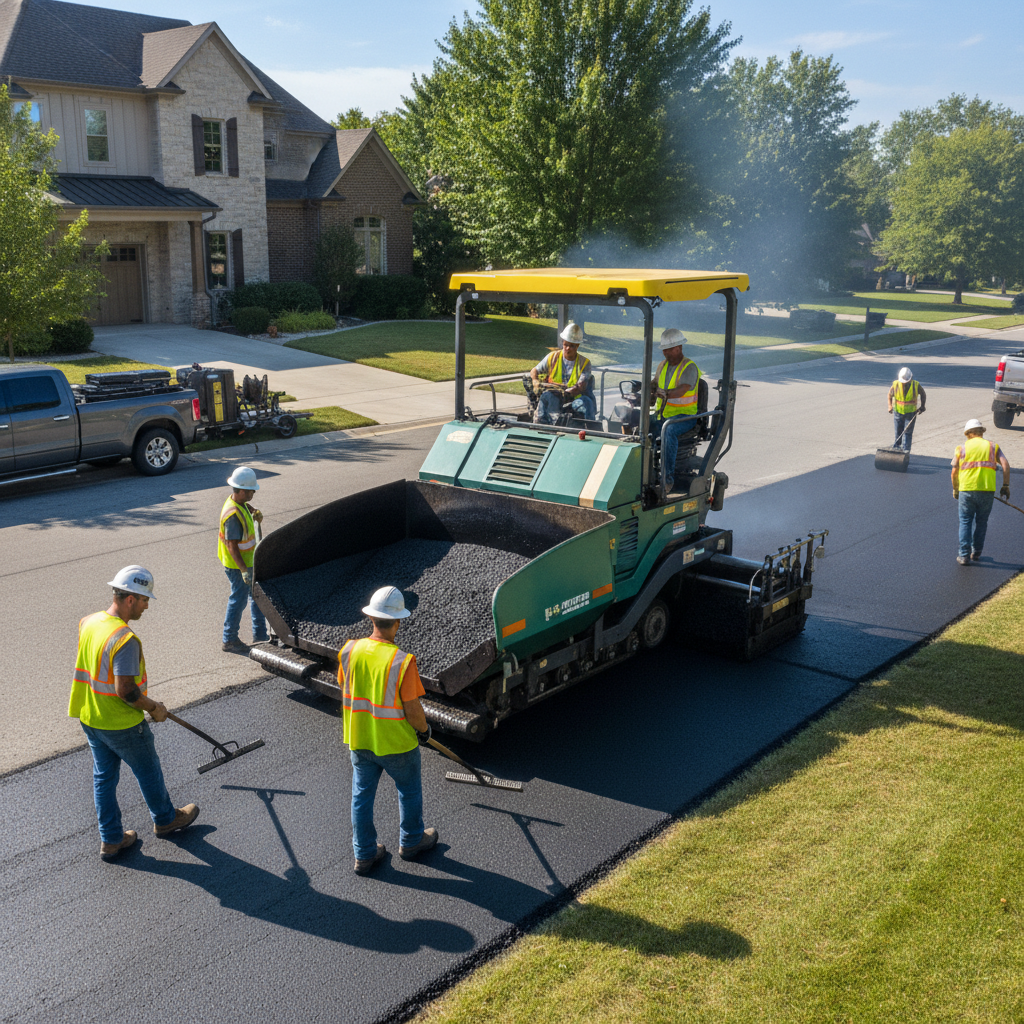
Driveway paving options and costs in Burke Mountain
Burke Mountain is a growing community on the north side of the Lower Mainland, and that matters for driveway paving because local demand stays strong every spring. With a population of 12,100 (Statistics Canada, 2021 Census), you’ll see steady turnover of residential lots and ongoing upgrades to older lanes and newly completed homes. In most Burke Mountain neighbourhoods—especially around the Burke Mountain / Panorama area—driveways are typically attached to single-detached homes, so contractors are busy balancing aesthetics with long-term performance in wet winters and repeat freeze–thaw around the shallow coastal frost zone.
In the Lower Mainland–Southwest, pricing is driven less by deep, icy frost and more by intense rainfall, drainage control, and the way moisture moves through compacted base. Even though coastal frost penetration is relatively shallow, crews still design for a frost line on the order of 18" for exposed applications, which means proper granular base thickness and drainage work are rarely “optional.” Scheduling can also tighten because hot-mix asphalt needs workable air temperatures above about 10°C, so spring rain can compress the best laying windows. That’s why two quotes for the same driveway can land far apart: one may include full tear-out, adequate base depth, and proper slope/drainage corrections, while the other leaves those items limited.
Use the table below as a practical cost comparison for Burke Mountain driveways, then we’ll break down what drives variation in pricing and how to evaluate contractors.
| Material |
Lifespan |
Maintenance |
Best For |
Price per sq ft |
| Asphalt (new installation, proper base) |
15–25 years |
Seal every 3–5 years; patch as needed |
Clean, cost-effective, durable driveways with good drainage |
$12 – $20 |
| Asphalt (overlay on existing gravel base) |
10–18 years |
Seal every 3–5 years; monitor edges and low spots |
Cost control when base is still sound |
$10 – $16 |
| Interlocking concrete pavers |
25–40 years |
Re-level occasional stones; replace individual units if needed |
Curb appeal and easy spot repairs without full resurfacing |
$20 – $40 |
| Poured concrete (broom finish) |
20–35 years |
Minor patching; consider crack repairs as needed |
Low visual maintenance and a clean, consistent surface |
$18 – $35 |
| Exposed aggregate concrete |
20–35 years |
Occasional sealing; patch and re-finish localized spalls |
Texture for slip resistance and “premium” appearance |
$22 – $38 |
| Gravel / crushed stone (budget option) |
3–8 years (depends on grading) |
Top up annually; re-grade; manage weed growth |
Temporary or utility-access surfaces |
$6 – $14 |
Prices are estimates only and vary by project scope, site access and material selection.
What affects the price of paving in Burke Mountain
In Burke Mountain and across the Lower Mainland–Southwest, you can see the same driveway priced 30–50% differently between quotes. Usually it isn’t “the contractor taking advantage”—it’s scope differences: excavation depth, how thoroughly drainage is corrected, whether the crew tears out to proper base, and what asphalt/concrete mix spec they’re actually pricing for. Even within British Columbia, labour rates and scheduling pressure shift between areas and weeks, and premium crews often price for better compaction equipment and tighter quality control.
Two factors dominate cost in this region: frost line design and moisture management. While coastal frost is less severe than Interior or Northern BC, local practice still assumes a frost line on the order of 18" for exposed infrastructure. That means granular base thickness and proper compaction matter—skimping there can lead to heaving, rutting and cracking. In colder provinces like Ontario/Alberta you’ll commonly see thicker bases (often 6–12" for exposed drive applications), but in coastal BC it’s typically more like 4–6" when conditions are ideal—so when site soils are saturated or clay-heavy, you may still need deeper excavation and additional base to get the right gradation.
The paving season is also effectively “shorter” than it looks on a calendar because hot-mix asphalt placement requires air temperatures above roughly 10°C. A rainy shoulder season can delay starts and increase standby time, which pushes asphalt from the lower end of the $12 – $20 per sq ft band toward the top end. For concrete, air-entrained mixes and proper curing become more important when freeze–thaw cycles and winter wetting are repeated.
Concrete examples in Burke Mountain: (1) a thicker, well-supported base under a broom-finished slab costs more up front, but it reduces early settlement cracks; (2) if your driveway slopes toward a garage or landscaped area, correcting drainage and sub-base grading may add labour before any surface work—yet it can prevent recurring “soft spots” that make asphalt overlays fail early. In short, newer homes and well-drained sites can land closer to the lower end of the $18 – $35 band, while clay-saturated or poorly graded lots often pull pricing upward.
| Price Factor |
Why It Matters |
Cost Impact |
| Driveway area in sq ft |
Most materials and most labour scale directly with square footage |
High: typically drives 50–70% of total cost |
| Base depth required |
Frost line design and soil conditions determine granular thickness and stability |
High: additional excavation/aggregate can swing costs significantly |
| Grading and drainage work |
Correct slope, sub-drain paths, and positive drainage prevent water pooling |
Medium–High: can add trucking, labour, and extra materials |
| Tear-out of existing surface |
Breaking, hauling and disposal add time and equipment use |
Medium: often increases the price beyond a “resurface” estimate |
| Edge restraints and curbing |
Prevents paver spread and asphalt edge breakdown |
Medium: required if the driveway has curves or adjacent soft landscaping |
| Sealing requirement |
Asphalt needs sealing after 6–12 months to protect against moisture and aging |
Low–Medium: usually a future cost, but some quotes include it |
| Site access |
Narrow lanes/tight turns slow equipment movement and reduce productivity |
Medium: can add labour hours and equipment planning |
| Asphalt mix specifications |
Freeze–thaw-rated mixes hold up better under wet winters |
Medium: improved mix spec can raise per-ton pricing |
Permits & regulations in British Columbia
For most homeowners in British Columbia, paving a private driveway on your own property typically does not require a building permit. In Burke Mountain, the work most likely to proceed without a permit is like-for-like surfacing within your lot line—such as replacing an existing asphalt surface, rebuilding the driveway in the same footprint, or installing pavers/concrete strictly within the property area you’re already allowed to use.
Where permits and approvals usually come into play is when the project affects the municipal right-of-way or storm infrastructure. That means things like new or modified curb cuts, changes to the boulevard, work that alters drainage patterns away from your property, or any tie-in/adjustment to storm systems under municipal jurisdiction. Some municipalities also have lot-grading requirements that can restrict how close hard surfaces can sit to certain lines or how runoff must be directed.
Before excavation, step one is always utility locates. Use BC 1 Call to mark gas, power, telecom and any buried services—this is non-negotiable for safety and to protect you from costly damage. Step two is contractor verification: check the contractor’s licence status (through the appropriate BC registry for paving/asphalt work), confirm liability insurance (request a current certificate of insurance naming the job site/address), and verify they carry the proper worker coverage for their employees (WSIB/WCB in the form that applies in BC). For higher assurance, ask for a clearance letter or evidence of account standing. Step three is to confirm lot-grading rules with the municipality in case your driveway work changes slope or runoff.
Asphalt vs pavers vs concrete for Burke Mountain driveways
For Burke Mountain homeowners, the “right” surface is the one that matches how you maintain the driveway and how the base is built for wet winters and repeat freeze–thaw near the shallow frost zone. Asphalt usually wins on lowest upfront cost: it’s typically priced in the $12 – $20 per sq ft range when installed with a proper granular base and good drainage. The catch is maintenance—sealed asphalt generally performs best when sealed every 3–5 years, and small cracks must be patched early to stop water from driving down into the base.
Interlocking concrete pavers cost more upfront (often aligned to the $20 – $40 per sq ft band), but they’re the most forgiving for Burke Mountain’s localized drainage issues. If a section settles due to soil moisture, pavers can be lifted, re-leveled and reset without replacing the whole driveway. That repairability is a big advantage when you get soft spots after heavy rains in a clay-leaning subgrade.
Poured concrete sits in the middle on price and appearance, but it must be air-entrained and properly cured to resist freeze–thaw. Concrete can also crack; the key is correct base support, jointing strategy, and managing water runoff so salts and winter moisture don’t accelerate deterioration. In the Lower Mainland–Southwest, frequent winter rain means drainage design is often the difference between “looks good” and “keeps cracking.”
A real-world example: if a 600 sq ft driveway is quoted at the low end of asphalt versus pavers, you may see roughly a $4,000 to $14,000 gap depending on tear-out, base depth and edge restraints. That difference is justified when you value curb appeal and long-term rework flexibility—or if your driveway alignment makes future repairs expensive for a monolithic material.
| Material |
Frost Resistance |
Curb Appeal |
Repair Method |
Lifespan |
Price Band |
| Asphalt (sealed regularly) |
Good with proper drainage and freeze–thaw-rated mix |
Moderate (clean, uniform look) |
Patch localized areas; re-seal periodically |
15–25 years |
$12 – $20 |
| Interlocking concrete pavers |
Very good when base is properly compacted and edged |
High (varied colours/patterns) |
Lift and reset individual stones/sections |
25–40 years |
$20 – $40 |
| Poured concrete (air-entrained) |
Good with air-entrainment and correct joints |
Moderate–High (clean slab look) |
Crack repair and seal; localized patching |
20–35 years |
$18 – $35 |
| Exposed aggregate concrete |
Good with proper mix and curing |
High (textured, premium appearance) |
Targeted patching; may require re-finish for repairs |
20–35 years |
$22 – $38 |
| Permeable pavers (drainage grid) |
Very good for managing wetting and reducing pooling |
Medium–High (depends on design) |
Replace individual units; maintain drainage cells |
20–35 years |
$28 – $48 |
| Chip seal / tar-and-chip |
Moderate (shorter service life; sensitive to base issues) |
Low–Moderate (more “functional” finish) |
Re-surface or patch and re-seal |
6–12 years |
$10 – $18 |
How to choose a paving contractor in Burke Mountain
Choosing a paving contractor in Burke Mountain comes down to verification and documentation. First, confirm they’re properly licensed for the work they’ll do in British Columbia (and the specific scope—excavation, base work, asphalt/paver installation). Next, check liability insurance: ask for a current certificate of insurance that lists the project address. For worker protection, ensure they have the correct worker coverage for their employees (WSIB/WCB coverage in the form applicable in BC) and request proof such as account clearance or coverage verification. Don’t accept “we’re covered” without seeing paperwork.
Then get 2–3 itemised written quotes that separate labour and materials, and clearly state assumptions (driveway size, tear-out extent, base depth, drainage corrections, and what disposal/trucking is included). A fair asphalt quote should describe the granular base thickness, compaction approach, whether edges need restraints, and the asphalt mix spec for freeze–thaw conditions. For concrete, the quote should specify air-entrainment, finish type, joints, and curing practices.
Review warranty details: workmanship warranty length and how it’s handled for settlement/cracking. Confirm whether product/manufacturer warranties apply to materials only or include installation. Payment schedule matters—never pay more than 10–15% upfront; hold back a portion until the job is complete and cleaned. Finally, get the start date and completion estimate in writing, including what weather triggers rescheduling.
- Ask for proof of British Columbia licence/registration for the exact trade scope.
- Request a certificate of liability insurance naming the job site/address.
- Verify worker coverage (WSIB/WCB) for employees; request evidence of account standing.
- Get 2–3 itemised quotes (labour + materials), not just a lump sum.
- Confirm measurement method for sq ft (and whether allowance is included for waste).
- Ensure base depth and drainage corrections are written into the scope.
- Specify tear-out limits and whether disposal/haul-away is included.
- For asphalt, confirm compaction testing approach and edge restraint requirements.
- For pavers, confirm bedding sand thickness and jointing sand specification.
- For concrete, confirm air-entrainment and jointing plan.
- Ask about warranty terms: length, exclusions, and whether it’s transferable.
- Set a payment schedule with a 10–15% maximum deposit and a holdback until completion.
Red flags in Burke Mountain: quotes that are missing base-depth or drainage details, “cheap” tear-out assumptions without disposal included, no insurance paperwork provided up front, a warranty that’s only verbal or extremely short, and vague schedules that don’t commit to start/completion dates in writing.
Frequently asked questions — paving in Burke Mountain
Why does my driveway crack and heave in winter?
In Burke Mountain and across coastal areas of British Columbia, heaving and cracking are often caused by moisture + freeze–thaw acting near the shallow frost zone. If water can’t drain away (low spots, insufficient slope, or blocked sub-base), it soaks into the granular base. When temperatures swing around freezing, that trapped moisture expands, pushing pavement upward (heave) and creating cracks. Clay-heavy soils in parts of the Fraser Valley can hold water longer, making the base more vulnerable if excavation depth or drainage wasn’t adequate. Fixing it usually requires more than surface patching: a proper base rebuild and drainage correction is the real solution—otherwise you end up paying again. This is why “budget” asphalt quotes sometimes look attractive but fail sooner than an installation priced closer to the $12 – $20 per sq ft band with proper base work.
Do I need a permit to pave my driveway in British Columbia?
In most cases in British Columbia, paving your private driveway within your own property footprint does not require a building permit. Typically, like-for-like surface replacement or rebuilding on the same footprint (as long as you’re not changing how storm drainage behaves) proceeds without a permit. However, permits/approvals can be required when work affects the municipal right-of-way—such as adding/modifying a curb cut, changing boulevard features, or altering drainage patterns that tie into municipal systems. Also check lot-grading rules: some municipalities restrict how close hard surfaces are to property lines and how runoff must be directed. Before excavation, confirm utility locates through BC 1 Call. To avoid surprises, ask your contractor to clearly state whether their scope includes any right-of-way or grading approvals before work starts.
How long before I can drive on new asphalt?
For new asphalt in Burke Mountain, the general rule is that you shouldn’t drive on it until it has cooled enough to avoid surface damage—crews typically manage this with staged access and traffic control. Placement and weather matter: if it’s cool or rainy, the surface takes longer to cool and bind. Also note that sealing is different from “drive time”: asphalt is usually sealed after it has cured, commonly 6–12 months after installation, depending on the product and site conditions. If your driveway is part of a longer paving season window in the Lower Mainland–Southwest, scheduling can be tight, so plan for temporary access. If you opted for a quote that prices near the $12 – $20 per sq ft band, ask whether the contractor includes a sealing recommendation or future sealing plan, since sealing timing can affect long-term performance and crack protection.
What causes potholes and how are they repaired?
Potholes in Burke Mountain are usually a failure of the surface over a base that’s holding water or has weakened. Water gets into cracks or edges, undermines the granular layers, and then traffic breaks the asphalt apart. You may also see potholes emerge after winter rain events, especially if a drainage slope is off or the driveway edges aren’t restrained. Repair is typically a localized cut-out to remove the damaged asphalt and any saturated/failed material below, followed by reinstating proper base and compacting, then placing asphalt to match the grade. Good repairs also address the cause—often drainage corrections at low spots or edge areas. A “patch only” approach without base repair tends to fail faster and can cost more long-term, particularly compared with the durability you expect from a well-built driveway priced within the $12 – $20 per sq ft band.
How do I prepare for a paving project?
Start by clearing the driveway area so the crew can move equipment safely—remove vehicles, portable basketball hoops, planters, and anything that could be damaged by excavation or compaction. Mark any sprinkler heads or garden features along the edges and talk to the contractor about whether landscaping will be disturbed. If you have downspouts that discharge near the driveway, make sure your contractor inspects runoff routes so water isn’t redirected into weak areas during the rebuild. Before work begins, confirm utility locates are completed through BC 1 Call. Ask for an itemised scope and a timeline in writing so you know what’s included: tear-out depth, base depth, disposal, and whether drainage/grading corrections are part of the job. Finally, plan for short-term access limitations—especially in the Lower Mainland where rain can compress the best paving windows.
How do I compare paving quotes fairly?
To compare quotes fairly in Burke Mountain, insist on apples-to-apples scopes. Make sure each quote includes the same measurement (sq ft), the same tear-out plan, and the same base depth and drainage work. Ask whether the contractor includes disposal/haul-away and whether edge restraints are included—those details can swing pricing and performance. Confirm material specs: asphalt mix type suitable for freeze–thaw conditions, or for concrete, whether it’s air-entrained and includes jointing/cure methods. Compare warranty terms (workmanship duration and exclusions) and the payment schedule: reputable contractors usually take a small deposit (10–15% or less) and leave a holdback until completion. If one quote is far lower than others, check if it’s cutting corners. For reference, asphalt driveways commonly land in the $12 – $20 per sq ft range, pavers often in the $20 – $40 range, and concrete in the $18 – $35 range—then verify what those numbers include.