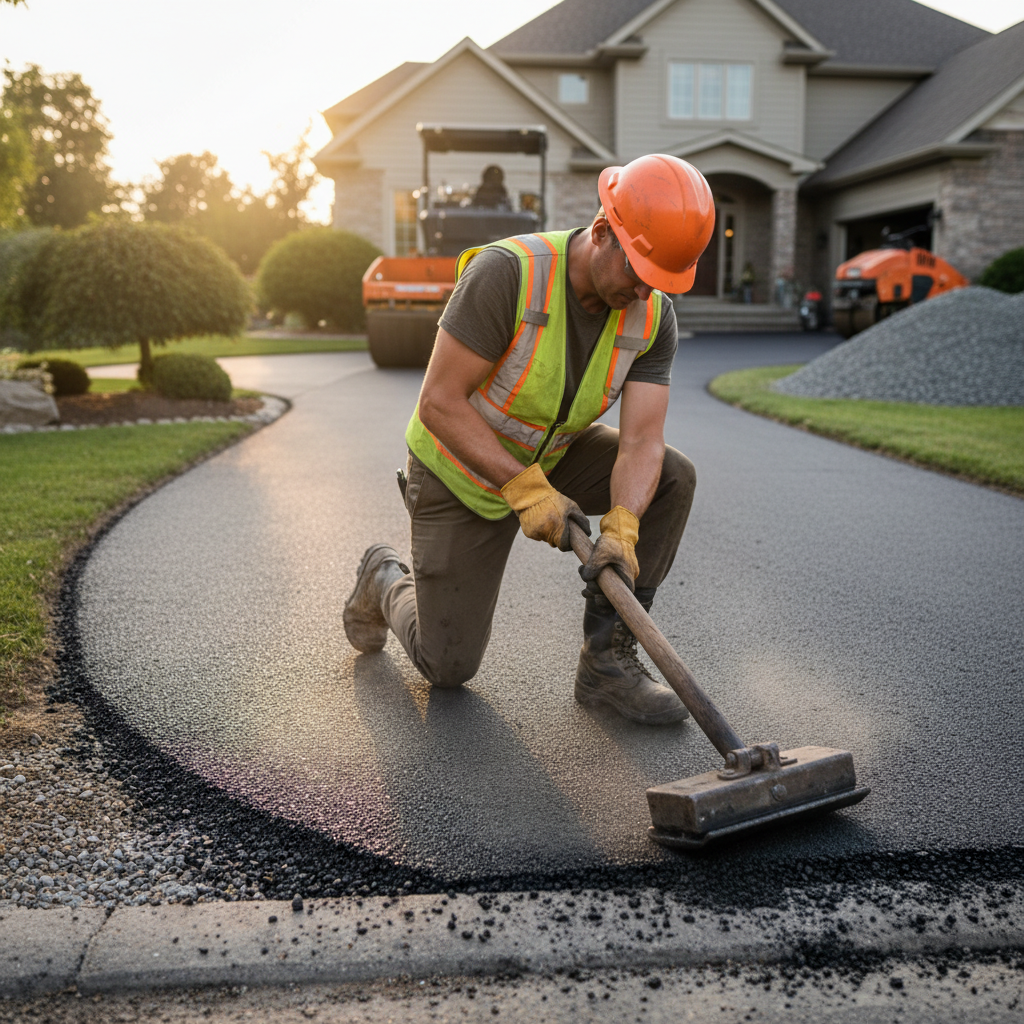
Driveway paving options and costs in Fort Macleod
Fort Macleod homeowners typically have three practical driveway paths—fresh asphalt, interlocking pavers, or concrete—because most driveways in town serve single-detached homes (77.0% of dwellings) rather than multi-unit lots. With 1,025 homeowner households (77.4% of households owning), there’s a steady local demand for smooth, winter-ready surfaces that can handle Alberta’s freeze–thaw grind.
In the Lethbridge–Medicine Hat economic region, paving costs are shaped by frost depth and repeated freeze–thaw cycles. Frost penetration is commonly in the 6 ft range, so contractors plan thicker granular bases, compacted subgrade, and more robust drainage to reduce heaving and early cracking. The paving season is also shorter—hot-mix asphalt needs warm conditions (commonly above 10°C)—so scheduling pressure in late spring to early fall can nudge unit pricing upward, especially for smaller residential jobs. Labour and equipment time are impacted by haul distances and site access, and nearby areas such as Lethbridge and Medicine Hat can draw crews away when larger commercial projects stack up.
If your place is in higher-demand pockets like the older residential blocks near downtown Fort Macleod, you’ll often see more asphalt overlays and spot repairs, because many homes were built before 1981 (60.8% of dwellings) and may have older bases, narrower excavations, or established grading that needs careful work. Once you match your material to your base and drainage plan, pricing becomes easier to compare—see the cost bands below.
| Material |
Lifespan |
Maintenance |
Best For |
Price per sq ft |
| Asphalt (new installation, proper base) |
15–25 years |
Sealcoat every 3–5 years |
Strong value with good winter performance when base is built for frost |
$6.50–$11.50 |
| Asphalt (overlay on existing gravel base) |
8–15 years |
Sealcoat every 3–5 years; patching as needed |
Budget upgrades when the existing subgrade is sound |
$5.50–$9.50 |
| Interlocking concrete pavers |
25–40 years |
Re-sand joints as needed; lift-and-replace repairs |
Curb appeal and easier localized repairs without tearing out the whole driveway |
$12.00–$19.00 |
| Poured concrete (broom finish) |
20–30 years |
Seal as recommended; crack monitoring |
Clean, low-maintenance look with strong performance when properly air-entrained and jointed |
$11.00–$17.00 |
| Exposed aggregate concrete |
20–35 years |
Seal occasionally; remove minor surface staining |
High traction and premium finish for sloped or high-traffic driveways |
$13.00–$20.00 |
| Gravel / crushed stone (budget option) |
3–7 years |
Top up and re-grade 1–3 times per year |
Short-term solution or interim surface on tight budgets |
$3.00–$6.50 |
Prices are estimates only and vary by project scope, site access and material selection.
What affects the price of paving in Fort Macleod
In Fort Macleod and across Alberta, quotes for the same driveway can swing by 30–50% because the “same size” often hides very different base construction, drainage corrections, and demolition scope. One contractor may price a straight re-pave, while another may need to rebuild the granular base to frost depth, improve subgrade, and handle hauling and disposal. Those differences show up quickly when you’re dealing with southern Alberta’s frost depth and freeze–thaw cycles.
Frost depth is decisive in the Lethbridge–Medicine Hat region. Deeper frost requires a thicker, well-compacted granular base—often 6–12 inches of compacted granular layers depending on soil and drainage—to prevent frost heave and reflective cracking. That’s more robust than what you’d typically design for in milder coastal regions, where the frost depth and freeze–thaw intensity are far less. The paving season also tightens scheduling: hot-mix asphalt generally needs favourable air and pavement temperatures (commonly above 10°C), which means fewer weather windows and more crew coordination in spring and early fall. Asphalt mix design must also be freeze–thaw rated, and that costs more than a generic “standard” mix.
Two concrete examples of local conditions that raise cost in Fort Macleod: (1) clay-heavy or poorly drained soils often require thicker base and better underdrain or daylighting; (2) driveways on older grading can need extra excavation and re-slope so water doesn’t pond before winter. Homes built before 1981 (60.8% of dwellings) frequently have established drainage patterns or older base material that’s not uniform, and that can add hundreds to thousands in base correction—pushing total asphalt projects toward the broader band of $6,000–$12,000 rather than the low end.
On the other hand, if your base is already well-built and drainage is clear, an asphalt overlay or partial grind can keep you closer to the lower segment; and when you’re choosing pavers or concrete, the better base is what makes the higher upfront price feel justified.
| Price Factor |
Why It Matters |
Cost Impact |
| Driveway area in sq ft |
More surface means more asphalt/pavers/concrete, and more base and compaction |
Largest driver; strongly tied to your total estimate |
| Base depth required |
Frost line determines granular thickness to reduce heaving and cracking |
Can add major excavation and aggregate costs |
| Grading and drainage work |
Proper slope and subdrainage prevents water retention and freeze damage |
Often adds cost when ditches, culverts, or swales must be corrected |
| Tear-out of existing surface |
Breaking, hauling and disposal are time-consuming and depend on material thickness |
Typically increases labour and disposal charges |
| Edge restraints and curbing |
Prevents paver spread and maintains asphalt thickness at the edges |
Moderate cost, big impact on long-term performance |
| Sealing requirement |
Asphalt needs sealcoat after it cures to protect from moisture and oxidation |
Adds a future maintenance budget (but extends lifespan) |
| Site access |
Narrow lanes, gates, or steep approaches slow equipment movement |
Raises labour hours and equipment time |
| Asphalt mix specifications |
Freeze–thaw rated mix and designed gradations handle southern Alberta winters better |
Can move the job toward the higher end of local asphalt pricing |
Permits & regulations in Alberta
In Alberta, paving a private driveway within your own property typically does not require a building permit. However, the moment the work touches municipal assets or drainage infrastructure, you may need municipal approval. Examples of work that commonly does require municipal involvement include: creating or modifying a curb cut or driveway access in the boulevard, changing storm drainage patterns (including adding/altering culverts or reconnecting catch basins), and any alterations to right-of-way features (sidewalk/curb/boulevard grading) that affect how water flows.
Work that typically does not require a permit is repaving or resurfacing entirely on private property—such as removing and replacing asphalt, adding pavers or concrete on your driveway footprint, or installing base and surface improvements as long as you’re not changing municipal drainage or right-of-way elements.
Before digging in Fort Macleod, always request utility locates through Alberta One-Call. Then verify your contractor the way you’d check any other major trade:
- Licence: check the contractor’s business registration and any applicable trade licensing details through official Alberta sources (and confirm the paving business is properly set up to operate).
- Liability insurance: request a certificate of insurance showing the coverage amount and effective dates.
- WCB/WSIB coverage: in Alberta this is handled through WCB; ask for proof of WCB coverage (or a clearance letter where applicable).
Ask for these documents before work starts so you’re protected if something goes wrong.
Asphalt vs pavers vs concrete for Fort Macleod driveways
For Fort Macleod’s freeze–thaw climate and a typical winter routine (plowing, sand, and sometimes salt), asphalt, pavers, and concrete all can work—but they differ in upfront cost, maintenance rhythm, and how they respond to winter stress. Asphalt is usually the lowest upfront option in the region, but it’s not “set and forget.” When built on a frost-ready base, asphalt should be sealcoated regularly (often every 3–5 years) to protect from moisture and oxidation. Asphalt also tends to show surface fatigue first; with proactive sealing and patching, it can last well.
Interlocking concrete pavers cost more upfront, but they offer the best repairability: one damaged area can be lifted and reset without tearing out the entire driveway. That matters in Alberta winters because localized settlement, drainage issues, or freeze-related movement can show up in spots, not evenly across the whole slab. Pavers also give strong curb appeal, which is a real draw in neighbourhoods with older homes and established landscaping.
Poured concrete sits in a middle lane for cost and appearance, but it’s susceptible to cracking if it isn’t properly air-entrained, correctly jointed, and tied to a stable base with good drainage. Exposed aggregate gives traction and a premium look, though it still depends on the same fundamentals: base thickness and water management.
In practical terms, a homeowner choosing asphalt at $6,000–$12,000 may spend less than pavers at $9,000–$18,000—but the extra paver budget is justified when you want long-term curb appeal and a repair system that doesn’t interrupt the whole driveway. If your site has drainage risks or older, uneven subgrade (common in pre-1981 housing stock), the base and drainage budget is the real driver that makes any surface last.
| Material |
Frost Resistance |
Curb Appeal |
Repair Method |
Lifespan |
Price Band |
| Asphalt (sealed regularly) |
Good when based for frost and drained properly |
Moderate (clean, uniform look) |
Patch, then seal; localized milling and resurfacing |
15–25 years |
$6,000–$12,000 |
| Interlocking concrete pavers |
Very good with restrained edges and stable base |
High (variety of patterns and colours) |
Lift-and-replace individual stones or small sections |
25–40 years |
$9,000–$18,000 |
| Poured concrete (air-entrained) |
Good with air entrainment, proper joints, and base support |
Moderate to high (clean and solid) |
Crack repair/patching; often spot repairs, not full panel replacement |
20–30 years |
$8,000–$16,000 |
| Exposed aggregate concrete |
Good with correct curing, drainage, and base |
High (premium texture) |
Surface restoration and patching; localized repairs where feasible |
20–35 years |
$10,000–$18,000 |
| Permeable pavers (drainage grid) |
Very good for water management when designed correctly |
High (modern look) |
Replace paver units; maintain infill layers as required |
25–40 years |
$10,000–$20,000 |
| Chip seal / tar-and-chip |
Moderate; sensitive to base prep and winter wear |
Low to moderate |
Aggregate loss patching and re-surfacing |
7–12 years |
$4,000–$9,000 |
How to choose a paving contractor in Fort Macleod
Picking the right contractor in Fort Macleod is less about slogans and more about verifying coverage and scope. Start with Alberta compliance checks. Ask for a certificate of insurance for general liability (and ensure dates and jobsite address are covered). For worker protection, request proof of WCB coverage or a clearance letter where applicable—this matters because paving crews in Alberta work in tight windows and under variable ground conditions. Also confirm the contractor’s business registration and that the paving team is set up to handle excavation, hauling, and disposal properly.
Next, get 2–3 itemised written quotes—not lump sums. You want a labour/material breakdown showing excavation and base work, compaction/testing allowances, asphalt/paver/concrete quantities, edge restraints, drainage adjustments, and disposal. Ask whether a permit pull is included if any municipal boulevard access or storm drainage changes are required. Clarify inclusions and exclusions: is removal of existing surface included, and is hauling/disposal included?
Warranty is critical. Ask for the workmanship warranty length and what it covers (settlement? cracking? edge movement?). Also ask whether the concrete product warranty is from the manufacturer and if it’s transferable to subsequent owners.
For payment timing, never pay more than 10–15% upfront. Hold back a portion until the driveway is complete, clean, and meets grade/drainage expectations. Finally, request a start date and completion estimate in writing—weather windows in southern Alberta can shift, so a clear schedule helps you plan around late spring and early fall.
- Confirm WCB clearance/coverage proof before work begins.
- Provide a current liability insurance certificate.
- Ask for an Alberta business registration and contact info.
- Get 2–3 itemised quotes (line-by-line scope, not lump sum).
- Require a written schedule with start and substantial completion dates.
- Verify subgrade proof/compaction steps are included (not “we’ll compact”).
- Confirm base thickness and drainage design are specified in the quote.
- Clarify tear-out limits and disposal/hauling inclusions.
- Ensure edge restraints/curbs are included where needed.
- Ask when sealcoat will be applied for asphalt and whether a follow-up is offered.
- Review warranty terms in writing (workmanship + product, if applicable).
- Use a payment schedule that holds back funds until final grade/cleanup.
Red flags in Fort Macleod: (1) quoting without discussing frost depth/base thickness and drainage; (2) refusing to provide insurance/WCB documents; (3) “cash only” or large upfront deposits beyond 10–15%; (4) vague scope language like “prep included” without thickness/quantities; and (5) no written schedule, or promises to pave outside feasible temperature windows for asphalt.
Frequently asked questions — paving in Fort Macleod
Do I need a permit to pave my driveway in Alberta?
In Alberta, paving a private driveway entirely within your own property usually doesn’t require a building permit. In Fort Macleod, the permit question changes if your project touches municipal infrastructure—especially the boulevard area. If you’re making or changing a curb cut, altering storm drainage, adding/adjusting culverts, or changing right-of-way grading, you’ll generally need municipal approval before construction starts. A reputable contractor will flag this in the scope and tell you whether they’ll handle the process. Also, check any lot-grading rules that restrict how close hard surfaces can be near property lines. Before excavation, call Alberta One-Call for utility locates to avoid costly delays or safety issues.
How long before I can drive on new asphalt?
For asphalt in Alberta, you generally can drive on it after it’s cooled sufficiently—often within 24–48 hours depending on temperature, thickness, and how much traffic you’ll have. In Fort Macleod’s late spring to early fall paving windows, contractors usually plan for curing time and minimal disturbance so the surface doesn’t get scuffed. Thicker areas and high-heat days may shorten that window slightly, while cooler or breezy conditions can extend it. Even when you can drive sooner, you should avoid sharp turns and heavy loads right away. Also remember sealing isn’t immediate; asphalt typically needs time to cure before sealcoat, which is why regular maintenance matters to keep your driveway in the realistic lifespan range.
What causes potholes and how are they repaired?
Potholes usually start with water. In Alberta, freeze–thaw cycles expand trapped moisture in the base or subgrade, then the asphalt surface breaks down under traffic. In Fort Macleod, this is common when drainage is off grade, edges weren’t properly restrained, or the granular base wasn’t built to handle frost depth. Asphalt repairs typically involve saw-cutting the failed area, removing loose material, re-compacting base, and placing new asphalt to match the existing thickness. For recurring failures in the same area, a patch may only be temporary—sometimes a grind and overlay (or a base correction first) is the better fix. The contractor should assess whether it’s a localized issue or a systemic base/drainage problem.
How do I prepare for a paving project?
Preparation in Fort Macleod is mostly about access, drainage, and timing. Clear the driveway area of vehicles, trailers, and landscaping so equipment can stage safely. Mark any sprinkler heads and keep hoses and decorative items out of the work zone. Confirm where you want snow storage after the job, especially if you’re planning a tight scheduling window around late spring. If you have older drainage patterns, ask the contractor to review how water currently leaves the property and where it should go after paving. For asphalt, confirm whether sealcoat is included or planned later. Also expect utility locates to be required before excavation through Alberta One-Call.
How do I compare paving quotes fairly?
Compare Fort Macleod quotes like-for-like by reading the line items. Ask whether each estimate includes excavation, base thickness, compaction, drainage corrections, edge restraints, disposal/hauling, and the type/grade of asphalt or concrete mix. Watch for exclusions like “topsoil removal only” or “base as required” without stating depth. Quotes can differ by 30–50% when base and drainage scope changes, even if the driveway footprint is similar. Also check if asphalt sealcoat is accounted for—many homeowners see an “asphalt” number that doesn’t include the follow-up maintenance. For example, local asphalt installed pricing commonly lands in the $6,000–$12,000 band, while concrete/paver projects often move higher. Fair comparisons should clearly show what pushes your total toward the high end.
Can asphalt be laid in cold weather in Fort Macleod?
Cold weather is where most asphalt failures come from, so in Fort Macleod you generally can’t treat asphalt like a year-round material. Hot-mix asphalt typically needs pavement and air temperatures warm enough to place and compact properly—often above 10°C—because otherwise you don’t get proper compaction and bonding, and you increase the chance of early raveling or cracking. Contractors manage this by scheduling weather windows in late spring through early fall and using proper mix design for freeze–thaw conditions. If a contractor suggests paving when temperatures are too low, ask how they’ll ensure compaction meets specs. Even if it looks fine initially, Alberta winters will expose weak base or poor cure conditions quickly.