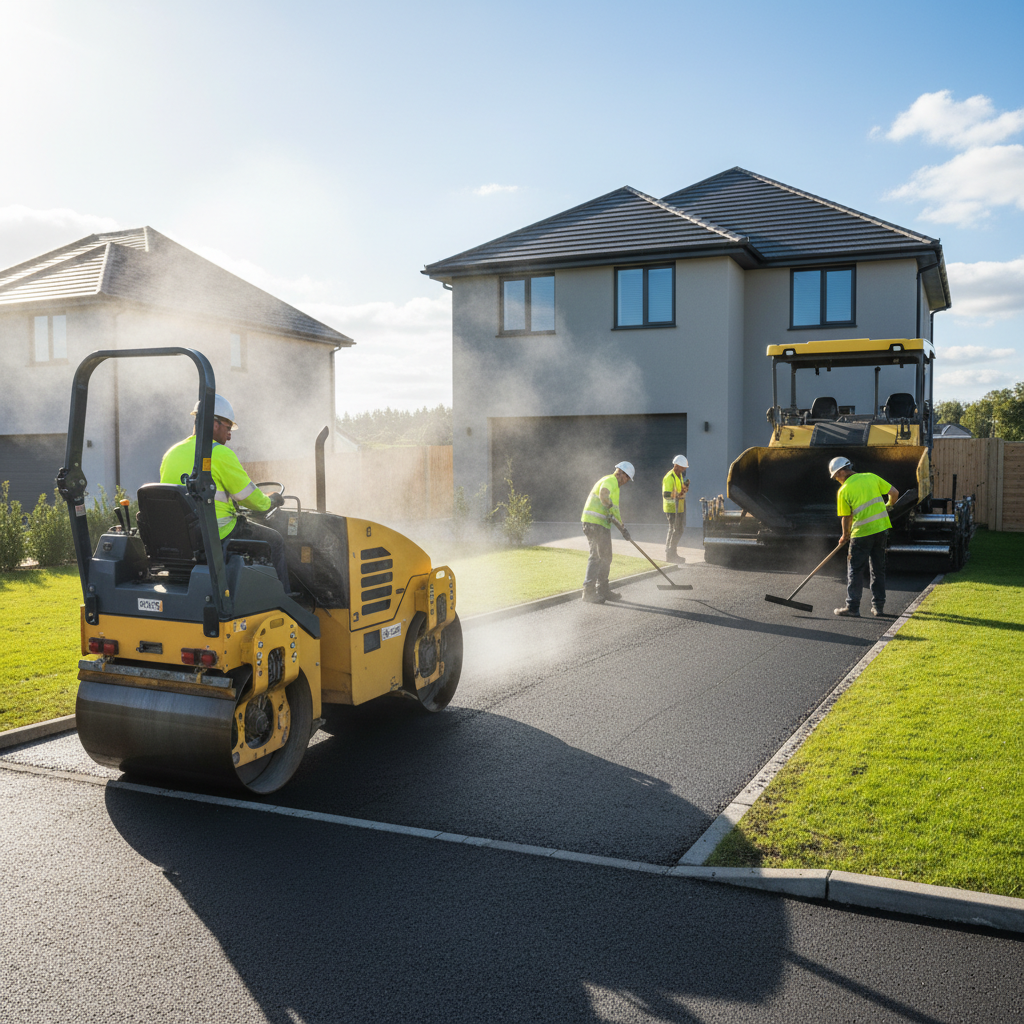
Driveway paving options and costs in Rocky Ridge
In Rocky Ridge, Alberta, homeowners usually want a driveway surface that handles Calgary’s freeze–thaw winters without turning into a patchwork by year five. With Rocky Ridge sitting in the Calgary economic region and a 2021 population of 8,195 (Statistics Canada, 2021 Census), most driveways are tied to established residential lots, and the demand tends to track owner turnover and landscaping upgrades. The area’s streets also see a lot of attached-to-detached housing activity—meaning contractors are frequently bidding driveways sized for family vehicles and snow-clearing access rather than large rural aprons.
Calgary’s cold continental climate is the real pricing driver: frost routinely penetrates to about 1.2 m, and repeated freeze–thaw cycles push water expansion upward. That means deeper, well-graded granular bases, tighter compaction, and drainage corrections aren’t “nice-to-haves”—they’re part of what keeps asphalt from heaving and prevents pavers from rocking. On top of that, the paving season is compressed (late spring through early fall). When small projects pop up in peak months, scheduling and mobilization can nudge per-square-foot pricing toward the top end of the local bands.
Trade demand is especially noticeable around the Rocky Ridge residential core and nearby commercial access areas where driveways are more visible and heavily plowed. If you’re comparing options, the table below gives practical cost ranges for common driveway builds—then we’ll break down what pushes your quote up or down.
| Material |
Lifespan |
Maintenance |
Best For |
Price per sq ft |
Price Range |
| Asphalt (new installation, proper base) |
15–25 years |
Sealcoat every 3–5 years; patching as needed |
Best value for most Rocky Ridge homes |
$12–$20 |
$6,500–$14,000 |
| Asphalt (overlay on existing gravel base) |
10–18 years |
Sealcoat every 3–5 years; more frequent crack filling |
When you need a budget improvement |
$11–$18 |
$5,500–$12,500 |
| Interlocking concrete pavers |
25–35 years |
Re-leveling and sand replacement; occasional paver swap |
Curb appeal and easier localized repairs |
$18–$30 |
$9,500–$22,000 |
| Poured concrete (broom finish) |
25–35 years |
Joint sealing and crack monitoring |
Low look-upkeep, clean lines |
$15–$25 |
$8,000–$20,000 |
| Exposed aggregate concrete |
25–35 years |
Sealer as specified; spot repairs |
Slip resistance and decorative finish |
$18–$28 |
$10,000–$24,000 |
| Gravel / crushed stone (budget option) |
5–10 years |
Annual top-ups and edging refresh |
Short-term solution or drainage-friendly area |
Varies widely |
$3,000–$7,500 |
Prices are estimates only and vary by project scope, site access and material selection.
What affects the price of paving in Rocky Ridge
In Rocky Ridge, you can easily see 30–50% quote swings for what sounds like the “same” driveway. The difference usually isn’t the surface layer—it’s what happens underneath: base preparation, drainage corrections, edge restraint, and how much tear-out and disposal is required. Two contractors can both quote asphalt, yet one may be rebuilding the granular base for Calgary’s freeze–thaw conditions (frost depth around 1.2 m), while the other may be trying to pave over a marginal base. In a cold continental region like ours, that shortcut tends to show up early as raveling, alligator cracking, or settlement around wheel paths.
Frost line depth and freeze–thaw cycles are decisive cost factors in Calgary. Deeper frost requires thicker, compacted granular bases to prevent heaving and cracking. In practice, Rocky Ridge driveways often need a well-graded aggregate build-up that’s substantially more than in milder areas, plus stronger attention to positive drainage (so water doesn’t sit and expand during winter). The paving season is also shorter here because hot-mix asphalt production and placement rely on suitable air and pavement temperatures—many crews won’t risk early spring lifts when temperatures dip below workable thresholds. That scheduling pressure can lift labour and equipment costs during peak months.
Concrete pricing can move too. For example, an air-entrained concrete mix (critical in Alberta winters) can add cost, while thicker slabs for heavy vehicle loads or thicker edge beams can raise the budget. On the other hand, if your existing driveway base is truly solid and properly sloped, you may save money on tear-out and grading. Those savings are one reason a straightforward asphalt install (often aligned with the $12–$20 per sq ft band) can come in far better than a premium paver build in the $18–$30 band—even if the “finish” looks similar from the street.
| Price Factor |
Why It Matters |
Cost Impact |
| Driveway area in sq ft |
Most costs scale directly with square footage: excavation, base, asphalt/concrete |
High (largest variable) |
| Base depth required |
Frost line determines granular thickness to reduce heaving and cracking |
High (material + compaction labour) |
| Grading and drainage work |
Slope correction, ditch ties, and downspout/roof runoff routing to prevent pooling |
Medium to high |
| Tear-out of existing surface |
Breaking and hauling concrete or old asphalt; disposal fees and extra labour |
Medium to high |
| Edge restraints and curbing |
Prevents paver spread and asphalt edge failure during freeze–thaw movement |
Medium |
| Sealing requirement |
Asphalt typically needs sealcoat after 6–12 months to protect from oxidation |
Low to medium (ongoing lifecycle cost) |
| Site access |
Narrow lots or tight turns slow equipment movement and reduce daily production |
Medium |
| Asphalt mix specifications |
Freeze–thaw-rated mix design and performance additives can cost more |
Low to medium |
Permits & regulations in Alberta
For most Rocky Ridge homeowners, paving a private driveway on your own property typically does not require a building permit. The common exception is when the work affects the municipal right-of-way or impacts municipal infrastructure. That includes new or altered curb cuts, changes to the boulevard area, or any modifications that tie into storm drainage. If your project involves changing how water flows toward the road or adjusting existing drainage features, municipal approval is usually required.
Even when a permit isn’t required, there can be lot-grading expectations. Some municipalities have lot-grading bylaws that restrict how close hard surfaces or filled grades can be to property lines and how runoff must be managed. This matters in Rocky Ridge because freeze–thaw cycles punish poor drainage: pooled water expands, leading to heaving and early surface failure.
Before excavation, always arrange utility locates through Alberta One-Call so crews can safely mark buried services. Step-by-step, you can also protect yourself by verifying the contractor’s credentials in Alberta: (1) check the contractor’s licence/registration status through the appropriate Alberta consumer or trade registry access point the contractor should provide; (2) request a current certificate of insurance showing liability coverage limits; and (3) confirm WSIB/WCB coverage information for the crew—then match the paperwork details to the company name on the contract. For extra confidence, ask whether the contractor can provide clearance documentation and a written scope that clearly lists excavation, base prep, and drainage responsibilities.
Asphalt vs pavers vs concrete for Rocky Ridge driveways
Choosing between asphalt, interlocking pavers, and concrete in Rocky Ridge comes down to upfront cost, how you maintain the driveway, and how well the system tolerates Calgary’s winter abuse. Asphalt is usually the lowest upfront option and offers a smooth driving surface, but it needs sealcoating every 3–5 years to slow oxidation and protect against salt and winter wear. Asphalt also relies heavily on base quality—without a frost-resistant granular base and strong drainage, freeze–thaw motion shows up as cracks along wheel paths.
Interlocking concrete pavers typically cost more at the start, but they’re the most repair-friendly: if a section settles, a contractor can remove and re-lay affected units without replacing the entire driveway. In Rocky Ridge, where snowbanks and plowing patterns can stress edges, pavers with proper edge restraints tend to hold their geometry better. Poured concrete sits in the middle for pricing, and with the right air-entrained mix and properly formed joints, it performs well under freeze–thaw. However, concrete can still crack if joints are poorly planned, the base isn’t uniform, or salt exposure is excessive with inadequate surface protection.
For Calgary’s frost depth, drainage design and base preparation are non-negotiable across all three options. If you’re expecting a heavy snow-clearing routine and want a clean look that resists surface damage, pavers often make sense. If budget is the main driver, asphalt is usually the best value within the $12–$20 per sq ft band, especially when the contractor is building the deeper base required for 1.2 m frost and good water control.
Example: if asphalt is quoted at around $12–$20 per sq ft while pavers land closer to $18–$30 per sq ft, that $6–$10 per sq ft difference can be justified when you want easier localized repairs and maximum curb appeal—especially on driveways visible from the street.
| Material |
Frost Resistance |
Curb Appeal |
Repair Method |
Lifespan |
Price Band |
| Asphalt (sealed regularly) |
Good with proper base + drainage |
Medium |
Mill/patch or overlay sections |
15–25 years |
$12–$20 |
| Interlocking concrete pavers |
Very good when edged and properly bedded |
High |
Remove and re-lay individual pavers |
25–35 years |
$18–$30 |
| Poured concrete (air-entrained) |
Good with air entrainment + joints |
Medium to high |
Patch cracks/joints; slab repair as needed |
25–35 years |
$15–$25 |
| Exposed aggregate concrete |
Good with correct finishing + protection |
High |
Limited patching; localized replacement if needed |
25–35 years |
$18–$28 |
| Permeable pavers (drainage grid) |
Very good where water infiltration is managed correctly |
High (modern look) |
Re-level bed and replace affected units |
20–30 years |
$20–$35 |
| Chip seal / tar-and-chip |
Moderate; depends on base and traffic |
Low to medium |
Re-seal and surface re-treat |
5–12 years |
Varies |
How to choose a paving contractor in Rocky Ridge
For Rocky Ridge homeowners, the best quotes come from contractors who can prove they’re set up for Alberta winters—base prep, correct materials, and proper documentation. Start by confirming Alberta coverage: ask for a current liability insurance certificate (it should name the correct legal business), then request WSIB/WCB information for their workers (so you’re not exposed if someone is injured on site). Next, verify licensing/registration status through the contractor’s publicly available registration details or the Alberta registry they should be willing to point you to. A reputable contractor will provide this quickly without “we’ll send it later” runarounds.
Then get 2–3 itemised written quotes—not lump sums. You want a labour + materials breakdown that shows excavation depth, base type and thickness, compaction steps, thicknesses for asphalt/concrete, and how edges are handled. Make sure scope items are spelled out: is permit pull included if needed for right-of-way or drainage changes? Is disposal of old asphalt/concrete included? Is topsoil or grading backfill included, and who supplies it? Ask about warranty terms for workmanship (often separate from the manufacturer’s product warranty) and whether the warranty is transferable if you sell your home.
Payment schedule matters: never pay more than 10–15% upfront, and hold back a final payment until the job is complete and the contractor has done the final cleanup and touch-ups. Get a written start date and completion estimate—Calgary scheduling can shift quickly in peak season, and you want that risk addressed in writing.
- Ask for base build-up details (aggregate type and compacted thickness) before you agree to any price.
- Confirm drainage and grading responsibilities in the scope (where water will go, not just “slope it”).
- Request proof of liability insurance and the correct insured business name.
- Verify WSIB/WCB coverage for workers before any excavation starts.
- Get 2–3 itemised quotes with unit pricing or clear line items for removal, base, and surface.
- Check if disposal/hauling is included for old asphalt or concrete.
- Ask who supplies and compacts edge restraints and bedding sand (especially for pavers).
- Confirm whether sealcoat is included after 6–12 months for asphalt—or who schedules it.
- Review warranty length for workmanship and ask what triggers a warranty claim.
- Make sure the quote specifies air-entrained concrete if concrete is proposed (critical in Alberta).
- Agree on a realistic timeline aligned with the paving season and curing requirements.
- Keep everything in writing: change orders, exclusions, and any allowance quantities.
Concrete red flags I see in Rocky Ridge include: (1) vague quotes that don’t state base thickness or disposal; (2) promises to “pave over” weak subgrade without any geotechnical reasoning; (3) no insurance/coverage paperwork provided up front; (4) overly fast start dates without discussing cure time and weather backups; and (5) payment demands that exceed 10–15% upfront or no holdback at completion.
Frequently asked questions — paving in Rocky Ridge
How do I get the most accurate paving quote in Rocky Ridge?
To get an accurate paving quote in Rocky Ridge, start with measurements and a clear scope. Provide driveway dimensions (length × average width), note any slope issues, and share photos of existing cracking, standing water, and edge conditions. Then ask contractors to include base preparation details—compacted granular thickness and how they’ll manage drainage—because Calgary’s frost depth and freeze–thaw cycles demand it. Also request a quote that lists tear-out and disposal if there’s an existing asphalt or concrete surface. For asphalt, ask whether the estimate includes the correct freeze–thaw-rated mix and whether sealcoating is planned after installation. When quotes are too “cheap,” it’s usually because they skip base or drainage work, which shows up as early failure.
How much does it cost to pave a driveway in Rocky Ridge?
Driveway paving costs in Rocky Ridge typically land within local price bands depending on the material and how much prep work is required. For asphalt, many driveway projects fall around $12,000 – $14,000 for a typical sized residential install, aligning broadly with the $12–$20 per sq ft band when base and drainage are done properly. Interlocking pavers usually run higher, often closer to the $18–$30 per sq ft band because of bedding, restraints, and labour intensity. Concrete is commonly in the $15–$25 per sq ft band, with air-entrained mix and joint layout affecting final cost. If you have significant tear-out, poor drainage, or limited access, costs can rise meaningfully even if the surface material stays the same.
Asphalt vs interlocking pavers vs concrete — which is best in Rocky Ridge?
In Rocky Ridge, asphalt is usually the best choice for homeowners who want solid performance at the lowest upfront cost, as long as the contractor builds the deeper granular base and addresses drainage for Alberta winters. Plan for sealcoat every 3–5 years; skip that and you’ll shorten the asphalt lifespan. Interlocking pavers are best when curb appeal matters and you want the ability to repair localized areas without replacing an entire slab—useful in driveways stressed by plowing patterns. Poured concrete (air-entrained) is a strong mid-range option when joints are properly formed and the base is uniform; still, concrete can crack from freeze–thaw if workmanship or base prep is weak. In most Calgary-area driveways, the “best” option is the one with the best base + water management, not just the finish.
How long does a paved driveway last in Rocky Ridge?
Longevity in Rocky Ridge depends on base quality, drainage, and maintenance—especially with frost penetrating roughly 1.2 m and frequent freeze–thaw cycles. With proper installation and ongoing upkeep, asphalt commonly lasts 15–25 years, but it needs sealcoating and timely crack filling to prevent water intrusion. Interlocking pavers often last 25–35 years because individual units can be replaced if sections settle or heave. Air-entrained poured concrete can also reach 25–35 years when joints and finishing are done correctly. If you delay repairs, water finds the weak points during winter expansion and the driveway accelerates failure. Think of maintenance as part of the lifecycle cost, not an optional extra.
When is the best time of year to pave in Rocky Ridge?
The best time to pave in Rocky Ridge is late spring through early fall, when conditions support proper compaction and curing. In Alberta’s cold continental climate, contractors typically avoid early lifts when temperatures may dip and moisture in the subgrade can interfere with base compaction. Hot-mix asphalt also needs suitable temperatures for placement and rolling, and concrete requires temperature control for curing and finishing consistency. Planning around the shorter paving season helps you secure scheduling and reduces the risk of cold joints or inadequate cure. If you’re doing asphalt, also plan for the follow-up sealcoat window (often after 6–12 months), because seal timing affects how well the surface resists winter oxidation and salt exposure.
How deep should the base be for Rocky Ridge's frost?
For Rocky Ridge, “base depth” isn’t one universal number—it’s a design response to frost and drainage. Calgary’s frost depth (about 1.2 m) and freeze–thaw cycles mean you should expect a thicker, well-graded granular base with strong compaction compared with milder climates. The right build-up depends on your soil type, whether water drains away correctly, and whether there’s existing subbase to tie into. A proper contractor will assess the site and specify the compacted granular thickness and grading so water doesn’t sit and expand. If someone quotes asphalt or concrete without discussing base thickness and drainage correction, that’s a warning sign. In practice, base depth can become a major portion of the quote—so it’s worth getting the details in writing.