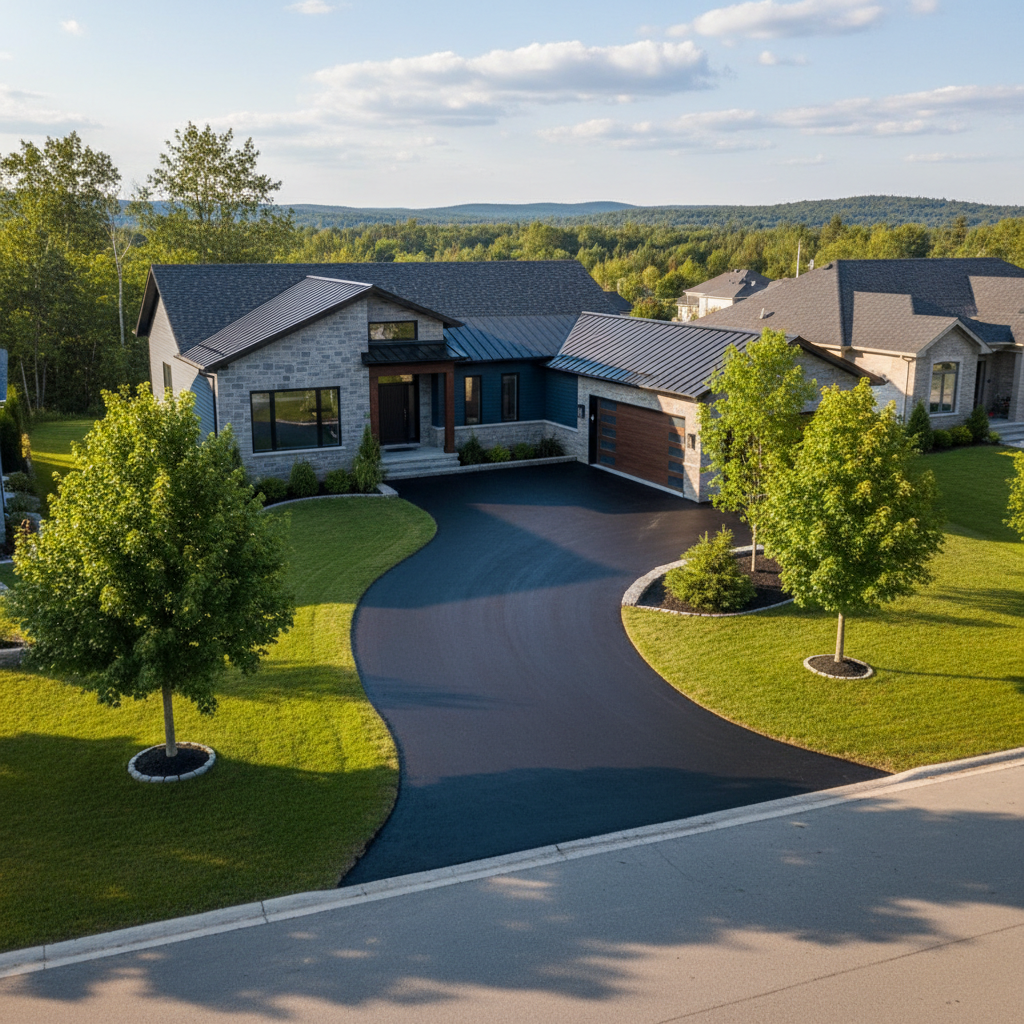
Driveway paving options and costs in Hinton
In Hinton, Alberta, the right driveway surface comes down to how you want to balance upfront cost, long-term maintenance, and winter durability. With most homes here being single-detached (55.6% of dwellings) and a large share of households owning their homes (71.8%), driveway projects are a steady part of the local paving workload—from neighbourhood infills to full rebuilds of older driveways. That’s especially true in areas like the West Hinton / Sifton Park belt, where many properties were developed decades ago and frost-affected subgrades show up as early cracking or soft spots.
In the Banff–Jasper–Rocky Mountain House corridor, pricing is shaped by frost depth and aggressive freeze–thaw cycles. Central and northern Alberta designs for deep frost penetration, so you can’t “pave over” weak material. You need deep, well-graded granular base, proper drainage, and tight compaction, which increases excavation and aggregate quantities. The paving season is also shorter—hot-mix asphalt typically requires air temperatures above 10°C—so scheduling pressure can add mobilisation and overtime costs when we’re working late in spring or trying to finish before cold nights arrive.
The sections below give realistic price bands you’ll see in Hinton and how each material performs when winter starts early. Use the table as a quick benchmark, then rely on an itemised quote for your actual footprint, base requirements, and any tear-out or drainage corrections.
| Material |
Lifespan |
Maintenance |
Best For |
Price per sq ft |
| Asphalt (new installation, proper base) |
15–25 years |
Seal coat every 3–5 years; patching as needed |
Best value for typical residential driveways |
$9 – $18 |
| Asphalt (overlay on existing gravel base) |
10–20 years |
Seal coat every 3–6 years; spot repairs if base shifts |
When your existing gravel is strong and well-drained |
$7 – $15 |
| Interlocking concrete pavers |
20–30+ years |
Re-leveling of occasional units; re-sanding lines |
Repairable surface with high curb appeal |
$18 – $45 |
| Poured concrete (broom finish) |
25–35 years |
Seal (often optional); crack monitoring and patching |
Low visual maintenance and clean snowplow lines |
$15 – $30 |
| Exposed aggregate concrete |
25–35 years |
Sealer as recommended; patching limited to affected areas |
Slip resistance and decorative look |
$18 – $35 |
| Gravel / crushed stone (budget option) |
3–10 years |
Frequent top-ups; regrading; weed control |
Temporary or lowest upfront cost |
$3 – $9 |
Prices are estimates only and vary by project scope, site access and material selection.
What affects the price of paving in Hinton
In Hinton and the wider Banff–Jasper–Rocky Mountain House region, you can see the same driveway “type” priced 30–50% differently between quotes. The biggest reasons are usually hidden until you look at the site: how much excavation is required for a stable frost-resistant base, whether drainage is being corrected, and what needs to be removed and hauled away. Even the same square footage can change price fast if your contractor has to slow down for narrow access, deal with buried utilities, or rebuild the base because the existing subgrade pumps fines during wet periods.
Frost line depth and freeze–thaw cycles are decisive cost factors here. Deeper frost means you need a thicker compacted granular base to prevent heaving and cracking, and that typically translates into 6–12 inches of granular thickness in Alberta-style designs. The paving season is also shorter—hot-mix asphalt usually requires air temperatures above 10°C—so jobs that require careful staging and time for curing can cost more when we’re stacking projects before cold weather returns.
Concrete examples from local projects: if your current driveway has ponding, drainage correction (regrading, swales, and sometimes subdrains) can push an asphalt job from a typical $9 – $18 band toward the upper end because the base becomes more than just “fill and compact.” If you’re tearing out old concrete, breaking and hauling can add labour and disposal costs; for asphalt overlays, the savings only hold if the existing base is stable. Also, older homes in Hinton—over half built before 1981—often sit on established grading that later drains poorly, which forces additional earthwork and raises the installed cost.
| Price Factor |
Why It Matters |
Cost Impact |
| Driveway area in sq ft |
Most material and production time scales directly with surface area |
Often the single biggest driver |
| Base depth required |
Frost line determines granular thickness to stop heaving and cracking |
Can add significant excavation and aggregate |
| Grading and drainage work |
Slope corrections prevent standing water that weakens the base |
Moderate to major cost increase if drainage must be rebuilt |
| Tear-out of existing surface |
Concrete/asphalt removal requires equipment, break-up, and hauling |
Can be a major add-on depending on thickness and volume |
| Edge restraints and curbing |
Prevents paver spreading and asphalt edge failure |
Adds labour and materials, but improves longevity |
| Sealing requirement |
Asphalt sealing helps protect binder from UV and winter moisture intrusion |
Small ongoing cost that reduces early deterioration |
| Site access |
Narrow driveways slow trucks and compaction equipment placement |
Can increase labour and mobilisation time |
| Asphalt mix specifications |
Freeze–thaw-rated mixes and proper compaction targets add material cost |
Often shifts cost toward the upper end of the band |
Permits & regulations in Alberta
In Alberta, most paving work on a private driveway within your own property typically does not require a building permit. For example, replacing asphalt or pavers on your driveway footprint (with no changes to municipal infrastructure) usually falls under routine private property work. That said, permits and approvals can be required when your project affects the municipal right-of-way or drainage system—this includes new or modified curb cuts, changes to boulevard profiles, alterations to storm drainage that direct water off-site, or any work that changes how runoff reaches municipal infrastructure.
In Hinton, start by confirming whether any portion of your driveway ties into municipal infrastructure. Then, plan utility locates before excavation. Alberta uses utility marking/locates via Alberta One-Call, and it’s smart to schedule locates even for “simple” base work because driveways commonly run near services like power, gas, or low-voltage lines.
Next, verify your contractor the way you would in any Alberta renovation: (1) check licensing through Alberta’s online contractor or trade registry where applicable; (2) request a current certificate of insurance for general liability; and (3) confirm WSIB/WCB coverage in writing. Ask for the clearance letter or proof of coverage, and ensure the certificate lists your job site or at least your municipality as an additional insured where required. A reputable crew will provide these documents without pressure.
Asphalt vs pavers vs concrete for Hinton driveways
Choosing between asphalt, interlocking concrete pavers, and concrete in Hinton is really about how you expect your driveway to perform through freeze–thaw cycles—and how much maintenance disruption you can tolerate. Asphalt is usually the lowest upfront cost, landing within the local driveway paving range of $9 – $18 per square foot, but it depends on sealing and correct drainage. In our climate, sealing every 3–5 years is a smart insurance policy, especially once spring moisture starts pushing through the binder. If base preparation is rushed, asphalt will show fatigue cracks and rutting faster because water finds the weak points during thaw.
Interlocking pavers cost more upfront (often within the $18 – $45 per square foot band), but they’re repairable without replacing the whole driveway. That matters when plowing, salt, and occasional base settlement create localized failures. Pavers also maintain curb appeal even when sections are lifted and rebuilt.
Poured concrete sits in between on cost and can be very durable, but freeze–thaw performance depends on proper air entrainment and curing, plus joints and drainage. Concrete that’s not air-entrained or that receives water at the edge can crack sooner, and de-icing practices can accelerate surface wear.
Real-world dollar sense: if you have an asphalt quote near $10–$14/sq ft but it’s based on a thin base or no drainage correction, the “savings” can disappear. For example, spending an extra $1,000–$2,000 on deeper base and proper slope may be worth far more than choosing pavers just to avoid maintenance—provided the base is built correctly for frost depth and the winter routine (plowing and sand/salt use) is managed.
| Material |
Frost Resistance |
Curb Appeal |
Repair Method |
Lifespan |
Price Band |
| Asphalt (sealed regularly) |
Good with deep granular base and drainage |
Mid (clean finish; upgrades possible with borders) |
Patch and re-seal; localized repairs |
15–25 years |
$9 – $18 |
| Interlocking concrete pavers |
Very good when bed/base is compacted and restrained |
High (varied patterns, crisp edges) |
Remove and replace affected units |
20–30+ years |
$18 – $45 |
| Poured concrete (air-entrained) |
Good when air-entrained and properly jointed |
Mid to high (surface finishes available) |
Crack repair and patching; slab interventions as needed |
25–35 years |
$15 – $30 |
| Exposed aggregate concrete |
Good when drainage and finishing are done correctly |
High (decorative and slip-resistant) |
Patch within affected areas where feasible |
25–35 years |
$18 – $35 |
| Permeable pavers (drainage grid) |
Very good by reducing water retention under surface |
High (clean modern look) |
Targeted unit replacement; manage infill and voids |
20–30 years (system-dependent) |
$22 – $50 |
| Chip seal / tar-and-chip |
Moderate; depends on stone embed and base stability |
Mid (textured look) |
Spot chip/aggregate replenishment |
6–15 years |
$8 – $15 |
How to choose a paving contractor in Hinton
When you hire a paving contractor in Hinton, verify the basics before you compare prices. First, ask for proof of Alberta licensing where applicable to the work being performed (and confirm it matches the contractor name on the quote). Second, request liability insurance and confirm the certificate is current. Third, make sure they have WSIB/WCB coverage—ask for the clearance letter or proof of coverage in writing and keep it with your contract documents. If a contractor won’t provide documentation promptly, move on.
For pricing, ask for 2–3 itemised written quotes rather than lump sums. You want to see a labour/material breakdown that covers excavation, granular base, compaction, asphalt or paver supply, top course thickness, edge restraints, drainage corrections, and disposal/tipping fees. Pay attention to what’s excluded: permit pull (if any), utility locates, snow removal during mobilisation, and surface restoration around fences or landscaping should be spelled out. Also confirm the warranty terms—workmanship warranty length, the product/manufacturer warranty, and whether it’s transferable to future owners.
Payment matters: don’t pay more than 10–15% upfront. Use a holdback until the job is complete and you’ve reviewed compaction and line/grade. Get a written start date and a realistic completion window that accounts for Hinton’s early cold snaps and the need to cure asphalt in suitable weather.
- Check Alberta licensing documents match the contractor name on the contract.
- Verify general liability insurance is current and covers your project.
- Confirm WSIB/WCB coverage with clearance/proof documentation.
- Request an itemised quote (excavation, base, drainage, surfacing, disposal).
- Ask what base depth and granular type they’re installing for frost protection.
- Confirm edge restraints/curbing are included (especially for pavers).
- Clarify whether utility locates are included or your responsibility.
- Verify slope and drainage are addressed—no ponding at the garage door.
- Ask about asphalt mix design and targets for compaction.
- Get the warranty in writing (workmanship and product, plus transferability).
- Set a payment schedule with 10–15% maximum deposit and holdback.
- Get start date and completion estimate in writing with weather contingencies.
In Hinton, red flags I’ve seen include: quotes that ignore drainage corrections, promises of paving regardless of temperature/curing requirements, “thin base” assumptions to cut price, missing insurance/WSIB/WCB proof, and contracts that don’t specify disposal/tipping, compaction standards, or warranty coverage details.
Frequently asked questions — paving in Hinton
How long before I can drive on new asphalt?
Typically, you can drive on most new asphalt within 24–48 hours, but the exact timing depends on weather and mix temperature. In Hinton, we plan around cooler nights and early shoulder-season cold—so if daytime temperatures drop quickly, curing can take longer. Your contractor should specify when the surface is safe for light vehicle traffic and when it’s fully ready for normal use. If any areas were patched or if the paving was done late in the season, expect more cautious turnaround. If you’re budget-conscious, it’s still usually better to schedule paving for stable weather than to rush and risk tracking or premature wear. For long-term protection, plan sealing later—many owners budget around a sealing/repair range of $300 – $1,200 depending on driveway size and condition.
What causes potholes and how are they repaired?
Potholes in Hinton are usually the result of water getting into the base—then expanding and contracting through freeze–thaw cycles. When moisture softens the subgrade, the asphalt loses support and the surface breaks down under traffic and plowing vibrations. Common causes include poor drainage, areas with low spots, or base that was under-compacted or too thin for frost protection. Repairs are most effective when contractors remove the failing asphalt back to solid material, correct the base (add granular and compact), then replace the asphalt in a proper patch area. If the potholes keep returning in the same zone, it’s often a base/drainage problem rather than a surface-only issue. That’s why itemised quotes should include grading and drainage corrections, not just patch asphalt.
How do I prepare for a paving project?
Preparation is mostly about access and site readiness. Clear vehicles, trailers, and boats from the driveway area well ahead of the scheduled start. If you have landscaping, tell your contractor where you want protection or removal done, and keep sprinklers turned off so the subgrade isn’t saturated before excavation. Before work begins, ensure utility locates are complete for your lot—your contractor should coordinate this in advance of digging. Also think about snow management if the season is tight in Hinton; late-spring work may require faster staging so base and paving happen within workable temperatures (hot-mix asphalt generally needs warmer conditions, typically above 10°C). Finally, review the contract scope: disposal/tipping, edge restoration, and whether any aprons or boulevard connections are included.
How do I compare paving quotes fairly?
To compare quotes fairly in Hinton, don’t start with price per square foot alone—start with scope. Ask whether each quote includes the same base depth and granular specification for frost protection, and whether drainage grading corrections are included. Confirm whether tear-out is priced the same way (concrete/asphalt removal and hauling), and whether edge restraints are included for pavers or whether asphalt includes the right thickness and compaction targets. Look for included items like utility locates, disposal/tipping fees, and site access allowances. Also compare warranty terms: workmanship length and whether product/manufacturer coverage applies. A low quote can be expensive later if it skips drainage or uses a thinner base. Price bands like $9 – $18 for asphalt or $18 – $45 for pavers help, but only when the underlying scope is truly comparable.
Can asphalt be laid in cold weather in Hinton?
Asphalt placement in cold weather is limited. Hot-mix asphalt typically needs adequate air temperatures (often above 10°C) and good conditions for spreading and compaction so the mix cures properly. In Hinton, cold nights arrive earlier than many homeowners expect, and you can end up with problems like poor bonding, weak compaction, or surface cooling before the mix reaches the right density. A good contractor will plan around the weather window, coordinate staging, and sometimes schedule base work in a way that brings paving forward into workable conditions. If a contractor tells you they can pave anytime in the season without discussing temperature and curing, that’s a major red flag. If you’re trying to fit into the season, focus on getting base and drainage ready so paving can happen when conditions meet the mix requirements.
What is a driveway apron and do I need one in Hinton?
A driveway apron is the transition area—often at the edge where your driveway meets the street or boulevard—built to blend the driveway surface with the adjoining road works and maintain smooth drainage. In Hinton, whether you need an apron depends on your connection point: if your driveway ties into a curb cut area, changes how stormwater flows, or requires an interface with municipal right-of-way, it may require municipal approval and may be treated as more than “just paving your driveway.” Typically, if you’re only repaving within your private lot line, you may not need a formal apron. But if you’re adjusting grade, changing the curb cut, or rebuilding the drainage approach, you should plan for it and ask your contractor to spell it out in the scope. A correctly built apron helps reduce edge failures from freeze–thaw and plow impacts.