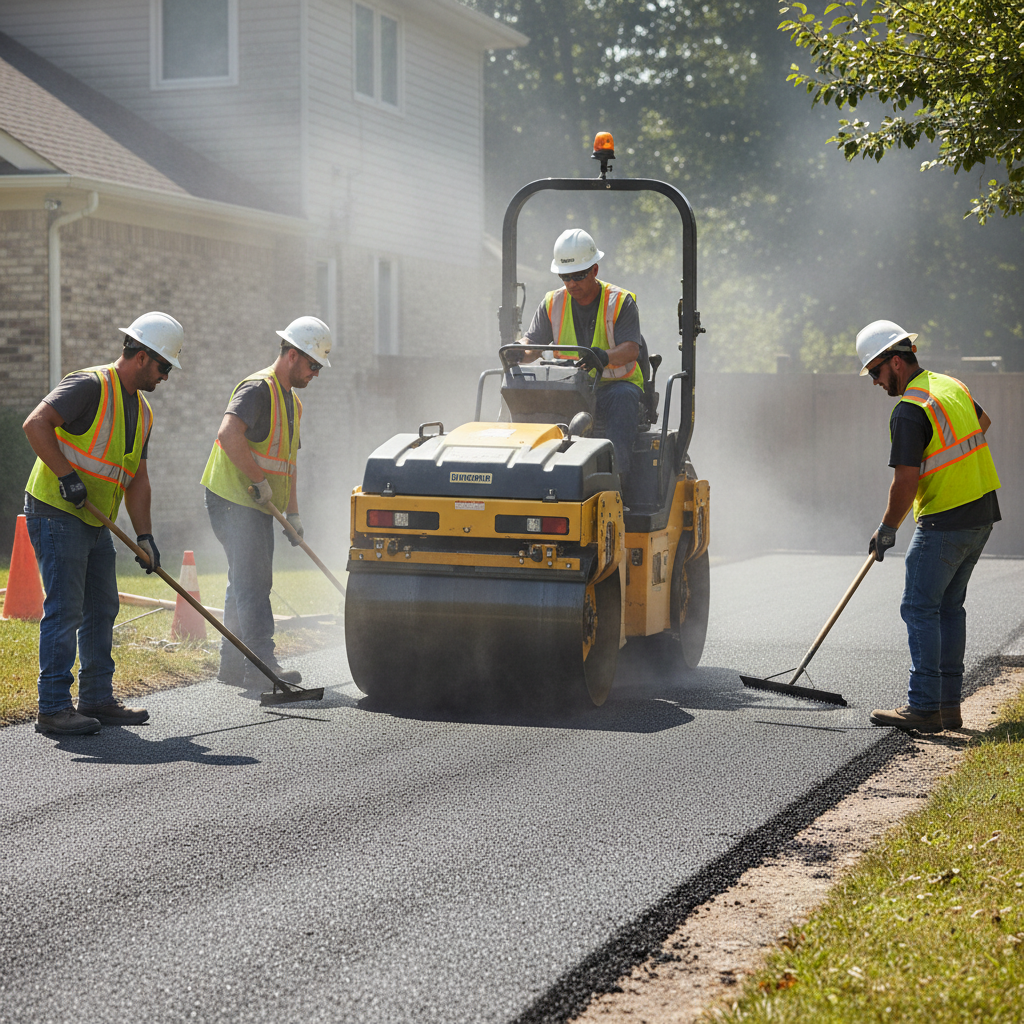
Driveway paving options and costs in West Hillhurst
In West Hillhurst, Alberta, choosing a driveway material is more than picking a look—it’s picking a system that can handle our cold continental winters, repeated freeze–thaw movement, and the way Calgary-area winters beat up edges. With West Hillhurst’s population at 6,635 (Statistics Canada, 2021 Census), there’s steady demand from homeowners and older neighbourhood streets where many driveways were originally built for lighter loads and shallower bases. Most private driveways here are associated with detached homes, so crews are commonly working around established landscaping, mature trees, and tight turning lanes that affect staging and disposal.
Calgary pricing also reflects a compressed paving season. Hot-mix asphalt typically needs air temperatures above about 10°C to place and compact properly, so late-spring and summer scheduling can tighten and push labour and equipment rates upward. On top of that, frost commonly penetrates deeply (around 1.2 m / 4 ft), so “cheap” paving that skips granular depth, compaction, and drainage details tends to fail early—often as raveling, cracking, and minor heaving that turns into bigger repairs.
Near well-travelled pockets like the 10 Avenue corridor, contractors are especially busy because residents want clean, plow-friendly surfaces before deep winter. Use the comparison below to estimate which option fits your budget and how much lifecycle maintenance you’re willing to plan for, then match it to your base and drainage needs.
| Material |
Lifespan |
Maintenance |
Best For |
Price per sq ft |
| Asphalt (new installation, proper base) |
15–20 years |
Sealcoat every 3–5 years; spot crack repair as needed |
Most common choice for cost-conscious homes |
$12 – $20 |
| Asphalt (overlay on existing gravel base) |
10–15 years |
More frequent patching; sealing still recommended |
When you want a faster, lower-impact upgrade |
$10 – $16 |
| Interlocking concrete pavers |
20–30 years |
Routinely keep joints clean; re-sand joints; replace individual stones if needed |
Curb appeal and “repairable” driveways |
$18 – $30 |
| Poured concrete (broom finish) |
25–30 years |
Limited maintenance; sealing optional depending on traffic and salts |
Low visual fuss and consistent surface |
$15 – $25 |
| Exposed aggregate concrete |
25–35 years |
Occasional cleaning; sealing often used for staining resistance |
Better texture/grip and upscale curb presence |
$18 – $32 |
| Gravel / crushed stone (budget option) |
3–7 years (varies widely by drainage) |
Re-grade and top up every season; weed control; more frequent edge reinforcement |
Temporary solution or low-budget access |
$5 – $10 |
Prices are estimates only and vary by project scope, site access and material selection.
What affects the price of paving in West Hillhurst
In West Hillhurst and the broader Calgary market, two quotes for what looks like the same driveway can differ by 30–50% because the “hidden work” varies—base thickness, drainage corrections, tear-out volume, and edge restraint are what drive real cost. A contractor quoting only surface material without detailing the granular and compaction plan is usually betting that the subgrade will behave. In our climate, it often doesn’t.
Frost line depth and freeze–thaw cycles are decisive cost factors in this region. When frost penetrates to roughly 1.2 m (4 ft), water in the subgrade and marginal base can expand as it freezes. That subgrade movement is what causes heaving, cracking, and surface raveling. To reduce that risk, proper projects in Calgary typically use deeper, well-graded granular bases and ensure positive drainage. That means more excavation, more crushed stone, more compaction passes, and more careful edge support—especially if your driveway slopes toward a garage corner or downspout line.
The paving season is also shorter here: hot-mix asphalt needs conditions warm enough for placement and compaction, so demand spikes late spring through early fall. That scheduling pressure can raise labour and equipment costs, particularly for smaller jobs that don’t share crew time with larger sites.
Concrete costs can shift based on reinforcement and air-entrainment quality for freeze–thaw. For example, a broom-finished poured slab may land in the $15 – $25 range, but adding thicker base preparation and proper reinforcement for a driveway that’s near a downspout or suffers standing water can push the real project toward the upper end. Similarly, asphalt near the $12 – $20 range can become more expensive if you require a full tear-out of existing asphalt and unstable gravel, rather than a straightforward overlay.
| Price Factor |
Why It Matters |
Cost Impact |
| Driveway area in sq ft |
Most materials and labour scale with square footage |
High (often the biggest single driver) |
| Base depth required |
Frost requires thicker, well-compacted granular layers to prevent heaving |
High; deeper excavation increases material and machine time |
| Grading and drainage work |
Proper slope and outlet locations reduce water pooling and freeze damage |
Medium to high, depending on how much correction is needed |
| Tear-out of existing surface |
Breaking, hauling and disposal add labour and equipment time |
Medium to high; can meaningfully swing total price |
| Edge restraints and curbing |
Prevents paver/aggregate spread and asphalt edge creep under plowing |
Medium; small items with large impact on longevity |
| Sealing requirement |
Asphalt needs sealcoat to protect against water and oxidation |
Lower upfront, but adds lifecycle cost for asphalt owners |
| Site access |
Narrow lots slow equipment movement and may require more labour to stage materials |
Medium; worst-case becomes high on tight sites |
| Asphalt mix specifications |
Freeze–thaw-rated mixes and correct binder help asphalt resist cracking and raveling |
Medium; better mix increases material cost but reduces early failures |
Permits & regulations in Alberta
In Alberta, paving a private driveway within your own property typically does not require a building permit. The usual exception is any work that impacts the municipal right-of-way (the area between your property line and the street), including new curb cuts, changes to boulevard grading, or alterations to storm drainage that affect how runoff is handled. If your driveway apron ties into a city sidewalk, curb, or any drainage infrastructure, you should expect municipal approval requirements.
Some municipalities also maintain lot-grading expectations (or bylaws) that restrict how close a hard surface can be to property lines and how water must be directed. Before work begins, it’s smart to confirm lot-grading rules with the municipality—especially in older neighbourhoods of West Hillhurst where lot drainage patterns may not match today’s downspout placement.
Also, always call for utility locates (Alberta One-Call) before excavation. A good contractor will schedule locates and mark all known services before any base removal.
To verify your contractor in West Hillhurst, check three things step-by-step: (1) their Alberta business profile/licensing details via online provincial registries or their trade credentials (the contractor should clearly identify the legal entity doing the work); (2) liability insurance—request a certificate of insurance showing adequate coverage and the project address; and (3) WSIB/WCB coverage—ask for a clearance letter or proof of coverage that matches the work being performed. If they can’t provide documents promptly, that’s a red flag.
Asphalt vs pavers vs concrete for West Hillhurst driveways
In West Hillhurst, Alberta’s freeze–thaw winters reward driveways that have the right base depth, edge stability, and drainage. Asphalt is usually the lowest upfront option, but it’s not “set and forget”: it needs sealcoating every 3–5 years to protect from oxidation and water intrusion. With the deep frost we see in the Calgary area, asphalt that isn’t sealed and maintained tends to let moisture into joints and micro-cracks, which accelerates deterioration under plowing and salted traffic routes.
Interlocking concrete pavers cost more up front, but they handle freeze–thaw well because individual units can be lifted and reset if settlement or a localized problem occurs. That repair flexibility matters in neighbourhoods where downspouts or seasonal saturation create “wet spots” you only find after a few winters. Pavers also deliver top curb appeal, which is a common homeowner priority along busier West Hillhurst streets where driveways are highly visible.
Poured concrete often sits mid-range: it can look clean and last a long time, but it needs correct air-entrainment and good curing, plus a well-prepared base to reduce cracking from frost movement and de-icing salts. For many homes, concrete base preparation can be as important as the surface itself.
To see how price differences can be justified: if asphalt lands around $12 – $20 per sq ft but your site has recurring drainage issues, the extra $ for better excavation and base may still outperform “cheap asphalt” that fails early. Likewise, pavers in the $18 – $30 range can be worth it when you want long-term aesthetics and easy repairs rather than replacing the whole surface after a localized failure.
| Material |
Frost Resistance |
Curb Appeal |
Repair Method |
Lifespan |
Price Band |
| Asphalt (sealed regularly) |
Good with proper base and sealing; sensitive to water intrusion |
Low to moderate |
Patch the affected area; seal after |
15–20 years |
$12 – $20 |
| Interlocking concrete pavers |
Very good; can accommodate minor movement with joint sand |
High |
Lift and replace individual pavers; re-sand joints |
20–30 years |
$18 – $30 |
| Poured concrete (air-entrained) |
Good if air-entrained and properly based; cracking can occur if subgrade is unstable |
Moderate to high |
Limited patching; larger issues may require section removal |
25–30 years |
$15 – $25 |
| Exposed aggregate concrete |
Good to very good with correct base and sealing |
Very high |
Patch/grind localized areas; may be harder to match finish |
25–35 years |
$18 – $32 |
| Permeable pavers (drainage grid) |
Very good where drainage design is correct |
High (modern look) |
Replace sections if grid or base layer fails; maintain surface permeability |
20–30 years (design-dependent) |
$20 – $36 |
| Chip seal / tar-and-chip |
Moderate; surface wears and needs periodic maintenance |
Low to moderate |
Spot repairs; re-seal treatments over time |
8–15 years |
$9 – $15 |
How to choose a paving contractor in West Hillhurst
Choosing the right contractor in West Hillhurst is mostly about proof and process, not just price. Start with Alberta licence/business verification: confirm the legal entity matches the quote and look for the contractor’s trade credentials where applicable. Next, verify liability insurance—ask for a current certificate of insurance naming your project address or showing coverage appropriate for paving/excavation work. For worker coverage, request proof of WSIB/WCB (often provided as a clearance letter or coverage documentation). If a contractor won’t provide documentation, you’re taking on unnecessary risk.
Then get 2–3 itemised written quotes—not lump sums. Ask for a breakdown showing labour, base preparation, drainage/grading, removal and disposal, and the specific surface type (including any sealcoat plan for asphalt). Read exclusions carefully: confirm whether permits (if required) are included, whether saw-cutting is included, and who handles disposal and hauling. For homeowners, the difference between a quote that includes proper granular base versus one that assumes “existing base is fine” often explains 30–50% swings.
Warranty should be in writing: workmanship warranty length, product/manufacturer warranty coverage, and whether the warranty transfers to future owners. For payment, never pay more than 10–15% upfront; use progress payments and a holdback until completion and cleanup are done. Finally, get the start date and completion estimate in writing, because Calgary’s short season can shift schedules when weather or crew availability changes.
- Ask for Alberta licence/business details that match the quote paperwork.
- Request a certificate of insurance before signing.
- Provide WSIB/WCB proof (clearance letter or equivalent).
- Get 2–3 itemised quotes with line-by-line base, grading, and disposal costs.
- Confirm whether utility locates are included and who pays.
- Insist the scope states base thickness targets and compaction requirements.
- Verify drainage plan: slope, outlets, and how water will be directed.
- Clarify tear-out scope (depth) and disposal/hauling responsibilities.
- Confirm edge restraints/curbing details (especially for pavers).
- For asphalt, ensure sealcoat timing is included (often after 6–12 months).
- Write down warranty terms for workmanship and product supply.
- Use a payment schedule with a holdback until final inspection and cleanup.
Red flags we often see in West Hillhurst: contractors who won’t discuss base depth or compaction methods, quotes that omit drainage or edge restraint details, “too-good-to-be-true” pricing that assumes no tear-out, no written scope/warranty terms, and crews asking for large upfront payments before measurements and locates are done.
Frequently asked questions — paving in West Hillhurst
How do I maintain my driveway through West Hillhurst winters?
For West Hillhurst and the broader Alberta freeze–thaw cycle, your goal is to reduce water infiltration and avoid mechanical stress on weak edges. Keep the driveway clear of loose snow so meltwater doesn’t sit in shallow depressions; if you can, use a blade set slightly above the surface on plowing to prevent ripping. Sand is usually safer than repeated salt flooding for asphalt, because salts can accelerate surface degradation when water gets into micro-cracks. For asphalt, plan crack filling as soon as you notice gaps and keep up with sealcoat schedules—typically every 3–5 years. If you have pavers, keep joints topped with proper joint sand so freeze expansion doesn’t create gaps. In all cases, avoid hot water for de-icing.
Is it worth sealing a new driveway right away in West Hillhurst?
In most Alberta installs, sealing immediately “after paving” is not ideal. Fresh asphalt needs time to cool, cure, and lose excess moisture, otherwise sealcoats can trap water and reduce adhesion. For homeowners in West Hillhurst, a common best practice is waiting until the asphalt is sufficiently cured—often around 6–12 months—then applying sealcoat as part of the lifecycle plan. That timing helps protect the surface from oxidation and water intrusion during our deep winter freeze cycles (frost commonly reaches about 1.2 m / 4 ft region-wide). If your contractor quoted asphalt in the $12 – $20 per sq ft band, ask whether the quote includes sealcoat timing and what products they’ll use. A well-timed sealcoat is one of the most cost-effective ways to extend asphalt service life.
What is a chip seal driveway and is it suited to West Hillhurst?
Chip seal (tar-and-chip) is a sprayed binder covered with aggregate. It can be a practical budget surface, but it’s generally less “premium” than asphalt paving or concrete and tends to need more ongoing maintenance in heavy winter conditions. In West Hillhurst, it can work on certain driveways where speeds are low and the base is built correctly for frost movement, but you should expect periodic aggregate replenishment and spot repairs after plowing and freeze–thaw. Compared with full asphalt paving in the $12 – $20 per sq ft band, chip seal usually comes in lower—often in the $9 – $15 range—but the lifecycle cost is more variable. If your site has drainage challenges or standing water, chip seal can show wear faster because moisture management is critical.
How much does driveway crack repair cost in West Hillhurst?
Crack repair cost depends on crack width, length, whether it’s isolated or part of widespread cracking, and how much prep is required. In practice, small crack sealing or patching is typically a manageable, targeted repair, while structural failures caused by weak base or poor drainage may require larger patch areas—or even a section rebuild. As a homeowner budgeting guide, think of crack repair as part of asphalt maintenance rather than a one-time fix, especially under Alberta freeze–thaw. For repair and sealing work, homeowners often see projects land in the $400 – $1,500 range depending on scope, access, and how many areas need attention. The best way to confirm your number is a site visit where the contractor identifies whether cracks are “surface only” or moving due to subgrade movement.
What base thickness do I need for pavers in West Hillhurst?
For pavers in West Hillhurst, base thickness is driven by frost movement and drainage. Because frost penetration in our region can reach about 1.2 m (4 ft), the key is not just “how thick is the base,” but also that it’s well-graded, compacted, and drained so water doesn’t remain in the construction layers. Many Calgary-area driveway installs aim for deeper granular base than you’d see in milder climates, and then add a bedding layer designed for paver setting. If your site is prone to standing water, expect the contractor to specify thicker excavation and possibly drainage corrections before laying pavers. A precise target depends on your existing subgrade condition, soil type, and how water currently behaves after rain. Ask your contractor to state the total thicknesses they’ll build to and how they’ll compact each lift.
How do I get the most accurate paving quote in West Hillhurst?
To get an accurate quote in West Hillhurst, insist on a site measurement and an itemised scope that includes base, grading, drainage, and tear-out/disposal. Provide photos of your driveway in spring melt conditions, and mention any spots that pond or remain damp after rain—those details often change excavation depth and base requirements. When you request quotes, ask for a breakdown (labour + materials) rather than a lump sum, and confirm whether disposal and haul-away are included. For asphalt, ask about the sealing plan and timing (often 6–12 months) so you can compare apples to apples with other bids. If your quotes fall within common market expectations, asphalt often lands around the $12 – $20 per sq ft band, with pavers and concrete typically higher depending on finish. Finally, verify the contractor’s insurance and WSIB/WCB documents before work starts.