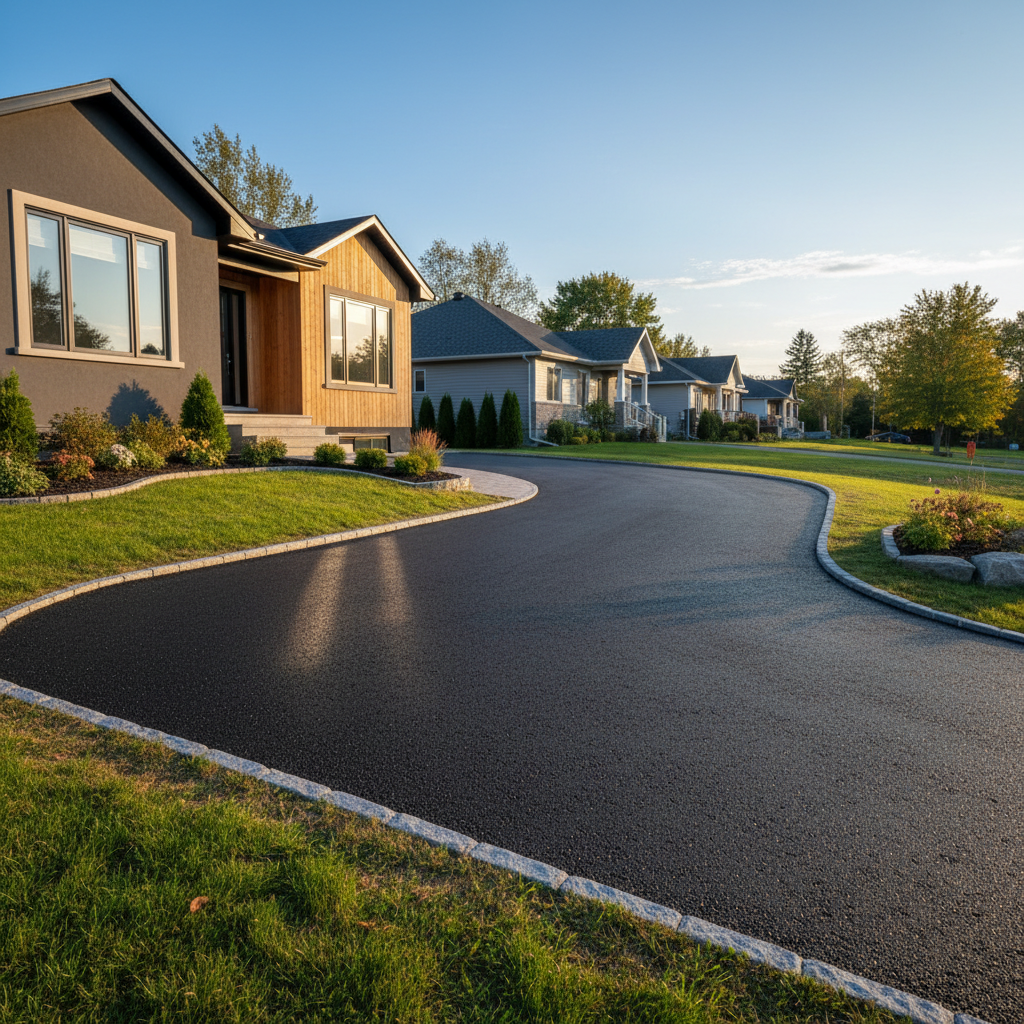
Driveway paving options and costs in Wembley
Driveway paving in Wembley, Alberta is a practical upgrade for the many single-detached homes that dominate the housing stock—about 80.0% of dwellings in the area are detached (Statistics Canada, 2021 Census). With roughly 465 homeowner households in Wembley, there’s a steady local demand for dependable surfaces that can handle long freeze–thaw cycles and spring soft ground. Many homes were also built before 1981 (46.4% of dwellings), which matters because older grades, weaker approach slabs, or long-settled gravel bases often need more preparation before any new asphalt, pavers, or concrete will perform well.
In the Athabasca–Grande Prairie–Peace River economic region, frost penetration commonly exceeds 1 m and can approach 1.5–2 m in harsher locations. That pushes contractors toward thicker, well-compacted granular base layers, better edge restraint, and drainage that keeps meltwater from re-entering the pavement structure. The freeze–thaw season is long, so the actual paving window is tight (mid-May to September), which can increase scheduling pressure and mobilization costs. On top of that, fine-grained subgrades (clays and silts) are prone to frost action, so undercutting or stabilization is sometimes required before paving or concrete placement.
In Wembley, driveway work is especially busy around the residential core near main local access routes where longer winter tire traffic and plowing turn marginal bases into potholes and cracks faster. The next step is comparing typical material choices side-by-side using the price bands homeowners usually receive for a properly built system.
| Material |
Lifespan |
Maintenance |
Best For |
Price per sq ft |
Price Range |
| Asphalt (new installation, proper base) |
15–25 years |
Seal every 3–5 years; spot patch as needed |
Most homeowners wanting best value with a smooth ride |
$7.50–$12.50 |
$6,500–$12,000 |
| Asphalt (overlay on existing gravel base) |
10–18 years (depends on base condition) |
Seal every 3–5 years; patch lifted areas quickly |
When the existing base is stable and properly graded |
$6.50–$10.50 |
$5,800–$10,500 |
| Interlocking concrete pavers |
25+ years |
Re-sand joints as needed; replace individual stones |
High curb appeal and easy, local repairs |
$11.00–$18.00 |
$9,000–$18,000 |
| Poured concrete (broom finish) |
20–30 years (air-entrained) |
Caulk/control joints review; occasional patching |
Long-term durability and low annual maintenance |
$10.00–$16.00 |
$8,000–$16,000 |
| Exposed aggregate concrete |
20–30 years |
Sealer as directed; patch spalls promptly |
Slip-resistant finish and premium look |
$12.00–$18.50 |
$9,500–$17,500 |
| Gravel / crushed stone (budget option) |
3–7 years before major regrading |
Top-up annually; regrade 1–2 times over time |
Lower upfront cost while you plan a full build |
$3.00–$6.00 |
$2,500–$6,500 |
Prices are estimates only and vary by project scope, site access and material selection.
What affects the price of paving in Wembley
Homeowners in Wembley can see driveway paving quotes swing by 30–50% for what looks like the “same” job on paper. The biggest reason is that the lowest bid often assumes an easier subgrade. In the Athabasca–Grande Prairie–Peace River region, deeper frost susceptibility and a long freeze–thaw season mean contractors must design for heaving control: thicker compacted granular base, careful grading, and drainage that routes water away from the pavement structure. If the quote doesn’t include proper base depth or the right aggregate gradation, you may end up paying again sooner through edge breakdown, rutting, or early cracking.
Frost depth is decisive. Deeper frost typically requires more granular thickness (often 6–12 inches in many parts of Alberta for paved driveways, versus thinner sections in milder or coastal areas), so material and compaction labour increase. Asphalt also has its own temperature limitations—hot-mix asphalt placement generally needs air conditions above about 10°C—so the paving season is tighter. That concentrates demand and scheduling pressure into mid-May–September, which can raise mobilization costs and overtime for crews. Mix design also matters: freeze–thaw rated asphalt is a real spec, and it can cost more than generic mixes.
Concrete pricing can jump in Wembley when the scope includes undercutting poor soils under older approaches, or when additional reinforcement and control joints are required to handle movement. Conversely, costs can be lower when the existing base is stable and well-drained (for example, a well-graded gravel pad with positive slope to the side ditch). If you’re comparing options, asphalt commonly lands in the $6,500–$12,000 range, while pavers typically trend higher at $9,000–$18,000 once proper edging, bedding sand, and restraint are included.
| Price Factor |
Why It Matters |
Cost Impact |
| Driveway area in sq ft |
Every material and most labour scale directly with area |
Often the #1 driver of the total quote |
| Base depth required |
Frost line depth and subgrade type determine granular thickness |
More excavation, more aggregate, and more compaction time |
| Grading and drainage work |
Positive slope and water routing prevent freeze–thaw cycling |
Can add trucking, regrading labour, and sometimes underdrains |
| Tear-out of existing surface |
Breaking/hauling concrete or removing old asphalt can be labour-heavy |
Higher disposal and equipment time, especially on thick slabs |
| Edge restraints and curbing |
Prevents lateral spread, especially for pavers |
Extra materials and formwork/anchors |
| Sealing requirement |
Asphalt performance depends on sealing after curing |
Adds a future cost; some contractors bundle it in Year 1 |
| Site access |
Narrow approaches slow equipment movement and can increase labour hours |
Longer setup time and more manual handling |
| Asphalt mix specifications |
Freeze–thaw rated mixes better resist cracking and raveling |
May increase material cost but reduce premature failure |
Permits & regulations in Alberta
In Alberta, paving a private driveway on your own property typically doesn’t require a building permit when you’re simply upgrading the surface and not changing how stormwater leaves the site. Most driveway resurfacing (like new asphalt, overlays where allowed, paver installs, or replacing an existing slab) is treated as private property work and is usually handled under the contractor’s standard compliance and your property access rules.
Where approvals can be required is when the work affects the municipal right-of-way or includes changes to drainage infrastructure. Examples that generally do require municipal approval include: creating or widening a new curb cut/driveway access from the street, altering boulevard grading, changing catch basins or storm drainage connections, or making any modifications within the right-of-way. Some properties also have lot-grading rules that restrict how close to property lines you can place hard surfacing and how water must be directed.
Before any excavation in Wembley, always require utility locates through Alberta One-Call (and confirm the contractor’s locate ticket is in place). Then, verify your contractor in a clear order: (1) confirm they are properly licensed for their work scope (and ask for proof in writing), (2) request a certificate of liability insurance naming you as additional insured where applicable, and (3) ask for their WCB/WSIB coverage clearance or account information. Step-by-step, insist they provide these documents before you sign an agreement, not after.
Asphalt vs pavers vs concrete for Wembley driveways
In Wembley, the choice between asphalt, interlocking pavers, and concrete comes down to freeze–thaw resilience, how often you want to do maintenance, and how the driveway behaves under plowing, winter sand, and occasional salt. Asphalt is usually the lowest upfront option and can be very smooth when built on a proper base, but it needs sealing every 3–5 years to protect the surface binder from moisture and air voids. Interlocking concrete pavers cost more up front, yet they’re the most forgiving if a section shifts—individual units can be lifted, re-leveled, and reset without tearing up the whole driveway. Poured concrete sits in the middle on upfront cost, but it needs air entrainment and correctly planned control joints to manage movement; otherwise, freeze–thaw can lead to cracking that won’t be fixed “cheaply.”
Given frost conditions across the Athabasca–Grande Prairie–Peace River region, all three options need strong drainage and a deeper granular base to reduce heaving risk. In practice, that means thicker, well-compacted layers and a clear water-shedding slope—especially at the approach and at the driveway edges where meltwater often collects. For winter maintenance routines in Wembley, pavers typically hold up best to repeated plow contact because repairs are local and fast. Asphalt can perform well too, but edges and seal timing are critical. Concrete can last decades when properly designed, but a bad base or poorly formed joints can turn into visible cracking faster than homeowners expect.
Where does the price difference make sense? If your asphalt bid lands near $6,500–$12,000 and pavers come in near $9,000–$18,000, the extra cost is often justified when you want premium curb appeal and you’re worried about future base settlement or you anticipate regrading at the driveway edges. If your site is straightforward and drainage is excellent, asphalt may be the most cost-effective “right now” choice.
| Material |
Frost Resistance |
Curb Appeal |
Repair Method |
Lifespan |
Price Band |
| Asphalt (sealed regularly) |
Good with proper base + drainage + sealing |
Medium (clean, uniform finish) |
Remove/patch localized areas; re-seal section |
15–25 years |
$6,500–$12,000 |
| Interlocking concrete pavers |
Very good; movement is manageable with flexible joints |
High (varied patterns/colours) |
Lift, re-bed, and replace individual pavers |
25+ years |
$9,000–$18,000 |
| Poured concrete (air-entrained) |
Good when air-entrained and joints are correct |
Medium to high (clean broom finish) |
Patch spalls/cracks; sometimes sectional replacement |
20–30 years |
$8,000–$16,000 |
| Exposed aggregate concrete |
Good when properly cured and sealed if needed |
Very high (textured, premium look) |
Patch with matching finish; may need larger panels |
20–30 years |
$9,500–$17,500 |
| Permeable pavers (drainage grid) |
Excellent at reducing water cycling under the surface |
High (architectural look) |
Replace affected paver units; clean/rejuvenate system |
25+ years (system-dependent) |
$12,000–$22,000 |
| Chip seal / tar-and-chip |
Fair to good; surface wears and needs rework |
Low to medium (functional) |
Re-chip/re-surface; targeted patching |
7–12 years |
$5,000–$9,000 |
How to choose a paving contractor in Wembley
Choosing the right contractor in Wembley matters because the “paving system” (base, drainage, and placement timing) is what resists frost heave—not just the surface material. Start by verifying the contractor’s Alberta coverage. Ask for their certificate of liability insurance (and confirm the coverage limits are reasonable for driveway work), and request their WCB/WCB clearance or account information so you’re not left exposed if someone is injured on your site. For licensing, ask what category applies to their specific scope and verify it through the appropriate provincial registry or by requesting their licensing number and proof.
Next, get 2–3 itemised written quotes rather than one lump sum. You want a line-by-line breakdown showing labour and materials: excavation/undercutting amounts, granular base thickness, aggregate type, compaction procedures, asphalt mix type (including freeze–thaw suitability), bedding sand for pavers, edge restraints, and any drainage corrections. Confirm what’s excluded—common exclusions include hauling/disposal of unsuitable soils, repairs to tie-ins near sidewalks, or additional base depth if the subgrade is worse than expected.
Warranty should be clear and in writing: separate workmanship warranty (often 1–3 years depending on product) versus any manufacturer warranty on materials. Ask whether it’s transferable if you sell your home. For payment, never pay more than 10–15% upfront; hold back a portion until grading is complete and the surface is accepted. Finally, insist on a written timeline with a start date window and completion estimate. In northern Alberta’s short paving window, a well-planned crew schedule is part of the quality.
- Ask for their Alberta licence/registration number and confirm it before work starts.
- Request a current certificate of liability insurance (and verify effective dates).
- Confirm WCB coverage with a clearance letter or account proof.
- Get 2–3 itemised quotes (base thickness, materials, disposal, and compaction notes).
- Require explicit scope for tear-out, hauling, and disposal of removed material.
- Ask how they will handle soft or frost-susceptible subgrade (undercut vs stabilization).
- Verify drainage details: slope targets, ditch tie-ins, and any drainage pipes if needed.
- For asphalt, confirm seal timing (and whether Year 1 sealing is recommended or included).
- For pavers, confirm edge restraints, bedding sand thickness, and joint sand plan.
- For concrete, require air-entrainment and specify joint/control joint spacing approach.
- Review warranty length, what it covers, and how to make a claim.
- Use a payment schedule with limited upfront deposit and holdback until completion.
Red flags I’d take seriously in Wembley: a contractor who won’t provide insurance/WCB documents; quotes that don’t state base depth or drainage slope targets; “lowest price” bids that skip undercutting when subgrade is soft; no written timeline for the short paving season; and vague warranty language that only covers materials or excludes workmanship.
Frequently asked questions — paving in Wembley
How much does driveway crack repair cost in Wembley?
In Wembley, crack repair pricing depends on whether it’s a hairline asphalt crack, a working crack at the driveway edge, or a problem caused by weak base/frost movement. For many asphalt driveways, homeowners typically spend in the $500–$3,500 range for a repair and sealing package—this can include cleaning, tack coat, crack filling or patching, and then sealing to blend the area. If the crack is simply surface-level, costs stay closer to the lower end. If the crack is repeating or accompanied by edge drop/rutting, the contractor may need a deeper patch or localized re-base, which increases labour and aggregate costs. Because freeze–thaw cycles are severe in this Athabasca–Grande Prairie–Peace River frost-susceptible zone, the best repairs address the cause (drainage and base support), not just the crack surface.
What base thickness do I need for pavers in Wembley?
For pavers in Wembley, base thickness is mainly driven by frost risk, subgrade stability, and drainage. In a frost-susceptible region where meltwater must be kept from cycling through freeze–thaw under the surface, contractors usually plan for a deeper granular base than homeowners expect. Practically, that means excavating to remove unsuitable topsoil/soft zones, then placing a well-graded base in compacted lifts (often in the 6–12 inch range for paved driveways, depending on site conditions) plus the required bedding sand layer for paver setting. The key is compaction and proper slope so water moves away instead of sitting under the joints. Homes built before 1981 (46.4% of dwellings in Wembley, Statistics Canada, 2021 Census) often have older grades that need more grading work before pavers will lock in correctly.
How do I get the most accurate paving quote in Wembley?
To get an accurate paving quote in Wembley, ask contractors to assess the driveway’s condition on-site and include measurable details in their estimate. Provide access for inspection and be ready to discuss how water drains off the driveway during spring melt. Request itemised pricing showing excavation/undercut quantities, base thickness, aggregate types, compaction method, and disposal. For asphalt, ask which mix spec they use for freeze–thaw performance and whether sealing is recommended after curing. For concrete, confirm air-entrainment and joint approach. A quote that looks “too good” often omits base corrections; in this region, frost penetration can exceed 1 m and that makes drainage and base depth decisive. Finally, compare timelines and crew start windows—because hot-mix asphalt placement relies on temperatures above about 10°C, the short paving season can affect labour scheduling.
How much does it cost to pave a driveway in Wembley?
Typical driveway paving costs in Wembley vary by material, area, base prep, and drainage corrections. For asphalt new installation with a proper base, the city-tier range commonly lands around $6,500–$12,000. Interlocking pavers typically fall higher, often $9,000–$18,000, mainly due to bedding, restraints, and installation labour. Poured concrete is frequently in the $8,000–$16,000 band depending on thickness, finishing, and whether the job includes undercutting and regrading. If your driveway has soft clay/silt subgrade or poor drainage, expect more base and grading work, which pushes pricing toward the upper end even for the same surface area. That’s normal in northern Alberta’s long freeze–thaw cycle—strong base and drainage are part of the price, not an add-on.
Asphalt vs interlocking pavers vs concrete — which is best in Wembley?
“Best” in Wembley depends on your priorities and how complex your subgrade/drainage situation is. Asphalt is usually the best choice for lowest upfront cost when it’s built on a strong granular base and you commit to sealing every 3–5 years; it commonly fits the $6,500–$12,000 range. Interlocking pavers are best if you want top curb appeal and the easiest repairs—if a section shifts due to freeze–thaw or localized water issues, individual units can be reset without replacing the entire driveway. Pavers often align with the $9,000–$18,000 range. Concrete can be an excellent long-term option if it’s air-entrained and jointed correctly, but it’s less forgiving if drainage or base prep is weak. For Wembley’s frost-susceptible conditions, any choice is only as good as the base and water management.
How long does a paved driveway last in Wembley?
With proper construction in Wembley’s cold freeze–thaw environment, lifespan is typically: asphalt about 15–25 years when it’s sealed on schedule and maintained with prompt patching; pavers often 25+ years due to the ability to repair localized areas; and air-entrained poured concrete generally 20–30 years when control joints and base support are done correctly. Longevity drops fast when water can migrate under the surface—meltwater cycling under asphalt or concrete can accelerate cracking and edge failure. That’s why contractors in this region focus on deeper granular base, well-graded aggregates, and drainage corrections even if it increases the initial quote. Homeowners around Wembley with older grades (many homes built before 1981) should plan for additional base prep, because a “surface-only” upgrade rarely holds up as long.