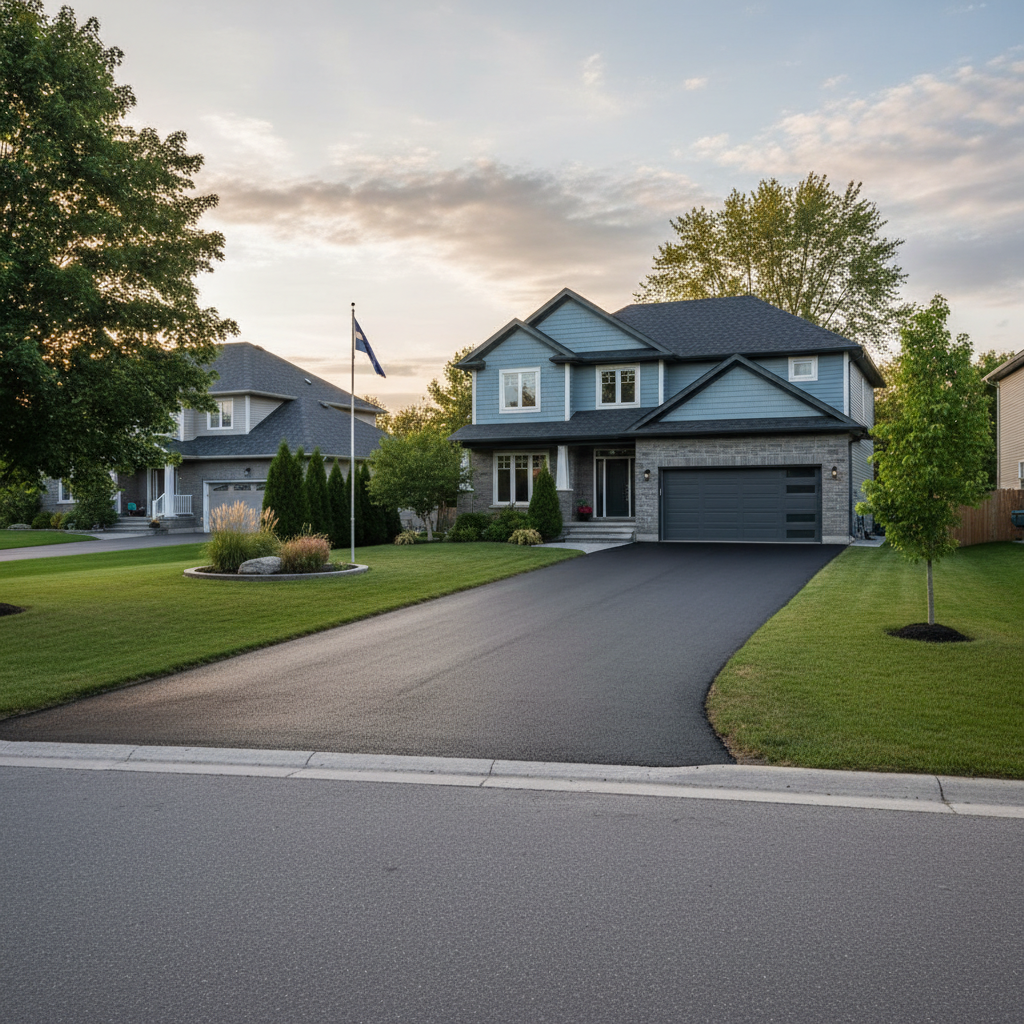
Driveway paving options and costs in Sexsmith
Sexsmith homeowners typically have one main thing in common: most of the neighbourhood’s housing stock is single-detached, so private driveways make up a large share of local paving demand. With 83.0% of dwellings being single-detached (Statistics Canada, 2021 Census), you’ll see crews planning around long, straight runs from the street to garages, plus frequent tie-ins to existing gravel or older asphalt. In 2021 there were 655 homeowner households in Sexsmith (Statistics Canada, 2021 Census), which matters because steady owner-occupied turnout supports consistent contractor availability—but it also means demand spikes quickly during the short paving window.
In the Athabasca–Grande Prairie–Peace River economic region, the climate is cold and frost-susceptible, so frost penetration commonly exceeds 1 m and can approach 1.5–2 m in harsher pockets. That translates to a thicker, well-compacted granular base and careful drainage so meltwater doesn’t cycle through freeze–thaw right under the asphalt or concrete. Locally, spring soft subgrades and early fall frosts compress the practical paving season (mid-May to September). As a result, projects often cost toward the upper end of the provincial norms, especially when subgrade undercutting, stabilization, or extra granular depth is needed.
Trades are especially busy in areas like downtown Sexsmith and the surrounding residential lanes, where lots are established and tie-ins to existing curb cuts, sidewalks, and storm drainage are common. Use the table below to compare typical options and budgeting ranges for a properly built driveway in Sexsmith—then we can narrow the numbers once your site condition is known.
| Material |
Lifespan |
Maintenance |
Best For |
Price per sq ft |
Price Range |
| Asphalt (new installation, proper base) |
15–25 years |
Seal coat after 6–12 months, then every 3–5 years |
Good value, smooth ride, modern look |
$4.50–$7.75 |
$6,500–$12,000 |
| Asphalt (overlay on existing gravel base) |
10–18 years |
Seal as above; monitor edges and weak spots |
When drainage and base condition are already solid |
$3.75–$6.75 |
$5,500–$10,000 |
| Interlocking concrete pavers |
25–35 years |
Occasional re-leveling of a few units; replace single paver blocks |
Curb appeal, repairability, stable surface feel |
$10.00–$16.50 |
$9,000–$18,000 |
| Poured concrete (broom finish) |
20–30 years |
Keep joints maintained; seal optional depending on finish |
Low-maintenance, durable slabs with correct detailing |
$9.00–$14.00 |
$8,000–$16,000 |
| Exposed aggregate concrete |
20–30 years |
Seal periodically to maintain colour and reduce staining |
Slip resistance and a premium look |
$11.00–$17.50 |
$9,500–$17,500 |
| Gravel / crushed stone (budget option) |
3–8 years |
Top up and re-grade every 1–3 years |
Short-term solution or tight budgets |
$2.25–$4.00 |
$3,500–$6,500 |
Prices are estimates only and vary by project scope, site access and material selection.
What affects the price of paving in Sexsmith
In Athabasca–Grande Prairie–Peace River, two bids for the same driveway can land 30–50% apart, even when the final surface type looks similar. The main reasons are how contractors manage frost-susceptible soils, how much work is required to create a stable, well-drained base, and how tight the scheduling window is. When spring conditions soften subgrades and early frosts approach, labour and equipment time become more expensive, and crews often need to push start dates (and sometimes overtime) to fit within the mid-May–September paving window. That pushes asphalt driveway paving that might be lower-cost elsewhere to the upper end of the $6,500–$12,000 band in Sexsmith.
Frost line depth and freeze–thaw cycles are decisive cost factors here. Deeper frost requires a thicker, compacted granular base (often more than you’d see in milder areas), so material and compaction hours rise. Asphalt also has to meet local freeze–thaw performance needs; a freeze–thaw-rated mix design can cost more, but it reduces early raveling and patch failures.
On concrete jobs in Sexsmith, the “cheap” option is rarely cheap once detailing is done correctly. For example, if old driveway material is removed and you need undercutting due to weak, fine-grained subgrade, that can add thousands in excavation, haul-off, and replacement. Conversely, if your existing base already drains well and the grade is correct, poured concrete or pavers can stay close to the lower end of their bands like $8,000–$16,000 for concrete. In neighbourhoods with older lots—like portions of established residential areas where many homes date back earlier decades—more sites need corrections to slope and drainage, which is why the variation between quotes is often significant.
| Price Factor |
Why It Matters |
Cost Impact |
| Driveway area in sq ft |
Most costs scale directly with square footage and compaction effort |
Major (often the #1 difference between bids) |
| Base depth required |
Frost susceptibility demands thicker granular thickness to prevent heaving |
Major (+ material, + labour, + haul) |
| Grading and drainage work |
Positive slope and drainage paths reduce freeze–thaw cycling |
Moderate to major (varies with site) |
| Tear-out of existing surface |
Concrete/old asphalt removal requires saw-cutting, breaking, and proper disposal |
Moderate to major |
| Edge restraints and curbing |
Prevents lateral spreading, especially for pavers and asphalt edges |
Moderate |
| Sealing requirement |
Asphalt needs sealing after cure, and then periodically to resist moisture damage |
Low to moderate (but affects long-term performance) |
| Site access |
Narrow lots and obstacles slow equipment movement and increase labour time |
Moderate |
| Asphalt mix specifications |
Freeze–thaw-rated mixes are engineered for Northern Alberta conditions |
Moderate (quality-driven) |
Permits & regulations in Alberta
In Alberta, paving a private driveway on your own property usually does not require a building permit. That includes typical resurfacing like asphalt replacement, installing pavers, or pouring a driveway slab entirely within your lot lines. However, work that affects the municipal right-of-way typically needs municipal approval. Examples include creating or changing curb cuts, altering the boulevard area, adjusting storm drainage features, or changing how water flows from the street/ditch. If your project involves drainage re-routing, the municipality may require review before excavation starts.
Here’s a practical step-by-step approach for a Sexsmith homeowner: (1) call for utility locates before digging—Alberta One-Call is the starting point so you avoid hitting buried services; (2) check your lot-grading rules with the municipality (some places limit how close hard surfaces can be to property lines and how runoff must be managed); (3) confirm with your contractor whether permit applications are included if any right-of-way work is required.
Next, verify your contractor’s protection. Ask for a copy of their Alberta licence (if applicable for their type of work), then request a certificate of liability insurance showing adequate coverage and your address listed (or you as an interested party). For worker coverage, check WSIB/WCB clearance documentation—contractors should be able to provide proof of coverage upon request. Finally, don’t rely on verbal assurances: download or review the certificates during the quote process.
Asphalt vs pavers vs concrete for Sexsmith driveways
For Sexsmith in Northern Alberta’s cold frost-susceptible zone, your driveway surface needs more than just a “pretty finish”—it needs a base and drainage system built for deep frost penetration and long freeze–thaw cycles. Asphalt is usually the lowest upfront option; when it’s built on a proper granular base and sealed correctly, it offers a smooth ride and quick installation. The trade-off is maintenance: sealing every 3–5 years helps keep moisture out and protects the binder from northern weather wear.
Interlocking concrete pavers cost more upfront, but they tend to be the most repairable. If a section settles due to a weak subgrade or an unexpected drainage issue, contractors can lift and re-set the affected units rather than replacing the entire surface. That repairability matters in Sexsmith where older, fine-grained soils can be prone to frost action if the base and drainage aren’t right the first time. Pavers also handle plowing impacts better when edge restraints are installed correctly, which is a real-world concern during winter snow clearing.
Poured concrete sits in the mid-range cost and can last decades when the slab is detailed properly with air-entrainment, correct thickness, and joints. That said, concrete can crack when freeze–thaw movement or drainage problems allow water to sit under/around the slab, and repeated de-icing can be rough if the mix and finishing aren’t chosen for northern exposure.
As a practical dollar example, many homeowners choose asphalt because the band is typically $6,500–$12,000 for asphalt driveway paving. Upgrading to pavers might land in the $9,000–$18,000 range, and that difference is justified when you want long-term curb appeal, faster spot repairs, and maximum resilience to localized subgrade problems.
| Material |
Frost Resistance |
Curb Appeal |
Repair Method |
Lifespan |
Price Band |
| Asphalt (sealed regularly) |
Good with thick base and proper drainage |
Medium (clean, modern look) |
Cut-and-patch patches; re-surface if widespread failure |
15–25 years |
$6,500–$12,000 |
| Interlocking concrete pavers |
Very good with well-graded base and edge restraint |
High (premium curb appeal) |
Lift/replace individual pavers |
25–35 years |
$9,000–$18,000 |
| Poured concrete (air-entrained) |
Good with correct mix, air entrainment, and joints |
Medium to high (depends on finish) |
Section replacement for significant failures |
20–30 years |
$8,000–$16,000 |
| Exposed aggregate concrete |
Good with frost-rated base and curing |
High (textured premium look) |
Limited; often patching with match finish where feasible |
20–30 years |
$9,500–$17,500 |
| Permeable pavers (drainage grid) |
Very good when designed to drain and not clog |
Medium to high |
Replace affected blocks; clean drainage layers as needed |
20–30+ years |
$10,500–$20,000 |
| Chip seal / tar-and-chip |
Fair to good with correct prep; more sensitive to base issues |
Low to medium |
Top-up maintenance; localized rework |
7–12 years |
$4,500–$8,500 |
How to choose a paving contractor in Sexsmith
Start by verifying your paving contractor is properly set up to work in Alberta. Ask for their business information and check their coverage documentation: request a certificate of liability insurance (with adequate limits for driveway-scale work) and make sure it’s current. For worker coverage, ask for WSIB/WCB clearance or proof of coverage. A reputable Sexsmith contractor should provide these without pressure and well before the job starts.
Then get 2–3 itemised written quotes instead of one lump-sum number. You want a breakdown that separates labour, excavation/tire-out (if needed), granular base materials, geotextile/stabilization (if recommended), asphalt mix or concrete thickness, forms/curbs/edge restraints, and disposal fees. A detailed scope should also state what’s excluded: for instance, repairing buried drainage deficiencies, relocating utilities, or replacing over-excavated areas beyond the allowance. Also ask whether permit pull (if right-of-way work is required) and inspections are included.
On warranty, look for two parts: a workmanship warranty (often for cracking/settlement attributable to installation) and the manufacturer’s product warranty (for materials). Confirm the warranty length and whether it’s transferable if you sell your home.
For payment, never pay more than 10–15% upfront. Use a schedule tied to milestones (base complete, asphalt/concrete installed, final cleanup). Finally, request a written timeline with a start date and completion estimate—Northern Alberta schedules shift, but you should still get commitments in writing.
- Confirm liability insurance and request proof of coverage in writing.
- Provide WSIB/WCB clearance (or proof of coverage) before starting.
- Get 2–3 itemised quotes with labour and materials separated.
- Ask for base section details (thickness and compaction approach) in plain language.
- Confirm drainage plan (slope, outlets, and how meltwater is managed).
- Verify disposal and haul-off are included for tear-out.
- Ask if geotextile or stabilization is proposed for soft or fine-grained subgrade.
- Check if edge restraints/curbs are included for pavers and asphalt edges.
- Request asphalt cure and sealing timeline (seal after cure, not immediately).
- Confirm concrete air-entrainment and joint plan for freeze–thaw movement.
- Review warranty terms: workmanship length, exclusions, and transferability.
- Set payment milestones; keep holdback until final grade and cleanup are verified.
In Sexsmith, concrete and asphalt red flags include: a quote that skips base thickness details, crews who downplay drainage (“we’ll just pave over it”), no written warranty for workmanship, refusing to provide insurance/WSIB/WCB documentation, and pressure to pay the majority upfront before base prep is verified.
Frequently asked questions — paving in Sexsmith
How do I get the most accurate paving quote in Sexsmith?
To get the most accurate paving quote in Sexsmith, ask for a site visit and a clear scope in writing. The biggest price driver is not the surface alone—it’s base preparation, drainage, and whether undercutting or stabilization is required for frost-susceptible soils. When contractors quote, request exact details: driveway size (sq ft), proposed base depth, compaction approach, and how they’ll manage meltwater so it doesn’t re-freeze under the slab. Because Athabasca–Grande Prairie–Peace River freeze–thaw cycles are intense, a contractor should discuss drainage slope and whether your subgrade is fine-grained clay/silt prone to pumping. Finally, compare quotes with itemised line items and confirm whether disposal, saw-cutting, and any right-of-way considerations are included.
How much does it cost to pave a driveway in Sexsmith?
Typical driveway paving costs in Sexsmith depend mostly on square footage and how much base work your site needs. For asphalt, most properly built driveway projects land in the $6,500 – $12,000 range for new asphalt paving with a proper granular base. Concrete commonly falls in the $8,000 – $16,000 band for poured work, while interlocking pavers tend to be higher at $9,000 – $18,000 because of materials, restraints, and installation time. If you have to tear out old asphalt/concrete or correct drainage, expect higher costs than a “simple overlay.” In Northern Alberta’s short paving window, scheduling pressure and extra compaction time can also push pricing toward the upper end.
Asphalt vs interlocking pavers vs concrete — which is best in Sexsmith?
There isn’t one “best” option for every Sexsmith driveway, but the decision usually comes down to maintenance preference and how repairable you want it to be. Asphalt is often the best fit for homeowners who want the lowest upfront cost within the $6,500 – $12,000 band and are comfortable with sealing every 3–5 years. Interlocking pavers are usually the top choice if you want maximum curb appeal and the ability to lift and re-set sections without replacing the whole driveway—important when frost movement or drainage quirks affect only a portion. Poured concrete (air-entrained) can be a great mid-range option in Alberta, but it relies heavily on correct base thickness, jointing, and drainage. In all three cases, the foundation/base and drainage design matter at least as much as the surface.
How long does a paved driveway last in Sexsmith?
In Sexsmith, driveway lifespan depends on base depth, compaction, and how water behaves during spring melt and freeze–thaw cycles. Asphalt that’s built with the right granular base and sealed after cure typically lasts about 15–25 years. Interlocking pavers often reach 25–35 years because individual units can be replaced if a localized area shifts. Poured concrete, when air-entrained and properly jointed with correct drainage, commonly lasts around 20–30 years. Gravel is the short-term option—usually only a few years—because it needs frequent re-grading. If you’ve had earlier cracking/heaving, don’t assume the surface failed; many issues trace back to drainage or fine-grained subgrade that needs undercutting or stabilization before asphalt or concrete goes down.
When is the best time of year to pave in Sexsmith?
The best time to pave in Sexsmith is during the effective paving window when temperatures allow proper placement and compaction. In Northern Alberta’s Athabasca–Grande Prairie–Peace River region, the work window is typically mid-May through September, because heavy loads and soft subgrades can limit work in spring, while early fall frosts can shorten the season. For asphalt, hot-mix asphalt placement requires warm conditions (air temperatures generally above about 10°C), and sealing timing matters after the asphalt cures. If you wait too late, you risk not achieving proper compaction and curing. A good contractor will plan around the forecast and your driveway access, and will set expectations in writing about start and completion dates.
How deep should the base be for Sexsmith's frost?
Base depth in Sexsmith isn’t one universal number; it depends on your subgrade condition (fine-grained clays/silts often need more attention), drainage, and how frost-susceptible the soil is. What matters most is engineering the driveway so frost doesn’t heave the pavement structure and so meltwater can’t sit beneath the surface during freeze–thaw cycles. In our cold frost-susceptible zone, contractors typically build a deeper, well-compacted granular base than you’d see in milder regions, because frost penetration routinely exceeds 1 m and can approach 1.5–2 m in harsher locations. In practice, that often means a significantly thicker base structure with good gradation and proper drainage. Your contractor should explain the base section in the quote—if they can’t, that’s a warning sign.