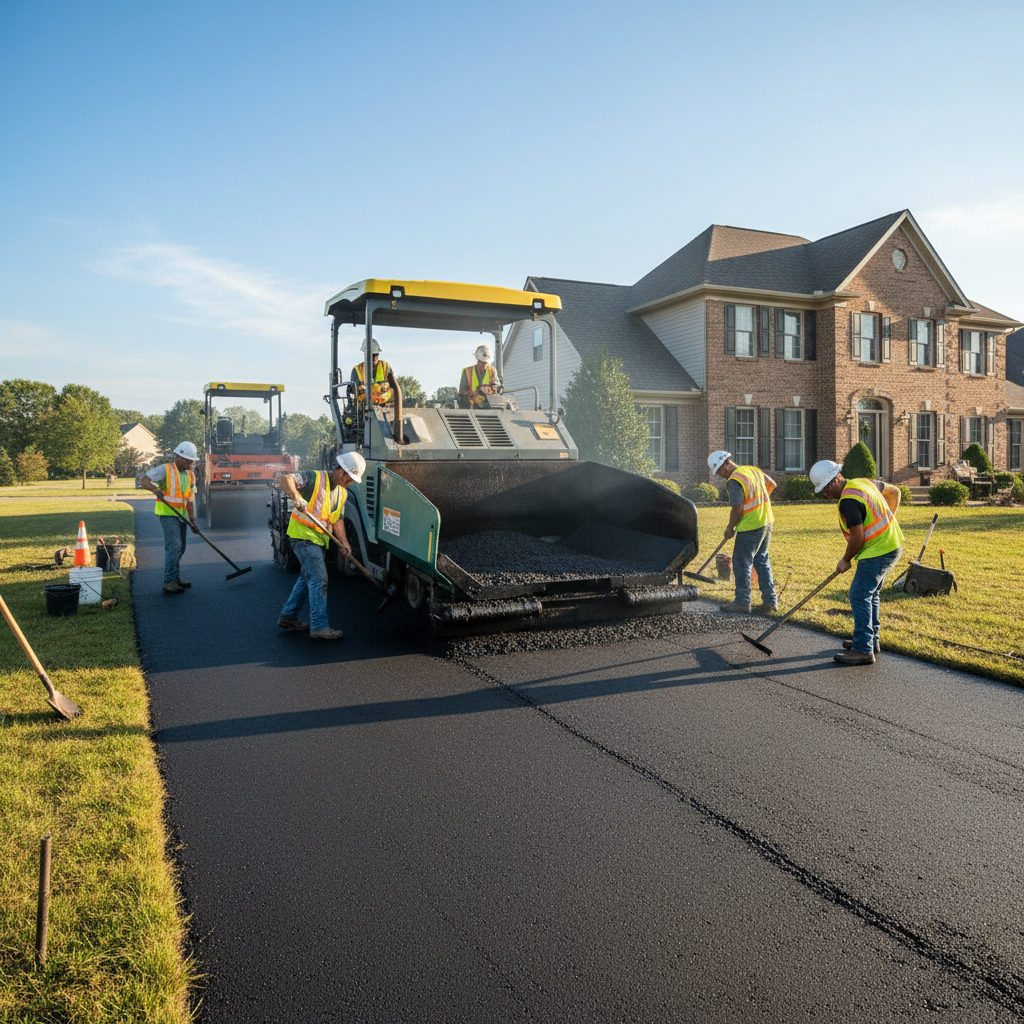
Driveway paving options and costs in Calgary
Calgary is a great place to talk driveway paving because your options are clear, but your costs are not—freeze–thaw stresses and a compressed season change both the build quality required and the labour availability. With 345,690 homeowner households in the city (68.8% of households own) and single-detached homes making up 55.0% of dwellings, most private driveways are being paved on residential lots where access, grading, and base preparation make or break the result. Calgary’s cold continental climate regularly drives frost down to about 1.2 m (4 ft), and the ground expands and contracts with repeated freezing and thawing. That’s why contractors price thicker, well-graded granular bases, proper edge support, and real positive drainage—otherwise you’ll see raveling, cracking, and surface settlement. Work is also concentrated from late spring through early fall; when temperatures and ground conditions are right, demand spikes, and smaller jobs often cost more to schedule and mobilize.
In neighbourhoods like Scenic Acres (and similarly built-out areas across the NW and SE), we see consistent demand because lots are older, access can be tight, and homeowners want curb appeal that survives Calgary winters. The table below compares common driveway materials, typical lifespan expectations, maintenance needs, and realistic per-square-foot ranges for Calgary.
| Material |
Lifespan |
Maintenance |
Best For |
Price per sq ft |
| Asphalt (new installation, proper base) |
10–20 years |
Seal 3–5 years after install; crack repair as needed |
Lowest upfront cost with good performance when the base is engineered |
$12 – $20 |
| Asphalt (overlay on existing gravel base) |
8–15 years |
More frequent monitoring; seal and patch earlier if base isn’t uniform |
Limited excavation budget where the gravel is stable and well-drained |
$10 – $16 |
| Interlocking concrete pavers |
20–30+ years |
Replace individual stones/sections; periodic sweeping and joint sand refresh |
High curb appeal and modular repairability |
$18 – $30 |
| Poured concrete (broom finish) |
20–30 years |
Crack sealing/patching; consider surface protection |
Clean look, simple maintenance, strong longevity with air-entrainment |
$15 – $25 |
| Exposed aggregate concrete |
20–30 years |
Seal/guard periodically; repair patches blend with resurfacing |
Slip resistance and “premium” surface texture |
$18 – $28 |
| Gravel / crushed stone (budget option) |
5–10 years (varies by drainage and grading) |
Re-grade and top up annually; weed control; dust management |
Lowest upfront cost while you plan drainage/base upgrades |
$3 – $8 |
Prices are estimates only and vary by project scope, site access and material selection.
What affects the price of paving in Calgary
Even for the “same” driveway, you can see quote swings of 30–50% across Calgary and surrounding Alberta municipalities. The difference usually isn’t the asphalt or concrete itself—it’s the hidden work needed to survive Calgary’s winter. In our cold continental climate, frost can penetrate to about 1.2 m (4 ft). That means the base has to be thick and well-compacted so water doesn’t migrate upward and expand during freeze–thaw cycles. If a contractor underbuilds the granular base, you often pay twice through early cracking and heaving. In addition, the paving season is shorter locally: hot-mix asphalt generally requires air conditions above about 10°C for paving and compaction, so scheduling pressure in spring and early summer can push labour and equipment costs up.
Concrete work can also change price based on mix and reinforcement detailing. For example, a stamped curb tie-in or added drainage swale typically costs more than a straightforward driveway pad. If your lot slopes toward the garage, drainage corrections might add base and grading before any surface goes down. Conversely, a relatively flat site with stable soils and easy access can keep costs closer to the lower end of the $12 – $20 asphalt paving band. For a more premium look, interlocking pavers at $18 – $30 can be worth the difference when you want repairs without replacing the whole surface—especially on driveways that get heavy ploughing where edge support matters.
Home age influences cost too. Calgary has a meaningful share of homes built before 1981 (35.2%), and older lots often have settled areas, older drainage patterns, or more curb/sidewalk constraints. Those site conditions translate directly into extra tear-out, regrading, and base rebuild dollars.
| Price Factor |
Why It Matters |
Cost Impact |
| Driveway area in sq ft |
Most materials and production time scale with square footage |
Largest driver (often 50–70% of total) |
| Base depth required |
Frost line depth requires thicker, well-graded granular thickness |
Higher base can add significant material and compaction labour |
| Grading and drainage work |
Positive drainage reduces water-driven freeze–thaw damage |
Can add major labour if regrading/slope corrections are needed |
| Tear-out of existing surface |
Removing old asphalt/concrete and hauling debris takes equipment time |
Typically increases costs more on concrete tear-out than asphalt |
| Edge restraints and curbing |
Prevents paver spread and asphalt edge breakup |
Adds materials/installation time, especially on curved drives |
| Sealing requirement |
Asphalt needs a protective seal after initial curing to slow oxidation |
Direct added cost, plus usually one follow-up season expense |
| Site access |
Narrow lots, long pushes, or limited staging slow equipment movement |
Mobilization and extra handling can raise labour |
| Asphalt mix specifications |
Freeze–thaw rated mix design improves durability in Alberta conditions |
Often modest per-sq-ft increase but meaningful lifetime benefit |
Permits & regulations in Alberta
In Alberta, paving a private driveway within your own property typically does not require a building permit—especially when it’s replacement or a new surface on the driveway footprint without changing municipal infrastructure. Where permits and approvals can come into play is when the work touches the municipal right-of-way or affects how water is managed off-site. For Calgary homeowners, that usually includes: creating or changing curb cuts, modifying the boulevard, altering or reconnecting storm drainage, or doing anything that affects how the municipality’s drainage system functions.
Also pay attention to lot-grading bylaws. Some municipalities restrict how close hard surfaces can be to property lines and may limit how grading is altered to protect neighbouring lots from water migration. Before excavation, always arrange utility locates through Alberta One-Call—digging without confirming line locations is where projects get delayed or become unsafe.
To verify your contractor in Calgary, do three quick checks: (1) confirm the contractor’s Alberta licence/registration in the relevant provincial system, depending on their scope; (2) ask for a current certificate of liability insurance showing adequate coverage for paving work; and (3) confirm WSIB/WCB coverage (request the clearance letter or proof of account status). A legitimate contractor should provide these documents without hesitation, and they should match the name on the written estimate and contract.
Asphalt vs pavers vs concrete for Calgary driveways
For Calgary’s freeze–thaw climate, asphalt, interlocking pavers, and concrete can all work—but they solve different homeowner priorities. Asphalt is usually the lowest upfront option and is a common fit when you want a smooth, quiet ride-on surface and accept that it needs sealing every 3–5 years. Its performance depends heavily on base preparation and the asphalt mix meeting freeze–thaw expectations, because water movement under the surface is what leads to cracking and raveling. Interlocking concrete pavers cost more up front, but they’re built for repair: if a section settles, you can remove and replace only the affected units instead of tearing out the entire driveway. That’s a real advantage in Calgary where plowing, seasonal expansion, and sometimes edge water intrusion can stress corners.
Poured concrete sits in the middle for cost and durability when it’s air-entrained and properly detailed. However, concrete can crack due to thermal movement and freeze–thaw stresses, and surface scaling risk rises if the wrong mix is used or if de-icing practices are too aggressive. For most Calgary driveways, drainage design and base thickness matter more than which “brand name” material you choose. In a typical cold-climate build, you plan for a well-compacted granular base designed to manage frost effects down toward about 1.2 m (4 ft). Gravel and chip options look cheaper at first, but they tend to need more frequent regrading in Calgary’s winter conditions.
Where does the price difference make sense? If asphalt lands near $12 – $20 per sq ft and pavers run around $18 – $30, the extra can be justified if you want curb appeal, modular repairs, and stronger resistance to localized edge failures—common on driveways with curving borders or where runoff concentrates after melting.
| Material |
Frost Resistance |
Curb Appeal |
Repair Method |
Lifespan |
Price Band |
| Asphalt (sealed regularly) |
Good when base and drainage are engineered for freeze–thaw |
Medium |
Patch/overlay sections and seal |
10–20 years |
$12 – $20 |
| Interlocking concrete pavers |
Excellent with proper base, restraints, and jointing sand |
High |
Remove and replace individual pavers/sections |
20–30+ years |
$18 – $30 |
| Poured concrete (air-entrained) |
Good to very good when air-entrained and properly cured |
Medium to high |
Seal cracks; patch spalls; occasional resurfacing |
20–30 years |
$15 – $25 |
| Exposed aggregate concrete |
Good with correct mix, curing, and drainage |
Very high |
Patch with specialist repairs; keep surface protection maintained |
20–30 years |
$18 – $28 |
| Permeable pavers (drainage grid) |
Good when designed for local soils and winter performance |
High (modern look) |
Remove/rebuild affected grid areas |
15–25 years |
$22 – $38 |
| Chip seal / tar-and-chip |
Fair; can ravel in heavy traffic without maintenance |
Low to medium |
Re-chipping and localized rework |
5–12 years |
$10 – $18 |
How to choose a paving contractor in Calgary
Choosing the right paving contractor in Calgary comes down to proof, not promises. First, verify licensing and insurance. Ask for their Alberta licence/registration details relevant to their scope, then request a current certificate of liability insurance (make sure it’s active during the job dates and covers contract work). For workers’ coverage, confirm WSIB/WCB status—ask for the clearance letter or proof of coverage. If they can’t provide documentation quickly, treat that as a risk to your schedule and budget.
Next, get 2–3 itemised written quotes. You want a breakdown that separates excavation/grading, base supply and compaction, curb/edge restraints, surface material, and any sealant (if applicable). Avoid “lump sum only” pricing—itemisation helps you compare apples to apples. Also read the scope for exclusions: is permit work included if needed, is old material disposal included, and what’s the treatment for soft spots or unstable soils discovered during excavation? With Calgary’s older housing stock (many homes built before 1981), those surprises are common.
Warranty matters. Ask for the length and what it covers (workmanship vs product). Confirm whether the workmanship warranty transfers if you sell your home. Keep payment practical: never pay more than 10–15% upfront; hold back part of the amount until completion and final cleanup. Finally, insist on a written timeline with a proposed start date and completion estimate—Calgary’s late-spring through early-fall window can affect when crews are available.
- Request proof of Alberta licence/registration relevant to paving/contracting scope.
- Confirm current liability insurance and adequate coverage limits.
- Get WSIB/WCB clearance or proof of coverage in writing.
- Choose quotes that itemise labour and materials, not just a total price.
- Ask for base build-up details (aggregate type, thickness, compaction method).
- Confirm edge restraints/curbs are included if needed for your driveway design.
- Clarify drainage/grading responsibility and how runoff will be directed.
- Review tear-out scope: what’s included (saw-cutting, hauling, disposal)?
- Verify sealcoat plan for asphalt (timing after cure and expected follow-up).
- Ask about asphalt mix design freeze–thaw suitability and testing practices.
- Ensure warranty terms specify workmanship and any exclusions.
- Confirm payment schedule and holdback amount, plus dispute handling.
Common red flags in Calgary include: refusing to show insurance/coverage documents, providing non-itemised “lump sum” quotes, promising long lifespans without discussing base thickness and drainage, starting work before utilities locates are complete, and requiring large upfront payments beyond 10–15% without a written schedule and contract details.
Frequently asked questions — paving in Calgary
Asphalt vs interlocking pavers vs concrete — which is best in Calgary?
In Calgary, “best” depends on how you weigh upfront cost, repairability, and winter maintenance. Asphalt is typically the best value if you’re comfortable with sealing every few years and you get a properly engineered base for frost effects (Calgary’s frost can reach about 1.2 m). Interlocking pavers cost more (often around $18 – $30 per sq ft), but they’re highly repairable and look excellent, which is why many homeowners choose them in established areas like the NW and SE where curb appeal matters. Poured concrete is a strong mid-range option (commonly $15 – $25 per sq ft) when it’s air-entrained and detailed for thermal movement. If you’re dealing with edge water or settled spots, pavers usually win on repair flexibility.
How long does a paved driveway last in Calgary?
Typical lifespan in Calgary is driven by base quality, drainage, and how often you manage water and de-icing residue in winter. Properly installed asphalt with a strong base often lasts around 10–20 years, assuming you seal after the initial cure and handle cracks early. Interlocking pavers commonly reach 20–30+ years because damaged sections can be lifted and reset instead of tearing out the whole driveway. Air-entrained concrete usually targets 20–30 years as well, but cracking can occur from freeze–thaw and temperature cycling; good design and sealing reduce deterioration. If your driveway is on a property with older grading issues—common for homes built before 1981, which make up 35.2% of Calgary housing stock—lifespan can be shorter unless the base and drainage are corrected.
When is the best time of year to pave in Calgary?
The best time to pave in Calgary is late spring through early fall, when the ground isn’t frozen and contractors can achieve proper compaction and curing. Asphalt generally requires warm enough air temperatures (commonly above about 10°C) so the crew can place and compact safely. Concrete also benefits from warmer conditions to support curing, especially if you want consistent finishing and strength gain. Ordering work in the early part of the season often helps with scheduling because spring is busy for both asphalt and concrete crews. If you’re planning multiple projects, sequence them so drainage and base work are done first—then surface installation right after when conditions are stable.
How deep should the base be for Calgary's frost?
Base depth isn’t one number for every driveway, because soil type, drainage, and driveway thickness all affect how frost heave risk is managed. Calgary’s frost penetration can be around 1.2 m (4 ft), so contractors focus on building a thick, well-graded compacted granular base and ensuring positive drainage so water can’t sit below the surface. In practical driveway builds, that often means engineered granular thicknesses in the multi-inch to deeper-range depending on conditions; if excavation reveals soft spots or poor subgrade, base thickness and replacement may increase. The contractor should explain their proposed base build-up and compaction standards in writing. If they only say “a few inches,” that’s a major caution sign for Calgary.
How often should I seal my asphalt driveway?
For Calgary asphalt driveways, sealing frequency depends on the original asphalt, weather exposure, and how well the base drains. A common approach is to seal after the asphalt has cured—then plan on resealing roughly every 3–5 years. If you wait too long, oxidation accelerates, and you’ll see more raveling and fine surface cracking. If you reseal regularly, you usually reduce moisture infiltration, which matters a lot in freeze–thaw cycles. Sealing is typically an add-on cost that contractors include as part of lifecycle planning; many homeowners budget within the overall paving plan rather than treating it as optional later. For best results, address cracks early with proper patching before the next seal coat.
Why does my driveway crack and heave in winter?
Cracking and heaving in Calgary almost always comes back to water movement and frost effects. During freeze–thaw cycles, water expands as it freezes; if the subgrade is weak or drainage is insufficient, that expansion can lift parts of the driveway and create stress fractures. Edge failures are also common when curb restraints aren’t installed or when water runs toward the surface during spring melt. Older driveways can be worse because the base may have compacted unevenly or settled over time—especially on properties where older grading patterns were never corrected. The fix isn’t just patching: you need proper drainage grading and a base rebuild designed for Calgary’s cold continental conditions. Catching issues early can prevent localized damage from turning into full-depth failure.