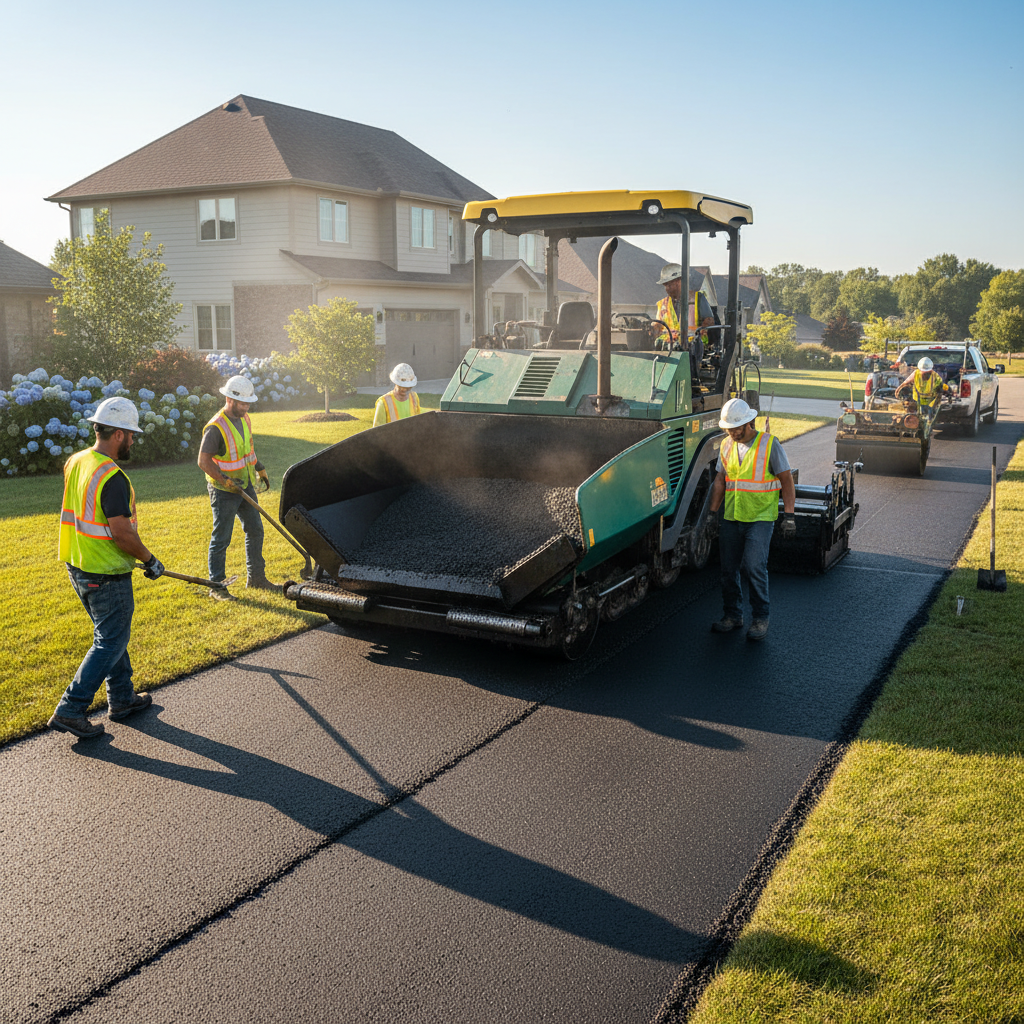
Driveway paving options and costs in Swan Hills
Swan Hills homeowners typically see the same trade-offs every spring: you want a driveway that stays level through frost, handles plough traffic, and looks good beside a home. With 82.5% of dwellings in the community being single-detached, that matters—most private driveways are tied to detached houses, so there’s a large, consistent demand for quality grading and a properly compacted base (Statistics Canada, 2021 Census). It’s also a mature housing stock: 64.3% of homes were built before 1981, which often means existing driveways may be on older subgrades that need undercutting or drainage fixes before any new asphalt or concrete goes down (Statistics Canada, 2021 Census).
In the Athabasca–Grande Prairie–Peace River economic region, costs trend toward the upper end of Alberta because the frost-susceptible zone can drive frost penetration beyond 1 m and potentially closer to 1.5–2 m in harsher spots. That forces thicker granular base design, meticulous compaction, and more robust edge/surface drainage so meltwater drains away instead of cycling through freeze–thaw right under the pavement. The paving window is also shorter: hot-mix asphalt needs warm air temperatures, so contractor schedules tighten mid-summer and again in early fall for catch-up work.
In Swan Hills, paving demand is especially noticeable around residential pockets along the main access routes and near downtown amenities where driveways experience more plough passes and visibility matters for curb appeal. Use the table below to compare realistic options for your driveway size and how each material performs in a cold, frost-prone climate.
| Material |
Lifespan |
Maintenance |
Best For |
Price per sq ft |
Price Range |
| Asphalt (new installation, proper base) |
15–25 years |
Seal coat every 3–5 years |
Best balance of cost and performance |
$6.50–$10.50 |
$6,500–$12,000 |
| Asphalt (overlay on existing gravel base) |
10–18 years |
Seal coat; monitor settlement |
When gravel base is stable after grading |
$7.50–$11.50 |
$7,000–$13,500 |
| Interlocking concrete pavers |
25–40 years |
Spot repairs as needed; re-sanding |
Maximum curb appeal and easy repairs |
$10.50–$17.00 |
$9,000–$18,000 |
| Poured concrete (broom finish) |
20–30 years |
Caulking/patching as cracks appear |
Low maintenance flat, clean surface |
$10.00–$15.00 |
$8,000–$16,000 |
| Exposed aggregate concrete |
20–30 years |
Sealer reapplied as recommended |
Decorative look with slip resistance |
$12.00–$17.50 |
$10,000–$18,500 |
| Gravel / crushed stone (budget option) |
2–8 years (typical) |
Annual top-up and grading |
When you need a temporary or lowest-cost surface |
$2.50–$5.00 |
$1,800–$6,000 |
Prices are estimates only and vary by project scope, site access and material selection.
What affects the price of paving in Swan Hills
In Swan Hills and across the Athabasca–Grande Prairie–Peace River region, it’s common to see quotes for the “same” driveway differ by 30–50%. The usual reason isn’t the surface material—it’s what’s happening below it. Two contractors might both list asphalt, for example, but one may price a deeper frost-ready granular base plus drainage corrections, while the other assumes the existing subgrade is stable. Add winter scheduling pressure (thin paving windows) and labour/mobilization changes, and the final number can swing quickly.
Frost line depth and freeze–thaw cycles are decisive in this cold frost-susceptible zone. Deeper frost requires thicker compacted granular thickness to prevent heaving and cracking; in milder parts of Alberta and especially coastal BC you can sometimes get away with thinner sections, but here contractors typically plan on more granular depth and more attention to grading. Asphalt mix design must also be freeze–thaw rated; that’s why a “cheap” asphalt quote can cost more later when you’re dealing with premature raveling or rutting.
Concrete can also move price up or down. If your existing driveway is old and settlement has opened up edges, the tear-out and regrading can add labour and disposal. Conversely, if you have good drainage fall already and only need a resurfacing-grade base correction, concrete and pavers can be less disruptive. For homeowners, that’s why a move from a gravel base to full new asphalt may land in the $6,500–$12,000 band, while a full build-out for pavers often pushes into the $9,000–$18,000 range once edge restraints, compacted base, and proper bedding are included.
| Price Factor |
Why It Matters |
Cost Impact |
| Driveway area in sq ft |
Most line-items (base, asphalt, concrete, bedding) scale directly with square footage |
Large driver; biggest swing between quotes |
| Base depth required |
Frost penetration requires thicker, well-graded compacted granular layers to resist heaving |
Often adds substantial material and compaction time |
| Grading and drainage work |
Positive drainage prevents meltwater cycling through freeze–thaw beneath pavement |
Can increase scope if ditches/culverts are adjusted |
| Tear-out of existing surface |
Removing old asphalt/concrete means breaking, hauling, and disposal |
Commonly increases cost notably on older homes |
| Edge restraints and curbing |
Prevents paver spread and asphalt edge failure, especially under ploughing |
Higher-quality finish typically costs more upfront |
| Sealing requirement |
Asphalt needs sealing after cure; it slows oxidation and reduces water entry |
Upfront scheduling for sealing; lowers long-term failure risk |
| Site access |
Tight lots slow equipment and may require smaller-load haul cycles |
Labour and equipment time premium |
| Asphalt mix specifications |
Freeze–thaw-rated mix and proper binder selection cost more but improves durability |
Higher materials cost but better performance through winters |
Permits & regulations in Alberta
For private driveway paving in Alberta, most homeowners are surprised to learn that work within your own property usually does not require a building permit. If you’re resurfacing or rebuilding a driveway on your lot (including typical asphalt, concrete, or paver installs), the contractor can generally proceed without a permit, assuming you meet safety, drainage, and excavation best practices. That said, permitting typically becomes relevant when you change anything that impacts municipal infrastructure or servicing.
Work that DOES usually require municipal approval includes paving and grading changes that affect the municipal right-of-way—think new or modified curb cuts, changes to boulevard area, alterations to storm drainage, or any adjustment to how water runs across the road/ditch system. Some municipalities also enforce lot-grading rules that limit how close hard surfaces can be placed to property lines or how water must be directed away from foundations.
Before excavation, require utility locates. In Alberta, contact Alberta One-Call so underground services are marked before the first bucket hits the ground. Then verify your contractor the correct way: (1) Alberta licence details—check the contractor’s business registration/licence information through the applicable online business registry resources; (2) liability insurance—ask for a current Certificate of Insurance showing your address/property name in coverage and correct policy dates; and (3) WSIB/WCB coverage—confirm active status with a clearance letter or proof of coverage before work starts. Finally, ask whether they include disposal and any required traffic protection or barricading when they work near municipal edges.
Asphalt vs pavers vs concrete for Swan Hills driveways
For Swan Hills driveways, you’re choosing not just a finish, but how your driveway behaves through long freeze–thaw cycles, spring thaw softness, and winter maintenance (ploughing and occasional sand/salt near entries). Asphalt is usually the lowest upfront cost, and when it’s built with the right frost-ready granular base and sealed every 3–5 years, it performs well and stays smooth for tires and plough blades. The trade-off is that asphalt surface aging happens—if sealing gets delayed, water intrusion accelerates raveling and patching.
Interlocking concrete pavers cost more up front, but they’re the most homeowner-friendly for repairs: individual blocks can be lifted and reset if settlement or a utility issue occurs. In a frost-susceptible zone, that matters because you want a system that can recover from localized movement without replacing the entire driveway. Pavers also look sharp along the main residential streets where curb appeal is noticeable.
Poured concrete typically lands mid-range. In cold regions, concrete must be properly air-entrained and designed to manage freeze–thaw. Concrete can crack as part of normal shrinkage and movement, and freeze–thaw cycles can widen problems if the subbase or drainage isn’t right. If you regularly get de-icing salt near the edges, it can also shorten life—especially on exposed edges or low spots where meltwater sits.
A practical example: if a comparable asphalt driveway is quoted in the $6,500–$12,000 band, pavers often move you into the $9,000–$18,000 range. That price difference is usually justified when you want curb appeal and easier spot repairs in the years after installation—especially in older neighbourhoods where you might uncover drainage issues during tear-out.
| Material |
Frost Resistance |
Curb Appeal |
Repair Method |
Lifespan |
Price Band |
| Asphalt (sealed regularly) |
Good when base is frost-ready and drainage is positive |
Medium |
Patch and overlay in sections |
15–25 years |
$6,500–$12,000 |
| Interlocking concrete pavers |
Very good with proper base compaction and edge restraint |
High |
Lift/replace individual pavers and re-sand |
25–40 years |
$9,000–$18,000 |
| Poured concrete (air-entrained) |
Good when air-entrained and base/drainage are correct |
Medium to high (finish-dependent) |
Crack repair/patching; full replacement if widespread |
20–30 years |
$8,000–$16,000 |
| Exposed aggregate concrete |
Good, similar to poured concrete when designed correctly |
Very high |
Patch/grind and re-finish locally |
20–30 years |
$10,000–$18,500 |
| Permeable pavers (drainage grid) |
Very good for managing meltwater if detailing is correct |
High (modern look) |
Spot repair; maintain aggregate infill |
25+ years (performance depends on base) |
$11,000–$20,500 |
| Chip seal / tar-and-chip |
Moderate; depends heavily on maintenance and base quality |
Low to medium |
Frequent rework and rejuvenation |
6–12 years |
$5,500–$10,500 |
How to choose a paving contractor in Swan Hills
Choosing the right contractor matters more in Swan Hills because the “hidden” work—base depth, compaction, drainage—drives long-term performance through frost. Start by verifying Alberta coverage and paperwork. Ask for (1) Alberta business/licensing information—confirm the company’s legal status and the right business details on their quote; (2) liability insurance—request a current Certificate of Insurance that clearly shows coverage in effect during the job; and (3) WSIB/WCB (Workers’ compensation) coverage—get a clearance letter or proof of active status before work begins. A contractor should be able to provide these without hesitation.
Next, get 2–3 itemised written quotes. You want a breakdown that separates excavation/undercut, base materials, compaction, asphalt/concrete/paver supply, forming/edge restraints, and any required drainage correction. Avoid “one-price” quotes that don’t show what you’re paying for—especially when one contractor includes disposal and the other doesn’t. Confirm what’s excluded: permit fees (if applicable), locates, traffic control, saw-cutting, crack repair to existing slabs, and whether they include hauling away excess soil and old materials.
Warranty should be clear in writing: workmanship warranty length, what it covers (settlement? surface defects? base failure?), whether the product/manufacturer warranty applies, and if it’s transferable to the homeowner. For payment, don’t pay more than 10–15% upfront; use staged progress payments and hold back funds until the driveway is complete and cleaned up. Finally, require a timeline in writing with an achievable start date and completion estimate—remember the paving window is tight in northern Alberta, so schedule risk is real.
- Ask for Alberta liability insurance and verify expiry dates.
- Confirm WSIB/WCB clearance letter (active coverage) before work starts.
- Require an itemised quote: labour + materials + equipment time.
- Check that base depth and granular type are specified for frost conditions.
- Confirm drainage plan (slope, ditch tie-in, culvert needs).
- Get details on tear-out scope and disposal hauling included or excluded.
- Verify edge restraints/curbing are included where required.
- For asphalt, confirm tack coat, compaction standards, and cure/seal timing.
- For pavers, confirm bedding sand depth and joint sand specs.
- For concrete, confirm air-entrainment and finishing method.
- Ask what “winter protection” looks like if weather slows the job.
- Use a signed contract and clear milestones for progress payments.
Red flags in Swan Hills include: quoting “thin base” without explaining frost-ready granular depth; refusing to provide insurance/clearance documentation; changing scope after excavation without written change orders; demanding large upfront deposits beyond 10–15%; and vague warranties that don’t specify workmanship limits or what happens if settlement occurs.
Frequently asked questions — paving in Swan Hills
How much does it cost to pave a driveway in Swan Hills?
In Swan Hills, most homeowners fall into the common Alberta price bands because the frost-susceptible zone demands more granular base and careful drainage. For asphalt driveway paving, budgets typically land in the $6,500 – $12,000 range depending on driveway size, access, and whether you’re doing full new installation or a deeper rebuild. If you’re comparing materials, interlocking pavers often start higher—commonly $9,000 – $18,000—because you’re paying for bedding, edge restraint, and higher material quantities. Concrete usually sits around $8,000 – $16,000, with exposed aggregate on the higher end. The biggest swing factor is usually how much undercutting and base replacement is required once the crew excavates.
Asphalt vs interlocking pavers vs concrete — which is best in Swan Hills?
There isn’t a single “best” material for every Swan Hills driveway, but the decision usually comes down to how you want to handle maintenance and repairs. Asphalt is often the best value if it’s installed with a frost-ready base and sealed every 3–5 years; it’s typically in the $6,500 – $12,000 range. Interlocking pavers are ideal when curb appeal and long-term repairability matter—if a small section settles, it can be lifted and reset instead of replacing the entire surface, and pricing often lands in the $9,000 – $18,000 band. Poured concrete can work well when air-entrained and finished correctly, usually around $8,000 – $16,000, but freeze–thaw performance depends heavily on subbase drainage and base compaction. For many homeowners in older areas, solid drainage detailing is the deciding factor regardless of material.
How long does a paved driveway last in Swan Hills?
Longevity in Swan Hills is driven by frost action, drainage, and how quickly small issues are handled. Asphalt installed on the right base and sealed regularly commonly lasts about 15–25 years. If sealing gets skipped and water finds its way into cracks or along edges, you can see earlier raveling and pothole-style patching. Interlocking pavers often last 25–40 years because they’re repairable; when localized movement happens, you can correct it without removing the whole driveway. Poured concrete can typically last 20–30 years when it’s properly air-entrained and the base supports it; cracks may still occur, but good detailing limits freeze–thaw damage. In northern Alberta’s long freeze–thaw season, the best warranty experiences usually come from contractors who prove their base depth and compaction plan in the quote—not just the surface material.
When is the best time of year to pave in Swan Hills?
The best window is usually mid-May through September in Swan Hills and across northern Alberta, because paving requires workable subgrades and suitable air temperatures. Hot-mix asphalt typically needs air temperatures above about 10°C to place and compact properly, and spring can be soft when meltwater saturates the subgrade. Early fall can still work for some projects, but crews often have to plan around early frosts that can interrupt compaction and curing. If you’re scheduling, try to book in advance so you’re not pushed into late-season weather risk. For concrete, finishing and curing conditions matter too—too-cold temperatures can increase early surface issues. Ask contractors for a written start date and weather contingency plan so your driveway isn’t left partially complete during a cold snap.
How deep should the base be for Swan Hills's frost?
Base depth isn’t one-size-fits-all, but in Swan Hills you should expect a frost-ready granular design because frost penetration can exceed 1 m (and in harsher locations approach 1.5–2 m). That means many projects need deeper compacted granular layers than you’d see in milder areas, especially when you have fine-grained subgrades (clays/silts) that are prone to frost action. In practical terms, contractors commonly plan for a deeper granular build-up plus a properly prepared subgrade (sometimes including undercutting or stabilization if the soil is soft). The right depth also depends on whether drainage is corrected and whether you’re installing new asphalt/pavers/concrete or rebuilding over existing base. A good quote will specify base thickness and materials, not just the final surface.
How often should I seal my asphalt driveway?
For asphalt driveways in Swan Hills, sealing is one of the simplest actions to protect your investment through freeze–thaw cycles. Typically, contractors recommend sealing after the asphalt has cured—often after about 6–12 months for a new surface—then re-sealing every 3–5 years depending on traffic, weather exposure, and how quickly winter maintenance wears the surface. If you’ve got frequent plough passes, meltwater channels that don’t drain well, or salt/sand near the entry, you may need to stay closer to the earlier end of that range. Skipping sealing can allow water to penetrate and accelerate raveling and edge deterioration, leading to larger repairs later. Ask your contractor what seal type they plan to use and include it in your long-term maintenance plan rather than waiting until the asphalt looks “rough.”