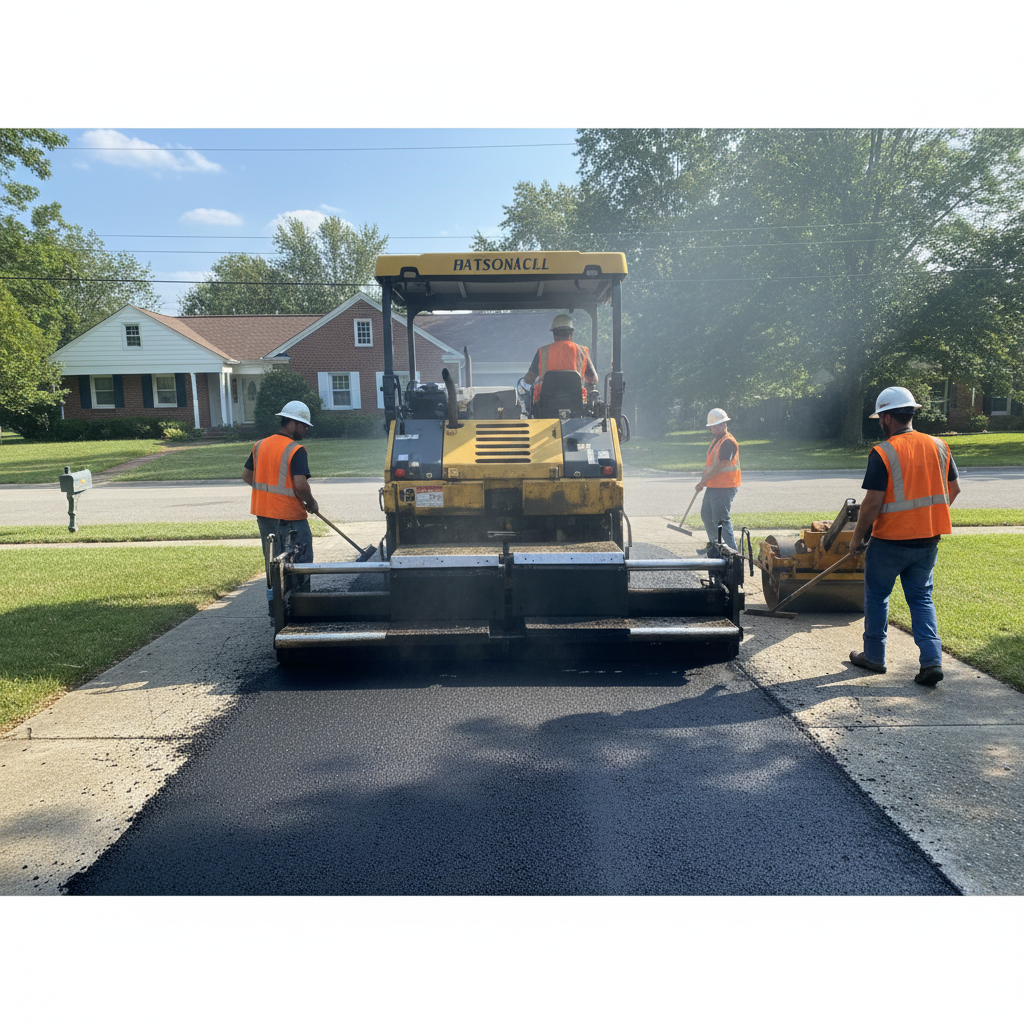
Driveway paving options and costs in Kincora
Kincora, Alberta sits in the Calgary region where winters are long and freeze–thaw cycles are a daily reality for roads and driveways. With a 2021 Census population of 7,030 and a neighbourhood mix dominated by private single-detached homes, most of the demand locally is for driveways that can handle daily vehicle traffic while staying stable through spring thaw and winter salt. (Statistics Canada, 2021 Census) In practice, that means contractors price not just the surface, but the groundwork—granular base, proper grading, and drainage—because frost can penetrate to about 1.2 m (4 ft) in this climate.
In Kincora (and nearby Rocky View County-style sites), quotes often swing because the paving season is compressed: hot-mix asphalt needs warm air for proper placement and compaction, so crews concentrate work late spring through early fall. That scheduling pressure can push per-square-foot pricing higher for smaller jobs when equipment and labour are in peak demand. Also, mobilization time to Kincora matters—sites around South Kincora and other semi-rural lots commonly require extra effort for access, staging, and waste haul-off.
Below is a practical comparison of the common driveway finishes that homeowners in Kincora consider, along with what you can typically expect for lifespan and maintenance. Use it to sanity-check any estimate you receive, then we’ll break down what drives the cost in Alberta.
| Material |
Lifespan |
Maintenance |
Best For |
Price per sq ft |
| Asphalt (new installation, proper base) |
15–20 years |
Seal 6–12 months after install, then every 3–5 years |
Budget-conscious driveways that want a smooth, dark finish |
$12–$20 |
| Asphalt (overlay on existing gravel base) |
12–18 years (depends on base quality) |
Seal every 3–5 years; more frequent crack monitoring |
When you already have a reasonably compacted, stable granular base |
$11–$17 |
| Interlocking concrete pavers |
25–35 years |
Routine brushing/cleaning; individual paver repairs as needed |
Curb appeal and easy section repairs without full replacement |
$18–$30 |
| Poured concrete (broom finish) |
20–30 years |
Seal periodically; crack repair as hairline cracks open |
Low-maintenance, clean look with consistent grades |
$15–$25 |
| Exposed aggregate concrete |
22–30 years |
Seal to reduce staining; surface touch-ups over time |
Texture and slip resistance for Alberta winter conditions |
$18–$28 |
| Gravel / crushed stone (budget option) |
5–10 years |
Regrading and topping up every 1–3 years |
Short-term solution or when drainage must “breathe” |
$6–$12 |
Prices are estimates only and vary by project scope, site access and material selection.
What affects the price of paving in Kincora
Even when you’re comparing the same driveway size in the Calgary region, quotes can vary by 30–50% because paving price isn’t just “surface.” It’s the full assembly: excavation, haul and disposal, granular base thickness, compaction, drainage correction, edge restraints, and—depending on the finish—reinforcement or geotextile. In Kincora, that variability tends to be sharper on smaller projects because the contractor still has mobilization costs, equipment staging, and a compressed work window late spring through early fall.
Frost line depth and freeze–thaw cycles are decisive cost factors here. Because frost can penetrate roughly 1.2 m (4 ft), the granular base needs to be thick and well-graded to reduce subgrade movement. That’s why you’ll commonly see deeper, compacted base requirements in Alberta compared with milder regions. If the base is too thin or poorly drained, water expands during freezing and the surface can crack, heave, or ravel—meaning contractors build a more robust foundation and spend more time on grading. Asphalt also has mix design requirements to perform through freeze–thaw; a freeze-thaw-rated mix typically costs more at the plant, and it’s reflected in per-square-foot pricing.
Two concrete examples from typical Kincora driveways: (1) If your slope pushes water toward the garage apron, adding drainage correction and regrading can move the job toward the higher end of the asphalt $12–$20 per sq ft band. (2) If you need full tear-out of old asphalt and concrete and haul it away, you may see totals more in line with the interlocking pavers $18–$30 per sq ft range because edge restraints and base work expand. Also, older properties with settled approaches often require additional base and sometimes thicker asphalt to stabilize the transition—small changes, but the dollar impact adds up quickly.
| Price Factor |
Why It Matters |
Cost Impact |
| Driveway area in sq ft |
Most labour and material quantities scale directly with square footage |
Often the single biggest driver (commonly 40%–70% of total variability) |
| Base depth required |
Frost line determines granular thickness to prevent heaving and cracking |
Extra 2 inches of properly compacted base can noticeably increase haul, material, and labour |
| Grading and drainage work |
Slope, ditch ties-in, and downspout runoff control protect the subgrade |
Can add significant cost when excavation and regrading are required |
| Tear-out of existing surface |
Old asphalt/concrete needs breaking, removal, and disposal |
Typically increases both labour hours and equipment time |
| Edge restraints and curbing |
Pavers and asphalt edges need restraint to resist lateral movement |
More edge linear footage increases material and setup time |
| Sealing requirement |
Asphalt performance depends on sealing 6–12 months after install |
Adds a future maintenance line item that should be budgeted |
| Site access |
Narrow lots slow equipment movement and complicate staging |
Can raise labour cost due to extra time and smaller lifts/loads |
| Asphalt mix specifications |
Freeze-thaw-rated mix improves durability in Alberta’s cycles |
Usually pushes the asphalt price toward the upper end of the band |
Permits & regulations in Alberta
For homeowners in Kincora, most private driveway paving on your own property typically does not require a building permit. The general idea in Alberta is that you’re improving your lot surface, not altering a municipal asset. Where it changes is when the work crosses into the municipal right-of-way—especially at the road edge. New or modified curb cuts (driveway entrances), changes to the boulevard, adjustments to storm drainage patterns, or any grading that affects municipal ditching usually requires municipal approval before the contractor excavates.
Start with a simple checklist: confirm where your driveway apron meets the road, then ask the municipality whether a permit or approval is needed for the specific approach width and drainage tie-in. You should also request utility locates before any digging. In Alberta, use Alberta One-Call so underground services are located and marked.
Next, verify your contractor properly. In Alberta, ask for: (1) your contractor’s Alberta licence and business details, (2) current liability insurance (ask for the certificate of insurance), and (3) proof of coverage for workplace injuries—commonly documented via WSIB/WCB coverage where applicable. A homeowner can check credibility by reviewing the contractor’s listing in the relevant online registries (licensing/business details), verifying that the certificate of insurance matches the legal business name and covers the address area, and requesting a clearance letter or documentation if the contractor’s trade coverage requires it for projects.
Asphalt vs pavers vs concrete for Kincora driveways
Choosing a driveway finish in Kincora comes down to how each material handles freeze–thaw, winter maintenance, and how you prefer to manage repairs. Asphalt typically has the lowest upfront cost (often falling within $12–$20 per sq ft) and gives a smooth, consistent driving surface, but it relies on proper sealing after installation (generally 6–12 months) and then recurring sealcoating every 3–5 years. Without sealing, surface oxidation accelerates and small cracks can widen faster.
Interlocking concrete pavers cost more upfront—frequently within $18–$30 per sq ft—but they’re highly serviceable. If a section settles after winter, a contractor can lift and re-set the affected area instead of replacing the entire driveway. In freeze–thaw conditions, that localized repair flexibility is a big advantage, especially on driveways with transitions or drainage challenges.
Poured concrete is often a mid-range choice (commonly $15–$25 per sq ft) and can last 20–30 years when it’s air-entrained and placed over a well-prepared base. Concrete is still vulnerable to freeze–thaw and can be affected by de-icing salt and thermal shock if not specified correctly, so it’s important the contractor uses the right mix and joints.
Concrete base prep is critical across all three: deeper, compacted granular base layers and excellent drainage are what prevent heaving and cracking. With Kincora’s winter routine—plowing, salting, and sand—pavers and properly air-entrained concrete generally tolerate wear better at the surface. A real-world example: if a 400 sq ft asphalt driveway lands around $5,000 – $8,000, pavers might push closer to $7,200 – $12,000, but the ability to replace a small failed zone can justify the difference when you expect settlement near edges or downspout runoff.
| Material |
Frost Resistance |
Curb Appeal |
Repair Method |
Lifespan |
Price Band |
| Asphalt (sealed regularly) |
Good with proper base, drainage, and freeze-thaw-rated mix |
Low to medium (dark, clean look) |
Patch the failed area; re-cut and pave spot repairs |
15–20 years |
$12–$20 |
| Interlocking concrete pavers |
Very good; tolerates localized movement when edged and bedded correctly |
High (styles, colours, clean lines) |
Liftoff and re-set individual pavers/sections |
25–35 years |
$18–$30 |
| Poured concrete (air-entrained) |
Good when air-entrained and properly jointed over stable base |
Medium to high (clean broom finish) |
Crack repair and patching; full replacement only if widespread |
20–30 years |
$15–$25 |
| Exposed aggregate concrete |
Good; surface texture hides minor wear better |
High (decorative finish) |
Limited patching options; section repairs can be blended |
22–30 years |
$18–$28 |
| Permeable pavers (drainage grid) |
Very good where designed to manage water effectively |
High (clean modern look) |
Re-set individual pavers; maintain drainage layer |
25–35 years (with proper maintenance) |
$22–$35 |
| Chip seal / tar-and-chip |
Moderate; depends heavily on base and maintenance |
Low to medium (texture finish) |
Maintenance re-seal/patch; less “clean” spot repair |
7–12 years |
$8–$14 |
How to choose a paving contractor in Kincora
Start by verifying the basics for paving contractors in Alberta: licensing/business legitimacy, liability insurance, and workplace coverage (WSIB/WCB documentation). In Kincora, ask for (and keep copies of) the certificate of insurance showing coverage amounts and the legal business name matching the contract. For workplace injury coverage, request current proof of clearance or coverage documentation as applicable. Then verify the contractor’s registration/licence information through the appropriate online registries (and confirm the contractor’s contact/address details are consistent across proposals and invoices).
Next, get 2–3 itemised written quotes rather than one lump sum. You want line items that separate excavation/haul, granular base and compaction, geotextile (if needed), asphalt or concrete quantities, edge restraints, and any drainage corrections. Read the scope carefully: what’s included and what’s excluded (permit fees, disposal, saw-cutting limits, trucking distances, and patching transitions)? A quote that doesn’t specify disposal or drainage often “finds” extra costs after mobilization.
Warranty matters. Ask for workmanship warranty length, whether product/manufacturer warranties apply (especially for concrete mixes, paver manufacturers, or asphalt mix), and whether the warranty is transferable if you sell your home. For payment scheduling, never pay more than 10–15% upfront; hold back a portion until the job is complete and clean-up is satisfactory. Finally, insist on timeline details in writing—start date, curing/seasonal constraints, and estimated completion—so you can align with the short Kincora paving window.
- Confirm the contractor’s Alberta licence/business registration before signing.
- Request a current certificate of liability insurance and verify it matches the legal name on the contract.
- Ask for WSIB/WCB clearance or proof of coverage (as applicable) and keep it on file.
- Get itemised quotes: excavation, base materials, drainage, surface material, and compaction steps.
- Insist on base specs: granular type, thickness, and compaction requirements (not just “put in base”).
- Verify drainage plan: slope direction, ties into existing catch basins/ditches, and water management.
- Confirm edge restraint details (paver edging, curbing, asphalt edge support) and linear footage.
- Ask whether utility locates are included and who coordinates Alberta One-Call.
- Clarify tear-out scope and disposal: what is removed, where it goes, and how much is hauled.
- Check for permit/approval responsibility if work touches the right-of-way or curb cut area.
- Review warranty: workmanship duration, exclusions, and whether it’s transferable.
- Use a payment schedule with a holdback until final grading and clean-up are done.
In Kincora, red flags include: contractors who won’t provide written, itemised scope; no proof of insurance or workplace coverage; promises of “one-and-done” asphalt without sealing; unclear drainage/grading plans for frost protection; and pressure to pay the majority upfront or to start without confirming utility locates and site prep.
Frequently asked questions — paving in Kincora
What is a chip seal driveway and is it suited to Kincora?
Chip seal (also called tar-and-chip) is a layer of bitumen sprayed onto a prepared base, followed by aggregate chips rolled into place. In Kincora and across the Calgary region’s freeze–thaw climate, it can work on some driveways, but it’s usually less durable than properly constructed asphalt or pavers because it’s more dependent on base stability and regular maintenance. It’s also more sensitive to surface raveling if drainage isn’t right. If you want the most predictable longevity for winter plowing and salting, many homeowners choose asphalt within the typical $12–$20 per sq ft band or interlocking pavers when curb appeal and repairability matter. A contractor should show you the proposed base build-up and drainage tie-ins before recommending chip seal.
How much does driveway crack repair cost in Kincora?
In Alberta, crack repair cost depends on whether it’s a hairline surface crack or a wider opening caused by base movement or poor drainage. For a typical Kincora homeowner, small spot repairs (cleaning, routing if needed, and filling) may be priced per linear foot, plus labour and mobilization. If the cracks indicate settlement or frost heaving, the solution may require localized base correction—then the cost rises because you’re effectively doing partial rebuild work. As a benchmark, sealing and crack control are often a cheaper “maintenance lane” that helps extend asphalt life, whereas extensive repair steps can move you closer to the broader paving pricing you’d see in the $12–$20 per sq ft asphalt range. Get a contractor to identify whether the crack is surface-only or structural.
What base thickness do I need for pavers in Kincora?
Paver base thickness in Kincora should be based on soil conditions, frost protection needs, and your driveway load (passenger vehicles vs. frequent heavy equipment). With Alberta’s freeze–thaw cycles and frost penetration approaching 1.2 m (4 ft), you generally need a well-compacted granular base thick enough to prevent upward movement and keep water from migrating into the subgrade. In practical terms, many Calgary-area installs use a compacted granular base in the range of several inches, plus paver bedding sand, with thickness increased where soils are weaker or drainage is challenging. The right answer isn’t a single number—it’s a design built from site conditions, grading, and drainage. Ask your installer to state the exact granular type, thickness, and compaction passes in writing.
How do I get the most accurate paving quote in Kincora?
To get an accurate quote in Kincora, start with a site visit and measurements—photos aren’t enough if drainage and edge conditions vary. Provide the contractor access to confirm: existing base condition (especially if overlaying), any required tear-out limits, slope, and where runoff goes during spring thaw. Make sure the estimate is itemised so you can compare like-for-like: excavation and disposal, granular base thickness and materials, drainage corrections, edge restraints, and the surface system. Ask whether the quote includes utility locates coordination (via Alberta One-Call) and whether right-of-way approvals are needed for your driveway approach. Finally, confirm the material specifications are freeze–thaw appropriate—ask how the asphalt mix meets local performance needs or what concrete mix (including air entrainment) will be used.
How much does it cost to pave a driveway in Kincora?
Driveway paving cost in Kincora is usually priced per square foot, with totals driven by area, base depth, tear-out, and drainage corrections. For asphalt driveway paving, homeowners commonly see estimates in the $12–$20 per sq ft range when a proper base is built for Alberta frost conditions. Interlocking concrete pavers typically run higher at $18–$30 per sq ft, mainly because of base preparation, bedding, and edging. Poured concrete often lands around $15–$25 per sq ft, depending on finish and reinforcement needs. If your driveway is small and the contractor still needs full mobilization and extra access work, the per-square-foot unit cost can lean toward the upper end of these bands. A firm quote should also address disposal, grading, and drainage.
Asphalt vs interlocking pavers vs concrete — which is best in Kincora?
In Kincora’s Alberta freeze–thaw climate, there isn’t one “best” option for every homeowner—it’s best-fit. Asphalt is usually best for cost-efficiency and a smooth driving surface, provided you seal after install and keep up with maintenance; it often sits in the $12–$20 per sq ft range. Interlocking pavers are ideal when curb appeal and repairability matter most: you can lift and re-set damaged sections instead of replacing everything, and pricing often fits the $18–$30 per sq ft range. Poured concrete can be a great mid-range choice when it’s air-entrained and installed over a stable, drained base; it’s commonly around $15–$25 per sq ft. If your driveway experiences runoff toward the apron or edge settlement, pavers or well-specified concrete often hold up better with winter sanding/salting routines.