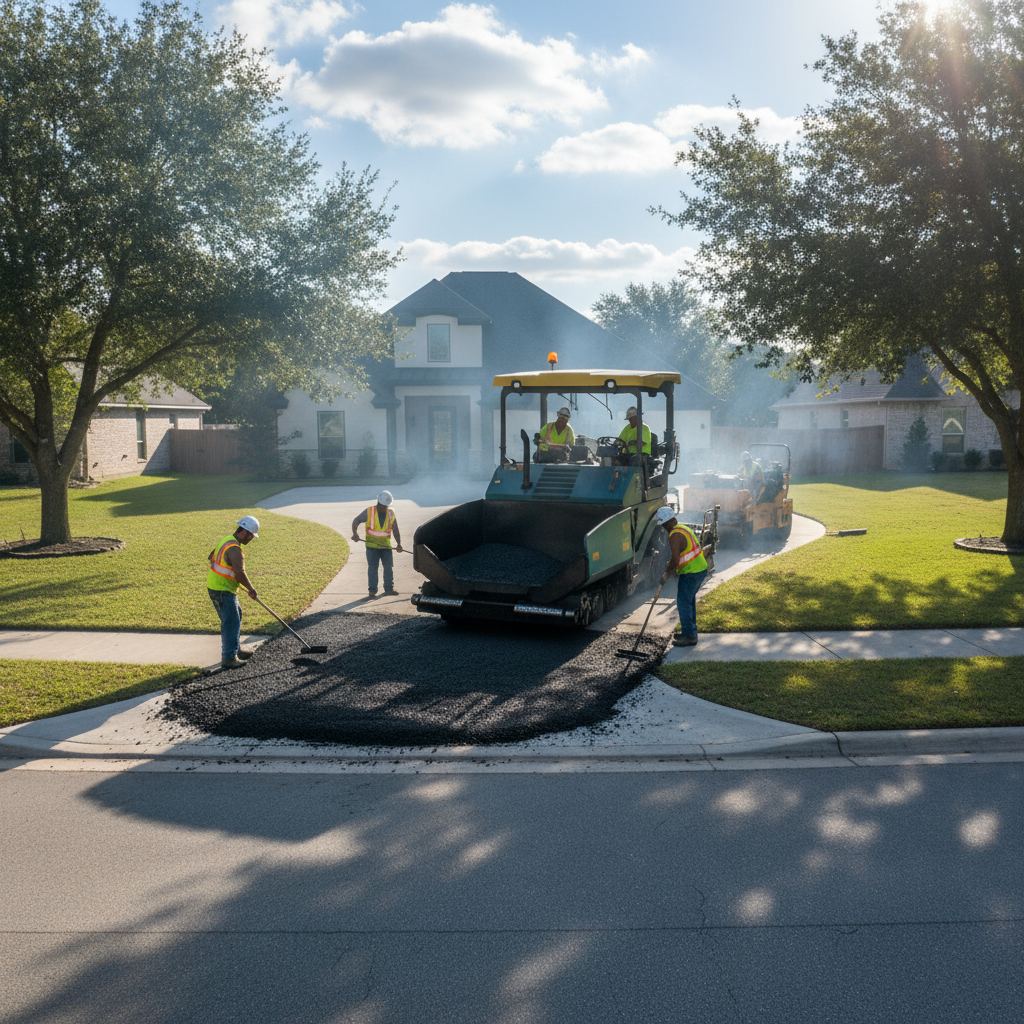
Driveway paving options and costs in Stittsville
Stittsville homeowners typically have three main paths when it comes to paving: asphalt, interlocking pavers, and concrete. With a population of 40,889 (Statistics Canada, 2021 Census), and a steady mix of family homes throughout town, demand is strongest for durable, salt-tolerant surfaces that can handle Ottawa-area freeze–thaw cycles. In Stittsville, the common driveway type is attached to single-family housing, which usually means a straightforward access footprint—but it also means most projects involve meaningful excavation and base rebuilds once contractors find soft spots or drainage issues.
Pricing here isn’t just about the surface material. Ottawa’s frost depth (often modelled around 1.8 m) pushes contractors to design thicker, well-compacted granular bases and stronger drainage away from the house to reduce heaving and cracking. That deeper base requirement increases material quantities and excavation time. Also, the paving season is shorter: hot-mix asphalt needs proper curing conditions, which compresses scheduling into warmer, drier months and can raise labour costs when crews are booked.
You’ll often see the biggest differences between quotes come from how much tear-out is required, whether geotextile and edge restraints are included, and whether drainage is corrected before paving. In neighbourhoods like the Beaverbrook area and around the Stittsville core (including parts near Hazeldean Rd), contractors are especially busy because many driveways were built decades ago and are now due for re-grading and base upgrades. Use the table below as a realistic comparison starting point for budgeting, then we can narrow it to your exact scope.
| Material |
Lifespan |
Maintenance |
Best For |
Price per sq ft |
Price Range |
| Asphalt (new installation, proper base) |
15–25 years |
Seal every 3–5 years; patch as needed |
Lowest upfront cost with good performance if base/drainage are engineered |
$6.50–$10.50 |
$4,500–$9,000 |
| Asphalt (overlay on existing gravel base) |
10–18 years |
Seal every 3–5 years; more frequent patching |
Budget-friendly resurfacing when base is confirmed strong |
$5.50–$9.00 |
$4,500–$8,000 |
| Interlocking concrete pavers |
25–40 years |
Rake/joint sand top-ups; lift-and-relay repairs |
Curb appeal and easy repairs without replacing the entire driveway |
$11.00–$18.00 |
$6,000–$15,000 |
| Poured concrete (broom finish) |
25–35 years |
Limited routine upkeep; seal optional every 5–7 years |
Clean, simple look; strong structure if correctly formed and air-entrained |
$10.00–$16.00 |
$7,000–$16,000 |
| Exposed aggregate concrete |
25–35 years |
Occasional cleaning; seal optional depending on finish |
Slip resistance and premium appearance |
$12.00–$18.50 |
$8,500–$17,500 |
| Gravel / crushed stone (budget option) |
5–12 years |
Rake and top-ups; weed control; re-grade periodically |
Short-term solution or rural-style budgets |
$3.50–$6.50 |
$2,000–$5,000 |
Prices are estimates only and vary by project scope, site access and material selection.
What affects the price of paving in Stittsville
In the Ottawa economic region, two quotes for the same-looking driveway can vary by 30–50% because the work underneath the surface often isn’t the same. The “surface” line item is only one part of the budget: contractors may need to rebuild subgrade, add a geotextile separator, increase compacted crushed stone depth, rework slopes, and improve drainage so water can’t freeze and expand under the pavement. In Stittsville, that deeper build is commonly driven by frost modelling around 1.8 m, which means you typically need a stronger granular base section than you would in milder climates.
Freeze–thaw cycles matter for both asphalt and interlock. When bases are undersized or drainage is off, water migrates upward and causes heaving, joint movement, and cracking. That’s why many Ottawa-area bids include heavier-duty base and sometimes edge restraints—both increase material and labour costs. Asphalt is also time-sensitive: hot-mix asphalt generally requires air temperatures above 10°C for proper placement and compaction, so the shorter paving season concentrates demand in spring and summer. Mix design has to be freeze–thaw rated for the local climate, which can add cost compared with generic mixes.
Concrete can also move in winter if it isn’t properly air-entrained and detailed for freeze–thaw. For example, a driveway with a poor slope toward the house can cost more because regrading is needed before paving. Conversely, if your existing base tests solid and drainage is already corrected, you may stay closer to the asphalt new-install band around $4,500–$9,000 rather than drifting upward once extensive excavation starts. Older neighbourhood driveways around the Stittsville core often show settlement from decades of frost movement, and that can add thousands once the contractor has to haul out and replace soft subgrade.
| Price Factor |
Why It Matters |
Cost Impact |
| Driveway area in sq ft |
Most costs scale directly with paved square footage plus base thickness. |
Major driver (often 50–70% of total) |
| Base depth required |
Frost depth and local soil conditions determine how thick the compacted granular layer must be. |
High impact (more excavation and stone) |
| Grading and drainage work |
Correct slopes and ensure water runs away from the foundation to reduce freeze–thaw damage. |
Moderate to high impact |
| Tear-out of existing surface |
Breaking and hauling old asphalt or concrete adds labour, disposal, and base replacement. |
Moderate to very high impact |
| Edge restraints and curbing |
Pavers need restraints to prevent lateral spread; asphalt benefits from defined edges. |
Moderate impact |
| Sealing requirement |
Asphalt needs sealing after curing (commonly 6–12 months, then on a cycle) to slow oxidation and raveling. |
Low to moderate (recurring over time) |
| Site access |
Narrow gates, long distances, or soft lawns increase setup time and equipment handling. |
Moderate impact |
| Asphalt mix specifications |
Freeze–thaw rated mix design and proper binder content can cost more but improves performance. |
Small to moderate impact |
Permits & regulations in Ontario
In Ontario, paving a private driveway within your own property usually doesn’t need a building permit when you’re staying within the existing footprint and not altering storm drainage. However, work that affects the municipal right-of-way typically does require approval—especially if you’re doing a new curb cut, changing the boulevard/sidewalk area, or modifying stormwater patterns. If your project involves altering catch basins, changing how surface water flows across municipal property, or you’re reworking the municipal connection area, plan for municipal review before excavation.
Before any contractor digs, confirm utility locates through Ontario One Call so they can mark buried services. Then you can proceed safely with excavation, cutting, and base installation without hitting lines or damaging nearby infrastructure.
To verify your contractor in Stittsville step-by-step, start by checking their Ontario business details and trade qualifications through publicly available registries (where applicable for their business type). Next, ask for a certificate of insurance showing general liability—review the coverage limits and ensure it lists you as an additional insured where possible. For work involving injuries or subcontracted labour, confirm they have current WSIB coverage (or valid clearance documentation, where applicable). Finally, request the contractor’s written scope for excavation, base, paving, and disposal so you know exactly what’s covered and what is not.
Asphalt vs pavers vs concrete for Stittsville driveways
For Stittsville’s freeze–thaw climate, asphalt, interlocking pavers, and concrete can all perform—if the base and drainage are engineered to handle water movement through winter. Asphalt typically offers the lowest upfront cost, but it relies on proper sealing and a well-prepared granular base to prevent raveling and cracking. Interlocking concrete pavers cost more up front, yet they’re the most flexible for repairs because a contractor can lift and replace only the affected stones if a utility trench was previously patched or if a spot settles. Poured concrete sits in the middle for price and can be very durable when properly air-entrained, but it can still crack over time if joints, thickness, and subgrade are not detailed for Ottawa-area winter stress and de-icing salt.
Because Ottawa-area frost is commonly modelled around 1.8 m, contractors usually build deeper compacted base and pay close attention to slope toward a safe drainage pathway. If your driveway drains poorly toward the garage or foundation, all three materials become more expensive because grading corrections are required first. In a typical Stittsville scenario—say a 600–700 sq ft driveway—choosing pavers over asphalt may be justified when you want curb appeal and the ability to fix localized failures without full replacement. If you want a clean comparison: asphalt new installation commonly falls into $4,500–$9,000, while pavers commonly land in the $6,000–$15,000 band depending on edge details, excavation, and base thickness. If your goal is a premium look near the front entry and you anticipate needing repairs later (utility access, small settling), pavers often earn their cost. If your main priority is value and quick installation, asphalt is usually the practical choice—provided sealing is planned.
| Material |
Frost Resistance |
Curb Appeal |
Repair Method |
Lifespan |
Price Band |
| Asphalt (sealed regularly) |
Good with engineered base and proper drainage; seal helps resist raveling |
Medium (clean, uniform finish) |
Cut out and patch small areas; full resurfacing later if needed |
15–25 years |
$4,500–$9,000 |
| Interlocking concrete pavers |
Very good when base, geotextile, and edge restraints are installed correctly |
High (varied patterns and colours) |
Lift/replace individual stones; re-sand joints and reset |
25–40 years |
$6,000–$15,000 |
| Poured concrete (air-entrained) |
Good with air-entrainment and correct thickness/joints |
Medium to high (depends on finish) |
Diamond grind/patch localized areas; full replacement for widespread issues |
25–35 years |
$7,000–$16,000 |
| Exposed aggregate concrete |
Good; surface texture can improve slip resistance under plough/salt cycles |
Very high (premium appearance) |
Localized patching is possible but usually visible; sometimes recoat/overlay options |
25–35 years |
$8,500–$17,500 |
| Permeable pavers (drainage grid) |
Good if designed for soils and water handling; reduces standing water |
Medium to high (technical look) |
Lift/replace affected units; periodic cleaning of openings |
20–35 years |
$9,000–$18,000 |
| Chip seal / tar-and-chip |
Moderate; performance depends heavily on base and Ottawa freeze–thaw durability |
Low to medium |
Spot patch and re-chip over time |
7–15 years |
$3,500–$7,000 |
How to choose a paving contractor in Stittsville
Start by confirming your contractor is set up for Ontario paving work. Ask for their current business documentation, then request a certificate of general liability insurance and review the coverage limits and policy dates. Next, confirm WSIB coverage or provide a valid clearance letter where applicable for their employment/work model—don’t assume it. If subcontractors are used, require proof they’re covered as well.
For pricing, get 2–3 itemised written quotes (labour + materials + equipment) rather than a single lump sum. The best quotes separate excavation and disposal, base stone supply and compaction, geotextile/edge restraints, and the paving surface. Read the exclusions: are permits included (when needed), is soil disposal included, and does the scope cover re-grading at the garage entrance/low points? Also ask how they handle drainage corrections—especially important in Stittsville where winter water movement is a common cause of early failure.
Warranty matters for workmanship. Ask: how many years for installation, does it cover labour only or materials too, and is it transferable if you sell your home? For payment, a practical rule is never more than 10–15% upfront; hold back a meaningful portion until completion and final grading checks. Finally, demand a start date and estimated completion timeline in writing, since the paving window is limited by temperature and rain in the Ottawa area.
- Verify WSIB clearance/coverage (request documentation).
- Confirm current liability insurance and ask for proof.
- Request an itemised quote with excavation, base, paving, and disposal separated.
- Ask whether geotextile and edge restraints are included.
- Confirm how drainage will be corrected (slope and water routing).
- Check if tear-out is included and how hauling/disposal is priced.
- Clarify compaction/testing process for the base.
- Ask for the asphalt mix type and freeze–thaw suitability.
- Confirm sealing timing for asphalt (often after proper curing, commonly 6–12 months).
- Read the warranty terms for labour and materials.
- Review the payment schedule; avoid large upfront payments.
- Get the start and completion dates in writing.
Red flags in Stittsville: a contractor who won’t show insurance/WSIB proof, vague scopes that don’t specify base depth and drainage work, pressure for full payment upfront, no written warranty terms, and ignoring the need for sealing (or refusing to discuss it for asphalt) despite our freeze–thaw and salt environment.
Frequently asked questions — paving in Stittsville
How do I compare paving quotes fairly?
In Stittsville (Ottawa area), compare quotes on the scope beneath the surface, not just the total price. Ask each contractor for an itemised breakdown: excavation and disposal, granular base thickness, whether geotextile is included, edge restraints/curbing, compaction steps, and the finish course. The same driveway can swing by 30–50% if one quote includes proper drainage corrections and another assumes the existing base is “good enough.” Also check what’s excluded—permit/municipal approval work (if it touches the right-of-way), haul-away, and asphalt sealing timing for new installs. For budgeting, you can sanity-check whether the quote aligns with typical local bands such as asphalt new installation around $4,500–$9,000 or pavers in the $6,000–$15,000 range.
Can asphalt be laid in cold weather in Stittsville?
You can’t treat asphalt like a “set and forget” product in Stittsville. Hot-mix asphalt generally needs adequate air temperatures for proper placement, compaction, and curing—commonly air temperatures above 10°C for reliable results. When crews lay too early or during cold, damp conditions, the mix may not compact correctly, which increases the chance of early raveling and cracking once freeze–thaw cycles begin. Ottawa’s winter movement is unforgiving, and water trapped in the pavement structure can worsen damage. A reputable contractor will schedule work based on weather windows, moisture conditions, and surface temperature, and they’ll explain the plan if rain or cold snaps threaten the paving season.
What is a driveway apron and do I need one in Stittsville?
A driveway apron is the transition section that typically connects your driveway surface to the roadway/municipal connection area (often at the curb cut or edge where different materials meet). Whether you need one depends on what you’re changing and where the driveway meets the street or boulevard. If you’re improving a connection near the municipal right-of-way, you may need an approved apron approach and grading so stormwater doesn’t pond and freeze. If your project stays entirely within your private property and doesn’t alter the municipal interface, you may not need a “formal apron,” but you still want a smooth transition that matches grades. Ask your contractor to specify the exact connection details in the written scope and confirm if municipal approval is required for your curb cut or drainage changes.
How do I maintain my driveway through Stittsville winters?
For Stittsville winters, maintenance is about controlling water and avoiding mechanical damage. Keep an eye on low spots where meltwater can collect; even small puddles freeze repeatedly and can contribute to surface breakdown during Ottawa-area freeze–thaw cycles. Use snow removal practices that protect the edges—don’t scrape aggressively at paver joints or asphalt margins. For asphalt, avoid frequent high-heat or harsh de-icing that can accelerate wear, and if you salt, do it sensibly to prevent unnecessary chemical attack on the surface. For pavers, check joint sand after big storms so stones remain supported. If you see raveling or small cracks early in the season, prompt patching is usually cheaper than waiting for full replacement later.
Is it worth sealing a new driveway right away in Stittsville?
In most Stittsville cases, you shouldn’t seal immediately. Asphalt needs time to cure so moisture and volatiles can dissipate; sealing too early can trap moisture and lead to premature failure. Many contractors recommend sealing after proper curing—often around 6–12 months for a new driveway—then putting it on a maintenance cycle based on traffic and weather exposure. The benefit is real in Ottawa’s conditions: sealing helps slow oxidation and reduces water penetration, which matters when freeze–thaw cycles repeatedly stress the pavement. If you’re comparing quotes, ask whether sealing is included and what product is proposed. Your budget planning can reflect that ongoing maintenance; sealing is commonly in the $400–$2,000 range depending on size and condition.
What is a chip seal driveway and is it suited to Stittsville?
Chip seal (tar-and-chip) is a surface treatment where binder is applied and aggregate is broadcast, creating a textured, compacted riding surface. It can be a budget-friendly option, but suitability depends heavily on base quality and how well the driveway drains—because poor base/drainage turns winter into a faster wear cycle. In Stittsville, the Ottawa region’s freeze–thaw activity and salt use can reduce its lifespan compared to asphalt or concrete, and you may need re-chipping or spot repairs over time. Chip seal can still work if your contractor designs a solid base, handles edges properly, and manages water away from the structure. If you want a low upfront cost, chip seal can be a short-to-mid term solution, but for long-term durability many homeowners choose asphalt (with sealing) or pavers.