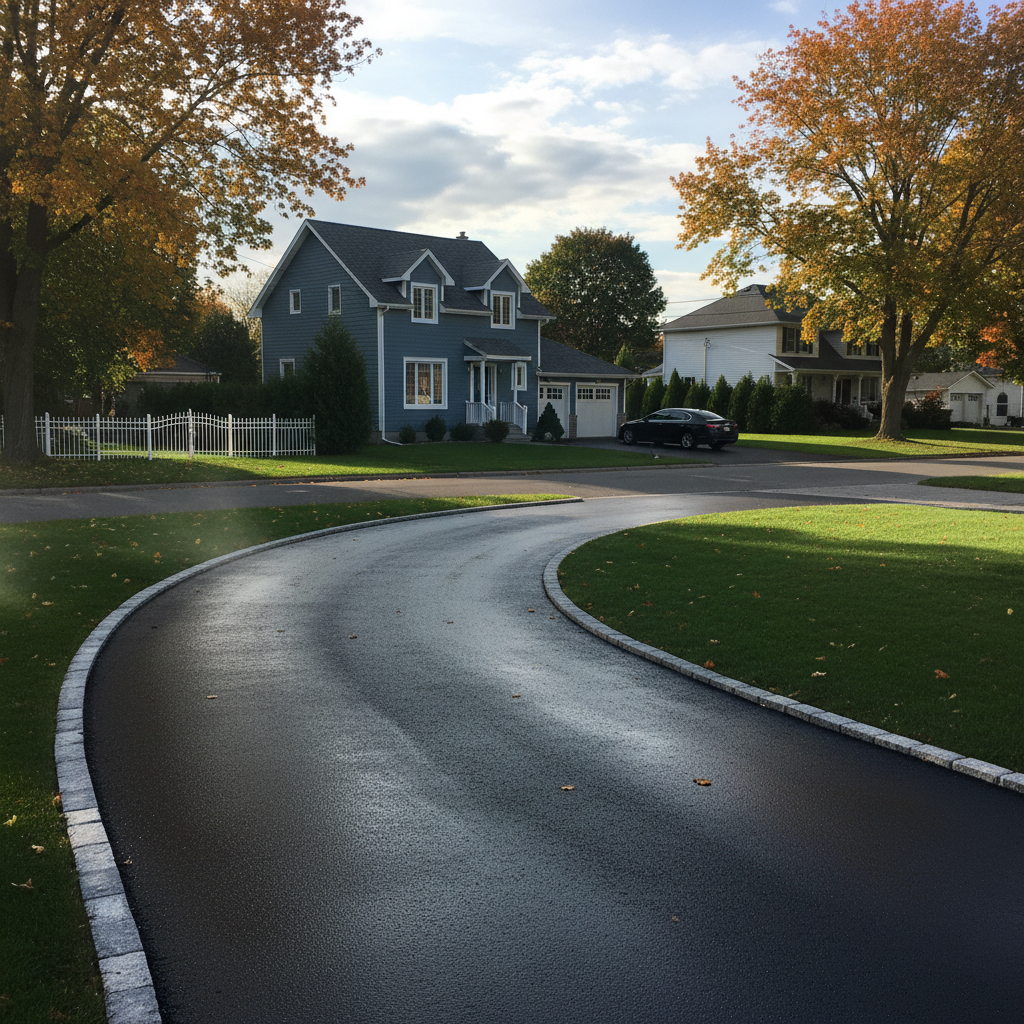
Driveway paving options and costs in Mississauga Beach
In Mississauga Beach, choosing driveway paving is mostly about balancing upfront cost with how well the surface survives Ontario’s freeze–thaw seasons. With a population of 4,662 (Statistics Canada, 2021 Census), this is a smaller market than downtown Toronto, but you still feel Toronto-area pricing pressure during prime spring and early-fall dates. Most private driveways here service detached homes, so the “typical” driveway layout—straight run to the garage, tight edges near landscaping, and a lot of snow-plow traffic—strongly influences material choice and the amount of excavation and base required.
Toronto-area frost depth (roughly 3–4 feet) means even routine driveways need deeper, well-compacted granular base and reliable drainage so water doesn’t sit under the pavement and then expand when it freezes. That adds material, labour, and inspection time, and it also shortens the paving window because hot-mix asphalt should generally be placed when air/road temperatures are workable (above about 10°C). Availability can tighten in the busiest months, so the “same driveway” can quote higher if you’re booking a rush date.
If you’re in the Lakefront area or along busier arterial access routes, we often see higher demand for clean, neat edges and dependable drainage because runoff patterns and plow approach lines tend to be consistent. From there, it usually comes down to asphalt versus interlocking pavers versus concrete—and the table below gives you practical cost ranges you can use when comparing quotes.
| Material |
Lifespan |
Maintenance |
Best For |
Price per sq ft |
Price Range |
| Asphalt (new installation, proper base) |
15–25 years |
Seal every 3–5 years; crack fill as needed |
Best value when you want a smooth, quiet surface |
$6.50–$10.50 |
$3,500–$8,000 |
| Asphalt (overlay on existing gravel base) |
10–18 years |
Seal every 3–5 years; patching if base settles |
Lower-cost start when the old base is mostly stable |
$5.75–$9.00 |
$3,000–$7,200 |
| Interlocking concrete pavers |
25–35 years |
Joint sand top-up; replace individual stones if damaged |
Maximum curb appeal and easy, localized repairs |
$18–$28 |
$9,000–$20,000 |
| Poured concrete (broom finish) |
20–30 years |
Seal when recommended; repair cracks early |
When you want simple lines and low visual maintenance |
$12–$20 |
$6,000–$15,000 |
| Exposed aggregate concrete |
20–30 years |
Seal as advised; keep drainage working |
Slip resistance and a decorative look |
$15–$24 |
$7,000–$16,500 |
| Gravel / crushed stone (budget option) |
3–10 years |
Rake and top-up annually; re-grade as needed |
Temporary or low-budget solution |
$3.00–$6.00 |
$1,800–$5,500 |
Prices are estimates only and vary by project scope, site access and material selection.
What affects the price of paving in Mississauga Beach
In Toronto and across Ontario, you’ll often see quotes for the “same” driveway swing by 30–50% because paving pricing isn’t just the top layer—it’s the engineered base, excavation, drainage corrections, traffic-control, and the labour timing tied to the weather window. In Mississauga Beach, even if the job seems straightforward, deeper frost protection and dependable drainage are non-negotiable due to Ontario’s freeze–thaw behaviour. Frost depth studies in the Toronto economic region show ground freezing to roughly 3–4 feet, which pushes contractors toward thicker compacted granular layers (often 6–12 inches of granular and sometimes more depending on conditions) so the pavement doesn’t heave and crack when ice forms below.
Toronto-area late fall through early spring freeze–thaw cycles also matter for asphalt mix design. Hot-mix asphalt needs workable air/road temperatures (commonly above about 10°C), so your paving schedule compresses into late spring through early fall. That means peak demand in a few months can raise costs—especially if a crew is juggling multiple residential jobs. Asphalt that’s built to local freeze–thaw specifications generally costs more than a basic mix, but it performs better over time.
Concrete costs can vary too. For example, an air-entrained mix helps concrete resist freeze scaling, but it may slightly increase material cost. Cutting and controlling joints for long driveway runs can add labour, yet it reduces random cracking. If your driveway already has an unstable gravel base or poor drainage, tear-out and base rebuild work can push you toward the higher end of the asphalt range (for example, closer to $3,500–$8,000), whereas a well-prepped base can keep pricing nearer the lower end. If you’re comparing to pavers, the bigger driver is usually base and edge restraints; once those are done correctly, the investment aligns with the higher band of $9,000–$20,000 for interlocking.
| Price Factor |
Why It Matters |
Cost Impact |
| Driveway area in sq ft |
More surface means more asphalt/concrete/pavers and more base preparation |
High (typically the biggest driver of total cost) |
| Base depth required |
Frost line depth determines granular thickness to prevent heaving and cracking |
High (thicker base increases excavation, hauling, and compaction) |
| Grading and drainage work |
Proper slope, crown, and drainage prevent water from sitting under the surface |
Medium to High (can be major if the site sheds poorly) |
| Tear-out of existing surface |
Removing old asphalt or concrete adds breaking time, hauling, and disposal |
Medium to High (especially for reinforced concrete) |
| Edge restraints and curbing |
Stops pavers/spread and keeps asphalt from raveling at the perimeter |
Medium (material + extra labour) |
| Sealing requirement |
Asphalt needs sealing after the surface cures (often after 6–12 months) |
Low to Medium (adds a future cost but protects the surface) |
| Site access |
Narrow lots slow equipment movement and increase manual handling |
Medium (labour time increases) |
| Asphalt mix specifications |
Freeze–thaw-rated mixes cost more and help resist winter deterioration |
Medium (but often improves long-term performance) |
Permits & regulations in Ontario
In Ontario, paving a private driveway on your own property typically does not require a building permit. Where approvals do come into play is when you change municipal infrastructure in the right-of-way, such as altering the curb line for a new or modified driveway apron, creating or changing curb cuts, or modifying storm drainage tied to the boulevard. Also, some municipalities enforce lot-grading rules that restrict how close hard surfaces and drainage outlets can be to property lines or how runoff must be directed. For Mississauga Beach homeowners, the practical takeaway is this: if your plan affects the boulevard, curb, or how water drains to municipal systems, you should expect municipal approval before excavation.
Step one is always utility locates. Call Ontario One Call before digging so you don’t hit buried services. Next, confirm your lot-grading and drainage expectations with the municipality and ask whether any approvals are required for your specific driveway width, slope changes, or tie-in to existing drainage. When you hire a contractor, don’t skip verification: ask for their Ontario licence (through the relevant public registry listing), a current certificate of liability insurance, and WSIB coverage information or a clearance letter/coverage proof consistent with their obligations. If they can’t provide these documents up front, treat it as a risk—especially when your job includes excavation and tear-out.
Asphalt vs pavers vs concrete for Mississauga Beach driveways
For Mississauga Beach driveways, freeze–thaw performance and winter maintenance habits are the deciding factors. Asphalt usually has the lowest upfront cost and tends to feel smoother for daily driving, but it relies on good base prep and regular sealing (often every 3–5 years) to resist winter water intrusion. Interlocking concrete pavers cost more initially, yet they handle Ontario winters extremely well when the base is engineered correctly: individual units can be reset or replaced without ripping out the entire driveway, and the joints tolerate minor movement. Poured concrete sits in the middle on cost, but it must be air-entrained and properly detailed with control joints and drainage to avoid cracking from freeze–thaw and salt exposure from winter sanding and plowing.
Toronto’s frost conditions (ground freezing to roughly 3–4 feet) mean all three options need a well-compacted granular base and drainage design that prevents water pooling. Asphalt and concrete also depend on curing and mix design. In practice, asphalt performs best when the subgrade is stable and the driveway edges are restrained; otherwise you get cracking around the perimeter where water migrates. Pavers generally hold up best to seasonal movement, especially when interlock edging and polymeric joint sand are installed correctly.
Here’s where the price difference is justified: if a typical asphalt driveway is quoted around $3,500–$8,000, a comparable paver driveway may land in the $9,000–$20,000 band because of base depth attention and the materials/crew time for interlock. If you want long-term curb appeal and the ability to repair isolated areas after winter damage, pavers are often the more cost-effective choice over many years—especially in a place like the Lakefront area where homeowners expect their driveway to look sharp year-round.
| Material |
Frost Resistance |
Curb Appeal |
Repair Method |
Lifespan |
Price Band |
| Asphalt (sealed regularly) |
Good with proper base and drainage; seal helps block water |
Medium (clean and smooth) |
Crack fill, patching, and localized resurfacing |
15–25 years |
$3,500–$8,000 |
| Interlocking concrete pavers |
Very good when base is engineered and joints are maintained |
High (visual upgrade) |
Lift and replace individual pavers; re-sand joints |
25–35 years |
$9,000–$20,000 |
| Poured concrete (air-entrained) |
Good with air-entrainment and correct joints |
Medium (depends on finish) |
Crack repair + patching; sometimes sealing over time |
20–30 years |
$6,000–$15,000 |
| Exposed aggregate concrete |
Good with proper mix and drainage |
High (decorative texture) |
Patch and re-finish select areas |
20–30 years |
$7,000–$16,500 |
| Permeable pavers (drainage grid) |
Very good where designed to manage water at the source |
Medium to High (modern look) |
Replace sections or top-up aggregate; maintain infiltration layer |
20–30 years |
$10,000–$22,000 |
| Chip seal / tar-and-chip |
Moderate; performance depends on base and membrane design |
Low to Medium (utility look) |
Re-chip or patch potholes; may need periodic maintenance |
8–15 years |
$3,000–$6,500 |
How to choose a paving contractor in Mississauga Beach
Choosing the right contractor in Mississauga Beach starts with verification. Ask for their Ontario licence information and confirm their liability insurance is current (a certificate of insurance should list your property/address as applicable or at least show the insurer and coverage limits). For workers’ coverage, request proof of WSIB clearance or the applicable coverage documentation for their trade. A reputable crew should provide these within minutes of your request, not days later.
Next, get 2–3 itemised quotes—not a single lump sum. You want a breakdown showing labour and materials separately (excavation, hauling/disposal, granular base, compaction testing allowance, edging/curbs, geotextile where used, asphalt/concrete quantities, and any jointing/control work for concrete). Review what’s excluded: is permit work included (if applicable), is old surface disposal included, and are utilities protection/locates included? In Ontario, a short quote often forgets disposal or drainage corrections—those omissions can change the final price fast.
Warranty should be clear: the workmanship warranty length, what it covers (settlement, cracking, surface defects), and whether any manufacturer warranty is assigned to you. Payment schedule matters: don’t pay more than about 10–15% upfront. Hold back a portion until the job is fully complete and cleaned up. Finally, insist on a written start date and completion estimate—Toronto-area seasonality means schedules can shift, but it shouldn’t be vague.
- Verify Ontario licence details and trade status before any work starts.
- Confirm liability insurance is active and request a copy of the certificate.
- Ask for WSIB clearance/coverage proof (and keep it for your records).
- Get 2–3 itemised quotes with labour + materials quantities.
- Require base depth and compaction expectations in writing (not “standard base”).
- Ensure drainage/grading plan is included (slope, crown, and direction of runoff).
- Confirm whether disposal of old asphalt/concrete is included.
- Check whether site protection (hoses, landscaping, fences) is described.
- For asphalt, confirm sealing timing (often after 6–12 months) and whether it’s quoted.
- For pavers, verify edge restraints/locking details and joint sand specification.
- For concrete, confirm air-entrainment and joint/control plan for freeze–thaw control.
- Use a payment schedule with a holdback; avoid large deposits.
Red flags in Mississauga Beach: (1) quotes that don’t specify base thickness or drainage, (2) “we don’t do locates” statements, (3) refusal to provide insurance/WSIB paperwork, (4) only an oral timeline with no completion date, and (5) no written scope for disposal or excavation limits.
Frequently asked questions — paving in Mississauga Beach
Can asphalt be laid in cold weather in Mississauga Beach?
In Mississauga Beach, asphalt work is heavily temperature-dependent because the goal is proper compaction while the asphalt can still be placed and rolled correctly. Hot-mix asphalt generally needs workable air/road conditions (often above about 10°C), and cold, damp surfaces can prevent the mat from bonding and achieving density. Late fall and early spring in the Toronto area also bring freeze–thaw swings that can set you up for early cracking if paving is rushed. A good contractor will schedule around the weather window and may refuse to place asphalt when conditions are too cold, even if it costs them prime dates.
What is a driveway apron and do I need one in Mississauga Beach?
A driveway apron is the portion at the edge of your driveway where it meets the curb/boulevard area—often a transition piece that helps vehicles climb safely and protects the driveway edge from damage. Whether you need an apron depends on your existing curb conditions, driveway approach grade, and whether any boulevard work is involved. If your project includes changing curb cuts, altering the boulevard, or modifying storm drainage, municipal approval is commonly required. For driveway performance in Mississauga Beach, the apron also matters because it reduces water infiltration at the transition zone where freeze–thaw begins to move moisture through the base.
How do I maintain my driveway through Mississauga Beach winters?
Winter maintenance in Ontario is mainly about reducing water and protecting the edges. Keep the surface cleared promptly (don’t let ice build), and use winter practices that limit corrosive salt contact where possible; heavy, direct salt exposure can accelerate asphalt aging and can be harsh on concrete finishes. For asphalt, plan on sealing after curing—often after 6–12 months, then repeating roughly every 3–5 years—because the seal coat helps block moisture entry during freeze–thaw cycles. For pavers, maintain joint sand so units don’t loosen and allow water migration. If you see minor edge breaks, patch early before water can work under the surface.
Is it worth sealing a new driveway right away in Mississauga Beach?
Usually, sealing right away isn’t the goal—proper timing is. For a new asphalt driveway in Mississauga Beach, contractors typically recommend sealing after the asphalt has cured, which is commonly in the 6–12 month window depending on weather and mix. Sealing too early can trap moisture and lead to premature wear. The reason homeowners still do it is protection: it slows water penetration that contributes to cracking during Ontario’s freeze–thaw seasons. If your project budget is in the asphalt band of $3,500–$8,000, sealing is one of the most cost-effective add-ons to help you stretch the service life instead of paying for larger repairs later.
What is a chip seal driveway and is it suited to Mississauga Beach?
A chip seal (tar-and-chip) is a surface treatment where a binder is sprayed and topped with aggregate chips, creating a textured wearing course. It can be suited to some Mississauga Beach driveways when you want a lower-cost surface and you’re starting from a stable base. However, it’s not the same as a thick asphalt build-up; performance depends on the base quality and how well it’s bonded to prevent water from working underneath. In Toronto freeze–thaw conditions, chip seal may need more maintenance than asphalt because surface wear and small cracks can develop over time. If you’re comparing costs, chip seal is often less than full asphalt in the $3,500–$8,000 band, but plan for periodic upkeep.
How much does driveway crack repair cost in Mississauga Beach?
Crack repair pricing depends on whether it’s a simple crack-fill (good for narrow, stable cracks) or a more involved patch (when edges have started to separate or water is undermining the base). In Mississauga Beach, small spot repairs typically cost a few hundred dollars for labour and materials, while larger patched sections or multiple repairs increase total cost. As a budgeting reference, many homeowners end up in the $300–$1,500 range for sealing and repair items, depending on how many areas need attention and how accessible the driveway is for equipment. The key is not waiting—repair early reduces the chance of freeze–thaw water intrusion turning a crack into base failure.