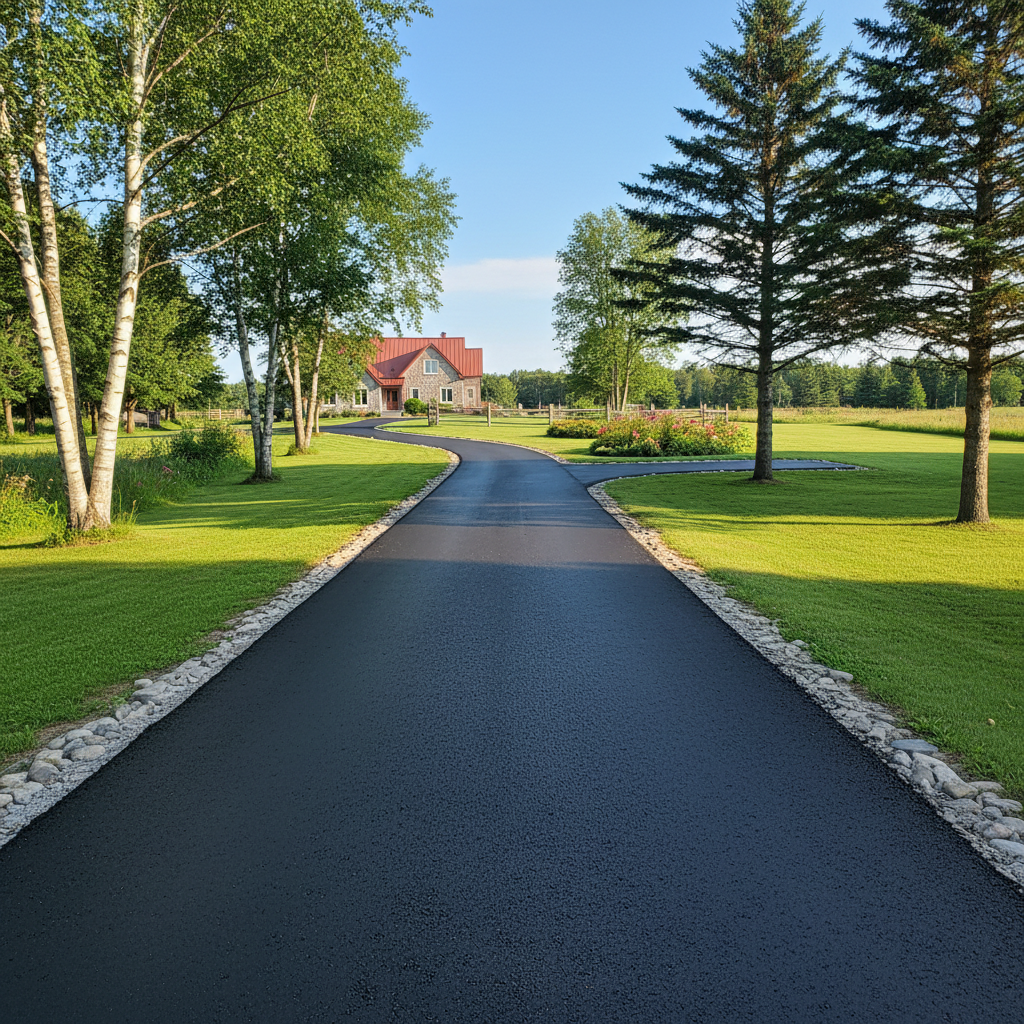
Driveway paving options and costs in Casselman
Casselman homeowners typically have a driveway on the same lot as their home, and with 66.5% of dwellings being single-detached, paving demand is steady for projects that include both driveway surfacing and the granular base underneath (Statistics Canada, 2021 Census). In a town of about 3,960 people, driveway work also tends to be concentrated in the same spring-to-fall window, so scheduling and lead times matter. That matters for your quote because asphalt and concrete placement depend on warmer, drier days, and Ottawa’s freeze–thaw cycles are hard on surfaces when drainage or base thickness is undersized.
Ottawa’s modeled frost penetration is commonly around 1.8 m, which means a residential driveway still needs a well-compacted crushed stone base engineered to stay below the frost zone and limit heaving. In practice, contractors in the Ottawa economic region often specify heavier-duty base sections, plus geotextile separation and edge restraint, which increases material and labour. If you’re in a busier area like Casselman’s downtown core and the Highway 417 corridor, you’ll also see higher demand for interlock and concrete because these streets have more vehicle traffic and visible curb appeal expectations.
Below is a practical comparison of the main driveway surfaces homeowners in Casselman consider, along with typical lifespan, maintenance expectations, and realistic price ranges for a properly built structure.
| Material |
Lifespan |
Maintenance |
Best For |
Price per sq ft |
Price Range |
| Asphalt (new installation, proper base) |
15–25 years |
Seal every 3–5 years; patch as needed |
Best balance of cost and smooth ride |
~$6.50–$10.50 |
$4,500–$9,000 |
| Asphalt (overlay on existing gravel base) |
10–18 years |
Seal and monitor for settlement; targeted repairs |
When you’re upgrading with limited excavation |
~$5.50–$9.00 |
$4,200–$8,200 |
| Interlocking concrete pavers |
25–40 years |
Occasional re-leveling; joint sand refresh |
Curb appeal and easier spot repairs |
~$10.00–$17.00 |
$6,000–$15,000 |
| Poured concrete (broom finish) |
20–30 years |
Seal optionally; address cracks early |
Clean look with straightforward maintenance |
~$9.00–$16.00 |
$7,000–$16,000 |
| Exposed aggregate concrete |
25–35 years |
Light sealing/cleaning; crack monitoring |
Non-slip texture and premium finish |
~$11.00–$18.50 |
$8,500–$17,500 |
| Gravel / crushed stone (budget option) |
3–7 years |
Top up annually; re-grade; manage washouts |
Short-term solution or very tight budget |
~$3.00–$6.00 |
$1,800–$4,500 |
Prices are estimates only and vary by project scope, site access and material selection.
What affects the price of paving in Casselman
In Casselman and across the Ottawa economic region, two quotes for the same driveway can easily differ by 30–50% because the “real work” isn’t the surface—it’s everything under it. A paving contractor might include full tear-out and hauling, geotextile, proper base thickness, drainage corrections, and edge restraints, while another quote may treat those as extras. In colder Ontario, the best-built structures cost more upfront, but they’re designed to survive the region’s freeze–thaw cycles without premature cracking or rutting.
Frost depth is one of the decisive factors. With frost commonly modelled around 1.8 m in Ottawa, the driveway has to rely on a deeper, compacted granular base and good drainage to keep freezing from lifting the pavement structure. That usually means thicker crushed stone layers than you’d see in milder regions (6–12 inches of well-graded base is typical for many Ontario residential driveway builds, depending on subgrade and site drainage), and the asphalt mix must be freeze–thaw rated. On top of that, the paving season is shorter here: hot-mix asphalt requires air temperatures above about 10°C, so labour and equipment are concentrated in a tighter window, pushing scheduling pressure and price.
Concrete pricing can change with site conditions too. If your driveway has older soil fill or poor drainage, contractors may need additional excavation and subgrade stabilization before pouring—adding cost. Conversely, a straightforward access point with solid, compactable subgrade can reduce labour and keep you closer to the lower end of the local asphalt band of $4,500–$9,000. For premium curb appeal like interlocking, the starting point moves into the $6,000–$15,000 range because restraints, bedding sand, and more detailed base preparation are built into the system.
| Price Factor |
Why It Matters |
Cost Impact |
| Driveway area in sq ft |
Surface and base are measured by area, so every extra square foot adds materials and labour. |
High (often the biggest driver) |
| Base depth required |
Frost conditions require a thicker compacted granular base to prevent heaving and cracking. |
High |
| Grading and drainage work |
Slope, ditch tie-ins, and run-off control keep water from saturating subgrade during thaw. |
Medium to High |
| Tear-out of existing surface |
Breaking, disposal and haul-off add equipment time and landfill/handling costs. |
Medium to High |
| Edge restraints and curbing |
In paver installs and wider asphalt jobs, restraints prevent movement and joint failure. |
Medium |
| Sealing requirement |
Asphalt typically needs sealing after installation (and then periodically) to slow aging. |
Low to Medium (timing matters) |
| Site access |
Narrow lots slow down equipment movement and can increase labour and staging time. |
Medium |
| Asphalt mix specifications |
Freeze–thaw capable mix design and proper compaction requirements can increase material cost. |
Medium |
Permits & regulations in Ontario
In Ontario, paving a private driveway within your own property usually doesn’t require a building permit. In most typical Casselman residential projects, you’re resurfacing and rebuilding on private land—so you can often proceed without a permit. However, work in the municipal right-of-way is a different story. That’s where permits/approvals may be required, especially if you’re changing how water drains or altering the curb line. Examples of work that typically does require municipal approval include new or modified curb cuts, changing the boulevard, altering storm drainage connections, or any modification that affects municipal infrastructure.
To verify what applies to your exact driveway, follow a simple step-by-step process:
- Step 1: Contact municipal planning/works or ask the contractor to confirm whether your scope touches the boulevard or right-of-way.
- Step 2: Call Ontario One Call before excavation so utility lines are located and marked.
- Step 3: Ask the contractor for a certificate of insurance showing liability coverage for paving work.
- Step 4: Verify worker coverage: request proof of WSIB compliance (or applicable coverage details) for the people doing the work.
- Step 5: For contractor legitimacy, check the contractor’s Ontario status and any trade licensing/registration they hold (you can ask for the number and confirm it matches their business).
If there are lot-grading considerations (how close grading and hard surfaces can be to property lines), confirm those rules with the municipality as well. Getting this right early helps avoid stop-work issues and costly changes after base is already excavated.
Asphalt vs pavers vs concrete for Casselman driveways
For Casselman driveways, the best choice depends on how you want the surface to behave through Ottawa-area winter and spring thaw. Asphalt is typically the lowest upfront option, and it provides a smooth ride. The trade-off is maintenance: asphalt needs sealing every 3–5 years to slow binder aging and keep moisture out. With freeze–thaw cycling, the asphalt system only performs well if the base is engineered for frost stability and drainage is corrected.
Interlocking concrete pavers usually cost the most upfront, but they’re the most forgiving if something ever shifts. Because pavers can be removed and reset, spot repairs are often possible without tearing up the entire driveway. That matters in Casselman’s housing-stock context—about 28.8% of homes were built before 1981, and older properties may have legacy grading, compacted base issues, or drainage quirks that show up after winter.
Poured concrete is often a mid-range cost option and can be durable, but it’s more vulnerable to cracking if it isn’t air-entrained and if the base/drainage aren’t right. Ottawa-area de-icing habits and plough vibration can also open cracks over time.
For base preparation, regardless of material, the goal is a deeper, compacted granular section to resist frost movement near the frost zone (often achieved with thicker aggregate base and careful subgrade preparation). In real-life winter maintenance, asphalt and concrete both respond better when plowing is done without scraping, and when drainage keeps water from ponding after thaw. If you want the most robust “repairability plus curb appeal” combination for the long run, pavers usually hold up best to local freeze–thaw service conditions.
Dollar-wise, it’s common to see asphalt at the local band of $4,500–$9,000, while interlocking pavers often land in the $6,000–$15,000 range. That difference is justified when you value curb appeal, want easier future repairs, or suspect your subgrade/drainage may need correction—things that cost far more if they’re ignored during base construction.
| Material |
Frost Resistance |
Curb Appeal |
Repair Method |
Lifespan |
Price Band |
| Asphalt (sealed regularly) |
Good with engineered base + sealing |
Moderate (clean, smooth look) |
Cold patch or asphalt section replacement |
15–25 years |
$4,500–$9,000 |
| Interlocking concrete pavers |
Very good; system tolerates small movements |
High (visible finish options) |
Remove/replace affected stones, re-sand joints |
25–40 years |
$6,000–$15,000 |
| Poured concrete (air-entrained) |
Good when air-entrained and properly base-supported |
Moderate to High |
Crack repair plus patching; sometimes section replacement |
20–30 years |
$7,000–$16,000 |
| Exposed aggregate concrete |
Good; depends on base and finishing practices |
Very High (premium texture) |
Patch and seal; cosmetic repairs may be limited |
25–35 years |
$8,500–$17,500 |
| Permeable pavers (drainage grid) |
Excellent for managing thaw water |
High (modern drainage look) |
Spot replacement with gravel bed/grids as designed |
20–35 years |
$8,000–$17,000 |
| Chip seal / tar-and-chip |
Fair to Good; sensitive to base and maintenance |
Low to Moderate (texture finish) |
Spot patching or re-surfacing sections |
8–15 years |
$3,500–$7,500 |
How to choose a paving contractor in Casselman
Choosing a driveway contractor in Casselman is mostly about verifying that they build correctly for Ottawa-area frost and that they’re properly insured. Start with licensing/coverage: ask for their Ontario registration/licence details (if applicable for their trade profile) and request proof of liability insurance naming you as an interested party where feasible. Then confirm WSIB coverage (or the applicable coverage documentation) for workers on-site. A credible paving company will provide these documents promptly—no pressure, no vague “we’re covered” statements.
Next, get 2–3 itemised written quotes. You want a breakdown that separates excavation, base materials, geotextile, asphalt/concrete/pavers supply, compaction, edge restraints, line-up and grade checks, and disposal. Avoid lump-sum quotes that don’t say what’s included: confirm whether the quote includes permit handling (if right-of-way approval is needed), utility locates coordination, and debris disposal.
Warranty should be clear and in writing. Ask about workmanship warranty length, product/manufacturer coverage, and whether the warranty transfers if you sell the home. For payment, never pay more than 10–15% upfront; use a holdback until the job is complete and surfaces are accepted. Also get the start date and a realistic completion estimate in writing, because the paving window in colder Ontario compresses scheduling.
- Ask for Ontario licence/registration details and verify the business name matches their paperwork.
- Request liability insurance and confirm coverage limits are current.
- Verify WSIB/WCB coverage documentation for paving crew members.
- Confirm utility locate coordination (Ontario One Call) is included before excavation.
- Require an itemised quote (labour + materials) rather than a single number.
- Check scope language for what’s included/excluded (tear-out, hauling, disposal, geotextile).
- For asphalt: confirm tack coat, lift thickness, compaction requirements, and sealing plan.
- For pavers: confirm edge restraints/locking patterns, bedding sand thickness, and joint sand type.
- Confirm drainage/grading plan, not just the surface colour or finish.
- Get a written warranty (workmanship vs product) and clarify claim process.
- Use a payment schedule with a holdback until final inspection/clean-up.
- Ask for proof of recent similar Casselman-area projects (photos + addresses or comparable descriptions).
Red flags in Casselman: (1) quotes that ignore drainage or base depth, (2) no written warranty or “we stand behind it” language only, (3) refusing to provide insurance/WSIB documentation, (4) requests for large upfront payments (beyond 10–15%), and (5) no clear schedule for the paved-season constraints—especially spring weather in Ottawa.
Frequently asked questions — paving in Casselman
How deep should the base be for Casselman's frost?
For Casselman (Ottawa economic region), the base depth is driven by frost movement and drainage. With frost commonly modelled around 1.8 m in the Ottawa area, most driveway builds rely on a deeper, well-compacted granular base so freezing doesn’t lift the pavement structure. In practice, many Ontario residential designs target roughly 6–12 inches of compacted granular base (sometimes more depending on subgrade condition, moisture, and the existing soil). If your yard has poor drainage, contractors may add stabilization or increase granular thickness—work that affects the quote. A well-built structure is why a driveway can land anywhere from around the lower asphalt band of $4,500–$9,000 to higher “proper base + corrections” scopes. Ask your contractor to explain base thickness, geotextile use, and how they’ll control water run-off.
How often should I seal my asphalt driveway?
In Casselman’s freeze–thaw climate, asphalt sealing is one of the simplest ways to slow down aging and moisture infiltration. Plan to seal your driveway about 6–12 months after installation (after the asphalt cures and before it starts to weather badly), then typically every 3–5 years depending on sun exposure, traffic, and how aggressively the surface is treated with sand/salt. If you notice fine raveling or the colour looks noticeably dull, that’s usually a sign it’s time to schedule sealing before more expensive repairs are needed. Sealing is also how you protect your investment if you’re trying to stay within the local asphalt budget range of $4,500–$9,000. Always confirm the exact timing and product type your contractor recommends for Ontario conditions.
Why does my driveway crack and heave in winter?
Cracking and heaving in Casselman are usually symptoms of either moisture issues, insufficient base thickness, or both. During freeze–thaw cycles, water in the base can freeze and expand, pushing upward and moving pavement—especially if drainage slopes are incorrect or if water ponds after thaw. Old driveways may also have a weaker subgrade or legacy fill that doesn’t compact well. When the base is underbuilt, you can see cracking patterns, joint movement, and sometimes potholes as materials break down. If the surface is asphalt, repeated movements can “ravel” the edges and create patchwork. The best fix is rarely just surface patching; it’s correcting drainage, ensuring proper granular base depth, and then rebuilding the surface. That’s why quotes that include only resurfacing often differ from bids that address base and drainage—by 30–50% in Ottawa-area projects.
Do I need a permit to pave my driveway in Ontario?
Typically, paving a private driveway within your own property in Ontario usually does not require a building permit. However, you may need municipal approval if your work affects the municipal right-of-way—such as new or changed curb cuts, boulevard modifications, or altered storm drainage connections. In Casselman, the easiest way to avoid surprises is to confirm whether any part of your scope touches the boulevard or drainage infrastructure before demolition. Regardless of permits, utility locates are non-negotiable: contact Ontario One Call before excavation. Also ask your contractor to document their insurance and coverage, since improper excavation or work near utilities can lead to delays and costs. If you’re changing grading close to drainage features, check any lot-grading rules with the municipality.
How long before I can drive on new asphalt?
In Ontario, drive-on timing depends on the asphalt type and weather conditions (temperature and moisture). In many typical driveway installs, contractors allow traffic once the asphalt has cooled and set sufficiently and the surface is stable—often within about 24–48 hours, but sometimes longer if conditions are cool or damp. Asphalt also needs time to cure, and contractors may restrict heavy vehicles or sharp turning for a period after paving. This matters in Casselman because spring and early fall weather can still be cool, and that extends the window for safe compaction and curing. Ask your contractor for the exact driveway curing schedule in writing. Also plan for sealing at the right time after installation (commonly 6–12 months), which can be part of protecting your investment in the local asphalt range of $4,500–$9,000.
What causes potholes and how are they repaired?
Potholes in Casselman usually start when water gets under the pavement. Freeze–thaw cycles expand moisture during cold nights and weaken the base during thaw, so the surface breaks down—first as small cracks or edge raveling, then as voids. Heavy loads, poor compaction, or a base section that didn’t get engineered for frost conditions can accelerate the problem. Asphalt pothole repair is generally a two-step process: break out to sound, stable edges; clean/dry and address the underlying base if needed; then install asphalt in proper lifts and compact it. If the damage is widespread, contractors may recommend a larger patch or an overlay instead of repeated small fixes. The right repair depends on whether the issue is localized or base-wide—so request a contractor assessment that includes drainage and base condition checks, not only surface patching.