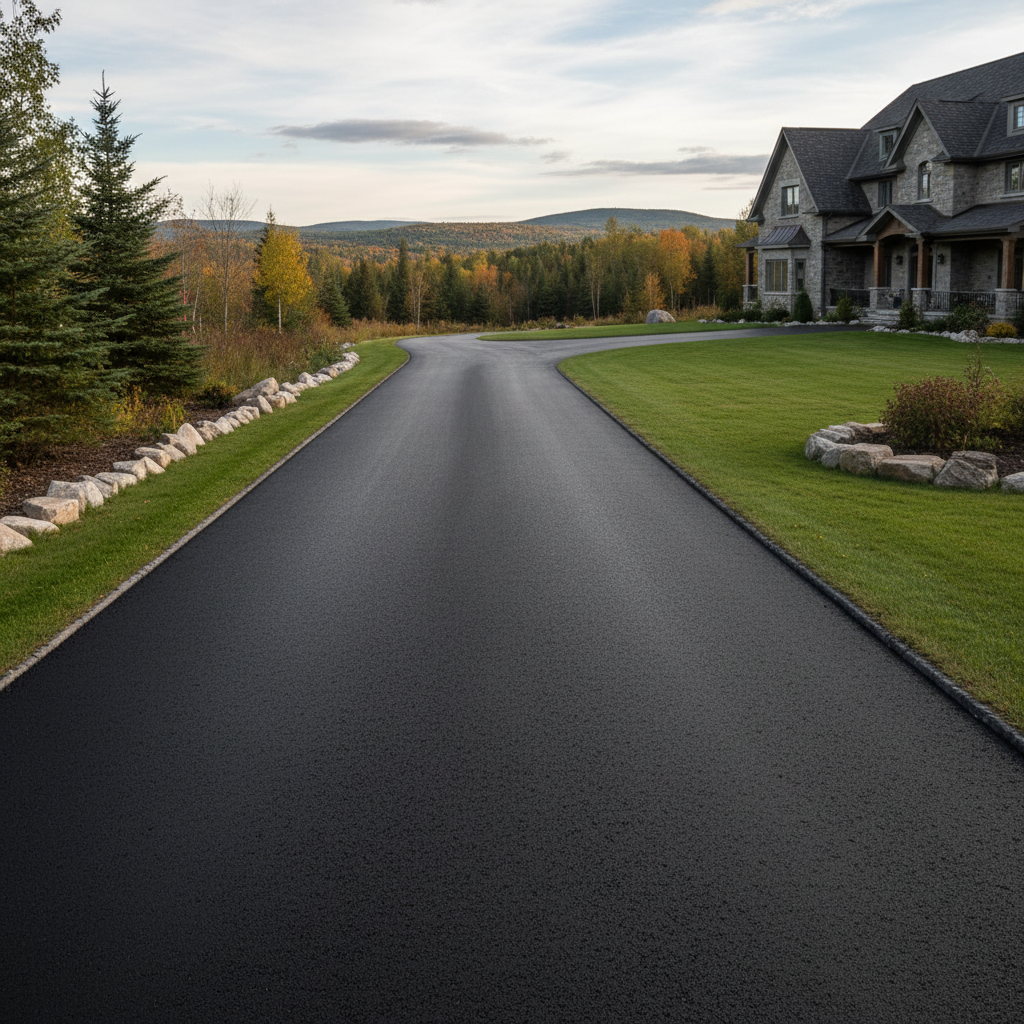
Driveway paving options and costs in Stoney Creek
Stoney Creek homeowners have three common driveway paths: asphalt, interlocking pavers, and concrete. With a 2021 population of 76,382 (Statistics Canada, 2021 Census), you’ll see plenty of demand across the Hamilton–Niagara Peninsula, especially where older housing stock meets busy commuting routes. In most private neighbourhoods, driveways serve detached homes—so contractors often design for heavy vehicles like pickups, delivery vans, and snow-clearing equipment, not just passenger cars.
Pricing in Stoney Creek is shaped by our moderate-to-cold Southern Ontario freeze–thaw cycle and frost penetration assumptions (often 1.2–1.5 m in Ontario design practice). That means the driveway isn’t just “laying asphalt or stone”—it’s excavation, granular base build-up (often 6–10 inches compacted), and drainage corrections so water can’t freeze underneath and push the surface up. Those site-prep elements can represent 35–45% of a residential driveway budget. Because the paving season here is effectively April–October, spring and early summer scheduling pressure can also push costs toward the upper end of typical Ontario price ranges.
In areas with more grading changes and clay/silty subsoils—like parts of Stoney Creek near the older escarpment-adjacent neighbourhoods—base depth and drainage work tend to become the deciding factor in whether a driveway performs well for years. Once you’ve got a sense of scope, the options below help you compare typical installed ranges and where each material fits best.
| Material |
Lifespan |
Maintenance |
Best For |
Price per sq ft |
Price Range |
| Asphalt (new installation, proper base) |
15–25 years |
Seal after 6–12 months, then every 3–5 years |
Best value in cold climates with periodic maintenance |
$4.50–$9.50 |
$3,000 – $8,000 |
| Asphalt (overlay on existing gravel base) |
10–18 years |
Same sealing cycle; depends on how stable the base is |
When you’re already starting with a firm, compacted base |
$4.00–$8.75 |
$3,200 – $7,600 |
| Interlocking concrete pavers |
25–40 years |
Occasional re-leveling of a few stones; replace failed units |
Curb appeal and easy localized repairs |
$10.00–$18.00 |
$9,000 – $20,000 |
| Poured concrete (broom finish) |
25–35 years |
Seal if desired; maintain joints and crack control strategy |
Low visual maintenance with good drainage design |
$9.00–$15.50 |
$7,000 – $18,000 |
| Exposed aggregate concrete |
25–35 years |
Less glare; still needs proper joints and drainage |
Texture/grip and premium appearance |
$10.50–$17.50 |
$8,500 – $19,500 |
| Gravel / crushed stone (budget option) |
3–8 years (surface stability varies) |
Top up and re-grade; weed control |
Short-term solution or low-traffic lanes |
$2.00–$5.00 |
$2,000 – $5,000 |
Prices are estimates only and vary by project scope, site access and material selection.
What affects the price of paving in Stoney Creek
In Stoney Creek and across the Hamilton–Niagara Peninsula, two quotes for what looks like the same driveway can swing 30–50%. The reason usually isn’t the asphalt or the pavers—it’s what’s happening underneath. Contractors price different scopes for excavation depth, base specification, drainage corrections, and how much removal and hauling is required for your existing slab/asphalt/gravel.
Frost line depth and freeze–thaw cycles are decisive cost factors in Ontario. When frost heaves, the culprit is often water trapped in the subgrade. To prevent that, driveways need a deeper compacted granular base (commonly 6–12 inches in Ontario practice, depending on your soil and whether it’s a new build or an overlay). That depth is paired with drainage—subdrain, daylighting, or at least correct cross-slope and ditch routing—so water doesn’t freeze under the surface. Asphalt also needs a freeze-thaw-rated mix design. The paving season is shorter here (roughly April–October because hot-mix asphalt requires adequate air temperatures for paving and compaction), so peak scheduling can raise labour and equipment time.
Concrete costs can rise or fall quickly based on your jointing plan and whether the contractor includes crack-control saw cuts and air-entrainment. For example, a straightforward asphalt replacement may fit the $3,000–$8,000 band when base thickness and grading are modest. But if you have older clay and need deeper granular rebuild plus drainage correction, the driveway can move toward the higher side even for asphalt; at that point, some homeowners compare it to paver or concrete projects that start in the $7,000–$18,000 (concrete) and $9,000–$20,000 (interlock) ranges because the expensive part—site prep—is already being done.
| Price Factor |
Why It Matters |
Cost Impact |
| Driveway area in sq ft |
Most material and production time scale directly with surface area |
Major driver (often the biggest single line item) |
| Base depth required |
Frost penetration requires thicker granular base to resist heaving and cracking |
Can shift price by $1,000–$4,000 depending on site conditions |
| Grading and drainage work |
Proper slope and water management reduce under-freezing and surface failure |
Commonly adds several thousand dollars on older or low spots |
| Tear-out of existing surface |
Breaking and hauling concrete or old asphalt adds disposal and labour time |
Often a mid-range add-on; higher if access is tight |
| Edge restraints and curbing |
Required to stop pavers from spreading and to hold asphalt/concrete profiles |
Can add a noticeable amount, especially for irregular geometry |
| Sealing requirement |
Asphalt should be sealed after 6–12 months to slow oxidation and raveling |
Moderate long-term cost; typically hundreds of dollars per visit |
| Site access |
Narrow lots and limited staging slow equipment movement and increase labour hours |
Can add time and equipment inefficiency costs |
| Asphalt mix specifications |
Freeze-thaw-rated mix and proper binder selection costs more than basic mixes |
Small-to-moderate premium that can improve longevity |
Permits & regulations in Ontario
In Ontario, paving a private driveway within your own property usually does not require a building permit. In most cases, the work you do strictly on your property line (like asphalt replacement, new gravel base, interlocking on your lot, or a concrete driveway slab) is treated as private site work.
Where permits and approvals can come into play is when you touch municipal infrastructure or grading that affects public space. The work that typically does require municipal approval includes changing a driveway entrance in the municipal right-of-way—such as a new curb cut, widening or altering boulevard areas, modifying storm drainage connections, or doing work that changes how municipal water is handled. Some municipalities also have lot-grading rules (often enforced through zoning/municipal by-laws) that restrict how close a hard surface can be to property lines and how stormwater must be directed.
Before any excavation, verify utility locations using Ontario One Call (1-800-400-2255). Then confirm the contractor’s legal coverage: in Ontario, ask for their certificate of liability insurance and proof of WSIB clearance (or WCB status). You can verify contractor licence and standing through online government/business registries where applicable, and you should still request the documents directly—an established paving company will provide them without hesitation.
Asphalt vs pavers vs concrete for Stoney Creek driveways
For Stoney Creek’s freeze–thaw climate, asphalt, interlocking pavers, and concrete each have a “best use,” but the winner depends on how you expect to maintain the driveway and how your subgrade behaves. Asphalt typically has the lowest upfront cost and handles temperature swings well because it’s flexible, but it needs sealing every 3–5 years to slow oxidation and water intrusion. Interlocking concrete pavers usually cost more up front, yet they’re highly repairable—if a section settles, a contractor can lift, adjust base, and re-lay without replacing the entire driveway. Poured concrete is often a mid-range option, but it can crack if the base is under-designed or if the mix isn’t properly air-entrained for freeze–thaw exposure.
Across the Hamilton–Niagara Peninsula, the base and drainage design are what determine performance in winter. If your driveway has clay/silty subsoil and there’s any chance water will pond, all three systems need correct slope, granular separation, and drainage attention. Where homeowners with snow and salt routines tend to differ is in long-term upkeep: asphalt will age gracefully with sealing, pavers tolerate localized fixes, while concrete is more sensitive to joint planning and freeze–thaw cycling without adequate air-entrainment and crack control.
Here’s a practical dollar example: if you’re comparing asphalt in the $3,000–$8,000 band versus poured concrete in the $7,000–$18,000 range, the price difference is often justified when you want longer “hands-off” appearance (concrete/pavers) and you’re willing to pay for a full base/drainage rebuild. If your site prep is limited and the driveway is straightforward, asphalt can deliver excellent value—especially when paired with proper sealing timing after installation.
| Material |
Frost Resistance |
Curb Appeal |
Repair Method |
Lifespan |
Price Band |
| Asphalt (sealed regularly) |
Good when base is deep and sealed on schedule |
Medium |
Patch or mill & overlay the affected area |
15–25 years |
$3,000 – $8,000 |
| Interlocking concrete pavers |
Very good with compacted base and tight jointing |
High |
Lift and reset pavers; replace only damaged units |
25–40 years |
$9,000 – $20,000 |
| Poured concrete (air-entrained) |
Good with air-entrainment and correct jointing |
Medium–High |
Crack repair/seal; panel replacement if severe |
25–35 years |
$7,000 – $18,000 |
| Exposed aggregate concrete |
Good when joints and curing are done correctly |
High |
Localized repairs are possible but panel-level work may be needed |
25–35 years |
$8,500 – $19,500 |
| Permeable pavers (drainage grid) |
Good with proper underdrain design |
High (clean look when maintained) |
Replace sections; clear and maintain infiltration layer |
20–35 years |
$10,000 – $22,000 |
| Chip seal / tar-and-chip |
Fair to good; performance depends on base stability |
Low–Medium |
Spot patch and refreshing coats over time |
5–12 years |
$2,500 – $6,500 |
How to choose a paving contractor in Stoney Creek
Picking the right contractor in Stoney Creek starts with verifying coverage and accountability. In Ontario, ask for proof of liability insurance (so you’re not exposed if something is damaged) and confirmation of WSIB/WCB coverage. How to check: (1) request a certificate of insurance showing your contractor’s name and coverage dates; verify it matches the company on the quote, (2) request WSIB clearance and/or WCB status documentation where required, and (3) ask for any licence/registration details they use to legally operate and perform contracting work.
Next, get 2–3 itemised written quotes. You want labour and materials broken out separately—especially excavation, base stone (Granular A/B or equivalent), asphalt/concrete thickness, trucking, compaction, and disposal. Avoid “one-line” quotes that hide scope; if the quote doesn’t clearly say whether tear-out disposal is included, or whether permit pulls/municipal approvals are handled, you could be paying change-order pricing later. Also confirm the warranty: ask for workmanship warranty length (how many years), what product/manufacturer warranties apply, and whether the warranty is transferable if you sell your home.
Payment schedule should be conservative. Never pay more than 10–15% upfront; hold a portion until substantial completion and final inspection. Timeline matters in our shorter April–October window—get a start date and estimated completion in writing so you’re not left waiting for spring scheduling.
- Ask for reference photos from similar Stoney Creek freeze–thaw basements/driveways (clay sites if possible).
- Confirm the base specification (granular type and compacted thickness) and whether drainage corrections are included.
- Require an itemized quote (excavation, base, geotextile if needed, asphalt/concrete thickness, compaction testing if offered).
- Get confirmation that utility locates are completed before digging.
- Ask how they’ll protect landscaping, fencing, and eaves during excavation and equipment movement.
- Verify edge restraints/curbing plans for pavers/asphalt profiles (prevents migration and washouts).
- Confirm disposal of old materials (haul and tipping fees) is included if tear-out is required.
- Check whether sealing asphalt is included or scheduled (asphalt should be sealed after 6–12 months).
- Ask for jointing and crack control details for concrete (air-entrainment and saw-cut plan where applicable).
- Clarify warranty terms: workmanship duration, what voids it, and whether warranty transfers.
- Agree on a payment schedule (max 10–15% upfront) and a holdback until completion.
- Confirm insurance and WSIB/WCB coverage before work starts; never rely on verbal promises.
Red flags to watch for: promises of “no base needed,” vague wording like “we’ll prep the area” without specifying granular depth, reluctance to show insurance/WSIB clearance, pressure to pay large deposits upfront, and missing itemization—especially around drainage, disposal, and thickness.
Frequently asked questions — paving in Stoney Creek
Asphalt vs interlocking pavers vs concrete — which is best in Stoney Creek?
In Stoney Creek, the “best” choice usually comes down to your tolerance for maintenance and how your subgrade handles water. Asphalt often wins on upfront cost (typical installed ranges around $3,000 – $8,000) and performs well through freeze–thaw when installed over a properly compacted, frost-resistant base and sealed after 6–12 months. Interlocking pavers cost more, but they’re very forgiving for future repairs—if a section settles, it can be lifted and re-levelled instead of replacing an entire panel. Poured concrete can be durable, but in Ontario’s freeze–thaw conditions it must be air-entrained and jointed correctly to limit cracking. If you’ve got clay-like soil or any low spots, base depth and drainage design matter more than the surface material.
How long does a paved driveway last in Stoney Creek?
Typical service life in Stoney Creek is strongly tied to base depth, drainage, and how water behaves in winter. Asphalt commonly lasts about 15–25 years when installed with a deep granular base and then sealed on schedule (after 6–12 months, then every 3–5 years). Interlocking pavers usually reach 25–40 years because localized repairs are practical—settled or damaged stones can be reset after base adjustments. Concrete often targets 25–35 years, but performance depends on air-entrainment, curing, and crack control/joint planning for freeze–thaw movement. Even a premium surface can fail early if water pools beneath it, so ask contractors to explain slope, underdrain/subgrade approach, and how they prevent under-freezing.
When is the best time of year to pave in Stoney Creek?
For asphalt in Stoney Creek, the most reliable window is late spring through summer—roughly April to October—when temperatures support proper compaction and the asphalt plant can produce and deliver consistently. Asphalt paving generally requires adequate air temperatures (often above 10°C) to place and roll properly, and cold snaps can slow production or reduce density. Concrete can sometimes be scheduled earlier/later with winter protection measures, but the practical reality is that curing and finishing still need workable conditions. If you’re planning pavers, weather matters too—freeze risk and wet subgrade can affect compaction, so contractors usually prefer dry, mild days within the main season.
How deep should the base be for Stoney Creek's frost?
Ontario’s frost penetration assumptions for Southern Ontario projects typically point toward deeper frost protection, and in Stoney Creek driveways are commonly built on a thicker compacted granular base to resist heaving and cracking. In practice, many good-quality residential driveway builds use about 6–10 inches compacted granular base (and sometimes more) depending on soil type and whether drainage is corrected. If you have silty/clayey subsoils, soft areas, or existing water problems, the contractor may specify closer to the higher end, plus proper drainage routing. The key is that the base design is matched to your site—don’t rely on “one depth fits all.” A detailed quote should spell out granular thickness and the approach to water management.
How often should I seal my asphalt driveway?
Seal timing is important in Stoney Creek because freeze–thaw and winter salts accelerate aging when water gets into surface voids. Standard practice is to let new asphalt cure first—typically sealing after 6–12 months—so you don’t trap moisture. After that, plan on sealing every 3–5 years depending on traffic, sun exposure, and how aggressively salt is used. If your asphalt already shows heavy raveling or bleeding before sealing, you may need repairs or a patch program first. Sealing doesn’t replace proper base drainage, but it can significantly slow oxidation and reduce water penetration pathways that lead to early deterioration.
Why does my driveway crack and heave in winter?
Cracking and heaving in winter usually comes from movement beneath the pavement, not from the surface alone. The most common causes in Stoney Creek are trapped water and an under-designed base: when water seeps into the subgrade and freezes, expansion pushes the surface up (heave). When it thaws, support can be lost, leading to cracking and settlement. Other contributors include insufficient compaction, lack of proper drainage slope, poor edge restraint, and incorrect asphalt mix or concrete jointing for freeze–thaw cycling. If you’re comparing fixes, a full base and drainage correction is often more cost-effective than repeated patching because it addresses the root cause of movement.