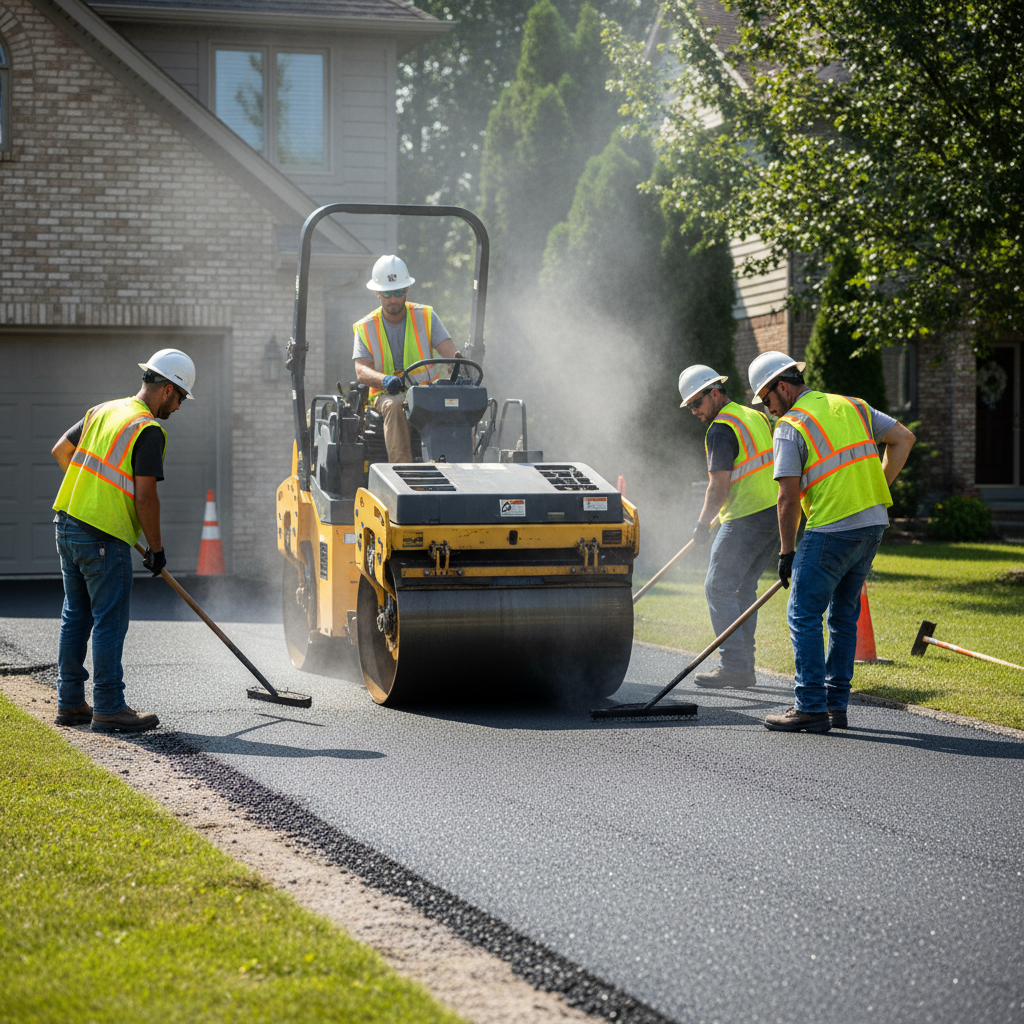
Driveway paving options and costs in Shuniah
In Shuniah, Ontario, homeowners usually have three practical pathways for upgrading a driveway: asphalt, interlocking concrete pavers, or concrete. With 97.2% of dwellings in the community being single-detached homes, most driveways start as a “car-first” surface tied to a detached house, not a shared lane—so site access, drainage, and base depth are big parts of every quote. Shuniah also has an older housing stock: 52.6% of homes were built before 1981 (Statistics Canada, 2021 Census). That matters because older properties often have legacy grading, older stone bases, and sometimes narrower service corridors, all of which can increase tear-out and prep time before new asphalt or concrete can perform in our freeze–thaw cycle.
In the Northwest economic region, costs are higher than southern Ontario because deep frost penetration and aggressive temperature swings push contractors to build a thicker, well-compacted granular base and to protect edges and drainage. The shorter paving season also concentrates work into a narrower late-spring to early-fall window, which can mean scheduling premiums and overtime when crews are already committed to other sites. For local demand, areas around Thunder Bay Road and the broader Shuniah corridor tend to stay busy as homeowners refresh older driveways ahead of winter.
The table below compares typical material choices for a properly built driveway (including base prep assumptions). Use it to align expectations before you request itemized quotes.
| Material |
Lifespan |
Maintenance |
Best For |
Price per sq ft |
| Asphalt (new installation, proper base) |
15–25 years |
Seal every 3–5 years; patch minor raveling |
Best balance of upfront cost and performance with correct frost base |
$7–$14 |
| Asphalt (overlay on existing gravel base) |
10–18 years |
Seal 3–5 years; monitor edge cracking |
When the existing base is sound enough to upgrade instead of rebuild |
$9–$16 |
| Interlocking concrete pavers |
25–35 years |
Spot repairs replaceable without full re-lift |
Curb appeal and repairability in freeze–thaw conditions |
$18–$35 |
| Poured concrete (broom finish) |
20–30 years |
Seal occasionally; manage minor hairline cracking |
Low ongoing fuss with strong, rigid surface |
$14–$28 |
| Exposed aggregate concrete |
20–30 years |
Seal as recommended; patch with matching mix if needed |
Higher traction and decorative look |
$18–$32 |
| Gravel / crushed stone (budget option) |
3–8 years (varies) |
Top up annually; re-grade |
Lowest entry cost while you plan the long-term upgrade |
$3–$7 |
Prices are estimates only and vary by project scope, site access and material selection.
What affects the price of paving in Shuniah
Even for the “same” driveway size, quotes in the Northwest economic region can swing by 30–50% because the underlying job scope usually isn’t identical. One contractor may be rebuilding the full granular base to manage frost, while another may be trying to work with a thinner base or a compromised subgrade. In our climate, frost line depth and freeze–thaw cycles are decisive: deeper frost demands a thicker, properly compacted granular structure so the asphalt or concrete doesn’t heave and crack. In practice, this often means base designs in the 4–6 ft frost protection zone conceptually translating to thicker granular builds (and more careful drainage), rather than “thin and cheap” installations.
The shorter paving season is also a real cost driver. Hot-mix asphalt needs suitable air temperatures (often above 10°C) and good compaction conditions; when late-spring weather windows are tight, crews and equipment spend more time waiting, mobilizing, and re-setting. That’s why asphalt pricing in Shuniah often aligns with the $7–$14 per sq ft band when the base and drainage are done properly, and it can push higher when contractors must meet freeze–thaw-rated mix requirements.
For concrete, Shuniah conditions can move costs up or down depending on prep and finishing. For example, older pre-1981 properties may need additional excavation to reach a stable subgrade before broom-finished concrete can be poured, which adds labour and disposal. Conversely, if drainage is already well-established and the existing base is uniform, concrete can stay closer to the $14–$28 per sq ft range. Interlocking pavers can cost more up front (commonly $18–$35 per sq ft), but localized repair after seasonal movements can be less disruptive than replacing an entire asphalt panel.
| Price Factor |
Why It Matters |
Cost Impact |
| Driveway area in sq ft |
Most materials and labour scale directly with surface area |
High—often the largest portion of the budget |
| Base depth required |
Frost protection and freeze–thaw resistance rely on thicker granular builds and compaction |
High—thin bases lead to early failures and costly rework |
| Grading and drainage work |
Slope corrections and drainage moves water away from the structure |
Medium to high—especially on older lots |
| Tear-out of existing surface |
Breaking, hauling, and disposing of old asphalt or concrete |
Medium—can be significant if thick slabs exist |
| Edge restraints and curbing |
Prevents paver spread and asphalt raveling at the perimeter |
Medium—often required for pavers |
| Sealing requirement |
Asphalt needs sealcoat after installation and again at intervals |
Low to medium—ongoing but predictable |
| Site access |
Narrow lots slow equipment movement and can require additional labour |
Medium—mobilization and time costs add up |
| Asphalt mix specifications |
Freeze–thaw-rated materials and proper binder selection cost more |
Medium—raises cost but improves longevity |
Permits & regulations in Ontario
In Ontario, most driveway paving on your own property typically does not trigger a building permit. If you are repaving, overlaying, or replacing a private driveway surface within your lot line, you’ll usually be working under private-property rules rather than municipal permitting. However, permits or approvals are commonly required when the work affects the municipal right-of-way—this includes creating or changing a curb cut/driveway opening in the boulevard, altering storm drainage that connects to municipal infrastructure, or changing ditching and graded drainage in the right-of-way.
Shuniah homeowners can also run into lot-grading restrictions. Some municipalities have bylaws that limit how close hard surfaces or changes in grade can be to property lines or how water is directed during and after construction. Before excavation, confirm whether your contractor is managing drainage to prevent runoff onto neighbouring lots or into low areas.
Step-by-step, here’s how to verify your contractor in Ontario. First, call Ontario One Call to mark underground utilities before any digging. Second, ask for proof of their Ontario licence (where applicable to the type of work and municipal requirements). Third, request current liability insurance and confirm whether they carry WSIB coverage. When you receive documents, check that the certificate of insurance lists your project address (or the correct insured party) and that coverage is active for the job dates. Many contractors can also provide a clearance letter or corresponding WSIB/WCB documentation on request—don’t skip this.
Asphalt vs pavers vs concrete for Shuniah driveways
For Shuniah’s freeze–thaw climate, the “best” driveway material depends on how you want to balance upfront cost, long-term crack behaviour, and winter maintenance realities. Asphalt is typically the lowest upfront option, and when properly built on a thick, compacted granular base, it performs well through thermal cycling. The trade-off is routine sealing: many owners need sealcoat every 3–5 years to slow oxidation and raveling, especially under frequent plowing and salted surfaces.
Interlocking concrete pavers usually cost more upfront (often within the $18–$35 per sq ft band), but they’re highly repairable. In a freeze–thaw region, that matters: if a section settles or a drain spot freezes differently, contractors can lift and reset affected units rather than removing and replacing a whole asphalt lane. Poured concrete is a mid-range option, commonly within $14–$28 per sq ft depending on thickness, finishes, and prep. Properly air-entrained concrete can handle repeated freezing better, but all concrete can still develop cracking if base preparation or drainage is off.
Here’s a practical dollar example. If your driveway is 600 sq ft, moving from asphalt at roughly $7–$14 per sq ft to pavers at $18–$35 can add about $6,600 to $16,800 in installed cost (before deciding on decorative upgrades). For many homeowners, that added investment is justified when curb appeal matters and you want the option to repair localized areas after seasonal movement rather than pay for a full surface replacement later.
In Northwest Ontario, drainage design and base thickness are non-negotiable across all three choices; the surface material alone won’t overcome poor subgrade compaction or standing water.
| Material |
Frost Resistance |
Curb Appeal |
Repair Method |
Lifespan |
Price Band |
| Asphalt (sealed regularly) |
Good with thick granular base and proper drainage |
Moderate (clean lines, upgraded edges help) |
Mill and patch or overlay sections |
15–25 years |
$7–$14 |
| Interlocking concrete pavers |
Very good; flexible surface over engineered base |
High—best “finished look” |
Lift/reset individual pavers |
25–35 years |
$18–$35 |
| Poured concrete (air-entrained) |
Good when air-entrained and on stable base |
Moderate to high (finishes vary) |
Crack patching; sectional repairs possible |
20–30 years |
$14–$28 |
| Exposed aggregate concrete |
Good; traction improves winter grip |
High—decorative texture |
Limited patch visibility; repairs are skilled |
20–30 years |
$18–$32 |
| Permeable pavers (drainage grid) |
Very good when drainage design is correct |
High (modern look) |
Replace units; clean/maintain drainage layer |
20–30 years |
$22–$40 |
| Chip seal / tar-and-chip |
Moderate; performance depends on base and weather timing |
Low to moderate |
Reapply/spot maintain surface |
7–12 years |
$6–$10 |
How to choose a paving contractor in Shuniah
Choosing the right paving contractor in Shuniah starts with verification, not promises. For Ontario, ask for proof of their Ontario licence (if applicable to their scope) and confirm liability insurance is active for the job duration. You should also obtain WSIB coverage information; if you’re comparing contractors, require the same proof from each so you’re not being quoted “cheap” with missing coverage. Look for this in the documentation package: (1) a current certificate of insurance, (2) WSIB clearance or coverage letter, and (3) any licence/registration numbers the contractor is required to maintain. If anything is unclear, ask directly—reputable crews answer quickly and provide documents without pushing back.
Next, get 2–3 itemised written quotes. “Itemised” means a breakdown of labour and materials (base stone, asphalt or concrete, geotextile if used, disposal, edging/curbs, and sealing/curing steps). Avoid lump sums that don’t specify whether tear-out and disposal are included, whether topsoil is replaced, and whether grading and compaction testing are part of the scope.
Warranty should clearly state workmanship coverage length and whether it covers material failures due to poor prep. Confirm product/manufacturer warranty terms and whether they’re transferable. Payment schedules should never ask for more than about 10–15% upfront; hold back a portion until completion and final cleanup. Finally, request a start date and estimated completion timeline in writing, so you can align with Shuniah’s shorter paving window.
- Verify licence details (where applicable) and ask for the contractor’s registration/contact info.
- Confirm liability insurance is current and applicable to your address/project dates.
- Request WSIB clearance/coverage proof before work begins.
- Insist on itemised quotes (base, surfacing, edging, sealing/curing, disposal).
- Ask what’s excluded: permits, hydro/utility marking, disposal, and grading repairs.
- Confirm utility locate responsibility—ensure Ontario One Call marking is handled before excavation.
- Ask about base spec and thickness for frost protection and how subgrade is compacted.
- For asphalt: confirm binder/mix is freeze–thaw rated and whether tack coat and sealcoat are included.
- For pavers: confirm edge restraints, bedding sand depth, and drainage layer plan.
- For concrete: ask about air entrainment and reinforcement plan (if required).
- Review warranty terms in writing, including what voids coverage.
- Keep payment tied to milestones; avoid large upfront deposits.
Red flags to watch for in Shuniah: a quote that skips base thickness details; no proof of WSIB/insurance; vague scope language like “we’ll fix it later” without specifications; no mention of sealing/curing steps; and contractors who won’t put the timeline and warranty in writing.
Frequently asked questions — paving in Shuniah
How much does it cost to pave a driveway in Shuniah?
In Shuniah, Ontario, driveway paving commonly lands within the regional price bands depending on material and how much prep is needed. For asphalt new installation on a properly built base, many projects fall around $7,000 – $14,000 per 1,000 sq ft equivalent range—though most homeowners budget using the per-square-foot band of about $7–$14. Concrete and pavers generally cost more: concrete driveway work often aligns with $14–$28 per sq ft and interlocking pavers typically sit around $18–$35 per sq ft. Your total cost can swing noticeably if tear-out and drainage/grading corrections are required, which is common on older properties (52.6% built before 1981) where base conditions and runoff patterns weren’t designed for today’s freeze–thaw stresses (Statistics Canada, 2021 Census).
Asphalt vs interlocking pavers vs concrete — which is best in Shuniah?
For Shuniah’s freeze–thaw climate, all three can work well when built on a thick, compacted granular base with proper drainage—but they serve different priorities. Asphalt usually wins if you want the lowest upfront price (often $7–$14 per sq ft), and you’re comfortable planning for sealcoat every few years. Interlocking concrete pavers are best if you care about curb appeal and want repairability without replacing the whole driveway; that’s why pavers often sit in the $18–$35 per sq ft band. Poured concrete can be a strong mid-range choice ($14–$28 per sq ft) if it’s air-entrained and the subgrade is stable; otherwise, freeze–thaw movement and poor drainage can lead to cracking. With plowing and salt, the “best” option is the one with the correct frost base and drainage design—not just the surface.
How long does a paved driveway last in Shuniah?
Typical service life in Shuniah depends on base preparation, drainage, and winter maintenance. Asphalt often lasts about 15–25 years when installed on a well-prepped granular base and sealed regularly. If sealing is skipped, oxidation and surface raveling can shorten that timeline. Interlocking pavers commonly reach 25–35 years because individual units can be reset if localized movement occurs. Poured concrete often falls around 20–30 years with air-entrained concrete and a stable base; however, poorly drained subgrade or insufficient base thickness can contribute to cracking over repeated freeze–thaw cycles. Because Shuniah has deep frost penetration and aggressive seasonal temperature swings, contractors usually focus heavily on frost protection depth and compaction; that’s where longevity is made.
When is the best time of year to pave in Shuniah?
For asphalt and concrete in Shuniah, the best window is typically late spring through early fall, when temperatures support compaction and curing. Hot-mix asphalt requires suitable air temperatures (often above 10°C) and weather that won’t ruin compaction. Concrete needs conditions that allow proper curing—too-cold and curing becomes inconsistent, which can lead to early surface problems. The Northwest region also has a compressed paving schedule, so booking earlier in the season helps lock in a start date. If your driveway needs drainage regrading or deeper excavation for frost protection and base rebuilds, planning those tasks at the start of the season can prevent rushed work that impacts performance.
How deep should the base be for Shuniah's frost?
There isn’t one universal “magic depth” for every Shuniah driveway, but frost protection design is driven by deep frost penetration and freeze–thaw cycling. Practically, contractors aim for a thicker, well-compacted granular base than what many homeowners remember from older installs, because the goal is to prevent heaving and cracking by keeping the pavement structure stable through winter. In Northwestern Ontario, deeper frost protection concepts typically translate into more substantial base builds and upgrades—especially where soils are clayey or poorly drained. The right design should be based on site conditions (subgrade type, existing thickness, and drainage). A reputable contractor will explain the base thickness they’re specifying and how they’re addressing drainage and compaction, rather than giving a generic number.
How often should I seal my asphalt driveway?
For asphalt driveways in Ontario, a common approach is to seal after the initial asphalt has had time to cure and then maintain it on a cycle. In Shuniah, many contractors recommend sealcoat after the first service period and then approximately every 3–5 years, depending on sun exposure, traffic, and how aggressively salt and sand are used during winter plowing. Sealing helps slow oxidation and reduces raveling, which can happen faster when moisture infiltrates at surface cracks. If you’re quoted an asphalt price, ask whether the sealcoat is included (or planned as a follow-up). Skipping sealcoat typically costs more later—patching and potential resurfacing become more frequent, especially under repeated freeze–thaw conditions.