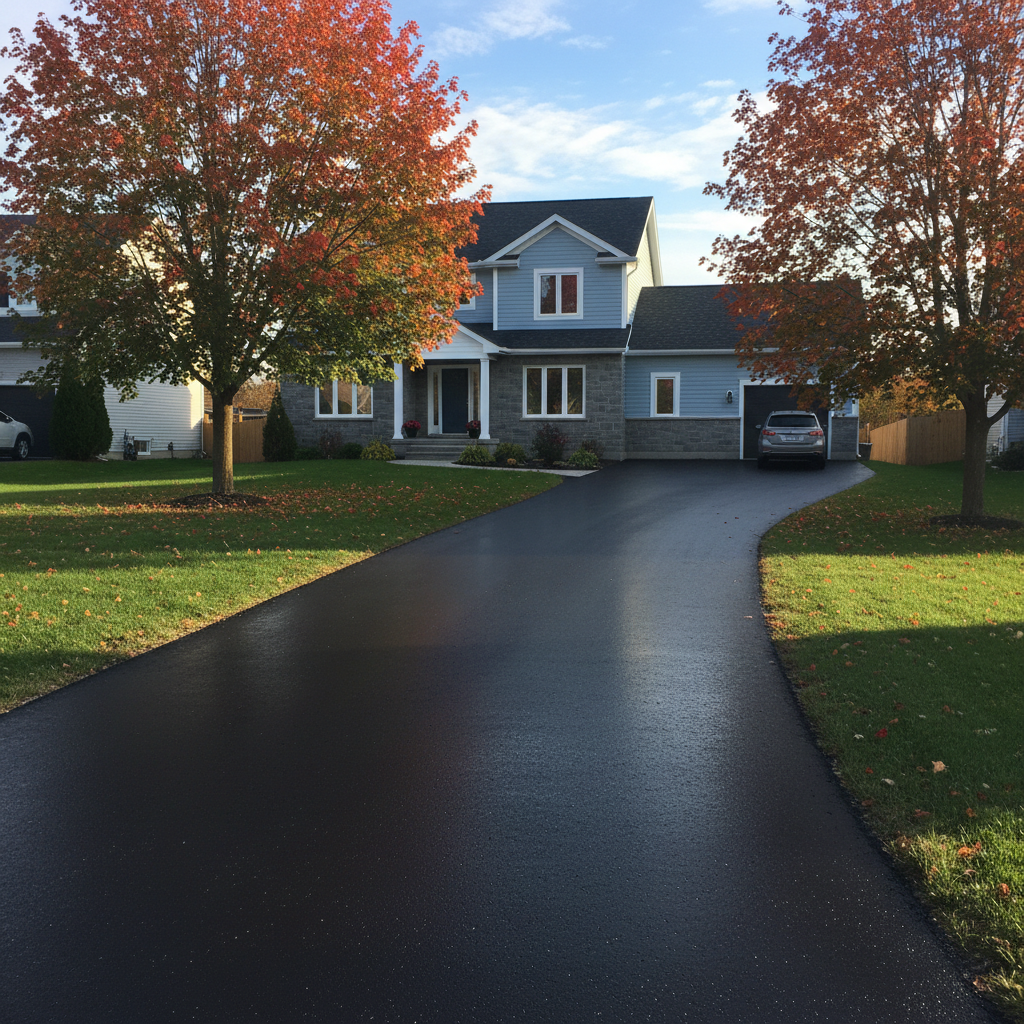
Driveway paving options and costs in Leaside-Bennington
In Leaside-Bennington, your driveway choice usually comes down to three things: upfront budget, how much maintenance you want to do, and how well the surface handles Toronto’s freeze–thaw winters. With a population of 16,828 in the area (Statistics Canada, 2021 Census), there’s consistent demand for private driveway upgrades and resurfacing, especially on older residential streets where original surfacing has aged out. Most driveways here serve single-family homes, so contractors see a steady flow of projects—whether it’s a fresh asphalt build, paver replacement, or concrete repair.
Toronto’s climate is a major cost driver. Ground freezing to roughly 3–4 feet means water control and base design aren’t optional; they’re what prevent heaving and cracking later. Those frost depths push installers toward a deeper, properly compacted granular base and tighter drainage detailing, which increases excavation, materials, and labour. On top of that, the paving season is effectively late spring through early fall, so prime scheduling can add cost when crews are booked for peak dates around Leaside, Bennington Heights, and nearby corridors.
To help you compare apples-to-apples, the table below shows typical lifespan and price ranges for common driveway materials in the Toronto economic region. Use it as a baseline for budgeting before you request an itemised quote.
| Material |
Lifespan |
Maintenance |
Best For |
Price per sq ft |
Price Range |
| Asphalt (new installation, proper base) |
15–25 years |
Sealcoat every 3–5 years; patch small spots as needed |
Solid value, fastest install, smooth driving surface |
$9–$14 |
$3,500–$8,000 |
| Asphalt (overlay on existing gravel base) |
10–18 years |
Sealcoat every 3–5 years; monitor base settlement |
Budget refresh when you have decent drainage and grade |
$8–$12 |
$3,200–$6,500 |
| Interlocking concrete pavers |
20–30 years |
Re-sand joints; lift/replace individual stones when needed |
Curb appeal, easier repairs, better tolerance to movement |
$14–$22 |
$9,000–$20,000 |
| Poured concrete (broom finish) |
20–30 years (with good drainage) |
Keep sealed if recommended; address spalls/cracks early |
Low visual maintenance, durable smooth finish |
$12–$20 |
$6,000–$15,000 |
| Exposed aggregate concrete |
20–35 years |
Occasional surface cleaning; patch minor chips |
Decorative look with good traction in winter |
$15–$25 |
$7,500–$17,500 |
| Gravel / crushed stone (budget option) |
5–10 years |
Top up annually; re-grade; manage weeds and washouts |
Short-term/lowest cost, temporary staging before paving |
$4–$7 |
$1,800–$4,000 |
Prices are estimates only and vary by project scope, site access and material selection.
What affects the price of paving in Leaside-Bennington
Across the Toronto economic region, you can see the same “standard” driveway job come in 30–50% apart depending on how a contractor handles base engineering, drainage, and the amount of tear-out. In Leaside-Bennington specifically, older properties often have unknown subgrade conditions—so one quote may include full base rebuild and proper slopes, while another assumes the existing base is adequate. That difference alone can move a project from the lower end of the asphalt band to the higher end.
Frost depth and freeze–thaw cycles are decisive cost factors. With ground freezing to roughly 3–4 feet in the Toronto area, the deeper granular base needs to be properly compacted to prevent heaving and cracking. In colder Ontario conditions, that typically means a thicker, well-compacted granular layer than you’d see in milder climates—plus more attention to filtration/drainage so water can’t sit under the pavement. Asphalt also depends on local freeze-thaw-rated mix design; in winter, a driveway that’s marginally built becomes susceptible to raveling and edge failure when water expands and contracts repeatedly.
The paving season is compressed into late spring through early fall. Because hot-mix asphalt placement works best above air/soil temperature thresholds (often around 10°C for asphalt production and placement), scheduling pressure can tighten availability and increase labour costs for prime dates. For concrete, Toronto driveways can cost more when the contractor builds in air-entrainment, proper jointing, and drainage corrections to manage winter salt exposure and seasonal movement.
As a practical example, a 400 sq ft asphalt driveway might land nearer the $3,500–$8,000 range when excavation is minimal, but full base correction and curb/edge work can push it toward the upper end. Similarly, pavers often start near the lower side of the $9,000–$20,000 band when only joints and bedding are replaced, but the price rises quickly with full rebuilds and difficult access.
| Price Factor |
Why It Matters |
Cost Impact |
| Driveway area in sq ft |
Material and labour scale directly with square footage |
Usually the biggest swing factor (commonly ±$1,500–$6,000) |
| Base depth required |
Frost line drives granular thickness and compaction needs |
Can add ±$800–$3,500 for excavation and imported base |
| Grading and drainage work |
Proper slope prevents ponding and under-surface freeze expansion |
Often ±$500–$2,500 depending on correction needed |
| Tear-out of existing surface |
Old asphalt/concrete removal, breaking, and hauling costs add up |
Can add ±$700–$3,000+ |
| Edge restraints and curbing |
Stops pavers/spread and maintains shape under freeze movement |
Commonly ±$400–$2,000 |
| Sealing requirement |
Asphalt benefits from sealcoat after curing (often 6–12 months) |
Adds ±$300–$1,500 over time (timing matters) |
| Site access |
Narrow driveways and tight setbacks slow equipment movement |
Often ±$300–$1,200 |
| Asphalt mix specifications |
Freeze-thaw rated mix costs more and improves performance |
Can shift cost ±$300–$1,000 depending on spec |
Permits & regulations in Ontario
For most homeowners in Ontario, paving within your own property usually does not require a building permit—especially when you’re replacing an existing driveway surface “in like kind” without changing municipal infrastructure. That said, work in the municipal right-of-way is where rules change. If your driveway ties into the street with a new curb cut, changes to the boulevard, or any adjustment that affects storm drainage or municipal grading, you should expect that municipal approval (and sometimes a permit) will be required.
Also check for local lot-grading requirements. Even when no permit is triggered for surface replacement, some municipalities restrict how close hard surfaces can be to property lines and how drainage must be directed so water doesn’t impact neighbouring properties.
Before excavation, do the basics every Ontario homeowner should do: request utility locates through Ontario One Call (and confirm the site markings are current). Then, verify your contractor properly—don’t rely on word-of-mouth.
Step-by-step, here’s how to confirm a paving contractor for Leaside-Bennington: (1) ask for their Ontario business licence/registration details (or the applicable provincial registration number) and confirm the scope of work they’re permitted to do; (2) obtain a current certificate of insurance naming you as an additional insured (liability) and ensure coverage limits are appropriate for your project size; and (3) confirm WSIB/WCB coverage—either by providing a clearance letter or showing the account status where applicable. If a contractor can’t provide documentation promptly, that’s a reason to pause.
Asphalt vs pavers vs concrete for Leaside-Bennington driveways
In Leaside-Bennington, all three mainstream materials can perform—but Toronto’s freeze–thaw climate rewards the right base, drainage, and material selection. Asphalt is the lowest upfront cost and usually installs quickly, but it needs routine sealcoat every 3–5 years to slow oxidation and help manage moisture intrusion. Interlocking concrete pavers cost the most up front, yet they’re highly repairable: individual stones can be lifted and reset if something settles or if you ever need future access to a drainage line. Poured concrete sits in the middle on cost and can last decades when it’s properly air-entrained, jointed, and drained—but it’s still more susceptible to surface cracking under relentless winter movement and de-icing salts if the mix and detailing aren’t dialled in.
Toronto’s frost conditions (ground freezing to roughly 3–4 feet) mean base preparation is the real differentiator. A “thin base” can make any finish fail early—whether asphalt ruts and edge-splits or concrete develops widening cracks. With proper granular base thickness and compacted subgrade, asphalt and pavers typically tolerate some movement; pavers generally handle minor movement best because they’re flexible as a system. Concrete can hold up extremely well if engineered for freeze-thaw and drainage is correct.
To put the dollars in context: if you’re considering a 400 sq ft driveway, asphalt may fit the $3,500–$8,000 band, while interlocking pavers often land in the $9,000–$20,000 range. That extra cost is justified when you want top curb appeal, easier future repairs, and a driveway that can better “give” without the entire slab failing. If you want the cleanest balance of cost and durability, asphalt with proper base and sealing—or air-entrained concrete with good jointing—tends to be the practical path in Leaside-Bennington.
| Material |
Frost Resistance |
Curb Appeal |
Repair Method |
Lifespan |
Price Band |
| Asphalt (sealed regularly) |
Good with deep base and drainage; medium risk if water sits |
Average (depends on finish and edging) |
Patch cut-and-repave; seal to slow deterioration |
15–25 years |
$3,500–$8,000 |
| Interlocking concrete pavers |
Very good; system flexibility handles movement |
High (colour/texture options) |
Lift/replace affected units; re-sand joints |
20–30 years |
$9,000–$20,000 |
| Poured concrete (air-entrained) |
Good when air-entrained and properly jointed with drainage |
Medium (broom finish) to High (decorative options) |
Crack repair/seal; replace sections if spalling occurs |
20–30 years |
$6,000–$15,000 |
| Exposed aggregate concrete |
Good when mix is freeze-thaw rated and drainage is correct |
High (texture and visual depth) |
Patch/skim; colour-matched repairs where needed |
20–35 years |
$7,500–$17,500 |
| Permeable pavers (drainage grid) |
Very good for moisture control; depends on subgrade |
High to very high (modern layout look) |
Replace units; clean system; service bedding as required |
20–30 years |
$12,000–$22,000 |
| Chip seal / tar-and-chip |
Fair; more sensitive to winter raveling if base is weak |
Low to average |
Spot re-seal and re-chip; top-up maintenance |
6–12 years |
$2,500–$6,000 |
How to choose a paving contractor in Leaside-Bennington
Choosing the right paving contractor in Leaside-Bennington is mostly about verifying documentation and reading the scope—not just picking the lowest number. In Ontario, ask for proof they’re properly registered for the work they’re doing and that they carry the insurance coverage you’d expect for excavation and heavy equipment. For WSIB/WCB, request current clearance documentation (or an account status letter) and don’t accept “we’re insured” without paperwork.
Next, get 2–3 itemised written quotes. You want the breakdown, not just a lump sum: excavation depth, type and thickness of granular base, number of asphalt lifts (or concrete thickness and jointing plan), compaction requirements, drainage corrections, and disposal/hauling. A fair quote will show what’s included and what’s excluded—especially tear-out, subgrade repair, and whether permit paperwork is handled if municipal approval is needed. If someone can’t specify base thickness or drainage steps, that’s a red flag in Toronto’s freeze–thaw environment.
Warranty matters too. Look for a workmanship warranty length (and what it covers: settlement? cracking? edge failure?), plus the product/manufacturer warranty on materials like asphalt mix components or paver products. Also confirm whether warranties transfer to a new homeowner if you sell the property.
On payment schedule, never pay more than 10–15% upfront. Hold back a portion until substantial completion and final cleanup. Finally, get a start date and an estimated completion window in writing, acknowledging that spring scheduling can shift when temperatures lag.
- Confirm Ontario business registration for the company and the exact type of work they perform.
- Request a certificate of insurance (liability) and ensure you’re named as additional insured where offered.
- Verify WSIB/WCB clearance or current status documentation before work begins.
- Ask for base thickness details in inches and the compaction method (not just “proper base”).
- Require drainage/grading notes: slope targets, ditching, and how water is directed.
- Get an itemised line for tear-out and disposal/hauling (and what dumps/fees are included).
- Confirm edge restraints/curbing requirements to prevent paver spread or asphalt edge breakdown.
- Ask how joints/cracks are handled for concrete (air-entrainment, joint locations, sealant plan).
- Clarify asphalt specs: mix grade and freeze-thaw performance expectations.
- Ask when sealcoat is expected after asphalt installation (often after curing, commonly 6–12 months).
- Review warranty terms in writing: length, coverage limits, exclusions, and claim process.
- Ensure payment schedule matches milestones and includes a holdback until final completion.
Red flags we commonly see in the Leaside-Bennington area: contractors who won’t show proof of WSIB/WCB or insurance; quotes that ignore base depth or drainage corrections; vague “we’ll fix it later” warranty language; not providing an itemised scope (especially for tear-out and disposal); and demanding large upfront payments before any work starts.
Frequently asked questions — paving in Leaside-Bennington
Why does my driveway crack and heave in winter?
In Leaside-Bennington and across Ontario, winter cracking and heaving are usually moisture and frost management problems, not “bad luck.” When water can get into the subgrade or under the pavement, it freezes and expands. With Toronto-region ground freezing to roughly 3–4 feet, that expansion can push the pavement up (heave) and later cause cracking when it settles again. Common causes include insufficient granular base, weak compaction, poor slope that lets water pond, or missing drainage details near edges. Asphalt without proper sealcoat can also allow water intrusion over time. Concrete can crack if it isn’t air-entrained or if joints and drainage aren’t planned for freeze–thaw movement.
Do I need a permit to pave my driveway in Ontario?
Usually, paving within your own property—replacing an existing driveway surface without changing municipal infrastructure—doesn’t require a building permit in Ontario. However, you may need municipal approval when your work affects the right-of-way, such as new curb cuts, changes to the boulevard, or alterations that influence storm drainage. In Leaside-Bennington, it’s smart to ask your contractor to confirm whether your scope stays entirely within your lot line. Also check whether there are lot-grading rules that restrict drainage or hard-surface placement near property lines. Regardless of permit needs, utility locates through Ontario One Call should always happen before excavation.
How long before I can drive on new asphalt?
For new asphalt in Ontario, most driveways can typically be driven on after it cools sufficiently and the surface isn’t marred by tire tracking. Many contractors allow same-day limited use, while full curing and optimal strength develop over time. Toronto projects are also influenced by temperature and wind during placement, because the paving season is concentrated into late spring through early fall. If the weather is cooler or there’s heavier traffic immediately after, you can damage the surface texture. Also, sealcoat timing matters: asphalt is commonly sealed after curing—often around 6–12 months—so the driveway stays protected through freeze–thaw cycles. A driveway in the $3,500–$8,000 range will only last if curing and sealing are handled correctly.
What causes potholes and how are they repaired?
Potholes generally start when water enters a weak spot—often at the edge of a crack, around a patch, or where the base settled. Freeze–thaw in Ontario enlarges the void as water expands, turning a small failure into a pothole. In Leaside-Bennington, salt and ploughing can also expose early failures at the surface. Repairs usually involve saw-cutting to remove loose material, excavating to stable base, adding compacted granular material, and then placing asphalt in lifts to match the existing grade. Proper tack coat and compaction are critical. For a driveway resurfacing budget, homeowners often consider sealing and patching early within the same $300–$1,500 repair/maintenance range, but major base issues may push costs toward new paving.
How do I prepare for a paving project?
Preparation is about access, protection, and avoiding surprises. Clear the driveway area so equipment can bring in materials safely—tight lots can raise labour because crews move slower. Mark any landscaping you want protected and discuss any planned drainage changes. If you have pets, arrange a safe area for them during work. Confirm disposal details in your contract (old asphalt or concrete haul-away should be itemised). For a homeowner, it also helps to review what the quote includes: excavation depth, granular base thickness, and whether edge restraints are included. If your project will be within the municipal right-of-way, ask about permits/approvals in writing. Finally, plan for scheduling during the prime season, since Ontario’s best paving window is late spring through early fall.
How do I compare paving quotes fairly?
To compare quotes fairly in Leaside-Bennington, insist on itemised scopes and consistent assumptions. Look for detailed line items: tear-out (and disposal), granular base type and depth, compaction, drainage/grading corrections, and the number of asphalt lifts or concrete thickness and jointing plan. A low number often omits base reconstruction or assumes existing base is “good enough,” which can cost more later when frost heave returns. Check warranty wording (workmanship vs product) and ask when sealcoat is expected for asphalt. Also compare timelines: prime-date work can affect pricing in Toronto, particularly in a busy stretch of late spring/summer. If one quote is near the $3,500–$8,000 asphalt band and another is similar but missing base depth or drainage notes, treat it as not apples-to-apples.