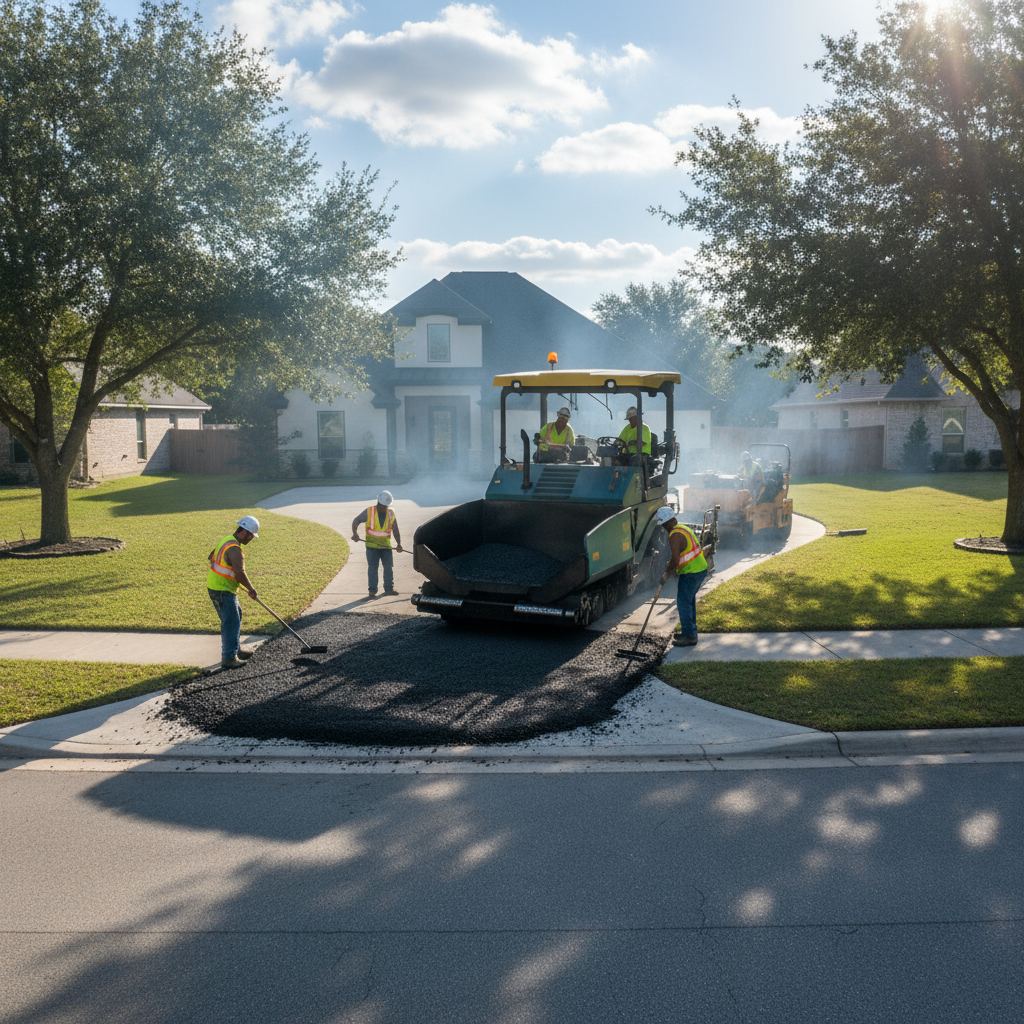
Driveway paving options and costs in Eglinton East
In Eglinton East, choosing a driveway paving option comes down to matching your budget with Toronto’s tough freeze–thaw reality. With a 2021 population of 22,776 in the area (Statistics Canada, 2021 Census), there’s steady demand for new surfaces and repairs, especially as homeowners update older driveways. Most private driveways here serve single-family homes, meaning lots of projects start with a straightforward “replace what’s there” scope—then expand once excavation and base drainage are revealed.
Toronto pricing is shaped by frost depth and seasonal timing. Ground freezes roughly 3–4 feet in the Toronto area, so contractors often need deeper, well-compacted granular base and reliable drainage to stop water from sitting under the pavement and causing heaving and cracking. On top of that, the usable paving window is basically late spring through early fall; hot-mix asphalt placement depends on temperatures (often above about 10°C), so prime dates can be booked quickly and labour costs rise when schedules tighten. In busy pockets of Eglinton East, such as around the Eglinton Avenue East corridor near transit and commercial frontage, crews are frequently in higher demand because access constraints and winter-ready surfaces are top of mind for residents.
Below is a practical cost comparison to help you understand what different materials typically run in Eglinton East—then we’ll break down what can push your final quote up or down in the next sections.
| Material |
Lifespan |
Maintenance |
Best For |
Price per sq ft |
| Asphalt (new installation, proper base) |
15–25 years |
Seal every 3–5 years; crack fill as needed |
Best value when base drainage is engineered |
$8 – $15 |
| Asphalt (overlay on existing gravel base) |
10–18 years |
Seal every 3–5 years; monitor for reflective cracking |
When existing base is stable and well-drained |
$7 – $12 |
| Interlocking concrete pavers |
25–35 years |
Re-sand joints every so often; re-level if needed |
High curb appeal and easy section repairs |
$18 – $30 |
| Poured concrete (broom finish) |
20–30 years |
Seal occasionally; manage jointing and de-icing impact |
Clean, uniform look with durable edges |
$15 – $26 |
| Exposed aggregate concrete |
20–30 years |
Seal every few years; keep surface clean to avoid staining |
Slip resistance and decorative finish |
$18 – $30 |
| Gravel / crushed stone (budget option) |
3–10 years |
Top up annually; re-grade; weed control |
Short-term or low-budget access path |
$3 – $7 |
Prices are estimates only and vary by project scope, site access and material selection.
What affects the price of paving in Eglinton East
If you’ve ever received two quotes for what sounds like the same driveway in Toronto, you may notice a 30–50% spread. That’s usually not “padding”—it’s the engineering differences behind the scenes: how deep the base needs to be, how much tear-out is required, whether drainage is corrected, and how tight the equipment access is at your specific lot. Even small changes—like removing old asphalt that’s delaminated or reworking grading so water runs away from the foundation—can add a surprising amount of excavation, haul-away, and labour.
In the Toronto economic region, frost depth and freeze–thaw cycles are decisive cost factors. When ground freezes to roughly 3–4 feet, you need a thicker compacted granular base and better drainage to prevent heaving and cracking. In practice, that means the granular layers and compaction requirements often increase the installed cost compared with milder climates. The paving season is also shorter in colder regions, and hot-mix asphalt placement is sensitive to air temperatures (commonly above ~10°C). That compresses scheduling into late spring through early fall, so prime-date labour can cost more. Asphalt also must use freeze–thaw-rated mix design; if a contractor uses an “off-the-shelf” approach rather than a spec-built mix, performance and longevity can suffer.
Concrete costs can swing as well. For example, a broom-finish slab with proper air entrainment and jointing can price closer to the $6,000 – $15,000 band for many typical driveways, while decorative exposed aggregate, heavier rebar/joint detailing, or extra excavation for drainage corrections pushes toward the upper end. If your home has an older driveway apron or the slab ties into garage steps, the tear-out and re-build can add to both asphalt (in the $3,500 – $8,000 band) and concrete scopes. Housing-stock age matters too: older installations often conceal weak base material that has to be rebuilt before any new surface can last.
| Price Factor |
Why It Matters |
Cost Impact |
| Driveway area in sq ft |
More surface area means more asphalt/pavers/concrete and base. |
Typically the biggest variable; can drive the largest portion of the final total. |
| Base depth required |
Frost line depth determines granular thickness to prevent heaving. |
Extra excavation and aggregate can raise the job by hundreds to thousands. |
| Grading and drainage work |
Toronto freeze–thaw punishes water trapped under pavement. |
Adding a correct slope, drainage layer, or re-grading increases labour and materials. |
| Tear-out of existing surface |
Breaking/hauling old asphalt or concrete often needs equipment and disposal. |
Can add significant cost if slab thickness is heavy or access is tight. |
| Edge restraints and curbing |
Edges stop paver spread and hold the system together under freeze–thaw movement. |
Upgrading to proper restraints improves longevity but adds material and labour. |
| Sealing requirement |
Asphalt needs sealing after installation to manage moisture and oxidation. |
Short-term cost plus a maintenance plan every 3–5 years. |
| Site access |
Narrow driveways slow equipment and increase manual labour. |
Often increases labour hours and may require smaller-load logistics. |
| Asphalt mix specifications |
Freeze–thaw-rated mixes better resist cracking in Toronto winters. |
Cost increases slightly upfront but reduces early failures and repair frequency. |
Permits & regulations in Ontario
In Ontario, paving a private driveway within your own property usually does not require a building permit. That’s typically true when you’re replacing an existing surface like-for-like (for example, removing old asphalt and installing new asphalt) without changing how water drains toward neighbouring properties. Where rules tighten is when your work affects the municipal right-of-way: if you’re creating or modifying a curb cut, changing the boulevard, or altering storm drainage patterns, you generally need municipal approval before excavation and paving.
For Eglinton East homeowners, a practical way to think of it is: what touches the city-owned frontage and drainage system likely needs approval; what stays fully within your lot boundary usually doesn’t. Before any digging, you should call for utility locates through Ontario One Call to confirm where services run. After that, confirm lot-grading bylaws with the local municipality—these can limit how close you can place hard surfaces to property lines and how grading/slope can be shaped to protect drainage.
When verifying an Ontario contractor, do it in a simple step-by-step order. First, check the contractor’s Ontario licence status using the relevant public registry (or licensing portal for their business category). Second, request a certificate of insurance: you should see liability coverage clearly listed (including driveway/surface work) and an expiry date. Third, confirm WSIB/WCB coverage for workers—ask for proof or clearance letter and ensure the employer name matches the invoice. If they hesitate or won’t provide paperwork, that’s a sign to move on.
Asphalt vs pavers vs concrete for Eglinton East driveways
For Eglinton East, the “best” driveway material is the one that performs through Toronto’s freeze–thaw cycles without letting water sit under the surface. Asphalt usually has the lowest upfront cost, but it’s a system: it needs a properly compacted base, a reliable drainage slope, and sealing every 3–5 years to slow moisture damage. In the Toronto market, many asphalt-driveway projects land in the $3,500 – $8,000 range depending on size and excavation, which is why it remains popular.
Interlocking concrete pavers cost more at the start, commonly falling into the $9,000 – $20,000 band, but they handle winter movement well because the surface can be re-leveled and repaired without replacing the whole driveway. The bigger advantage in a salted, plowed Ontario environment is that localized failures—like a spot that settles near a downspout or apron—can be lifted, corrected, and reset.
Poured concrete is mid-range, often near the $6,000 – $15,000 band, but it must be done right: air-entrained concrete, properly spaced joints, and thoughtful subgrade preparation are non-negotiable to limit freeze–thaw cracking. Exposed aggregate adds texture and slip resistance, but it’s still concrete—so drainage and air entrainment matter. A common justification example: if you’re considering asphalt versus pavers on a medium driveway, the extra paver investment is often “worth it” when you expect to live there long-term and want repairability and curb appeal along the Eglinton East curb line.
| Material |
Frost Resistance |
Curb Appeal |
Repair Method |
Lifespan |
Price Band |
| Asphalt (sealed regularly) |
Good when base/drainage is engineered and mix is freeze–thaw rated |
Medium |
Mill/patch or overlay a section |
15–25 years |
$3,500 – $8,000 |
| Interlocking concrete pavers |
Very good with proper bedding and edge restraints |
High |
Lift-reset individual units or sections |
25–35 years |
$9,000 – $20,000 |
| Poured concrete (air-entrained) |
Good to very good with joints and drainage |
Medium |
Crack repair and patching; sometimes slab replacement for major failures |
20–30 years |
$6,000 – $15,000 |
| Exposed aggregate concrete |
Good with correct mix, air entrainment, and sealing strategy |
High |
Targeted patching is possible but less “invisible” than asphalt |
20–30 years |
$7,500 – $17,000 |
| Permeable pavers (drainage grid) |
Very good where subsurface drainage is designed correctly |
High (modern look) |
Replace individual paver sections if clogged or settled |
20–30 years |
$10,000 – $22,000 |
| Chip seal / tar-and-chip |
Moderate; performance depends heavily on base stability |
Low to medium |
Spot repairs and occasional re-seal |
8–15 years |
$4,000 – $10,000 |
How to choose a paving contractor in Eglinton East
Choosing a contractor in Eglinton East is mostly about verifying coverage and scoping the work so you’re comparing apples to apples. Start with Ontario licensing: ask for their business licence details and check their registration using the appropriate Ontario public listings for their trade category. Next, request liability insurance—your certificate of insurance should name the company as insured, show an expiry date, and include adequate limits for property and driveway work. Third, confirm WSIB/WCB coverage for their workers. You can ask for proof or a clearance letter; make sure it’s current and matches the invoicing employer name. If they can’t provide these documents, that’s a hard stop.
Then get 2–3 itemised written quotes. You want a breakdown of labour + materials, including excavation, base aggregate, compaction, asphalt/paver/concrete supply, disposal/hauling, and any sealing. Avoid “lump sum only” bids when the scope isn’t fully defined. Read exclusions carefully: will permit pull (if required for right-of-way work) be handled by the contractor, and is disposal included? For asphalt, ask when sealing is scheduled and whether it’s included now or treated as a separate maintenance item later.
Warranty matters. Ask for the workmanship warranty length (not just product warranty), whether it covers base preparation, and whether it’s transferable if you sell. Payment schedule should be conservative: never pay more than 10–15% upfront; hold back a portion until the job is completed and cleaned up to standard. Finally, demand a written start date and estimated completion timeline so weather delays don’t become an open-ended excuse.
- Ask who will perform the base excavation and compaction and how it will be verified.
- Request a written scope of work with material types and thicknesses.
- Confirm disposal and hauling are included (especially for concrete tear-out).
- Get clear wording on edge restraints/curbs and bedding materials for pavers.
- For asphalt, confirm mix is freeze–thaw rated and compaction is measured.
- Ask about drainage corrections (slope, subdrain layers, and tie-ins).
- Ensure utility locates are arranged before any digging.
- Verify the contractor’s liability insurance and current WSIB/WCB coverage.
- Check warranty coverage for workmanship and base, not only surface material.
- Confirm payment terms: maximum 10–15% upfront; holdback until completion.
- Require insurance documents and licence information before signing.
- Get schedule details in writing, including weather contingency communication.
Red flags I see too often in Eglinton East: vague “all-in” pricing without thicknesses or drainage scope, no written workmanship warranty, contractors who won’t show current insurance/WSIB clearance, refusal to list exclusions (like disposal, sealing, or edge restraints), and crews that start excavation without utility locates. If any one of these shows up, slow down before you pay.
Frequently asked questions — paving in Eglinton East
Can asphalt be laid in cold weather in Eglinton East?
In Ontario, laying asphalt in cold weather is limited. Asphalt placement generally needs adequate air and surface temperatures so the material can be properly installed and compacted; otherwise you risk poor compaction and early cracking. In Eglinton East, that’s especially important because Toronto’s freeze–thaw cycles can amplify any weakness in the base or mat. If the job gets pushed into late fall/early winter, some contractors may try “warm-up” methods, but that doesn’t replace good site conditions and compaction requirements. A reputable contractor will confirm temperature forecasts, follow mix and placement specs, and often shift the schedule to late spring through early fall for quality assurance. If you’re comparing quotes, ask what temperature thresholds they follow and whether they include proper base drainage regardless of season.
What is a driveway apron and do I need one in Eglinton East?
A driveway apron is the transition section between your driveway and the road/sidewalk area (and it often affects the curb cut and grading at the frontage). In Eglinton East, whether you “need” an apron depends on how your existing surface meets the municipal frontage and whether your drainage pattern is correct. If you’re replacing an older driveway that already has a worn apron or uneven drop-off, upgrading the apron can help prevent water pooling at the edge and reduce premature settlement. If the work involves changes to the curb cut or boulevard/storm drainage in the municipal right-of-way, approvals may be required. For homeowners, the best approach is to ask your contractor to include apron/transition details in the written scope so your quote reflects the real grading and drainage work, not just the driveway surface.
How do I maintain my driveway through Eglinton East winters?
Maintenance in Ontario is really about reducing water and protecting the surface from mechanical stress. For asphalt in Eglinton East, keep plowing operations careful at the edges—sharp metal scraping can dislodge small aggregate and widen cracks. Use sand instead of aggressive de-icing salts when possible, especially on concrete joints, since repeated salt exposure can increase surface wear. Clear snow promptly to avoid prolonged freeze of meltwater on the surface. Avoid letting downspouts drain directly onto the driveway; if you have a foundation downspout nearby, confirm it discharges somewhere that won’t saturate the base. For pavers, the joint sand and edges matter: if you notice washouts or gaps, address them early so water can’t migrate under the bedding.
Is it worth sealing a new driveway right away in Eglinton East?
Sealing right away is usually not the right approach for new asphalt. Most contractors recommend waiting until the asphalt has cured and is ready—commonly after the surface has had time to cool and stabilize—so the sealant bonds properly and doesn’t trap excess moisture. In Eglinton East, sealing is still worthwhile because Toronto’s freeze–thaw cycles and winter moisture accelerate oxidation and water intrusion. Think of sealing as part of the lifecycle plan: plan to seal every 3–5 years rather than skipping it. If your asphalt quote is in the $3,500 – $8,000 range, ask whether sealing is included in year one and what the warranty requires. A good contractor will match the seal timing to product specs and local weather and will explain how it ties to crack resistance.
What is a chip seal driveway and is it suited to Eglinton East?
Chip seal (tar-and-chip) is a surface treatment where asphalt binder is sprayed and covered with aggregate chips. It can be a lower-cost option, but performance depends heavily on base stability and drainage. In Eglinton East, the Toronto freeze–thaw environment can challenge chip seal if the base is weak or water can move under the surface. That doesn’t mean it’s automatically a bad fit—it can be suitable where you want a functional, cost-conscious surface and the underlying granular base is engineered correctly. For some homeowners, it’s a stepping-stone option, especially if you’re budgeting and planning a longer-term rebuild later. If you’re comparing to asphalt in the $3,500 – $8,000 range or pavers in the $9,000 – $20,000 range, ask for base thickness details and a drainage plan. Those two items decide whether chip seal lasts or deteriorates quickly.
How much does driveway crack repair cost in Eglinton East?
Crack repair pricing in Ontario depends on crack width, length, and whether the issue is surface-only or related to base movement/drainage. In Eglinton East, minor asphalt crack filling is often relatively modest, while repairs that require cutting out and replacing affected sections cost more. A common range for sealing and repair work is $300 – $1,500, but that’s not the full story—if water management is the root cause, you may need drainage correction or base remediation. The most cost-effective approach is to have the contractor assess whether cracks are “cosmetic” or signals of deeper frost-lift or settlement. If the crack is actively widening near edges or low spots, fixing only the surface can lead to quicker repeat repairs.