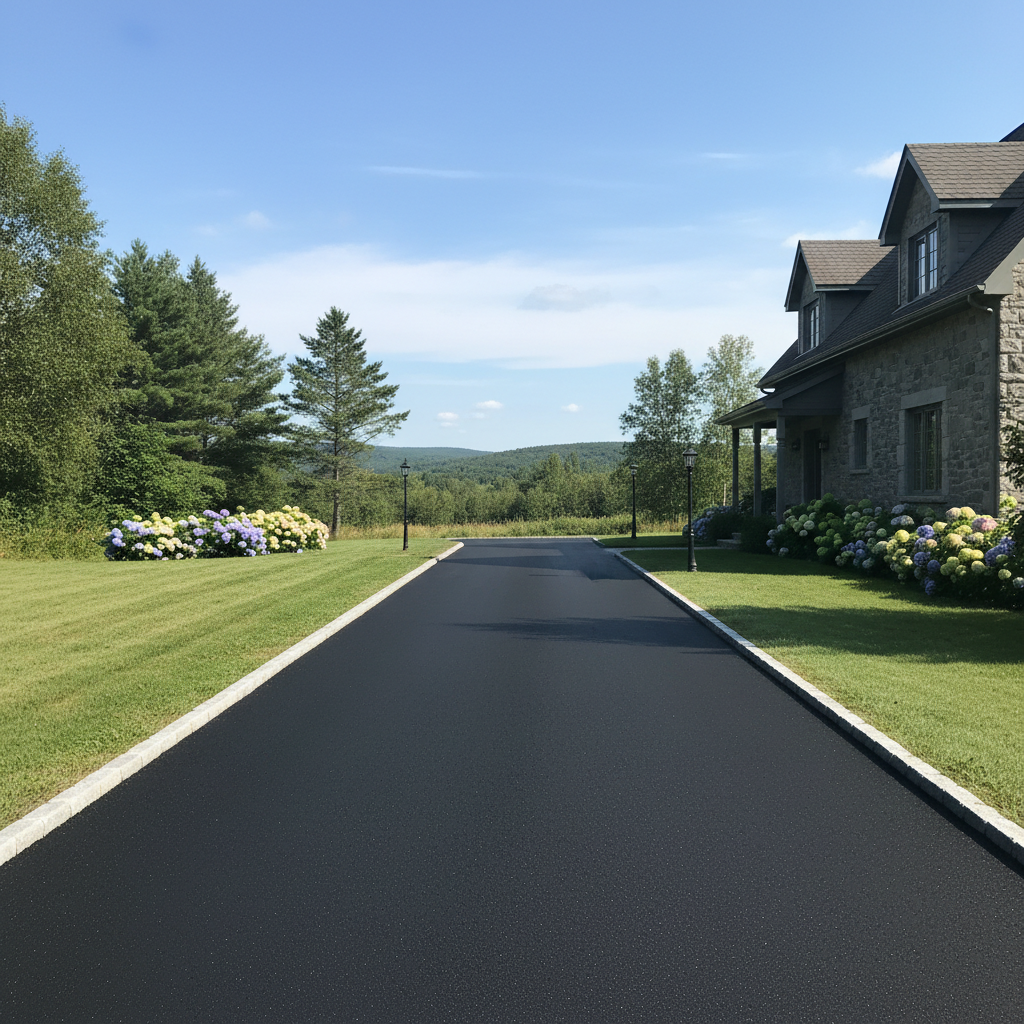
Driveway paving options and costs in Rockwood
In Rockwood, choosing the right driveway surface usually comes down to a balance of upfront cost, long-term durability, and how the material handles Ontario’s winter. With a population of 4,629 (Statistics Canada, 2021 Census), Rockwood has fewer contractors than the larger GTA cities—so planning ahead matters, especially for prime spring-through-summer install dates. Most private driveways in towns like Rockwood are tied to single-family homes, and the Toronto economic region’s freeze–thaw pattern can turn small drainage or base issues into visible cracking sooner than homeowners expect.
In the Toronto economic region, frost depth is roughly 3–4 feet. That means your driveway needs a properly engineered granular base, good subgrade compaction, and reliable drainage so water can’t sit under the pavement and heave when it freezes. Asphalt also depends on correct mix design to resist freeze–thaw stress, and the paving season is effectively concentrated late spring through early fall, which can tighten scheduling and increase labour demand. In areas like the rural approaches toward Rockwood’s outskirts and along the main residential streets, we often see especially high demand when homeowners replace older driveways before the first heavy spring freeze.
Below is a practical cost comparison for common materials, assuming good base preparation (the part that protects your investment in Rockwood’s climate) and typical driveway access.
| Material |
Lifespan |
Maintenance |
Best For |
Price per sq ft |
| Asphalt (new installation, proper base) |
15–25 years |
Seal every 3–5 years; address minor cracks early |
Most cost-conscious driveways with smooth finish |
$10 – $20 |
| Asphalt (overlay on existing gravel base) |
10–18 years |
Seal every 3–5 years; monitor base settlement |
Shorter timeline projects when base is stable |
$8 – $16 |
| Interlocking concrete pavers |
25–35 years |
Re-lay individual stones if needed; joint sand upkeep |
Curb appeal and repairability (no full-surface tear-out) |
$18 – $35 |
| Poured concrete (broom finish) |
20–30 years |
Seal as needed; crack control and joint maintenance |
Durability with a clean, uniform look |
$16 – $30 |
| Exposed aggregate concrete |
25–35 years |
Occasional sealing; keep drainage clear |
Enhanced appearance with better traction than smooth concrete |
$20 – $38 |
| Gravel / crushed stone (budget option) |
3–10 years |
Top up annually; re-grade and weed control |
Temporary solution or low-budget rural driveways |
$6 – $12 |
Prices are estimates only and vary by project scope, site access and material selection.
What affects the price of paving in Rockwood
In Rockwood and the wider Toronto economic region, it’s common to see quotes for the “same” driveway come in 30–50% apart. The difference usually isn’t the surface material alone—it’s the hidden work: excavation depth, base compaction quality, drainage correction, and how much old asphalt or concrete has to be hauled away. When frost depth is about 3–4 feet and freeze–thaw cycles are frequent from late fall through early spring, contractors must overbuild the base and keep water moving. That increases material volume and labour time, especially on lots where the subgrade has been disturbed or where the slope toward the garage and street doesn’t drain well.
Hot-mix asphalt also requires air temperatures above roughly 10°C for placement, so the paving season concentrates projects into late spring and summer. When crews are booked solid, rush work and scarce prime-date availability can push pricing toward the higher end of the asphalt band (for example, $3,500 – $8,000 total for typical driveway paving). Concrete pricing also shifts seasonally; if concrete placement waits for the right weather window, scheduling can affect jobsite costs. For interlock, especially, base and edge restraint details matter—good drainage and restraints are what stop pavers from shifting under winter loading.
In Rockwood, you’ll also see cost swings based on driveway age and condition. A driveway with old, broken asphalt often requires tear-out and haul-away (adding cost beyond the asphalt surface rate), while a stable gravel base can sometimes support a more economical asphalt build-up. If your home is on a slope or near an existing ditch line, drainage correction may be the biggest variable—sometimes adding several thousand dollars but preventing expensive heaving and cracking later.
| Price Factor |
Why It Matters |
Cost Impact |
| Driveway area in sq ft |
Surface area and base volume scale directly with size |
Typically the #1 driver (can swing most budgets) |
| Base depth required |
Frost line conditions dictate granular thickness to prevent heaving |
More excavation/materials increases total cost |
| Grading and drainage work |
Slope corrections and swales prevent water sitting under pavement |
Common add-on when sites drain poorly |
| Tear-out of existing surface |
Break-up and hauling concrete or aged asphalt takes labour and disposal |
Can add substantial cost versus “overlay” scenarios |
| Edge restraints and curbing |
Prevents paver spread and helps keep asphalt edges supported |
Higher cost on irregular or long-edge runs |
| Sealing requirement |
Asphalt performs better when sealed after initial cure period |
Adds a future maintenance line item (planned cost) |
| Site access |
Narrow lots slow equipment and limit haul truck efficiency |
Labour and time increases |
| Asphalt mix specifications |
Freeze-thaw-rated mixes improve performance in winter cycles |
Often increases material cost modestly but reduces failure risk |
Permits & regulations in Ontario
In Ontario, paving a private driveway on your own property—like replacing asphalt, installing interlock, or pouring concrete within your property lines—often does not require a building permit. Where homeowners get tripped up is when the work touches the municipal right-of-way. In practical terms for Rockwood, new curb cuts, changing the boulevard area, modifying municipal drainage, or altering stormwater connections typically require municipal approval before excavation and placement.
Here’s the step-by-step approach I recommend: (1) before work starts, ask the contractor whether your scope includes anything in the boulevard/municipal right-of-way; if yes, confirm the permit or approval path. (2) Ask for the contractor’s proof of Ontario licence (where applicable for their class of work), a current certificate of liability insurance, and evidence of WSIB coverage (or the applicable coverage they carry for workers). (3) Verify utility locations by calling Ontario One Call before digging—this should be scheduled so locate markings are on site before excavation. (4) If your driveway grade ties into lot grading, confirm any lot-grading requirements or setbacks with the local municipality, because hard surfaces and altered drainage directions can affect compliance.
When you receive documentation, don’t just take it on faith: check the insurance certificate for policyholder name and expiry date, and request a clearance letter/coverage proof showing the contractor is in good standing for the period of the job.
Asphalt vs pavers vs concrete for Rockwood driveways
For Rockwood driveways in the Toronto freeze–thaw climate, the “best” material depends on your priorities: lowest upfront cost, long-term curb appeal, or a surface that’s straightforward to maintain during winter. Asphalt is usually the lowest upfront choice (commonly $3,500 – $8,000 depending on size and base work). It’s also smooth for plowing and snow removal, but it needs sealing every 3–5 years to slow oxidation and protect against salt and water infiltration.
Interlocking concrete pavers cost more up front (often in the $9,000 – $20,000 band), yet they shine in Ontario’s freeze–thaw world because they’re mechanically installed and remain repairable. If a section settles or a utility ever needs access, we can remove and re-lay affected pavers without replacing the entire driveway. The key is engineering the base and using proper edge restraints—otherwise, paver joints can open over time.
Poured concrete typically lands mid-range in cost, but it can be susceptible to cracking if air-entrainment, joint spacing, and drainage aren’t designed for freeze–thaw and de-icing salt. In Rockwood, concrete that’s properly air-entrained and jointed performs far better than one poured without attention to winter durability.
A realistic example: if asphalt would be about $6,500 on your driveway but interlock is $13,500, the price difference is justified when you want a higher-end look and the ability to spot-repair localized failures rather than plan a full surface replacement sooner. With good base drainage, any of the three can perform well—but poor base drainage is what drives failure in our climate.
| Material |
Frost Resistance |
Curb Appeal |
Repair Method |
Lifespan |
Price Band |
| Asphalt (sealed regularly) |
Good with correct granular base and freeze-thaw-rated mix |
Moderate |
Patch/overlay localized areas |
15–25 years |
$3,500 – $8,000 |
| Interlocking concrete pavers |
Very good; base and jointing allow slight movement |
High |
Remove and re-lay affected pavers |
25–35 years |
$9,000 – $20,000 |
| Poured concrete (air-entrained) |
Good with proper air entrainment and joints |
Moderate to high |
Crack repair/patching at joints or isolated sections |
20–30 years |
$6,000 – $15,000 |
| Exposed aggregate concrete |
Good; traction-friendly surface in winter |
High |
Patch by section (matched finish as close as possible) |
25–35 years |
$8,000 – $18,000 |
| Permeable pavers (drainage grid) |
Very good where drainage design is correct |
High (depending on grid style) |
Section-based repairs; maintain underlying drainage media |
20–30 years |
$10,000 – $22,000 |
| Chip seal / tar-and-chip |
Moderate; depends heavily on base and stone embedment |
Lower to moderate |
Spot repairs possible but texture matching varies |
8–15 years |
$4,000 – $9,000 |
How to choose a paving contractor in Rockwood
Choosing the right contractor in Rockwood is mostly about verifying coverage, getting the right paperwork, and reading the scope line-by-line. Start with licensing: in Ontario, contractors may need specific qualifications depending on the type of work. Ask for their current Ontario licence details and confirm the information matches the name on the contract. Next, check liability insurance—request a certificate of insurance that lists your property address (or at least the insured contractor name), shows adequate limits, and isn’t expired.
For worker coverage, ask whether they carry WSIB coverage and request proof. The certificate should show coverage status and the policyholder; if subcontractors are used, insist on documentation that each involved crew is properly covered. Don’t rely on verbal confirmation.
Then get 2–3 itemised written quotes. You want a breakdown that separates excavation/grading, base materials, asphalt or concrete, reinforcement (if concrete), interlock bedding and joint sand, saw cutting/joints (concrete), and disposal fees. Avoid a lump-sum number with vague wording. Confirm what’s excluded: permit pull (if needed), site protection, restoration of landscaping, disposal of demolished material, and any allowance for unforeseen subgrade conditions.
For warranties, ask for both workmanship warranty length and product/manufacturer warranty terms—plus whether the warranty is transferable if you sell your home. Payment should be staged: never pay more than 10–15% upfront, and request a holdback until completion and final walk-through. Finally, demand timeline details in writing: start date, weather-dependent scheduling, and the estimated completion window.
- Request proof of Ontario licence/qualifications relevant to the job type
- Verify certificate of liability insurance (limits and expiry date)
- Confirm WSIB coverage for workers (or provide proof if using covered subcontractors)
- Get itemised quotes: excavation, base, surface, disposal, restoration
- Ask if a permit/approval is required for any right-of-way or curb-bulge work
- Confirm utility locate responsibility (Ontario One Call) and schedule
- Review the proposed base build-up depth and compaction method
- Check drainage plan: slope, swales, and how water will be directed away
- Clarify edge restraint/curb details (especially for pavers and asphalt edges)
- Ask about mix design or concrete specifications (freeze–thaw needs air-entrainment for concrete)
- Confirm warranty coverage for workmanship and what counts as “fault”
- Lock payment schedule and holdback in writing before any work starts
Red flags I commonly see in Rockwood include quotes that don’t specify base depth or compaction, skipping utility locate discussions, pushing large upfront payments, refusing to provide insurance/WSIB proof, and using vague language like “standard asphalt” without mix or placement details.
Frequently asked questions — paving in Rockwood
What is a driveway apron and do I need one in Rockwood?
A driveway apron is the section where your driveway meets the municipal curb and/or road surface—essentially the transition area that helps support the driveway edge and manage water. In Rockwood, whether you “need” one depends on how your current driveway connects to the boulevard and whether the curb cut and grading are intact. If the curb opening is being modified, or if your paving scope involves work in the right-of-way, municipal approvals are typically required. Practically, even when a permit isn’t triggered for work fully on your property, we often recommend building a properly engineered apron as part of the driveway rebuild to prevent edge failures caused by trapped water and winter expansion. If you’re budgeting, driveway paving often falls within $3,500 – $8,000 for asphalt when the base is sound, but right-of-way transition work can push the total higher.
How do I maintain my driveway through Rockwood winters?
Rockwood winters are tough on pavement mainly because of freeze–thaw cycling and de-icing chemicals. For asphalt, keep the surface clear so meltwater doesn’t pool; avoid letting salt-heavy slush sit along the driveway edges. For pavers, periodically check joint sand and keep edges firm—settlement often shows up where drainage is weakest. In every material, the biggest maintenance win is drainage: ensure downspouts discharge away from the driveway, and keep swales or low spots from holding water. After the first hard season, do a quick walk-around for early cracking or minor paver shifting. Small repairs done early are cheaper than waiting until frost has expanded the cracks. If you’re in the asphalt range of about $3,500 – $8,000, planning a seal at the right time (typically after the initial cure period) helps keep winter water and salts from accelerating wear.
Is it worth sealing a new driveway right away in Rockwood?
Usually, no—you should seal at the correct time, not immediately. Asphalt needs time to cure so the sealant can bond properly; sealing too soon can trap moisture and reduce performance. In Rockwood/ Ontario, we generally recommend sealing once the asphalt has cured and is ready for coating, often within the first 6–12 months depending on weather and the contractor’s product system. After that, sealing on a schedule (commonly every 3–5 years) protects against oxidation, water infiltration, and salt exposure, which is important with Toronto-region freeze–thaw conditions. If you’re comparing quotes, make sure the job plan tells you when sealing is recommended and whether it’s included or billed separately. The good news: even if your initial paving budget sits around $3,500 – $8,000, timely sealing can extend asphalt life and delay the higher-cost replacement phase.
What is a chip seal driveway and is it suited to Rockwood?
Chip seal (tar-and-chip) is a surface treatment where asphalt emulsion is sprayed and covered with aggregate chips, then rolled into place. It’s typically more budget-friendly than full asphalt paving and can work well in some driveways, but it’s more maintenance-sensitive. In Rockwood’s winter freeze–thaw environment, the performance depends heavily on base quality, correct binder application, and proper aggregate embedment—otherwise chips can loosen and rutting can appear. It also tends to be less uniform in look and texture than asphalt paving, and snowplow technique matters. If your driveway is heavily used, or if you’re dealing with poor drainage, a traditional asphalt build with a thicker, well-compacted base usually outlasts chip seal. Chip seal can fall around the lower paving bands (for example, $4,000 – $9,000 depending on scope), but I’d only recommend it if the underlying drainage and base are engineered for our frost conditions.
How much does driveway crack repair cost in Rockwood?
Crack repair cost varies based on crack width, length, depth, and whether the issue is surface-only or indicates a deeper base drainage problem. For small, manageable cracks, repair is often done with crack cleaning, sealing, and sometimes routing/widening for proper sealant adhesion. When cracks are widespread, or when heaving has occurred due to freeze–thaw water movement, you may need more than sealing—spot base correction or an overlay may be required. In Rockwood, pricing is also affected by access and seasonal scheduling. As a rough planning figure, minor asphalt sealing/repair work is often a smaller line item compared to full driveway resurfacing, while larger “failed section” repairs can approach a meaningful portion of your original asphalt budget (commonly $3,500 – $8,000 for a typical driveway). The fastest way to get an accurate number is for the contractor to assess whether water is pooling, because fixing drainage is usually the difference between a repair that lasts and one that returns quickly.
What base thickness do I need for pavers in Rockwood?
For interlocking pavers in Rockwood, base thickness is driven by Ontario’s frost depth and the need to prevent water from freezing under the slab. In Toronto-region conditions, the granular base often needs to be deep enough to resist frost heave—meaning excavation, compacted granular layers, and a properly graded subgrade are critical. A common approach is to build a compacted granular system that allows for frost protection (and adequate drainage) rather than relying on a thin base. The exact thickness depends on subgrade stability, whether you’re replacing existing material, and your site drainage. If you’re near a driveway approach where water tends to collect, base and drainage correction can increase cost, but it’s what protects the paver surface over multiple winters. Because interlock pricing often sits around $9,000 – $20,000, spending appropriately on base engineering usually offers the best return: fewer settlements and less joint loss after the first few freeze–thaw cycles.