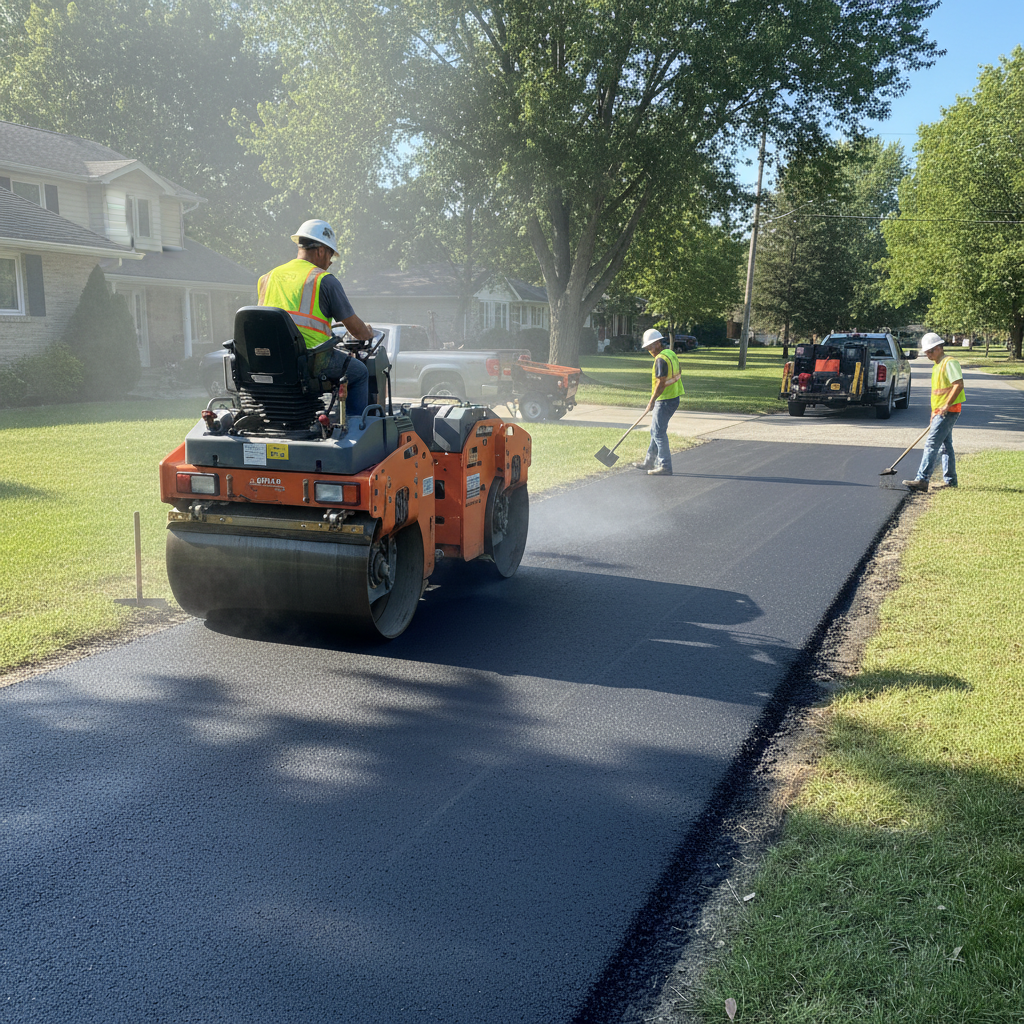
Driveway paving options and costs in Madoc
Madoc homeowners typically have driveway decisions that come down to three things: upfront budget, how long they want to wait between repairs, and how well the surface survives Madoc’s repeated freeze–thaw cycles. With most homes in Madoc being single-detached (98.3% of dwellings), and owner households making up 87.4% of households (Statistics Canada, 2021 Census), driveway paving is a major, long-term improvement that’s usually planned and financed by the property owner rather than a landlord. That matters because homeowners often want a clean, permanent finish near the road and they’re willing to invest in the base so the pavement doesn’t heave or crack.
In the Kingston–Pembroke economic region, costs are driven first by climate and soil. Local frost penetration is commonly around 4 feet (≈1.2 m) in much of Southern and Eastern Ontario, so contractors build a deeper, well-compacted granular base and focus heavily on drainage (ditch grading, swales, and sometimes French drains). The paving window also tightens because hot-mix asphalt generally needs air temperatures above 10°C, and spring is wet—so demand concentrates and schedules can tighten, especially around “shoulder” weeks.
In Madoc, paving and re-surfacing are especially in demand around the main built-up areas near Highway 62 and along the rural approaches where driveways commonly cross softer clay pockets and require extra granular import and grading. If you’re comparing options, the table below uses typical project scopes for Madoc to help you translate those conditions into realistic budget ranges—then you can tailor the quote to your driveway size and site access.
| Material |
Lifespan |
Maintenance |
Best For |
Price per sq ft |
Price Range |
| Asphalt (new installation, proper base) |
15–25 years |
Seal coat at 3–5 years (then as needed) |
Most cost-effective “finished” driveway |
$7.00–$13.50 |
$4,500–$9,000 |
| Asphalt (overlay on existing gravel base) |
12–20 years |
Seal coat at 3–5 years; monitor edges |
Gravel areas needing a faster conversion |
$6.50–$12.00 |
$4,200–$8,200 |
| Interlocking concrete pavers |
25–40 years |
Minimal; spot repairs as units shift |
Curb appeal and easy localized fixes |
$12.00–$20.00 |
$6,500–$14,000 |
| Poured concrete (broom finish) |
25–35 years |
Crack monitoring; sealant optional |
Smooth, low-maintenance finish |
$10.00–$18.00 |
$7,000–$15,000 |
| Exposed aggregate concrete |
20–30 years |
Reseal as recommended by finisher |
Slip-resistant, decorative driveway look |
$12.00–$20.00 |
$8,000–$15,800 |
| Gravel / crushed stone (budget option) |
5–10 years |
Regrade and top up every 1–3 years |
Lowest entry cost; improving drainage |
$2.50–$6.50 |
$2,200–$6,500 |
Prices are estimates only and vary by project scope, site access and material selection.
What affects the price of paving in Madoc
In Madoc and across the Kingston–Pembroke area, two driveways that look similar from the road can come in at very different totals—often a 30–50% swing—because the real work is in what’s underneath. Contractors may quote the same “asphalt” or “concrete” on the surface, but the base depth, compaction effort, drainage corrections, and how much material has to be imported to reach frost-safe levels can change the cost dramatically.
Frost penetration and freeze–thaw cycles are decisive in Ontario. Where frost influence is commonly near 4 feet (≈1.2 m), the granular base needs to be thick and tightly compacted to limit heaving and cracking. In practice, driveway designs often call for a thicker, engineered granular section (for many Ontario subgrades you’ll see a deeper build than milder climates). That’s why a contractor might be quoting a driveway with 6–12 inches of granular layers plus additional thickness for weak soils, not just a thin lift of asphalt. Also, hot-mix asphalt requires air temperatures above 10°C; because Madoc’s paving window is shorter, spring demand can tighten scheduling and labour availability, which can push pricing up during peak weeks. Asphalt mix design also matters: a freeze-thaw-rated mix typically costs more than a “standard” approach.
Concrete in Madoc can be priced higher when air-entrainment and reinforcement details are specified to handle freeze–thaw and moisture movement. Poured concrete may also cost more if your site has poor drainage or clay that requires extra excavation and re-compaction. If your driveway is accessible for dump trucks and you already have good grading and drainage, you can sometimes keep costs closer to the lower end of the typical asphalt band (for example, projects often land around $4,500–$9,000 depending on base and haul distances). If you’re building interlocking pavers, the added base and edge restraint to prevent paver spread is why many Madoc projects land in the $6,500–$14,000 range.
| Price Factor |
Why It Matters |
Cost Impact |
| Driveway area in sq ft |
Most materials and labour scale directly with square footage |
Typically 40–70% of the total |
| Base depth required |
Frost influence drives granular thickness to reduce heaving/cracking |
Often adds 15–35% depending on soil |
| Grading and drainage work |
Slope corrections and drainage prevent water pooling under the pavement |
Often 5–25% |
| Tear-out of existing surface |
Breaking/hauling concrete or disposing old asphalt increases labour and equipment time |
Often 10–30% |
| Edge restraints and curbing |
Restraints keep pavers and asphalt from spreading and washing out |
Often 3–12% |
| Sealing requirement |
Asphalt needs sealing after installation to slow aging from sun and water |
Adds 1–5% now; protects long-term value |
| Site access |
Narrow driveways, soft shoulders, or slopes slow equipment movement and add staging time |
Often 5–20% |
| Asphalt mix specifications |
Freeze–thaw-rated mixes improve durability in Ontario’s winter cycling |
Often 5–15% |
Permits & regulations in Ontario
In Ontario, paving a private driveway within your own property usually does not require a building permit. However, the moment the work affects municipal infrastructure, you’re typically dealing with municipal approval requirements. For a Madoc homeowner, the work that often does require municipal approval includes: creating or changing a curb cut, altering the boulevard, working near a municipal ditch, and changing storm drainage patterns (for example, re-routing runoff so it no longer follows the existing swale/ditch design). If your driveway project includes modifications to drainage that could affect neighbouring properties or the municipal right-of-way, plan on contacting the municipality before work starts.
Some municipalities also have lot-grading bylaws that restrict how close a hard surface can be to property lines and how drainage must be managed. Even if you don’t need a permit, you should still confirm that your driveway design complies with local grading and runoff direction rules.
Before any excavation, always call for utility locates through Ontario One Call so the contractor can safely plan for buried services. Then, when you verify the contractor, use a simple step-by-step check: (1) confirm the contractor’s business/contractor credentials where applicable (and that they can legally perform the work), (2) request a certificate of insurance showing liability coverage, (3) confirm WSIB coverage or provide the appropriate exemption documentation if they’re not required to carry it, and (4) ask for clearance letters or proof of account status when applicable. For paving companies, these documents are usually provided quickly—if they’re vague or reluctant, that’s a red flag.
Asphalt vs pavers vs concrete for Madoc driveways
For Madoc driveways, asphalt, interlocking pavers, and concrete all can perform well, but each has a “best use” in Ontario’s freeze–thaw reality. Asphalt is usually the lowest upfront cost and it’s practical for long driveways when you want a smooth ride. The trade-off is that asphalt needs sealing regularly—typically every 3–5 years—to protect against water intrusion and accelerated aging, especially after spring moisture and wet shoulder seasons. With good base preparation and proper drainage, asphalt can meet the $4,500–$9,000 expectation for many Ontario driveway projects.
Interlocking concrete pavers tend to cost more upfront, but they’re repair-friendly. If one area is damaged or shifts due to a localized drainage issue, pavers can be lifted and re-set without demolishing the entire driveway. That’s a big advantage in Kingston–Pembroke where clay pockets and variable subgrade conditions can cause uneven movement if the base isn’t uniform. If curb appeal is a priority—common along the main approaches near Highway 62—pavers commonly land in the $6,500–$14,000 range for full driveway projects.
Poured concrete sits in the mid-to-upper range. It can last a long time, but it’s susceptible to cracking if it’s not air-entrained and detailed for freeze–thaw movement and moisture. In Ontario winters, salt and sand from plowing can further stress the surface if the mix and finish aren’t done for durability. The option that typically holds up best to a “real” winter routine is the one backed by the right base depth and drainage. In Kingston–Pembroke, all three require robust granular base design tied to frost influence, and good slope/drainage so water can’t sit under the pavement.
A practical example: if your driveway is in good shape and you’re staying within an asphalt rebuild, upgrading from a basic asphalt approach to a freeze–thaw-rated base and proper drainage can be the difference between a lower asphalt total near $4,500–$6,000 and a more durable outcome closer to the upper end of $7,000–$9,000. If your goal is “install once, repair locally,” pavers can be worth the higher upfront price; if your goal is budget control with predictable maintenance, asphalt is often the sensible pick.
| Material |
Frost Resistance |
Curb Appeal |
Repair Method |
Lifespan |
Price Band |
| Asphalt (sealed regularly) |
Good with deep base and drainage; sealing slows water damage |
Medium (clean black finish, limited pattern options) |
Patch and re-compact; overlay if ageing accelerates |
15–25 years |
$4,500–$9,000 |
| Interlocking concrete pavers |
Very good when laid over the correct base and edge restraints |
High (colour/pattern options, strong street presence) |
Lift and re-lay affected units; rebuild localized sections |
25–40 years |
$6,500–$14,000 |
| Poured concrete (air-entrained) |
Good with proper mix, air-entrainment, and joints |
Medium (smooth or broom finish; exposed options are decorative) |
Patch repairs for small spalls; slabs may require larger fixes if heaving occurs |
25–35 years |
$7,000–$15,000 |
| Exposed aggregate concrete |
Good to very good if sealed/maintained and correctly finished |
Very high (textured decorative look) |
Surface repairs are limited; may need partial replacement if cracking spreads |
20–30 years |
$8,000–$15,800 |
| Permeable pavers (drainage grid) |
Very good where water management is difficult; reduces saturation under surface |
Medium to high (system look; styles vary) |
Replace grid sections; keep maintenance on filter layers |
20–30 years |
$7,500–$16,500 |
| Chip seal / tar-and-chip |
Moderate; performance varies with base quality and winter maintenance |
Low to medium (more utilitarian appearance) |
Spot patch; re-coat when stone loss accelerates |
7–15 years |
$4,000–$8,000 |
How to choose a paving contractor in Madoc
Choosing the right contractor is where you protect your budget. In Ontario, you should verify three core items before anyone starts digging: liability insurance, WSIB coverage (or the correct exemption documentation), and that the contractor can legally perform the type of work they’re quoting. To check liability insurance, ask for an up-to-date certificate of insurance naming you as an interested party where available. For WSIB, request proof of clearance or account status directly from the contractor—reputable paving companies can provide this without delay. If a contractor won’t share these documents or asks you to “trust them,” stop there.
Then get 2–3 itemised written quotes that break down labour and materials (not just one lump sum). You want line items for excavation, haul/disposal, granular base (with compaction details), asphalt/concrete or pavers, edge restraints, and any drainage corrections. Carefully review what’s excluded: is disposal included for old asphalt/concrete? Is permit handling included if your work touches municipal right-of-way? Are utilities locate costs included? A clean scope reduces change orders.
Warranty matters too. Ask for (1) workmanship warranty length and what it covers (settlement, scaling, premature raveling, joint cracking), (2) manufacturer warranty for products (like asphalt mix components or paver systems), and (3) whether warranties are transferable if you sell the home. For payment, never pay more than 10–15% upfront; use a holdback until the job is complete and cleanup is confirmed. Finally, ask for a start date and a completion estimate in writing, since Madoc paving is seasonal and weather-dependent.
- Provide WSIB clearance/proof or exemption documentation for the work scope
- Show a current certificate of insurance (liability) before scheduling
- Use itemised quotes: excavation, base, drainage, surface, edges, and disposal
- Clarify base thickness and compaction expectations (don’t accept vague “proper base”)
- Confirm whether utility locates are included or the homeowner needs to initiate them
- Ask how they handle drainage: ditch grading, swales, and French drains if needed
- Specify edge restraint type to prevent paver spread or asphalt edge failure
- Confirm for asphalt: seal coat timing (often after 6–12 months) and product type
- Confirm for concrete: air-entrainment, finishing method, and jointing plan
- Ask for warranty terms in writing: workmanship vs product/manufacturer
- Payment schedule: 10–15% max deposit; holdback until final walkthrough
- Get a realistic weather-dependent timeline and start/completion dates in the contract
Concrete red flags I’ve seen in Madoc: contractors who quote without measuring the driveway area, vague base descriptions (“we’ll do what’s needed”), no documented proof of WSIB or liability insurance, refusing to itemise disposal and haul costs, and promising year-round paving or skipping drainage corrections in clay-prone areas.
Frequently asked questions — paving in Madoc
What base thickness do I need for pavers in Madoc?
In Madoc (Kingston–Pembroke region), the base thickness is primarily driven by frost influence and your subgrade condition, not just the paver thickness. Because Southern and Eastern Ontario commonly see frost influence around 4 feet (≈1.2 m), contractors typically build a deeper, engineered granular base and compact it in lifts to limit heaving and uneven movement. If you have heavier clay or a driveway that’s historically softened in spring, expect more granular import and more attention to grading and drainage than a purely “standard” section. The fastest way to get an accurate number is to ask your contractor to describe their proposed granular layers (depth per layer) and compaction approach, plus whether they’ll address drainage (ditch grading or a French drain) before pavers go down.
How do I get the most accurate paving quote in Madoc?
For the most accurate quote in Madoc, ask for a site visit where the contractor measures square footage, checks the slope, and identifies where water drains during snowmelt and rain. In this region, drainage problems are often the reason for early failures, so confirm they’re pricing ditch/swale adjustments, not just the surface. Request itemised quotes that separate excavation and disposal, granular base depth, compaction, and the final material (asphalt, pavers, or concrete). Asphalt pricing often lands in the typical band of $4,500–$9,000, but that range swings when you add haul distances, deeper frost-safe base, or tear-out of old concrete/asphalt. Also ask whether utility locates are included and whether any municipal/right-of-way impacts are part of the scope.
How much does it cost to pave a driveway in Madoc?
Costs in Madoc commonly depend on driveway size, base prep, drainage corrections, and access for trucks and rollers. As a planning benchmark, asphalt driveway paving in this area often falls within $4,500–$9,000, while interlocking concrete pavers are typically in the $6,500–$14,000 range, and poured concrete commonly sits around $7,000–$15,000. If your driveway requires extra excavation for clay pockets or you need significant granular import to reach frost-safe thickness, you’ll see quotes lean toward the upper ends. Because Madoc has many owner-occupied single-detached homes (Statistics Canada, 2021 Census), projects are often fully finished driveways—not just patch work—so full tear-out and drainage are common scope items.
Asphalt vs interlocking pavers vs concrete — which is best in Madoc?
“Best” depends on what you value most, but in Madoc’s freeze–thaw climate the winning factor is usually the base and drainage design first. Asphalt is the best value for many homeowners because it typically costs less upfront (often $4,500–$9,000), but you must plan for sealing—generally after 6–12 months and then every 3–5 years—to prevent water damage. Interlocking pavers are usually the highest upfront option (often $6,500–$14,000) but they’re repairable: a localized settlement can be corrected without replacing the whole driveway. Concrete can be a solid long-term solution around $7,000–$15,000, provided it’s air-entrained and detailed for Ontario winters. If your driveway has recurring spring pooling, pavers or well-designed drainage with any option often performs best over time.
How long does a paved driveway last in Madoc?
With proper base preparation, drainage, and installation timing, you can expect meaningful lifespan in Madoc despite winter cycling. Asphalt typically lasts about 15–25 years when the base is frost-safe and the driveway is sealed regularly. Interlocking pavers often last 25–40 years because damaged areas can be lifted and re-set, and the system tolerates localized movement better when installed correctly. Poured concrete commonly lasts 25–35 years if air-entrainment and finishing/jointing are done for freeze–thaw conditions. Exposed aggregate can be similar but may require surface care depending on product and sealing approach. The biggest “early failure” drivers here are weak or poorly compacted base and water trapped under the pavement—so drainage and grading are not optional in Kingston–Pembroke.
When is the best time of year to pave in Madoc?
In Madoc, the best time is typically late spring through summer when the ground is workable and air temperatures support paving. Asphalt requires warm conditions—hot-mix is generally workable when air temperatures are above about 10°C—so late fall and early spring often lead to poor compaction or longer curing times. Concrete placement also benefits from consistent temperatures and controlled drying, so contractors usually avoid the coldest, wettest weeks. The practical reality in the Kingston–Pembroke region is that the paving window is shorter and spring is often wet, which can tighten schedules and affect pricing. If you want the best selection of crews, plan your project for the earliest consistently warm stretch, but still coordinate around site drainage so your base isn’t being compacted over soft, saturated soil.