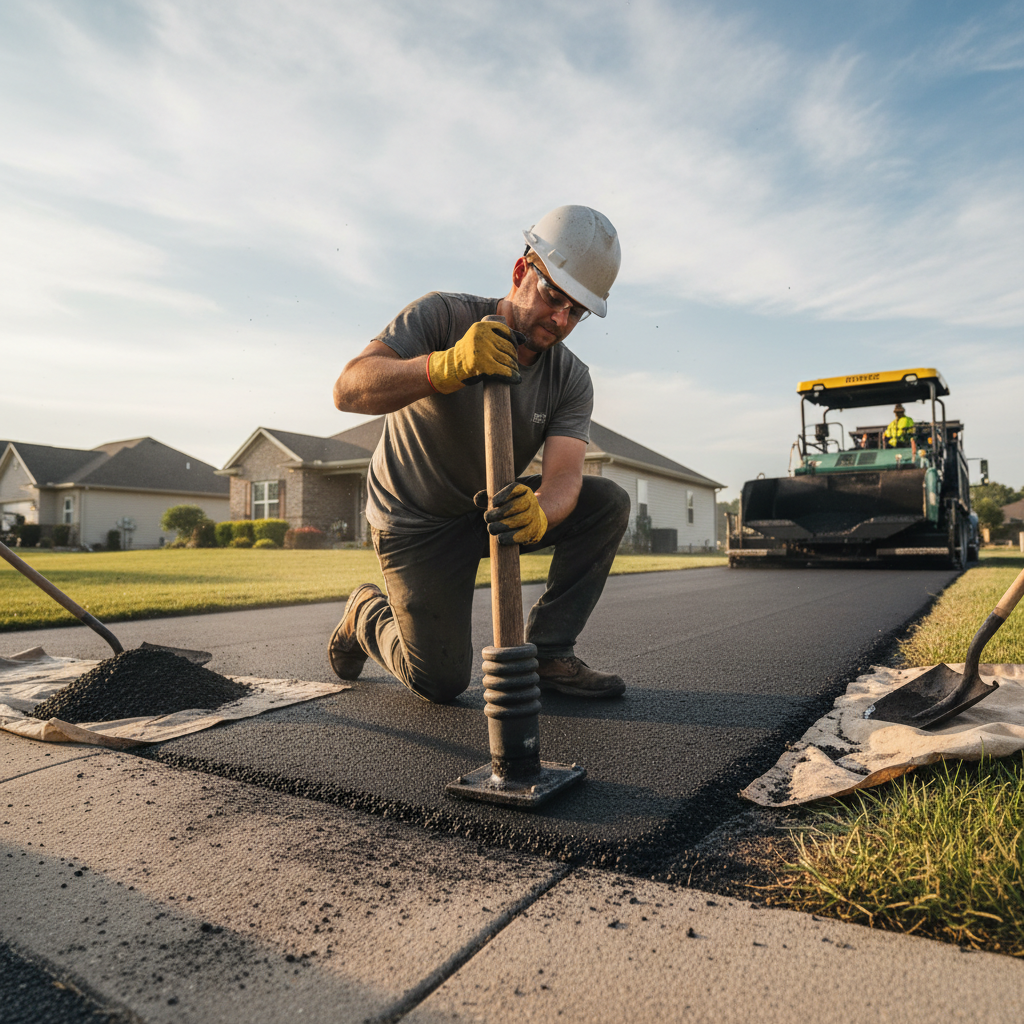
Driveway paving options and costs in Don Valley Village
Don Valley Village homeowners usually choose their driveway surface by balancing curb appeal, winter durability, and upfront cost. With a population of 27,051 (Statistics Canada, 2021 Census), the area has steady demand for private driveway upgrades, and most of the work we see is on attached-to-detached neighbourhood lots where residents need a dependable, year-round surface. In Toronto, paving pricing is shaped by something you feel every spring: freeze–thaw cycling and a frost line that can reach roughly 3–4 feet. That combination drives deeper granular base, careful subgrade compaction, and drainage corrections—especially where water can’t safely move away from the driveway.
It’s also why Don Valley Village scheduling tends to tighten: the paving season is effectively late spring through early fall, and hot-mix asphalt placement needs suitable air temperatures. When contractors have fewer “prime date” slots, you’ll often see costs move toward the higher end of the Toronto bands, particularly for larger driveways or jobs that require tear-out and drainage rework near the curb.
The sections below break down typical options for Toronto’s winter maintenance routine (ploughing, salt, sand) and what they usually cost when installed with a proper base. Use the table to compare lifespan and maintenance, then we can line up the best fit for your site access, drainage, and desired look—starting with asphalt versus interlock versus concrete.
| Material |
Lifespan |
Maintenance |
Best For |
Price per sq ft |
Price Range |
| Asphalt (new installation, proper base) |
15–25 years |
Seal after 6–12 months, then every 3–5 years |
Cost-effective, smooth ride, easy ploughing profile |
$5.50–$10.00 |
$3,500–$8,000 |
| Asphalt (overlay on existing gravel base) |
8–15 years |
Seal and monitor for settlement; patch as needed |
When the existing base is stable and excavation is limited |
$4.75–$8.50 |
$3,200–$6,500 |
| Interlocking concrete pavers |
25–40 years |
Re-leveling of affected sections, joint sand top-ups |
High curb appeal; easy repairs without full replacement |
$12.00–$22.00 |
$9,000–$20,000 |
| Poured concrete (broom finish) |
20–30 years |
Seal periodically; keep joints and edges managed |
Clean look, lower maintenance than pavers |
$10.00–$18.00 |
$6,000–$15,000 |
| Exposed aggregate concrete |
20–30 years |
Sealing to reduce staining and salt wear |
Slip resistance and decorative curb presence |
$11.50–$20.00 |
$7,000–$16,500 |
| Gravel / crushed stone (budget option) |
3–10 years (varies by drainage) |
Top-ups annually; edging and weed control |
Short-term solution or steep budget limits |
$3.50–$7.00 |
$2,000–$5,000 |
Prices are estimates only and vary by project scope, site access and material selection.
What affects the price of paving in Don Valley Village
In Don Valley Village and the broader Toronto economic region, quotes for what looks like the “same driveway” can vary by 30–50% once you account for what’s happening under the surface. Two contractors may both propose asphalt, but one may include a full tear-out, a deeper compacted granular base, and drainage adjustments—while the other assumes the existing base is adequate. Pricing also responds to short-term demand: the paving season is late spring through early fall, so prime summer dates can cost more when schedules are full.
Frost depth and freeze–thaw cycling are decisive cost drivers here. Toronto ground freezing can reach roughly 3–4 feet, and that typically means a thicker, well-compacted granular base and reliable drainage so water can’t sit under the pavement and heave when it freezes. In practical terms, deeper frost means more excavation, more base material, more compaction passes, and more labour—each of which pushes installed cost toward the higher end of the asphalt band (often $3,500–$8,000) or beyond if you need drainage or apron work.
Concrete costs can move either direction depending on how it’s engineered. For example, a broom-finished concrete driveway that’s designed with proper joints and air-entrained concrete can hold up well under salt and ploughing, while a poured driveway poured without careful mix selection or with poor drainage can crack sooner. Interlocking pavers can also rise in price if you need extensive edge restraints and excavation, but you may save money later because damaged sections can be lifted and reset without replacing the whole slab—one reason many homeowners choose pavers when winter performance matters.
| Price Factor |
Why It Matters |
Cost Impact |
| Driveway area in sq ft |
Most costs scale directly with square footage (base + asphalt/concrete) |
Major (often 40–70% of total) |
| Base depth required |
Frost line drives granular thickness to prevent heaving and cracking |
Major; can swing 10–25%+ |
| Grading and drainage work |
Correct slope and drainage keeps water away from subgrade |
Medium to major (+$800–$3,000 typical) |
| Tear-out of existing surface |
Break-up, hauling and disposal add labour and equipment time |
Medium to major (+$500–$4,000 typical) |
| Edge restraints and curbing |
Prevents paver spread and keeps asphalt/concrete edges from failing |
Medium (+$400–$2,000 typical) |
| Sealing requirement |
Asphalt needs sealing after curing (often 6–12 months) to slow oxidation |
Low to medium (commonly $300–$1,500 per service cycle) |
| Site access |
Narrow lots and long paths slow equipment movement and increase labour |
Medium (+$300–$1,500 typical) |
| Asphalt mix specifications |
Freeze–thaw-rated asphalt mix costs more and requires more QC |
Medium (can add several hundred dollars) |
Permits & regulations in Ontario
In Ontario, paving a private driveway on your own property usually doesn’t require a building permit. Where things change is when the work touches the municipal area outside your property limits. If you need a new driveway apron, a curb cut adjustment, changes to the boulevard, or modifications to storm drainage near the curb, that typically requires municipal approval before construction. In many Don Valley Village streets, the driveway tie-in point is where homeowners get surprised—because the interface between your property and the right-of-way is managed by the municipality.
Here’s a practical step-by-step approach: first, ask your contractor to describe exactly what they’re doing at the curb line (e.g., “matching existing grade,” “rebuilding apron,” “adjusting drainage for runoff”). If they plan any work in the municipal right-of-way, insist they confirm the approval path before the start date.
Second, verify your contractor’s credentials in writing. In Ontario, check the business registration/licensing details through the appropriate Ontario registry resources the contractor provides and confirm their certificate of insurance (general liability) and WSIB coverage (or WCB equivalent coverage where applicable) with valid clearance documentation. Then, request a copy of the clearance letter and ensure it matches the legal business name on the quote and invoice. Finally, before excavation, require utility locates through Ontario One Call so you’re not guessing about buried services.
Asphalt vs pavers vs concrete for Don Valley Village driveways
For Don Valley Village winters, the three most common driveway surfaces—asphalt, interlocking pavers, and poured concrete—perform differently once freeze–thaw and salt enter the picture. Asphalt is typically the lowest upfront choice, and when it’s installed on a properly compacted granular base it gives a smooth, plough-friendly ride. The catch is maintenance: asphalt should be sealed after it cures (often after 6–12 months), then resealed every 3–5 years to protect against oxidation and surface wear. This option usually lands near the asphalt band of $3,500–$8,000 depending on excavation and drainage needs.
Interlocking concrete pavers cost more at the start, commonly within $9,000–$20,000, but they’re highly repairable. If a section settles due to drainage or base issues, pavers can be lifted, the base corrected, and the units reset without demolishing the whole driveway. That matters in Toronto where water management and frost movement can be unforgiving. Poured concrete sits mid-range and can be durable, but it must be air-entrained and correctly jointed; otherwise, freeze–thaw cycling can lead to cracking and edge spalling—especially where sand and de-icing salt are repeatedly pushed by ploughing.
Base preparation depth and drainage design are the real differentiators in this climate. A well-drained base helps all three last longer, but pavers often provide the easiest “fix the problem area” pathway. For example, a homeowner with a 10–12 m long driveway that needs significant excavation may justify moving up from asphalt to pavers if they expect future base access (or want a superior visual finish). On the other hand, if drainage is already excellent and site access is straightforward, asphalt may be the best value without overpaying for aesthetics.
| Material |
Frost Resistance |
Curb Appeal |
Repair Method |
Lifespan |
Price Band |
| Asphalt (sealed regularly) |
Good when built on a proper granular base and drainage |
Good (clean, uniform finish) |
Patch and overlay sections as needed |
15–25 years |
$3,500–$8,000 |
| Interlocking concrete pavers |
Very good; flexible system helps tolerate minor movement |
Excellent (wide style range) |
Lift/reset affected stones; re-sand joints |
25–40 years |
$9,000–$20,000 |
| Poured concrete (air-entrained) |
Good to very good with proper air entrainment and joints |
Good to very good (smooth or broom finish) |
Patch repairs; larger failures may require slab replacement |
20–30 years |
$6,000–$15,000 |
| Exposed aggregate concrete |
Good with correct mix design and sealing |
Very good (texture and colour depth) |
Targeted patching; typically less “step-by-step” than pavers |
20–30 years |
$7,000–$16,500 |
| Permeable pavers (drainage grid) |
Very good where soil drainage is compatible with permeability |
Good to excellent (modern look) |
Remove/rebuild affected zones; clean bedding layer |
20–35 years |
$11,000–$22,000 |
| Chip seal / tar-and-chip |
Fair; best for certain conditions and maintenance plan |
Moderate (more utilitarian look) |
Resurface/spot-repair; periodic refresh required |
7–12 years |
$3,000–$7,000 |
How to choose a paving contractor in Don Valley Village
Choosing the right paving contractor in Don Valley Village is mostly about verifying proof—not just promises. Start with Ontario licensing/business verification and request liability insurance certificates showing adequate coverage for driveway work. Next, confirm WSIB coverage (or the correct provincial equivalent where applicable) with a current clearance letter, so you’re not exposed if a worker is injured on site. Ask for the documents before you sign anything, and make sure the names on the certificates match the company on the contract.
Then get 2–3 written, itemised quotes. For fair comparison, you want line items for excavation, disposal, compacted base thickness, subgrade preparation, asphalt/concrete, formwork where needed, edging/curbing, and any sealing allowance. Avoid “lump sum” quotes that don’t show what’s included. Confirm whether permit handling is included (if they need municipal approval for curb/boulevard/drainage work), whether they include disposal of old material, and how they handle unexpected conditions like soft subgrade or poor drainage discovered during excavation.
Warranty matters too. Ask for a clear workmanship warranty length (commonly measured in years) and whether the product/manufacturer warranty is included and transferable to future homeowners. For payment scheduling, never pay more than 10–15% upfront; hold back until the job is complete and cleaned. Finally, insist on a start date and a completion estimate in writing, because Toronto scheduling can shift quickly during peak late-spring through early-fall demand.
- Ask for proof of liability insurance before work begins
- Request WSIB clearance letter (current, matching the contracting company)
- Verify the quote includes all excavation depth and base thickness details
- Confirm disposal is included (where debris/old asphalt/concrete goes)
- Check whether utility locates (Ontario One Call) are confirmed
- Ensure drainage/grading changes are itemised, not assumed
- Ask what happens if subgrade is weaker than expected
- Confirm edge restraints/curbing details to prevent lateral movement
- For asphalt, confirm seal timing and whether sealing is included
- For pavers, confirm joint sand spec and re-sanding plan
- Get workmanship warranty terms in writing
- Clarify payment schedule and holdback amount before signing
Local red flags we commonly see in Don Valley Village: contractors who won’t show insurance/WSIB clearance paperwork, quotes that omit base thickness and drainage corrections, “too-good-to-be-true” pricing that doesn’t include tear-out and disposal, vague warranty language (no start/end dates or workmanship scope), and crews that pressure you for a large upfront payment or won’t commit to a start/completion timeline.
Frequently asked questions — paving in Don Valley Village
How do I compare paving quotes fairly?
In Don Valley Village, compare quotes side-by-side using the same criteria: square footage, excavation depth, compacted base thickness, drainage/grading scope, and what’s included for tear-out and disposal. Ask for line items—not one lump sum—so you can see whether the contractor is proposing a true frost-protection build-up or just resurfacing over unknown subgrade. Also compare material specs and workmanship terms: for asphalt, confirm freeze–thaw-rated mix and whether sealing is planned after curing (often 6–12 months). Finally, align pricing with realistic Toronto bands: many asphalt driveways fall around $3,500–$8,000, while pavers often land in the $9,000–$20,000 range depending on base and edging.
Can asphalt be laid in cold weather in Don Valley Village?
Ontario winters make asphalt a seasonal material. In the Don Valley Village area, asphalt placement is generally limited to periods when air temperatures are suitable and the base isn’t wet or frozen. Hot-mix asphalt needs warm placement conditions (commonly above about 10°C air temperature) so the mix can compact properly and bond to the base. If a contractor tries to rush paving late in the year or during cold snaps, you risk poor compaction, early raveling, and premature cracking—especially with Toronto’s freeze–thaw cycles. If you’re scheduling near the shoulder season, ask how they confirm base temperature, weather conditions, and whether they use heaters/winter processes (if available) rather than assuming “cold-weather paving” will work.
What is a driveway apron and do I need one in Don Valley Village?
A driveway apron is the paved section that transitions between your driveway and the road/curb area. In Don Valley Village, whether you “need” one depends on your current curb condition, how water drains, and whether your existing apron is cracked, settled, or misaligned. If the apron is being reconstructed, that can involve work at or near the curb/boulevard interface, and it may require municipal approval rather than just a private-property renovation. Your contractor should explain exactly where they’re cutting, how they’ll match grade, and whether drainage ties into existing infrastructure. If they’re proposing anything in the municipal right-of-way, ask for confirmation of approvals before they excavate.
How do I maintain my driveway through Don Valley Village winters?
For Don Valley Village winters, maintenance is about keeping water from pooling and reducing surface damage from salt and sand. Start with drainage: clear debris from edges and ensure the driveway slope directs water away from the garage and away from low spots. Use ploughing carefully—avoid aggressive blade contact that scrapes asphalt aggregate or chips concrete edges; keep sand application reasonable and avoid over-salting when possible. For asphalt, plan for sealing on schedule (typically after curing at 6–12 months, then again every 3–5 years) to slow oxidation and water penetration. For pavers, refill joint sand if it washes out and address any lifting early. If you notice cracks or settlement after freeze–thaw events, patch promptly so water doesn’t work under the surface.
Is it worth sealing a new driveway right away in Don Valley Village?
Usually, you shouldn’t seal immediately after installation. Asphalt needs to cure first so the binder isn’t too soft and so the sealant can bond correctly. In practice for Don Valley Village, sealing is commonly scheduled after the asphalt has cured—often around 6–12 months—then repeated about every 3–5 years depending on traffic, sun exposure, and how often the driveway is sanded/salted. Sealing is typically a cost-effective step within asphalt maintenance cycles (often in the range of $300–$1,500 depending on driveway size and prep). If you have new asphalt that’s already clean, stable, and properly cured, sealing helps protect against water intrusion—one of the biggest contributors to freeze–thaw damage in Toronto.
What is a chip seal driveway and is it suited to Don Valley Village?
Chip seal (sometimes called tar-and-chip) is an asphalt binder sprayed with aggregate, creating a textured surface. In Don Valley Village, it can be suitable in select cases—usually where your goal is a lower-cost surface and you’re comfortable with periodic maintenance. It doesn’t provide the same uniform, smooth ride as dense-graded asphalt, and Toronto’s freeze–thaw cycles and winter sanding can accelerate wear if the base and drainage aren’t engineered correctly. A chip seal may be cheaper up front (often roughly $3,000–$7,000 for many driveway scenarios), but you should expect refreshes sooner than with a properly built asphalt driveway. If you’re unsure, ask for a base/build-up recommendation and a maintenance plan rather than just a price.