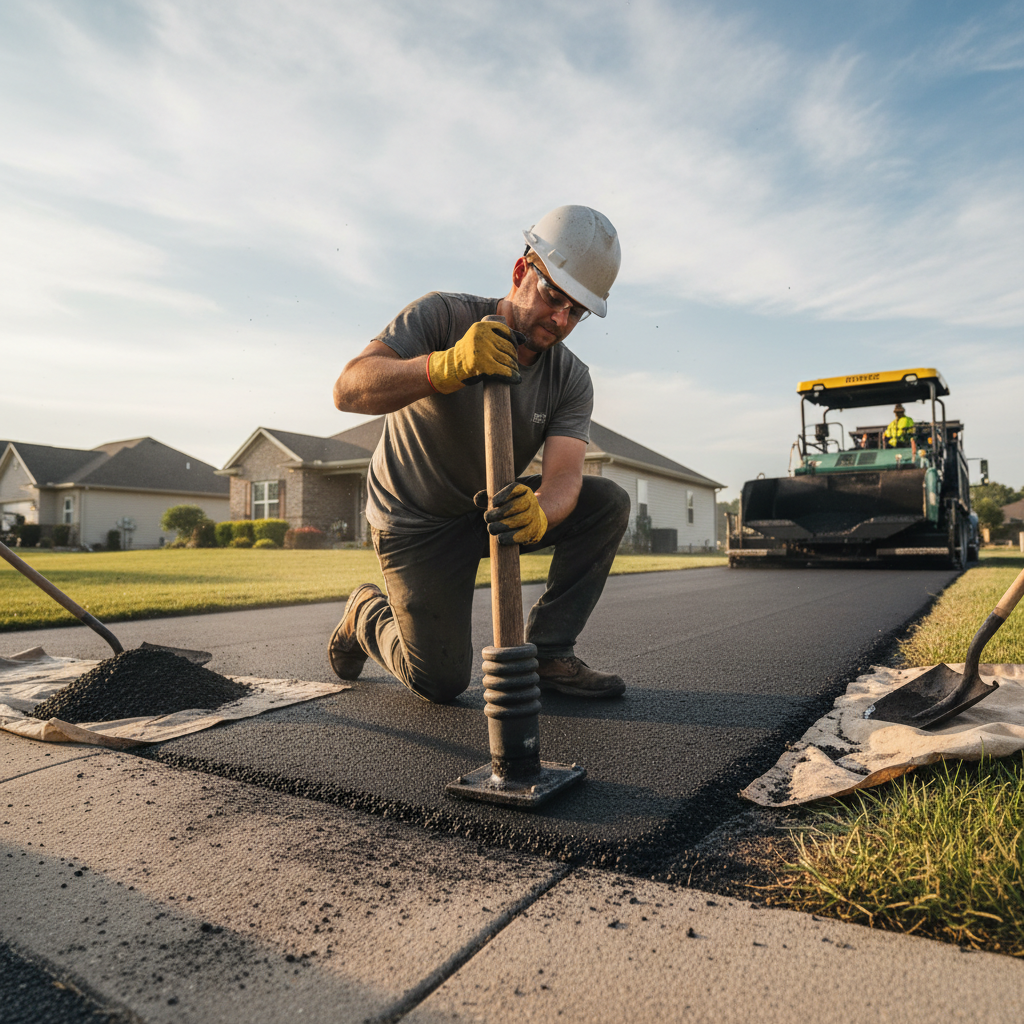
Driveway paving options and costs in Fort Erie
Fort Erie homeowners typically have three main choices when planning driveway paving: asphalt, interlocking concrete pavers, and concrete. With about 82.5% of dwellings being single-detached homes (Statistics Canada, 2021 Census), most driveways here are attached to private houses—so there’s consistent demand, especially in the older housing stock where replacements are more common. Roughly 62.1% of homes were built before 1981 (Statistics Canada, 2021 Census), and that age profile often means you’ll see deteriorated bases, settlement, or drainage issues that must be corrected before any new surface goes down.
In the Hamilton–Niagara Peninsula, pricing is strongly shaped by our moderate-to-cold winters and freeze–thaw cycles. Contractors plan for frost penetration and repeat temperature swings, so quality installs lean on a deeper, well-compacted granular base (commonly 6–10 inches) plus reliable drainage. Base and drainage work can be 35–45% of a residential driveway budget, which is why two quotes for the “same square footage” can land far apart.
Local trades are busiest in spring through early fall (roughly April–October). The paving season is shorter because asphalt plants and compaction requirements depend on warm enough conditions (hot-mix asphalt needs air temperatures above 10°C). That seasonal compression tends to push pricing up when everyone wants the same window—particularly around high-demand areas like Ridgeway and the older core near downtown Fort Erie.
Below is a practical comparison of common materials and typical price bands, so you can line up your goals (lowest upfront cost vs curb appeal vs long-term repairability) with realistic expectations. Use it as your reference point when you review bids.
| Material |
Lifespan |
Maintenance |
Best For |
Price per sq ft |
| Asphalt (new installation, proper base) |
15–25 years |
Seal every 3–5 years; crack-fill as needed |
Budget-conscious installs with good flexibility under freeze–thaw |
$5–$13 |
| Asphalt (overlay on existing gravel base) |
10–20 years |
Seal every 3–5 years; periodic patching |
When excavation is limited and the subbase is already sound |
$4.50–$11 |
| Interlocking concrete pavers |
25–40 years |
Re-lay individual blocks if needed; occasional joint sand top-up |
High curb appeal and easier localized repairs without full replacement |
$12–$22 |
| Poured concrete (broom finish) |
20–30 years |
Minor patching; sealant as recommended |
Clear, clean surface look and solid performance with the right base |
$10–$20 |
| Exposed aggregate concrete |
20–30 years |
Seal every few years; patch carefully where needed |
Slip resistance and premium look |
$12–$26 |
| Gravel / crushed stone (budget option) |
3–8 years (typical) |
Top up annually; re-grade; weed control |
Temporary or lowest-cost functional surface |
$3–$7 |
Prices are estimates only and vary by project scope, site access and material selection.
What affects the price of paving in Fort Erie
In Fort Erie and across the Hamilton–Niagara Peninsula, it’s common to see quotes for the same driveway vary by 30–50%. The biggest reason isn’t the surface material—it’s what sits underneath. Two contractors can quote “an asphalt driveway” with the same square footage, but one may include a deeper granular base, better drainage correction, full tear-out, and proper compaction/testing, while the other assumes existing conditions are adequate.
Freeze–thaw cycles are decisive cost factors here. In this moderate-to-cold Southern Ontario zone, frost penetration can drive you toward a thicker compacted granular base (often 6–12 inches depending on subsoil and design). The goal is to reduce frost heave and prevent cracking from repeated expansion and contraction. When base depth needs to increase, your costs rise because excavation, hauling, and compaction time increase. By contrast, in a warmer or milder coastal climate you might get away with thinner base work, but Fort Erie typically isn’t that scenario.
Season length also matters. Asphalt relies on hot-mix conditions; in spring, contractors face tight scheduling and may charge a premium when the window opens. Asphalt mix design also has to be freeze–thaw capable—better mixes cost more, and many quality installers price that in rather than cutting corners. On older properties (where 62.1% of homes predate 1981, Statistics Canada, 2021 Census), additional drainage correction can be required, which shifts the budget toward excavation and base replacement.
Concrete and pavers can cost more upfront—often landing in the mid-to-upper Ontario price bands—but sometimes the higher base-spec and longevity make the difference worth it. For example, asphalt might land near the $3,000–$8,000 range for a typical driveway scope, while interlock can more often move into the $9,000–$20,000 band when you add proper restraints, thicker bedding, and premium pattern/colour selection. The “why” is usually the groundwork and detailing, not just the surface.
| Price Factor |
Why It Matters |
Cost Impact |
| Driveway area in sq ft |
Most labour and materials scale directly with surface area |
Higher area often increases total cost sharply (often linear within typical ranges) |
| Base depth required |
Frost line determines granular thickness to prevent heaving and cracking |
Deeper 6–12 inch builds can be one of the largest budget movers |
| Grading and drainage work |
Proper slope and outlet control water; prevents soft subgrade and premature failure |
Drainage corrections and regrading add excavation, time, and materials |
| Tear-out of existing surface |
Breaking and hauling concrete/asphalt affects labour, disposal, and subbase condition |
Can add significant cost, especially if there’s thick slab or poor access |
| Edge restraints and curbing |
Stops paver spread and controls asphalt edges and transitions |
More restraint work increases labour and concrete/steel costs |
| Sealing requirement |
Asphalt benefits from sealing to slow oxidation and water intrusion |
Usually modest add-on cost; missing it reduces lifespan |
| Site access |
Narrow lots or long carries slow equipment movement and production |
Can add crew time and equipment costs |
| Asphalt mix specifications |
Freeze–thaw-rated mix and binder selection reduce early aging and cracking |
Higher-spec mixes increase material cost but improve long-term performance |
Permits & regulations in Ontario
In Ontario, paving a private driveway within your own property usually does not require a building permit. However, the work can cross into permitting territory when it affects the municipal right-of-way. For Fort Erie homeowners, that typically includes projects like installing or changing a curb cut, modifying a boulevard area, or altering storm drainage that ties into municipal systems. If you’re changing the way water leaves your property (for example, redirecting to a catch basin or adjusting drainage outfalls), confirm the approval requirements before the first shovel hits the ground.
It’s also smart to check lot-grading rules. Some municipalities regulate how close hard surfaces can be to property lines and how stormwater must be managed to avoid impacts on neighbouring properties. Even if there’s no “permit,” non-compliance can delay inspections, approvals, or affect future claims if water damage occurs.
Before excavation, always arrange utility locates through Ontario One Call (locates are required because digging can expose buried services). Then, verify your contractor properly: check their Ontario business/licence status (where applicable), ask for a certificate of insurance showing general liability appropriate to the job size, and confirm they have WSIB/WCB coverage (coverage varies by business type, but you should still request the clearance or proof documents). Step-by-step, you want: (1) an itemised written scope, (2) insurance documents, and (3) proof of WSIB/WCB coverage before work begins.
Asphalt vs pavers vs concrete for Fort Erie driveways
Choosing asphalt, interlocking pavers, or poured concrete in Fort Erie comes down to how you want the driveway to perform through freeze–thaw and winter maintenance, and how much upkeep you’re comfortable with. Asphalt typically has the lowest upfront cost and handles temperature swings well, but it does require sealing every 3–5 years to slow oxidation and water penetration. Interlocking concrete pavers cost the most upfront, yet they’re very forgiving for long-term ownership: if a section settles, the units can often be lifted and reinstalled without replacing the whole driveway. Poured concrete sits in the middle on price and looks clean, but it’s more sensitive to cracking if the base, joints, and air-entrainment aren’t handled correctly—especially where de-icing salt and ploughing contact the slab edge.
Across the Hamilton–Niagara Peninsula, all three options rely on the same foundation truth: base preparation and drainage design drive performance. With frost conditions in the region, contractors typically plan for a deeper granular base and careful grading to manage water. Better drainage means less subgrade softening in spring melt, which helps every material last longer. In Fort Erie’s older neighbourhoods (many pre-1981 homes), addressing existing drainage issues can be the difference between a 10–15 year surface and a 20+ year one.
For a realistic comparison: an asphalt driveway often fits the $3,000–$8,000 band depending on area and site conditions. If you step up to interlock, you might move into the $9,000–$20,000 band—where the added cost is justified if you want curb appeal and future-proof repairs. If your priority is a solid surface with fewer “unit-level” details, concrete can be a good middle ground, but insist on proper air-entrainment and jointing plans for our winter freeze–thaw rhythm.
| Material |
Frost Resistance |
Curb Appeal |
Repair Method |
Lifespan |
Price Band |
| Asphalt (sealed regularly) |
Good flexibility under freeze–thaw when base is deep and drained |
Medium (solid, smooth look; less “designer” than pavers) |
Patch and seal; localized resurfacing if needed |
15–25 years |
$3,000–$8,000 |
| Interlocking concrete pavers |
Very good with proper bedding, restraints, and drainage |
High (patterns/colours; strong street presence) |
Remove and re-lay individual pavers; spot repairs |
25–40 years |
$9,000–$20,000 |
| Poured concrete (air-entrained) |
Good if air-entrained and joints are done right |
Medium to high (clean lines; can be finished upgrade) |
Patch; sometimes partial re-slab if cracking progresses |
20–30 years |
$7,000–$18,000 |
| Exposed aggregate concrete |
Good with correct base and sealing |
High (textured premium look) |
Patch carefully; finish match can be harder |
20–30 years |
$8,000–$18,000 |
| Permeable pavers (drainage grid) |
Very good moisture management when designed correctly |
Medium to high (modern look; depends on product) |
Same as pavers: re-lay sections; maintain drainage system |
25+ years (system performance dependent) |
$10,000–$22,000 |
| Chip seal / tar-and-chip |
Variable; best on low-traffic or as a specific application |
Low to medium |
Roll and re-chip patches; less “refined” restoration |
7–12 years |
$4,000–$9,000 |
How to choose a paving contractor in Fort Erie
Start with proof—not promises. For Ontario work in Fort Erie, ask for their contractor information and verify coverage before you sign. You should be able to review a certificate of insurance for general liability (request the COI and confirm it lists your property address where possible) and confirm WSIB/WCB clearance or coverage documentation for their crew. If a contractor won’t provide these, treat it as a serious warning sign.
Next, get 2–3 written quotes that are itemised (labour and materials) rather than one lump sum. A quality quote breaks out excavation, granular base, geotextile (if used), drainage corrections, asphalt/paver/concrete supply, compaction, edge restraints, and disposal. It should also clarify what’s included in “prep,” such as whether they handle tear-out of existing asphalt/concrete and where the spoils go. Ask specifically if a permit or municipal approval process is included when curb cuts or right-of-way changes are involved.
Warranty should be written clearly: workmanship warranty length, how long product/manufacturer warranty lasts, and whether the warranty transfers if you sell the home. Payment schedule should protect you—never pay more than about 10–15% upfront. Hold back a remaining balance until the job is complete, edges are finished, and you’ve inspected the final grade and surface quality.
Finally, timeline matters in a short paving season. Get a start date and completion estimate in writing, and ensure weather contingencies are spelled out so you’re not left waiting on missed asphalt or compaction windows.
- Request insurance COI and confirm it’s valid for the project period.
- Verify WSIB/WCB coverage or clearance letter before work begins.
- Ask for an itemised quote (no “turnkey” mystery pricing).
- Confirm base depth and compaction method are included in writing.
- Require a drainage plan (slope, outlets, and any pipe/grate work).
- Specify tear-out scope and disposal included or excluded.
- Clarify edge restraints/curbs and transition details at the garage and walkway.
- For asphalt, confirm sealing timing and whether initial seal is recommended.
- Check if traffic control is included during curbing/asphalt curing.
- Confirm cold-weather and rain-day procedures (pauses, protection, rework policy).
- Get warranty details in the contract (workmanship + materials).
- Keep payment staged: small deposit, then payments after milestones and inspection.
Red flags in Fort Erie: (1) contractor won’t share insurance/WSIB/WCB proof, (2) vague scope like “prepare and pave” without base thickness or drainage notes, (3) quoting asphalt over visibly soft subgrade or cracked edges without tear-out, (4) requiring a large upfront payment beyond 10–15%, and (5) promising completion outside the realistic spring-to-October scheduling window without contingency.
Frequently asked questions — paving in Fort Erie
How do I get the most accurate paving quote in Fort Erie?
To get a quote that’s actually comparable, ask for an on-site measurement of driveway area and a walkthrough of drainage. In Fort Erie, the cost swings usually come from what the contractor finds under the surface—soft subgrade, poor slope, or the need for deeper granular base—so a site visit matters. Request that the quote be itemised with base depth, drainage correction, geotextile (if used), edge restraints, and disposal of old material. Also confirm utility locates are arranged before any excavation. If your neighbourhood is older (many homes were built before 1981), you may have hidden drainage or compacting issues that only show up after tear-out (Statistics Canada, 2021 Census). Finally, ask whether sealing is included for asphalt and what the timeline is.
How much does it cost to pave a driveway in Fort Erie?
For Fort Erie homeowners, typical driveway paving budgets often fall into these material bands: asphalt driveway paving is commonly estimated around $3,000–$8,000 depending on size, base depth, and whether there’s tear-out. Concrete driveways typically run in a broader range of $7,000–$18,000, with exposed aggregate usually closer to the upper end. Interlocking pavers are generally the premium option at $9,000–$20,000, especially when curbs, restraints, and higher detailing are included. Sealing and repair work is usually much smaller in comparison, often around $400–$2,000 depending on how much patching is needed. Your final number depends heavily on excavation, granular base requirements for frost, and drainage corrections.
Asphalt vs interlocking pavers vs concrete — which is best in Fort Erie?
There isn’t a single “best” for everyone in Fort Erie—freeze–thaw performance depends on base and drainage for all three. Asphalt is usually the best choice if you want the lowest upfront cost and can commit to sealing every 3–5 years; it flexes well under temperature swings when installed over a proper granular base. Interlocking pavers are often the top choice if curb appeal and easier repairs matter—individual units can be lifted and re-laid without tearing out the whole driveway, which is useful if settlement occurs over time. Poured concrete can be excellent if air-entrainment, joints, and base prep are done properly, but cracking risk is higher if joints and drainage are not carefully planned. If you’ve got ploughing and de-icing salt exposure, insist on the right detailing no matter which material you pick.
How long does a paved driveway last in Fort Erie?
With correct base design and maintenance, many Fort Erie driveways last well beyond the first few winters. Asphalt installed with a proper deeper granular base and sealed regularly typically lasts about 15–25 years. Pavers, when installed with correct bedding and restraints, often aim for 25–40 years; the key advantage is repairability if a localized section shifts. Poured concrete commonly lasts around 20–30 years when air-entrainment, joint spacing, and curing are handled correctly. Concrete and asphalt both can fail earlier if water is trapped under the surface or if the subgrade wasn’t compacted properly—freeze–thaw punishes weak drainage. That’s why reputable contractors in the Hamilton–Niagara Peninsula focus on excavation and granular base work as a major part of the driveway budget.
When is the best time of year to pave in Fort Erie?
In Fort Erie, the practical paving window is usually April through October. Asphalt placement depends on warm enough conditions—hot-mix asphalt generally requires air temperatures above 10°C—so spring work can be limited until conditions stabilize. Early fall can still work if temperatures stay supportive, but weather disruptions can affect compaction and finishing. Pavers and concrete may have a bit more flexibility, yet base prep and drainage still need to be dry and compactable. The short season in Southern Ontario can also affect contractor scheduling and price—late spring and mid-summer demand is often higher. If you’re planning a full tear-out and new base, it’s smart to book earlier to secure a realistic start date and avoid rushed installs after the compaction window tightens.
How deep should the base be for Fort Erie's frost?
In Fort Erie’s moderate-to-cold climate, the deeper granular base is one of the main cost drivers because it helps manage frost penetration and freeze–thaw movement. For typical residential driveway builds in Southern Ontario, contractors often design around a compacted granular base in the range of 6–10 inches, and in tougher subsoil or higher frost-risk situations, projects can move toward 8–12 inches. The exact depth depends on site conditions (subgrade type, existing drainage, and whether you’re doing full reconstruction or overlay). The goal is to prevent frost heave and reduce cracking. Don’t accept vague wording like “we’ll prep the base”—ask for base thickness in the contract and confirm drainage corrections (slope/outlets) are included. Proper base plus drainage is what makes any surface last through our winters.