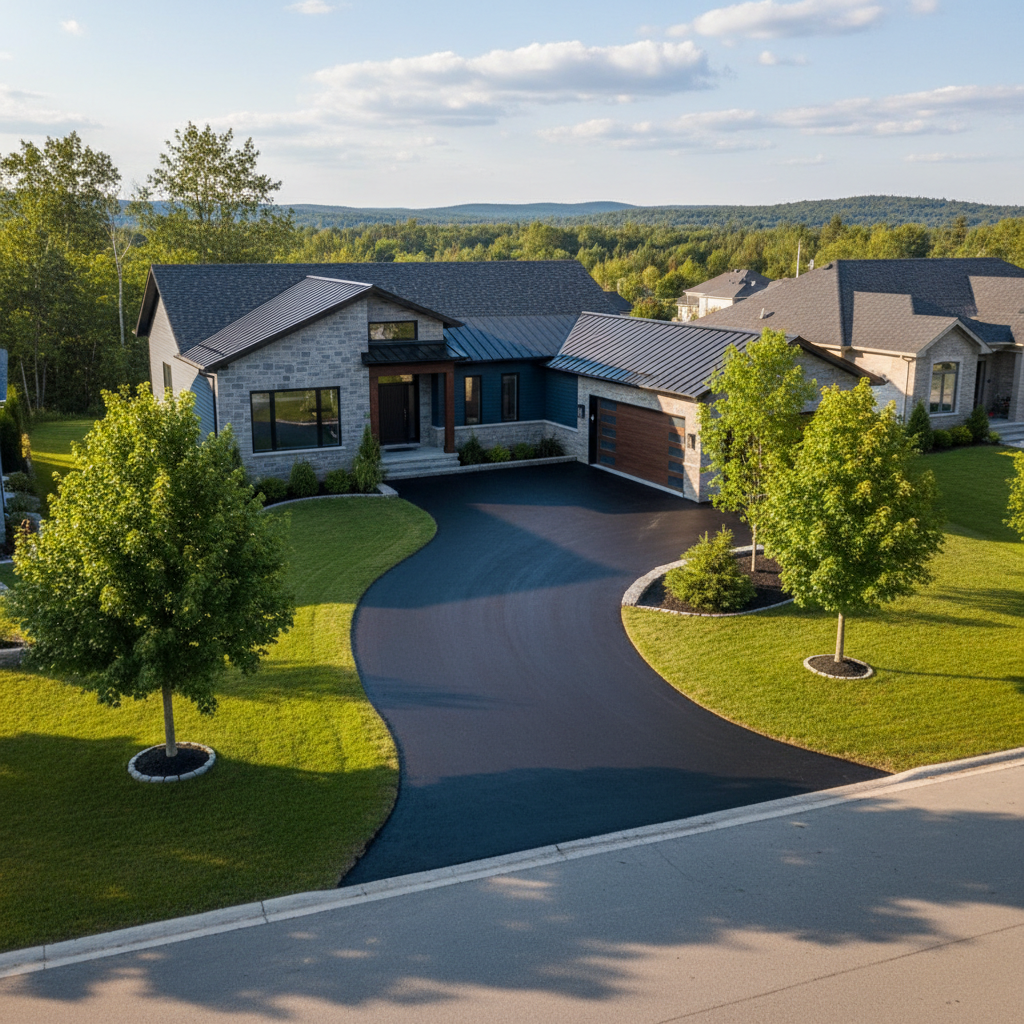
Driveway paving options and costs in Dunnville
Dunnville homeowners typically choose from asphalt, interlocking pavers, or concrete, and the right call mostly comes down to how your soil behaves in winter and how you want your driveway to look year-round. With a population of 5,907 (Statistics Canada, 2021 Census), Dunnville is smaller than the nearby Niagara and Hamilton hubs, but the weather stresses are the same: freeze–thaw cycles drive frost movement under pavements and directly impact what contractors can build (and how long it takes to do it properly). In Dunnville, most private driveways are tied to detached homes, which means driveways are often longer and need a more reliable base and drainage than you’d see on multi-unit sites.
On the Hamilton–Niagara Peninsula, paving costs are shaped by the moderate-to-cold Southern Ontario climate and the local assumption of frost penetration often in the 1.2–1.5 m range. Practically, that means a deeper, well-compacted granular base (commonly 6–10 inches for many residential builds) plus drainage corrections so water doesn’t sit under the pavement. In older neighbourhood pockets—especially where clay or silty subsoils are common—base work and excavation can become the biggest portion of the budget and can push you toward mid-to-upper Ontario pricing. Demand also concentrates in the April–October season, since hot-mix asphalt compaction needs warm air temperatures (often above 10°C), so spring scheduling can carry a premium.
If you’re comparing quotes, use the table below as a starting point—then match the listed material to your soil, slope, and desired lifespan.
| Material |
Lifespan |
Maintenance |
Best For |
Price per sq ft |
Price Range |
| Asphalt (new installation, proper base) |
10–20 years |
Sealcoat every 3–5 years |
Good value with flexible under-winter movement |
$7.50–$12.50 |
$3,500–$8,000 |
| Asphalt (overlay on existing gravel base) |
7–15 years |
Sealcoat every 3–5 years; watch weak spots |
When the old base is stable and drainage is good |
$6.50–$11.00 |
$3,000–$7,000 |
| Interlocking concrete pavers |
25+ years |
Light washing; occasional re-leveling |
Curb appeal and easier repair without full replacement |
$17.00–$26.00 |
$9,000–$20,000 |
| Poured concrete (broom finish) |
20–30 years |
Seal optional; manage surface water |
Durable, low-lift upkeep |
$14.00–$22.00 |
$7,000–$18,000 |
| Exposed aggregate concrete |
20–30 years |
Seal sometimes; keep drainage clear |
Slip resistance and premium look |
$16.00–$25.00 |
$8,000–$20,000 |
| Gravel / crushed stone (budget option) |
2–5 years |
Re-grade and top up seasonally |
Short budget window; temporary solution |
$2.00–$4.50 |
$2,000–$5,000 |
Prices are estimates only and vary by project scope, site access and material selection.
What affects the price of paving in Dunnville
In Dunnville and across the Hamilton–Niagara Peninsula, it’s common to see the same driveway scope quoted 30–50% apart. The difference usually isn’t the asphalt or concrete alone—it’s the depth and quality of the granular base, drainage corrections, and how much existing material must be removed. Two contractors might both “pave 400 sq ft,” but if one proposal includes proper excavation to achieve frost-safe depth and the other doesn’t, you’ll pay for it later through premature rutting, cracking, or the need for an overlay.
Frost line depth and freeze–thaw cycles are decisive cost factors. In Southern Ontario, contractors typically build a deeper, compacted granular base to resist heaving and cracking. In many builds, that means about 6–12 inches of compacted granular material (the tighter the subgrade and the wetter the site, the closer you are to the top of that range). The paving season is also shorter: hot-mix asphalt placement often requires air and surface conditions that support compaction, which means spring and early summer schedules can get tight and labour/equipment is in higher demand. Mix design matters too—freeze-thaw-rated asphalt is not “one size fits all,” and specifying the right performance blend can move the budget closer to the mid of the $3,000–$8,000 asphalt band.
For concrete, local conditions can raise or lower cost fast. Example 1: if your driveway ties into a drainage swale or has low spots that hold water, contractors may add subdrains and additional base thickness—this pushes poured concrete toward the upper $7,000–$18,000 range. Example 2: if a curb cut and forms are already in place and the subgrade is firm, concrete can come in leaner because fewer corrections are needed. Example 3: older neighbourhood driveways often require deeper tear-out of distressed asphalt, with disposal and hauling that adds time and equipment costs.
| Price Factor |
Why It Matters |
Cost Impact |
| Driveway area in sq ft |
Most material and paving labour scales directly with surface area |
Large jobs can reduce per-sq-ft rate, small jobs are less efficient |
| Base depth required |
Frost resistance depends on granular thickness and compaction |
Extra 2–3 inches of base + compaction can materially increase excavation |
| Grading and drainage work |
Water control prevents soft subgrade and winter heave |
Slope correction, subdrains, and topsoil removal add trades and equipment time |
| Tear-out of existing surface |
Concrete/asphalt removal affects disposal and haul distance |
Breaking and hauling often becomes a major swing factor in quotes |
| Edge restraints and curbing |
Prevents pavers/asphalt from spreading under traffic and freeze-thaw movement |
Restrained edges and proper bedding widen the scope and cost |
| Sealing requirement |
Asphalt needs sealcoat to protect from moisture and surface oxidation |
Short-term cost plus a mid-term maintenance plan |
| Site access |
Narrow driveways slow equipment movement and can require handwork |
Tighter access increases labour time and may limit paving equipment size |
| Asphalt mix specifications |
Freeze-thaw performance mix can improve longevity in Southern Ontario winters |
Higher-performance mix can add cost per ton but reduces early failures |
Permits & regulations in Ontario
In Ontario, paving a private driveway on your own property typically does not require a building permit. For most Dunnville homeowners, replacing an existing driveway surface (asphalt overlay, new asphalt, pavers, or concrete within your lot) is considered routine private work. Where things change is when the project affects municipal infrastructure or drainage in the right-of-way. If your driveway work includes any new curb cut, changes to the boulevard/sidewalk approach, or alterations to storm drainage patterns that reach municipal services, you usually need municipal approval before the work starts.
Some municipalities also have lot-grading or site drainage by-laws that can restrict how close hard surfaces can be to property lines and how you must manage runoff. The safest approach is to confirm your site-grading expectations with the municipality before excavation.
Before a contractor digs, you should always require utility locates. In Ontario, call Ontario One Call so buried utilities are marked before any excavation begins.
To verify a contractor’s Ontario compliance step-by-step, ask for:
- Ontario licence details if applicable to their work category (and confirm the business is properly registered for the type of paving/landscaping they’re selling).
- Liability insurance certificate of insurance (COI) showing coverage appropriate for property damage and third-party injury.
- WSIB coverage (or the relevant coverage/clearance documentation for the contractor’s structure). Request a clearance letter or proof that matches your contractor’s status.
- Contactable proof—email or document copies—before work starts.
Finally, ask who pulls any required municipal approvals (if any). A legitimate contractor will be clear about what you’re responsible for and what they handle.
Asphalt vs pavers vs concrete for Dunnville driveways
For Dunnville’s freeze–thaw winters, all three main options can work—but they fail differently when base or drainage is off. Asphalt is usually the lowest upfront driveway cost and performs well under temperature swings because it’s flexible; the trade-off is that it needs sealcoating every 3–5 years to slow moisture penetration and surface aging. Interlocking concrete pavers cost more to install, but they’re also the easiest to “repair in place”—a failed area can be lifted, re-leveled, and reset without replacing the whole driveway. Poured concrete sits in the middle on price and is durable, but it’s more sensitive to differential movement; without air-entrainment, proper jointing, and a frost-safe base, it can crack and spall earlier during freeze–thaw seasons. For homeowners using salt and sand in winter, concrete surface protection and joint design matter a lot.
On the Hamilton–Niagara Peninsula, the base and drainage design are what determine whether your driveway outlasts its warranty. Typically, contractors plan for a frost-resilient granular base and strong drainage so water doesn’t sit under the pavement. If your subsoil is clay/silty and the site has drainage issues, the “cheapest” choice can become the most expensive because early failures force repairs.
Here’s a realistic dollar example: for a driveway in the mid-size range, asphalt may land around the $3,000–$8,000 band, while interlocking pavers are commonly in the $9,000–$20,000 band. That premium is often justified where curb appeal is a priority and where you want the ability to address localized movement without full replacement.
| Material |
Frost Resistance |
Curb Appeal |
Repair Method |
Lifespan |
Price Band |
| Asphalt (sealed regularly) |
Good when base is frost-safe and drainage is correct |
Medium (clean and dark when maintained) |
Patch/re-level small areas and re-surface as needed |
10–20 years |
$3,000–$8,000 |
| Interlocking concrete pavers |
Very good with correct bedding and jointing |
High (variety of colours/patterns) |
Lift affected section, re-compact base, reset pavers |
25+ years |
$9,000–$20,000 |
| Poured concrete (air-entrained) |
Good when air-entrained and properly jointed |
Medium–High (can be stamped/exposed) |
Crack repair and sealing; resurfacing in some cases |
20–30 years |
$7,000–$18,000 |
| Exposed aggregate concrete |
Good when base and finish are done to spec |
Very high (texture and slip resistance) |
Localized patching; replacement usually for major failures |
20–30 years |
$8,000–$20,000 |
| Permeable pavers (drainage grid) |
Very good where water can infiltrate properly |
High (modern look) |
Replace individual blocks; maintain infiltration layers |
20–30+ years (with maintenance) |
$10,000–$24,000 |
| Chip seal / tar-and-chip |
Fair—best as a surface treatment, not a full structural build |
Lower–Medium (utility feel) |
Re-spray and top-up; repairs are surface-level |
5–10 years |
$2,500–$6,000 |
How to choose a paving contractor in Dunnville
Choosing the right contractor matters in Dunnville because your driveway’s longevity depends heavily on base prep and drainage, not just the finish. Start by verifying the contractor’s Ontario coverage and standing. Ask for proof of liability insurance (certificate of insurance) and WSIB status or the appropriate clearance documentation. Then, confirm their registration/licensing that applies to the type of work they’re selling, and don’t hesitate to check the business details in any online registry they provide. If a contractor can’t produce documents quickly, assume the work will also be light on details.
Next, demand 2–3 itemised written quotes. You want labour and materials broken out (excavation, granular base, asphalt mix, compaction, any subdrains, edge restraints/curbs, and disposal). A lump-sum quote with no breakdown makes it hard to compare “apples to apples,” especially when frost protection depth and drainage corrections are the real cost drivers.
Read the scope for exclusions: is disposal included? Is permit approval included if the project affects the boulevard or storm drainage? Are utility locate costs included? What happens if they find unsuitable subgrade—do they rebuild the base to spec or charge extra?
For warranty, ask for two things: the workmanship warranty duration and the product/manufacturer warranty (and whether it transfers to you). Also, set a sensible payment schedule: never pay more than 10–15% upfront, and hold back a portion until the final completion inspection and cleanup are done.
Finally, insist on a written timeline with a start date target and completion estimate. In Southern Ontario, timing can be everything, and reputable crews will schedule around weather and compaction requirements.
- Request WSIB coverage proof/clearance letter before signing.
- Request a current certificate of liability insurance (COI).
- Ask for at least one recent Dunnville or nearby Ontario project reference.
- Get quotes that list base depth and granular type (e.g., Granular A/B) explicitly.
- Confirm drainage scope: slope plan, ditches, and whether subdrains are included.
- Verify disposal is included (haul, tipping fees, and cleanup).
- Ask if utility locates are required by the contractor and who pays.
- Make sure edge restraints/curbing are included for pavers and even for asphalt transitions.
- For asphalt, confirm sealcoat is recommended after 6–12 months.
- Ask how cracks are handled during prep (stabilization vs “paving over everything”).
- Review warranty terms in writing (workmanship and material/manufacturer).
- Use a payment schedule with 10–15% maximum upfront and a holdback on completion.
In Dunnville, a few red flags I see often: contractors who won’t discuss frost-safe base depth and compaction; quotes that don’t specify drainage/grading or disposal; asking for large upfront payments; vague warranties (“up to our discretion”); and crews that start without utility locates or won’t show insurance/WSIB paperwork on request.
Frequently asked questions — paving in Dunnville
How deep should the base be for Dunnville's frost?
For Dunnville and the Hamilton–Niagara Peninsula climate, base depth is usually driven by frost protection and how wet/soft your subgrade is. Many good residential driveway builds end up with a compacted granular base in the ballpark of about 6–10 inches, and sometimes more when the soils are clay/silty or when drainage needs correction. The frost line depth assumption used by local practice often lands around the 1.2–1.5 m range, but you “translate” that into what’s practical under a driveway: remove weak material, install a proper granular layer, compact in lifts, and make sure water can’t pool. Ask your contractor to explain their plan for granular type, compaction method, and slope/drainage before they pave.
How often should I seal my asphalt driveway?
Most Dunnville asphalt driveways benefit from sealcoating every 3–5 years, depending on traffic and how much moisture gets to the surface. In Southern Ontario freeze–thaw conditions, sealcoat helps slow the entry of water that can worsen oxidation and raveling. If your driveway was paved earlier in the season, many contractors recommend sealing after the asphalt has had time to cure—commonly after 6–12 months—then following the cycle above. If your asphalt is already showing widespread fine cracking or soft edges, sealing may be a stopgap rather than a full fix; you may need patching first to keep the surface smooth and drainage-ready.
Why does my driveway crack and heave in winter?
Cracking and heaving usually come from movement of water and frost under the pavement. In Dunnville’s freeze–thaw winters, water that infiltrates into a weak base or sits in low spots freezes and expands, pushing the surface up (heave) and stressing it as it expands and contracts. The most common drivers are insufficient granular base depth, poor compaction, and drainage issues like inadequate slope or clogged swales. Over time, the surface can crack first, then you’ll see potholes or raised areas that worsen with plowing and salt. A correct fix typically starts below the pavement—rework the base and improve drainage—rather than relying on surface patching alone.
Do I need a permit to pave my driveway in Ontario?
In Ontario, paving a private driveway within your own property typically does not require a building permit. However, if your work affects the municipal right-of-way—such as a new curb cut, changes to the boulevard, or altered storm drainage—you’ll likely need municipal approval before excavation. Some places also enforce lot-grading or runoff requirements, which can influence how close you can build to lines and how water must be managed. Regardless of permits, you should always require utility locates before digging (Ontario One Call). If you’re unsure, ask the contractor to specify what approvals they believe are needed for your exact scope in Dunnville.
How long before I can drive on new asphalt?
After asphalt placement in Dunnville, you can generally drive on it after it cools enough that tires won’t damage the surface—often the same day. Contractors manage this by controlling traffic and sometimes limiting heavy loads until the mat is fully cooled. For best results, ask your contractor for their exact curing and access guidance because it depends on temperature, mix type, and whether tack coat or multiple lifts are used. Even after you can park and drive, avoid turning heavy equipment or dumping loads that could create ruts. For long-term protection, plan for sealcoating at the right time—commonly after 6–12 months—with driveway sealing costs typically falling in the $400–$2,000 range depending on size and surface condition.
What causes potholes and how are they repaired?
Potholes are usually the result of water getting under asphalt and weakening the base, then traffic breaking the surface. In Southern Ontario, repeated freeze–thaw cycles can accelerate this: moisture expands in winter, the pavement loses support, and the damage grows each spring. Common triggers include failing edges, drainage that channels water toward one spot, or a base that wasn’t compacted to spec. Repair is typically more effective when it addresses the cause: contractors cut out to sound material, remove wet/failed base, rework and compact granular layers, apply tack, then pave back and compact properly. Quick patching with no base correction can temporarily fill the crater but often fails again as water returns.