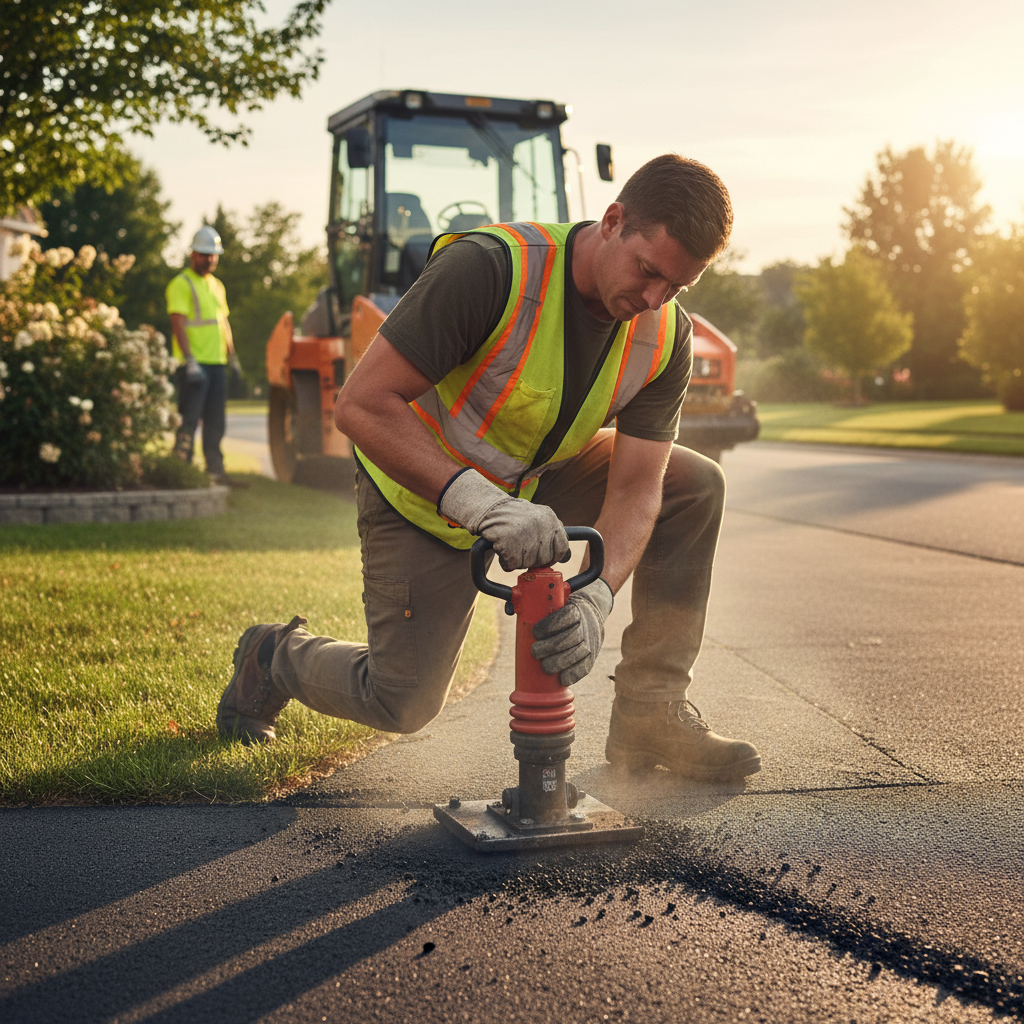
Driveway paving options and costs in Chatham
In Chatham, Ontario, the “right” driveway material comes down to how your site handles moisture and frost—not just what looks best. With a population of 43,550 (Statistics Canada, 2021 Census), the area has plenty of detached-housing driveways, so contractors see consistent demand around neighbourhoods like North Chatham where older lots meet heavier winter traffic and plough schedules. In the Windsor–Sarnia region, winters still bring freeze-thaw cycles that can lift weak, waterlogged bases, open cracks, and trigger early repairs. That means quotes often price deeper excavation, more granular stone, and drainage corrections so the asphalt or concrete isn’t freezing over trapped water.
Because the paving season is shorter and crews and equipment are scheduled tighter, spring and late-fall work can cost more than midsummer. Asphalt is usually the most cost-effective upfront choice (commonly in the $8–$14 per sq ft band for new installation with proper base), while interlocking pavers typically start higher (often in the $18–$32 per sq ft band) due to labour-intensive setting, edge restraints, and compaction. Concrete tends to land mid-range, with poured or aggregate finishes priced per your grading, thickness, and reinforcement needs.
Use the table below to compare typical lifespan, maintenance, and price ranges for Chatham-area driveways. Your exact quote will depend on removal volume, access, and how much your contractor needs to build back the granular base and drainage.
| Material |
Lifespan |
Maintenance |
Best For |
Price per sq ft |
| Asphalt (new installation, proper base) |
15–25 years |
Sealcoat every 3–5 years; crack repairs as needed |
Most value-focused driveways where base drainage is addressed |
$8 – $14 |
| Asphalt (overlay on existing gravel base) |
10–18 years |
Sealcoat every 3–5 years; patching where base settles |
Shorter-term upgrades when the base is stable |
$7 – $12 |
| Interlocking concrete pavers |
25–35 years |
Weed control; reset minor units; re-sand joints as needed |
Curb appeal and easier spot repairs |
$18 – $32 |
| Poured concrete (broom finish) |
25–30 years |
Joint/edge patching; surface cleaning; reseal selectively |
Clean look and solid, low-maintenance surface |
$12 – $20 |
| Exposed aggregate concrete |
25–30 years |
Seal for stain resistance; minor crack patching |
Slip resistance and decorative curb appeal |
$14 – $24 |
| Gravel / crushed stone (budget option) |
3–8 years |
Top up and re-grade yearly; weed control |
Temporary solution or low-traffic areas |
$4 – $8 |
Prices are estimates only and vary by project scope, site access and material selection.
What affects the price of paving in Chatham
Two homeowners in the Windsor–Sarnia region can get quotes that differ by 30–50% for the “same” driveway because the scope beneath the surface is rarely the same. The biggest driver is frost performance: in southern Ontario, freeze-thaw cycles still push at weak, moisture-heavy subgrades. If deeper frost protection excavation is needed, contractors must build a thicker, well-compacted granular base so water can drain instead of freezing under the pavement. In practice, that often translates to more stone and more labour than people expect—especially on clay-heavy or poorly drained properties.
Pricing also moves with the paving schedule. Hot-mix asphalt generally requires suitable air temperatures (above about 10°C) for placement and proper compaction, so in Chatham, spring and late-fall jobs can be priced higher because crews are booked tightly and curing windows are shorter. Mix design matters too: asphalt placed for local freeze-thaw conditions and durability requirements typically costs more than a generic “cheapest possible” mix.
Concrete costs can rise quickly when excavation and thickness increase. For example, if an older Chatham lot has soft spots, a poured slab may need additional base depth and better drainage, which can narrow the gap versus interlocking pavers. On the other hand, if you’re overlaying onto a stable, well-drained gravel base, asphalt can stay closer to the $8–$14 per sq ft band; but if there’s full tear-out of old concrete or failed asphalt, disposal and haul-off can push you toward the upper end of the $12–$20 concrete band just from prep. That’s why a square-foot price alone doesn’t tell the full story.
| Price Factor |
Why It Matters |
Cost Impact |
| Driveway area in sq ft |
Most materials and paving/labour scale directly with area |
High impact; changes final price the fastest |
| Base depth required |
Frost protection depends on subgrade moisture and drainage |
Medium to high; deeper excavation adds stone and compaction time |
| Grading and drainage work |
Proper slope and drainage prevent water from freezing under pavement |
Medium; culverts, regrading, and tie-ins add labour |
| Tear-out of existing surface |
Concrete/asphalt removal plus hauling and disposal drives expense |
High; can noticeably swing quotes (especially with thick slabs) |
| Edge restraints and curbing |
Prevents paver movement/spread and asphalt edge breakdown |
Medium; materials and formwork time |
| Sealing requirement |
Asphalt performance depends on sealing window |
Low to medium; typically a planned add-on after install |
| Site access |
Narrow driveways and obstacles slow equipment and increase labour hours |
Medium; can raise labour costs even if sq ft is unchanged |
| Asphalt mix specifications |
Freeze-thaw-rated mixes protect against rutting and early cracking |
Medium; usually increases unit cost but improves longevity |
Permits & regulations in Ontario
In Ontario, paving a private driveway on your own property typically does not require a building permit. However, if the work affects the municipal right-of-way—such as creating or changing a curb cut, modifying the boulevard, or altering storm drainage—municipal approval is usually required. Some municipalities also regulate lot grading, including how close a hard surface can be to property lines or how runoff must be directed to prevent flooding and icing issues.
Step-by-step for homeowners in Chatham: first, confirm the exact limits of the work. Ask the contractor whether any curb, sidewalk, boulevard, catch basin, or drainage inlet is being modified; if yes, request the permit/approval plan before excavation. Second, call for utility locates through Ontario One Call before any digging. Third, verify your contractor’s credentials: check their Ontario licence/registration details using available online business listings; request a certificate of liability insurance showing adequate coverage for your job; and confirm they carry WSIB/WCB coverage (or provide a clearance letter, where applicable). A reputable contractor can provide these documents before the first shovel of soil is removed.
In short: driveway paving on your lot is usually permit-light, but right-of-way changes and drainage/grade impacts are the items that typically trigger approvals.
Asphalt vs pavers vs concrete for Chatham driveways
For Chatham driveways, asphalt, interlocking pavers, and concrete each respond differently to freeze-thaw and winter maintenance routines (salt, sand, and plough patterns). Asphalt is usually the lowest upfront option: when built over a properly compacted granular base with good drainage, it performs well for many years. The trade-off is that asphalt needs sealcoat—typically every 3–5 years—to slow oxidation and reduce surface water penetration, which is critical in Windsor–Sarnia freeze-thaw conditions. With asphalt priced around $8 – $14 per sq ft for new installation in this market tier, it’s often the best choice when you want reliable performance without the highest first cost.
Interlocking concrete pavers cost more upfront (often $18 – $32 per sq ft) but shine in neighbourhoods with older foundations or where spot repairs are likely. In a freeze-thaw climate, pavers can be lifted, base corrected, and reset without replacing the whole driveway—useful if a drainage spot or utility patch settles later. Poured concrete lands in the middle, commonly $12 – $20 per sq ft, but it is more sensitive to cracking if the base isn’t uniform or if air-entrainment and jointing aren’t done correctly. Ontario winter salts and repeated temperature swings can expose small issues earlier when concrete is not properly designed.
A practical dollar example: for a 400 sq ft driveway, moving from asphalt at about $10 per sq ft to pavers at about $24 per sq ft can mean roughly $5,600 more in material and labour. That premium is usually justified when curb appeal matters, you expect future repairs, or your site has drainage sensitivity that pavers can accommodate. If your base and drainage are already solid, asphalt can be the better long-term value.
| Material |
Frost Resistance |
Curb Appeal |
Repair Method |
Lifespan |
Price Band |
| Asphalt (sealed regularly) |
Good when base is drained and compacted |
Moderate (clean and uniform finish) |
Patch and tack coat; localized resurfacing |
15–25 years |
$8 – $14 |
| Interlocking concrete pavers |
Very good; tolerates minor movement better |
High (variety of patterns and colours) |
Remove units, fix base, reset and re-sand |
25–35 years |
$18 – $32 |
| Poured concrete (air-entrained) |
Good with air-entrainment and proper joints |
Moderate to high (broom or exposed options) |
Crack repair and patching; full replacement if slab fails |
25–30 years |
$12 – $20 |
| Exposed aggregate concrete |
Good; depends on finish and curing |
High (decorative texture) |
Patch-matching is possible but less seamless than pavers |
25–30 years |
$14 – $24 |
| Permeable pavers (drainage grid) |
Excellent where drainage design is done correctly |
Moderate (more technical look) |
Replace sections; maintain the infiltration base |
20–30 years |
$22 – $38 |
| Chip seal / tar-and-chip |
Moderate; surface ravelling in harsh winters if underbuilt |
Low to moderate (more rustic finish) |
Spot patching; occasional re-chip |
7–12 years |
$6 – $10 |
How to choose a paving contractor in Chatham
Choosing the right contractor in Chatham is mostly about proof: proof they understand frost-driven base design, proof they’re insured, and proof the scope is clearly written. Start with licensing and insurance. Ask for their Ontario documentation/registration details, a certificate of liability insurance naming you as the certificate holder where appropriate, and confirmation of WSIB/WCB coverage (or a clearance letter). If they can’t supply these items promptly, move on.
Next, get 2–3 written, itemised quotes. “Itemised” should mean labour and materials broken out (excavation, granular base, asphalt/pavers/concrete, disposal, compaction, edging, and sealing). Avoid lump-sum estimates that don’t explain what’s included in tear-out, grading, and drainage. Confirm whether permits (if any right-of-way work is involved) are included, and whether disposal/haul-off is paid by them or you.
Warranty matters: ask for the workmanship warranty length and what product/manufacturer warranties apply. Confirm whether workmanship coverage is transferable if you sell the home. On payment, never pay more than 10–15% upfront; use milestone payments and hold back until the driveway is complete and final grade/cleanup is finished. Finally, require a start date and a completion estimate in writing—especially for asphalt curing and seasonal temperature constraints.
- Verify Ontario licensing/registration details before scheduling
- Request certificate of liability insurance (and confirm jobsite coverage)
- Confirm WSIB/WCB clearance or coverage in writing
- Get 2–3 itemised quotes (labour + materials, not only totals)
- Ask for a written scope: excavation depth, base type, and compaction steps
- Confirm drainage plan (slope, tie-ins, and water direction off the slab)
- Clarify tear-out scope and disposal/haul-away inclusion
- Ensure edge restraints/curbing are specified (especially for pavers)
- For asphalt, confirm sealing timeline (after 6–12 months) and responsibility
- Check warranty: workmanship length, product warranty terms, and transferability
- Agree on payment milestones (10–15% max upfront) and a holdback
- Get a written schedule with weather-impact contingencies
Red flags I see in Chatham: quotes with no base-depth detail, vague “asphalt to be placed” language without compaction/drainage steps, refusing to show insurance/WSIB/WCB paperwork, starting without confirming utility locates, and offering a very low price that omits tear-out/disposal or edge restraints.
Frequently asked questions — paving in Chatham
How deep should the base be for Chatham's frost?
For Chatham and the Windsor–Sarnia market, the base depth is primarily about how much frost protection and drainage your site needs, not the surface finish alone. In practice, many projects require deeper granular excavation and a compacted stone base to reduce moisture freezing under the asphalt or concrete. If you have clay soils, poor drainage, or previous settlement, contractors typically increase base thickness and improve drainage to lower heave risk. A common approach in Ontario frost-aware builds is to design for several feet of frost protection by adjusting excavation depth and base build-up—exact thickness depends on subgrade conditions, water management, and your driveway exposure. The right contractor will base the depth on a site assessment, not a one-size number.
How often should I seal my asphalt driveway?
In Ontario winters around Chatham, sealing helps protect asphalt from water penetration and oxidation caused by repeated freeze-thaw. Most asphalt driveways should be sealed after the initial installation curing period (commonly 6–12 months after paving), then re-sealed every 3–5 years depending on traffic, sun exposure, and how aggressively salt is used. If the driveway sees heavy ploughing or you get standing water near edges, sealing can be even more important because trapped moisture accelerates cracking. Your installer should specify the product type and recommended timing in the job documentation. If you’re comparing quotes, ask whether sealing is included in year-one scope and who’s responsible for the first sealcoat.
Why does my driveway crack and heave in winter?
In Chatham, winter cracking and heaving are usually a moisture-and-freeze problem. Freeze-thaw cycles can lift weak or waterlogged subgrade because ice forms under the pavement. Common causes include inadequate granular base, poor grading that directs runoff toward the driveway, or missing/insufficient drainage at low spots. Asphalt that wasn’t sealed early can also allow water to infiltrate through small surface cracks, worsening the process. Even concrete can crack when the base isn’t uniform or when joints and air-entrainment aren’t done properly. The fix isn’t just patching the surface—good quotes address excavation and drainage so the driveway has a stable, drier base for the next winter.
Do I need a permit to pave my driveway in Ontario?
Typically, paving a private driveway within your own property in Ontario often does not require a building permit. In Chatham, the situation changes when you work in the municipal right-of-way—for example, adding or changing a curb cut, altering boulevard surfaces, or modifying storm drainage features. Those cases generally require municipal approval. You should also confirm lot grading rules that may restrict how water drains and how close a hard surface can be to property lines. Before excavation, ensure utility locates are completed through Ontario One Call so nobody hits buried services. When you request a quote, ask whether any right-of-way or drainage tie-ins are involved so the contractor can tell you what approvals may be required.
How long before I can drive on new asphalt?
For new asphalt in Ontario, a safe “drive-on” timeframe depends on air temperature, mix type, and how the driveway is staged. Many installers aim for vehicles to stay off until the mat is sufficiently cooled and compacted—often the same day—but they’ll usually specify the exact wait time in writing. You should also avoid turning-heavy loads and sharp braking until the surface has fully stabilized. If the job happens in a cool spring window near Chatham, timelines can shift because asphalt needs suitable conditions for compaction and initial curing. A properly built driveway should be ready for normal use sooner than a poorly planned one—so insist on a clear schedule and curing instructions in your contract. If your contractor is promising “instant use” without conditions, that’s a concern.
What causes potholes and how are they repaired?
Potholes in Chatham usually start when water penetrates an existing weak spot—often around joints, edges, or previously patched areas. Freeze-thaw cycles expand the damage: the water freezes, breaks up the base, and then traffic dislodges material. The most durable repair addresses the underlying base and moisture route, not just the top layer. Typical asphalt repair involves cutting out to solid material, removing failed base, adding and compacting granular layers, then placing and compacting asphalt in lifts. If your driveway is near the upper end of the asphalt lifespan range, or if the same area fails repeatedly, a contractor may recommend an overlay instead of repeated patching to restore overall performance. Repair pricing generally follows the project scope within the same market bands used for sealing and repairs.