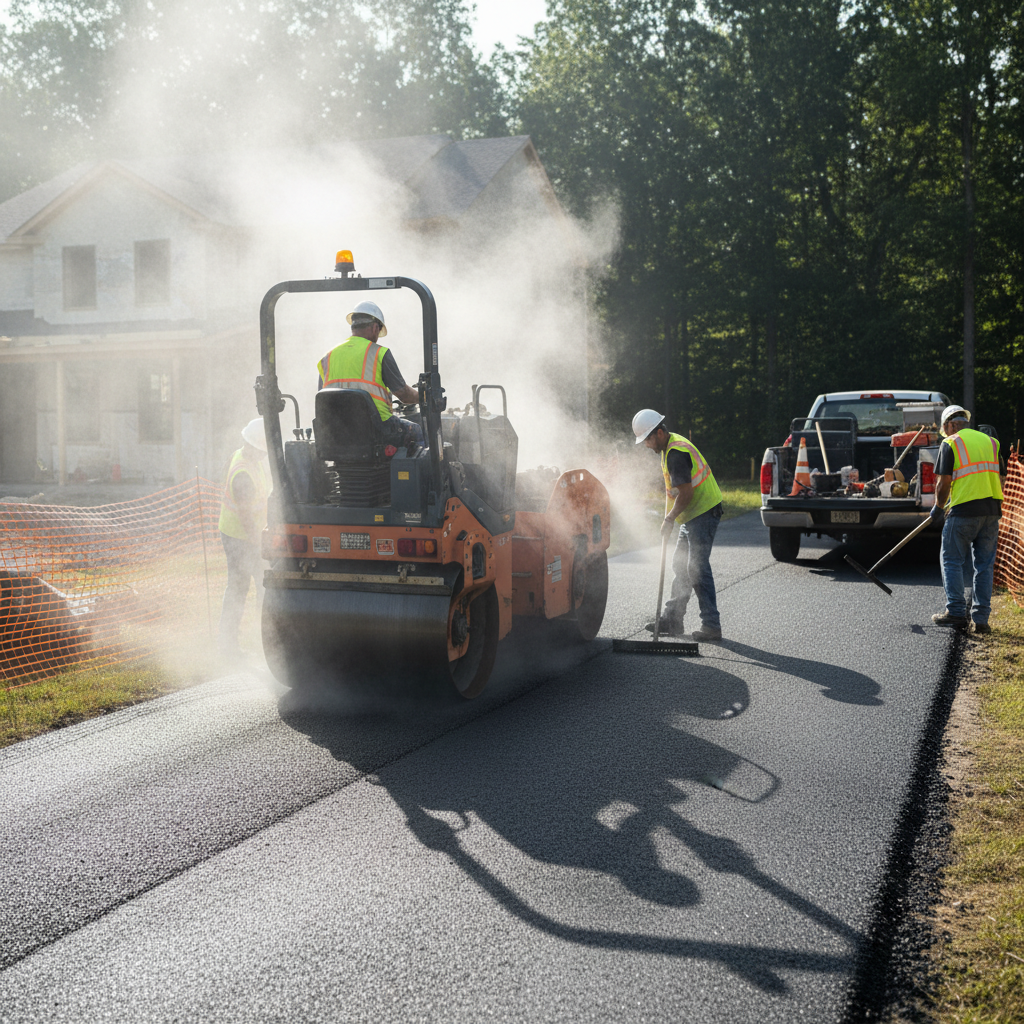
Driveway paving options and costs in Warfield
Warfield, British Columbia has a lot of homeowners paving long driveways on stable, single-detached lots—often in neighbourhoods like the Highlands area where older homes are common. With 86.2% of dwellings built before 1981, many driveways are already showing fatigue: ruts in gravel, soft spots, or cracking edges that need a deeper, properly compacted base rather than “patch-and-go.” That’s important in Warfield because the Kootenay interior experiences repeated freeze–thaw cycles and meaningful frost depth, so drainage and granular thickness are decisive for cost and durability. Contractors also work with a shorter asphalt and concrete season (late spring through early fall), which can tighten scheduling and raise per-day mobilization and labour rates versus milder parts of BC.
In terms of available options, asphalt is usually the lowest upfront investment, interlocking pavers offer excellent curb appeal and panel-by-panel repair, and concrete sits in the middle but must be engineered for frost exposure (air-entrainment and jointing). If your existing surface is gravel, new-install asphalt typically starts lower than concrete or pavers—especially when excavation and base build-up are straightforward. If you’re overlaying over a marginal base, the price may look attractive at first, but you’ll still need proper prep to avoid future settlement and edge failures.
Use the comparison table below to match your priorities (budget, appearance, long-term maintenance) to realistic Warfield pricing—then we’ll break down what most often drives the difference between quotes.
| Material |
Lifespan |
Maintenance |
Best For |
Price per sq ft |
Price Range |
| Asphalt (new installation, proper base) |
15–25 years |
Seal every 3–5 years; patch localized cracks |
Most cost-effective all-round choice with good base and drainage |
$7.50–$13.50 |
$7,000–$13,000 |
| Asphalt (overlay on existing gravel base) |
10–20 years (prep-dependent) |
Seal every 3–5 years; frequent edge/settlement monitoring |
When the existing base is sound and thickness corrections are minimal |
$8.50–$15.50 |
$8,000–$14,500 |
| Interlocking concrete pavers |
25–40+ years |
Occasional panel resets; re-sand joints as needed |
Driveways where curb appeal matters and repairs should stay localized |
$10.00–$18.00 |
$9,000–$16,000 |
| Poured concrete (broom finish) |
20–30 years (well-jointed) |
Light patching; keep expansion joints free of debris |
Long, straight driveway runs where clean lines are preferred |
$11.00–$16.50 |
$11,000–$18,000 |
| Exposed aggregate concrete |
20–35 years |
Sealer as specified; crack monitoring near edges and joints |
Premium look with slip-resistant surface texture |
$13.00–$20.00 |
$13,000–$20,000 |
| Gravel / crushed stone (budget option) |
3–8 years |
Top-up and re-grade every 1–3 years |
Short-term solution or where full excavation isn’t feasible now |
$3.50–$6.00 |
$3,500–$7,500 |
Prices are estimates only and vary by project scope, site access and material selection.
What affects the price of paving in Warfield
Even when two homeowners describe the “same driveway,” Warfield quotes can swing by 30–50% across Kootenay projects and the wider BC market. The biggest reason is that what looks like a simple surface replacement often turns into a frost-proof rebuild: excavation, base depth, drainage corrections, and haul/disposal. In our interior winters, frost depth is commonly in the 45–60 inch range depending on elevation and micro-climate—so contractors design for frost heave rather than just “leveling the grade.” This drives up labour and material quantities compared with coastal BC, where you can sometimes get away with shallower structures.
Freeze–thaw cycles also concentrate the paving season. Asphalt requires warm enough conditions (typically air temps above 10°C for hot-mix placement), so late spring scheduling and weather risk become real cost drivers. In years with narrow working windows, crews may charge more to lock in availability. Mix design matters too: a freeze–thaw-rated asphalt mix costs more than a basic blend, but it helps reduce early raveling and cracking.
Concrete can rise or fall quickly based on joints and the presence of active settlement. For example, older driveways built before 1981 often have compacted fill or weak subgrade; if we discover soft spots, base thickness and granular replacement can push a $11,000–$18,000 concrete job upward. On the other hand, if your subgrade is stable and drainage is already correct, an asphalt driveway can stay closer to $7,000–$13,000. With 1,753 residents and 630 homeowner households (Statistics Canada, 2021 Census), there’s steady demand, but projects can still be priced tightly to the short season and winter-proofing requirements.
| Price Factor |
Why It Matters |
Cost Impact |
| Driveway area in sq ft |
Materials and labour scale directly with square footage |
High (commonly 40–70% of total) |
| Base depth required |
Frost line determines granular thickness to resist heave |
High (more excavation/imports) |
| Grading and drainage work |
Slope corrections and daylighting controls water before it freezes |
Medium to high (plan/extra base) |
| Tear-out of existing surface |
Breaking up concrete or removing old asphalt + hauling |
Medium to high (disposal & time) |
| Edge restraints and curbing |
Prevents paver spread and asphalt edge failure during thaw |
Medium (often underestimated) |
| Sealing requirement |
Asphalt typically needs sealing after early cure and later re-seals |
Low to medium (adds long-term value) |
| Site access |
Narrow driveways slow equipment movement and increase labour hours |
Medium (mobilization/handling) |
| Asphalt mix specifications |
Freeze–thaw-rated mix improves performance in Kootenay winters |
Medium (material cost increase) |
Permits & regulations in British Columbia
In British Columbia, paving a private driveway within your own property typically does not require a building permit when you’re staying on your lot and not changing municipal infrastructure. What often does require municipal approval is anything in the municipal right-of-way—especially work that affects storm drainage, curb lines, or a required change to access. For Warfield homeowners, that usually means: installing or modifying a curb cut for vehicle access, changing boulevard areas, connecting or altering drainage that runs through municipal systems, or adjusting grading in areas regulated by local lot-grading rules.
A practical way to verify your situation is to follow a simple checklist: (1) confirm the driveway footprint stays entirely on title, (2) identify whether any portion touches boulevard/right-of-way, and (3) ask the municipality if there are lot-grading constraints that restrict how close a hard surface can be to property lines or how surface water must be shed. Also, always call for utility locates before excavation (BC One Call). This is not only about avoiding service disruption—it’s about protecting your contractor’s schedule and minimizing costly delays.
Before hiring, verify licensing and coverage in BC: check the contractor’s registration and status through the appropriate online directory (as applicable), request a current certificate of insurance, and confirm workers’ compensation coverage where required (WCB/WSBC or equivalent). Look for: certificate expiry date, correct project address or general liability limits, and matching business name. Ask for a written clearance letter if they provide one for your specific scope. Then confirm what’s included in their permit responsibility—if municipal approval is needed, it should be stated clearly in the contract.
Asphalt vs pavers vs concrete for Warfield driveways
For Warfield’s freeze–thaw climate, all three materials can perform well when the base and drainage are engineered correctly—but they behave differently under winter traffic, plowing, and de-icing. Asphalt is usually the lowest upfront option; it typically needs sealing every 3–5 years to protect against moisture infiltration and early surface aging. Interlocking concrete pavers cost more up front, but they’re the easiest to repair locally: if a driveway settles or a section is damaged, individual units can be lifted, re-based, and re-laid without tearing out the whole surface. Poured concrete often lands in the mid-range cost, but it must be air-entrained and properly jointed to manage expansion/contraction in cold weather.
Because Kootenay frost can be significant, base preparation usually requires compacted granular layers (commonly 6–10 inches for many driveway designs, increasing where soils are weaker or drainage is tricky). Drainage is non-negotiable: the goal is to keep water from pooling under the slab or seeping into asphalt edges during spring melt. Where plows and winter maintenance are routine, asphalt edges and paver restraints take on extra wear—good grading and strong edge restraints help prevent spread and cracking.
Here’s a realistic example: if your asphalt quote is around $7,000–$13,000 and pavers come in near $9,000–$16,000, the $2,000–$3,000 difference can be justified when you want long-term curb appeal and easier, cheaper future repairs—especially for driveways with observed settlement near a gate or where utilities have been previously opened. If your priority is lowest total cost and you’ll commit to regular sealing, asphalt usually wins. If you want a uniform finish and can accept periodic patching, concrete is a strong option—just make sure the contractor specifies freeze-focused mix and joint strategy.
| Material |
Frost Resistance |
Curb Appeal |
Repair Method |
Lifespan |
Price Band |
| Asphalt (sealed regularly) |
Good with deep, compacted base and proper drainage |
Moderate (clean, smooth finish) |
Cut-out and patch; seal jacket for surface protection |
15–25 years |
$7,000–$13,000 |
| Interlocking concrete pavers |
Very good when edges are restrained and base is well built |
High (varied colour and pattern options) |
Lift and replace individual pavers; re-sand joints |
25–40+ years |
$9,000–$16,000 |
| Poured concrete (air-entrained) |
Good with air-entrainment and correct joint spacing |
Medium to high (depending on finish) |
Patch cracks/joints; localized grinding and re-seal for some repairs |
20–30 years |
$11,000–$18,000 |
| Exposed aggregate concrete |
Good with proper freeze-thaw curing and joints |
High (textured, premium look) |
Localized patching; re-finish sections where needed |
20–35 years |
$13,000–$20,000 |
| Permeable pavers (drainage grid) |
Very good where engineered for subsurface infiltration |
High (system-based look) |
Replace affected units; clean or adjust underdrain as needed |
20–35+ years |
$12,000–$22,000 |
| Chip seal / tar-and-chip |
Moderate; performance depends heavily on base and maintenance |
Lower (more rustic finish) |
Re-chip/spot seal; surface replenishment |
8–15 years |
$6,000–$11,500 |
How to choose a paving contractor in Warfield
In Warfield and across BC, start by verifying three things: business legitimacy, liability protection, and workers’ compensation coverage. First, confirm the contractor’s licensing/registration status via the applicable provincial listing (and ensure the company name matches the quote). Next, request a current certificate of insurance (general liability) and make sure it covers paving/asphalt/concrete work, not just general contracting. Finally, confirm workers’ compensation coverage (WCB/WSBC or equivalent). Ask for the certificate details before work starts; reputable crews are used to homeowners requesting documentation.
Then get 2–3 itemised written quotes, not “one number.” You want a breakdown that shows labour and materials: excavation, granular base quantities, compaction, drainage/grading, geotextile (if specified), surface material, tack coat, edge restraints, and disposal/hauling. Make sure the scope includes what’s excluded—especially tear-out depth, whether saw-cutting is needed, and whether permit pulls (if required for right-of-way or drainage changes) are included. Also confirm warranty details for workmanship, product/manufacturer coverage (and whether it transfers to a future homeowner if you sell).
Payment schedule matters in the Kootenays where weather delays can occur. A practical rule: never pay more than 10–15% upfront. Use a holdback until completion and final grading verification. Get a written start date and completion estimate tied to weather conditions, and ask who is responsible for rescheduling if the season window closes.
- Ask for project photos from similar Warfield freeze–thaw driveway work.
- Require itemised quotes (base, drainage, tear-out, surface, restraints, disposal).
- Confirm compaction method and equipment used (roller type and lift thickness).
- Ask what granular specification is used for frost protection and why.
- Verify drainage plan: slopes away from garage/foundation, no ponding.
- Ensure asphalt includes tack coat and proper curb/edge detailing.
- For pavers, require edge restraints and jointing sand specification.
- Confirm concrete mix is air-entrained and joints/filler are included.
- Ask who handles utility locates and what happens if locates find conflicts.
- Check insurance limits and that the certificate is current for the job dates.
- Confirm workers’ compensation coverage before any excavation begins.
- Get warranty in writing: workmanship term, exclusions, and claim process.
Red flags I see too often in Warfield include: vague scopes (“as required”), no base-depth or drainage description, quotes that don’t include disposal/haul, withholding warranty terms until after payment, and contractors who want large upfront cheques without a signed timeline and completion criteria.
Frequently asked questions — paving in Warfield
What base thickness do I need for pavers in Warfield?
For pavers in Warfield, base thickness is driven by frost depth potential and drainage. Practically, most driveways need a compacted granular base in the 6–10 inch range, and we increase that when soils are weaker, there’s clay content, or the site drains poorly. Because Kootenay freeze–thaw cycles can be severe, we build for heave resistance rather than just appearance. A proper design also includes geotextile (if conditions warrant), a bedding layer for the pavers, and—crucially—edge restraints so pavers don’t spread when the ground moves. Ask your contractor to specify granular type, lift thickness, and compaction method in the quote, not just “base included.”
How do I get the most accurate paving quote in Warfield?
To get an accurate quote in Warfield, start by requesting an on-site assessment that includes a measured driveway area, inspection of the existing subgrade, and a plan for drainage. Because interior frost cycles raise the cost of mistakes, insist on itemised pricing: excavation/take-out, imported road base, granular depth, compaction, disposal, and the surface system. If the contractor can’t explain what base they’ll use and why, don’t assume it’s “standard.” Also ask what’s included for right-of-way or storm drainage changes—if work touches municipal areas, approval may be needed. Finally, bring recent photos and note any past settlement, ponding, or utility cuts, since those details affect base design and material selection. (Statistics Canada, 2021 Census) shows Warfield has a large share of older housing stock, so pre-1981 subgrade variability is common.
How much does it cost to pave a driveway in Warfield?
In Warfield, typical driveway paving costs fall into clear bands depending on material and how much base work is required. For asphalt new installation with proper base, plan on roughly $7,000–$13,000. If you prefer interlocking concrete pavers, pricing is commonly around $9,000–$16,000 because of excavation, base preparation, restraints, and the paver system. Poured concrete is often in the $11,000–$18,000 range. Final cost depends heavily on driveway area, tear-out needs, and drainage corrections—Kootenay projects frequently require deeper granular work due to frost and freeze–thaw cycles. If your site has tight access or you need significant haul/disposal, expect the higher end of the band.
Asphalt vs interlocking pavers vs concrete — which is best in Warfield?
“Best” in Warfield depends on whether you value lowest upfront cost, curb appeal, or repair flexibility. Asphalt is usually the most economical upfront choice, but it needs sealing every 3–5 years to reduce moisture damage in freeze–thaw conditions. Interlocking pavers typically cost more (often near $9,000–$16,000), yet they’re the best option when you want easy, localized repairs—useful if the driveway settles near an edge or future utility work is possible. Poured concrete (often $11,000–$18,000) can be durable if air-entrained and properly jointed, but it’s more rigid—repairs are usually patch-focused rather than unit-by-unit. Across BC’s interior climate and Warfield’s older housing stock, drainage and base depth are the true deciding factors; the right contractor will design for frost protection first, then match the surface.
How long does a paved driveway last in Warfield?
With the right base, drainage, and maintenance, a paved driveway in Warfield can last 15–25 years for asphalt, 20–30 years for air-entrained concrete, and 25–40+ years for interlocking pavers. The reason lifespan varies is how well the structure resists frost heave and how water is managed during spring melt. Asphalt performance improves significantly with regular sealing; without it, moisture can reach the base and accelerate cracking. Concrete longevity depends on joint spacing and curing, because freeze–thaw cycles can stress slabs that aren’t detailed correctly. Pavers last longer because localized repairs are feasible when a section is affected, rather than replacing the whole surface.
When is the best time of year to pave in Warfield?
The best time in Warfield is late spring through early fall, when temperatures are consistently suitable for hot-mix asphalt placement and concrete curing. Asphalt work is especially weather-sensitive because hot-mix typically needs warm enough air temperatures (commonly above 10°C) and proper surface conditions. Contractors also need dry base conditions; if the site is saturated, compaction and bonding suffer, which can lead to early failures in freeze–thaw seasons. Scheduling earlier in the season can reduce rush pricing, since the Kootenay paving window is shorter than coastal BC. If you’re planning repairs or overlays, try to book before peak summer demand so you’re not paying a premium for last-minute mobilization.