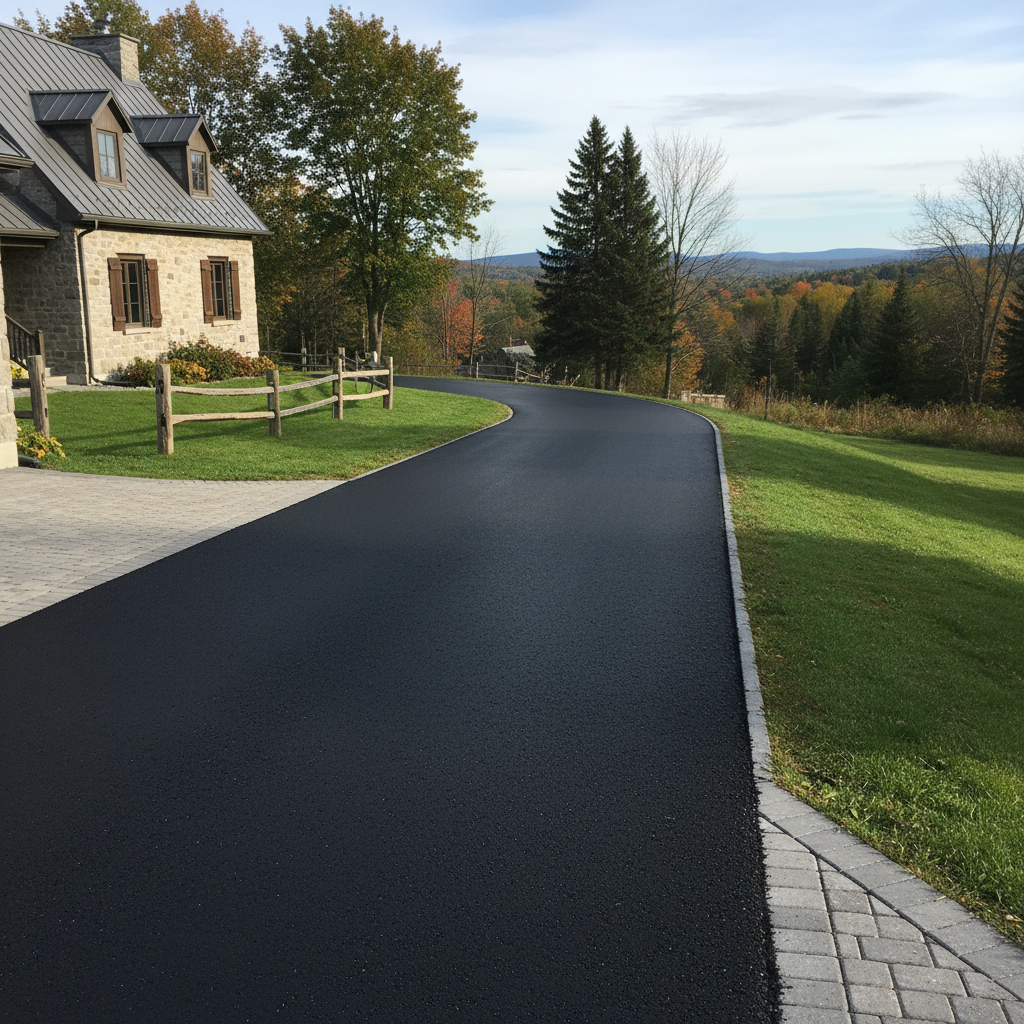
Driveway paving options and costs in Fort Langley
Fort Langley is a small community in the Lower Mainland–Southwest, and that shows up in how driveway work gets scheduled and priced: most driveways serve owner-occupied detached homes, where appearance, drainage reliability, and day-to-day maintenance matter as much as cost. With a 2021 population of 3,836 (Statistics Canada, 2021 Census), the market is big enough for steady contractor availability, but projects still depend on seasonal rain windows and crews that can travel within the Fraser Valley. In practice, that means your quote is often less about “frost depth at the exact centre of town” and more about how your site handles intense rainfall and clay-heavy subgrade in nearby areas.
Lower Mainland–Southwest paving is shaped by frequent wet-season soft spots and the need for engineered drainage and a properly compacted granular base. Frost penetration is relatively shallow compared with Interior or Northern BC, but local design practice still assumes a meaningful freeze line for exposed edges and sensitive infrastructure—so bases can’t be “too thin.” That’s why asphalt and concrete costs track closely with excavation and base prep, not just the surface material.
If you’re considering a driveway off Glover Road or around the village core (where access can be tighter), you’ll typically see more time spent on saw-cutting, hauling, and resetting edges. Use the table below to compare typical performance and price ranges for common materials in Fort Langley, then we’ll break down the biggest drivers behind variations in quotes.
| Material |
Lifespan |
Maintenance |
Best For |
Price per sq ft |
Price Range |
| Asphalt (new installation, proper base) |
15–20 years |
Seal every 3–5 years; patch as needed |
Best value balance of cost and smooth ride |
$4.25–$6.75 |
$6,200–$10,500 |
| Asphalt (overlay on existing gravel base) |
10–15 years |
Seal every 3–5 years; monitor for base settlement |
When the existing base is sound and well-drained |
$3.75–$6.25 |
$5,200–$9,200 |
| Interlocking concrete pavers |
25–30 years |
Occasional re-leveling and joint sand top-up |
Curb appeal and easy repair (replace sections) |
$9.50–$14.00 |
$10,500–$17,800 |
| Poured concrete (broom finish) |
20–30 years |
Crack monitoring; reseal if desired |
Low visual maintenance with durable surface |
$7.75–$11.50 |
$9,000–$15,500 |
| Exposed aggregate concrete |
20–30 years |
Sealer every few years; stain protection |
Slip resistance and premium look |
$8.50–$13.50 |
$10,200–$17,500 |
| Gravel / crushed stone (budget option) |
3–7 years (varies widely) |
Top up annually; re-grade to prevent rutting |
Lowest upfront cost and quick installation |
$2.25–$4.25 |
$3,200–$6,800 |
Prices are estimates only and vary by project scope, site access and material selection.
What affects the price of paving in Fort Langley
In Fort Langley, two quotes for the “same driveway” can differ by 30–50% across the Lower Mainland–Southwest and the rest of British Columbia because the visible surface is only part of the job. Most of the cost is buried in excavation, base preparation, compaction, drainage corrections, and disposing of removed material. A contractor can’t reliably price without confirming your existing base condition, slope, and whether the subgrade is clay-heavy or staying wet after storms—conditions that can change block by block.
Frost line depth and freeze-thaw cycles are still decisive cost factors in coastal BC design, even if our winters are milder than the Interior. When a deeper frost allowance is needed for exposed edges or sensitive footings, you’re typically looking at thicker compacted granular base (often closer to 4–6 inches in coastal BC applications, versus 6–12 inches commonly cited for harsher freeze regions) to prevent heaving, rutting, and early cracking. Asphalt also needs a freeze-thaw rated mix design, and that can add material cost compared with a basic mix.
Seasonality matters too: hot-mix asphalt placements rely on air temperatures above about 10°C, so spring and fall rain can compress the work window and tighten scheduling. In practical Fort Langley terms, that can move your project from “easy calendar fit” to “premium scheduling,” especially for longer driveways near the village core where access and traffic control take longer.
Concrete examples: if your existing driveway is breaking up and needs full tear-out, concrete removal and hauling can push a concrete pour toward the higher end of $18–$35 per sq ft pricing ranges; if the site drains well and the old surface can be milled or removed with minimal digging, concrete may land closer to the lower side. Asphalt might also fall into the $12–$20 per sq ft band when base thickness and grading are straightforward, but it climbs when drainage corrections and thicker granular layers are required—common where downspouts or yard runoff discharge near the driveway.
| Price Factor |
Why It Matters |
Cost Impact |
| Driveway area in sq ft |
Most labour and material scale directly with surface area |
Major driver: can change total cost by 40%+ for small design changes |
| Base depth required |
Controls frost/soft subgrade performance and reduces settlement |
Moderate to major increase when thickness or engineered base is added |
| Grading and drainage work |
Fixing slope, swales, and directing runoff prevents winter softening |
Can add significant cost if culverts, edge drains, or regrading are needed |
| Tear-out of existing surface |
Breaking, loading, and hauling removed asphalt or concrete |
Moderate to major increase depending on thickness and disposal distance |
| Edge restraints and curbing |
Prevents paver movement/spreading and improves long-term geometry |
Small to moderate increase, but strongly affects durability |
| Sealing requirement |
Asphalt benefits from seal timing (typically after cure) |
Minor added cost upfront; reduces oxidation and surface wear |
| Site access |
Narrow lots slow equipment movement and increase labour and time |
Moderate increase when hand-loading or multiple trips are required |
| Asphalt mix specifications |
Freeze-thaw rated mix improves performance in wet winters |
Moderate increase for better mix/requirements |
Permits & regulations in British Columbia
In British Columbia, paving a private driveway within your own property usually does not require a building permit. Typical work that generally falls under homeowner property maintenance includes replacing an existing driveway surface, reconstructing the driveway base, and installing asphalt or interlocking pavers within your property line.
However, you may need municipal approval when you work in the municipal right-of-way (the area that fronts the street) or when you change how water leaves the property. Common examples that typically DO require approval include new or modified curb cuts, altering boulevard drainage, changing catch basins or storm connections, and significant lot-grading changes that affect runoff patterns to the street.
Step-by-step, for a Fort Langley homeowner checking your contractor: (1) confirm utility locates are completed before excavation (in BC this is typically handled through BC 1 Call); (2) ask the contractor to provide a copy of their licence/registration information where applicable and a certificate of insurance that matches the work; (3) verify liability coverage is current and includes your address on the certificate; and (4) confirm workers’ compensation coverage (WSIB/WCB equivalent coverage in place) before work starts—request the clearance letter or account proof your contractor uses for jobs in BC.
Finally, confirm any lot-grading bylaws with the municipality—these can restrict how close hard surfaces can be to certain property lines or how water must be managed during and after construction.
Asphalt vs pavers vs concrete for Fort Langley driveways
For Fort Langley driveways, the “best” material depends on how you want to handle winter wetness, surface wear, and future repairs. Asphalt is usually the lowest upfront option and gives a smooth, quiet ride, but it depends on proper base prep and needs sealing every 3–5 years to slow oxidation from sun and moisture. Interlocking concrete pavers have the highest starting price, but they’re repairable—if a section settles or a utility trench is cut later, the contractor can remove and reset only the affected area instead of replacing the whole surface.
Poured concrete sits in the middle for many homes and is durable, but it’s more sensitive to cracking in freeze–thaw conditions if it’s not properly designed with air entrainment and good jointing. In the Lower Mainland–Southwest, repeated wet-season saturation and mild freeze cycles can still stress slabs, especially near edges where water ponds. That’s why drainage design matters as much as frost resistance: we want water directed away, and the granular base should be installed with correct thickness and compaction.
Where Fort Langley homeowners typically see the strongest long-term results is when the contractor matches base thickness to the job and keeps water moving—regardless of asphalt, pavers, or concrete. For routine winter maintenance (ploughing, sand, and occasional de-icing), asphalt performs well if it’s sealed and patched quickly; pavers handle plough contact well and are easier to spot-repair; concrete can work great if air entrainment and proper crack-control joints are done right.
Dollar example: for a similar driveway, asphalt might land in the $12–$20 per sq ft band, while interlocking pavers often come closer to the $20–$40 per sq ft band. The extra cost is justified when you want easy, localized repairs or you value curb appeal in higher-visibility areas near the village core.
| Material |
Frost Resistance |
Curb Appeal |
Repair Method |
Lifespan |
Price Band |
| Asphalt (sealed regularly) |
Good with proper base and freeze-thaw mix |
Moderate (clean, uniform finish) |
Mill/patch localized areas |
15–20 years |
$12–$20 per sq ft |
| Interlocking concrete pavers |
Very good with engineered base and drainage |
High (pattern variety) |
Remove/reset individual stones or bands |
25–30 years |
$20–$40 per sq ft |
| Poured concrete (air-entrained) |
Good with air entrainment and joints |
Moderate to high (finish dependent) |
Route/seal cracks; localized repair possible |
20–30 years |
$18–$35 per sq ft |
| Exposed aggregate concrete |
Good with proper finishing and sealer |
Very high (texture and colour) |
Limited patching; often panel-level repair |
20–30 years |
$22–$40 per sq ft |
| Permeable pavers (drainage grid) |
Excellent for stormwater handling when installed correctly |
High (modern look) |
Replace localized grid sections/pavers |
20–30 years |
$28–$50 per sq ft |
| Chip seal / tar-and-chip |
Fair to good; depends heavily on base and stone sizing |
Low to moderate (functional) |
Top up/re-surface sections |
7–12 years |
$10–$18 per sq ft |
How to choose a paving contractor in Fort Langley
Choosing the right paving contractor in British Columbia is mostly about verification and clarity. First, confirm liability insurance is active and provides coverage that matches your project scope. Second, verify workers’ compensation coverage (WSIB/WCB clearance proof) so you’re not left holding the risk if something happens on site. Third, ask for the contractor’s current licence/registration information where applicable and confirm they can provide it promptly—if they won’t, treat that as a serious concern.
Next, get 2–3 itemised written quotes. You want a breakdown that separates excavation/haul, granular base materials, compaction, asphalt/paver/concrete supply, finishing, and any sealing. Avoid “lump sum only” quotes because they can hide key inclusions. Ask whether permits are included (when right-of-way work or curb adjustments are required), whether disposal is included, and what the contractor does for utility locates and protection.
Warranty matters: request the workmanship warranty length, what it covers (e.g., base settlement vs surface defects), and whether product warranties from suppliers transfer to homeowners. Payment schedule should stay controlled—never pay more than 10–15% upfront, and keep a holdback until completion and cleanup are confirmed. Finally, insist on a written timeline: a start date estimate, a completion target, and what weather conditions could delay the work, since Lower Mainland–Southwest rain can push schedule by weeks.
- Request proof of liability insurance (certificate) before signing.
- Verify workers’ compensation clearance/coverage for the crew assigned.
- Confirm they pull/coordinate utility locates before any digging.
- Choose a contractor who measures and documents your existing base condition.
- Insist on itemised quotes (labour vs materials) rather than a single lump sum.
- Confirm excavation depth and base thickness in writing.
- Ask who is responsible for grading and drainage corrections.
- Clarify tear-out scope: saw-cut, break, haul-away and disposal included?
- For pavers, confirm edge restraints and bedding sand specifications.
- For asphalt, confirm tack coat and compaction requirements and when sealing is scheduled.
- Confirm warranty terms for workmanship and whether it’s transferable.
- Pay by milestones only; keep a holdback until punch-list items are complete.
Red flags: quotes that don’t specify base thickness, contractors who skip documented compaction steps, vague warranty language, refusing to provide insurance/coverage proof, or pressuring for large upfront deposits—these are common ways Fort Langley homeowners get stuck with avoidable settlement or premature cracking.
Frequently asked questions — paving in Fort Langley
What is a chip seal driveway and is it suited to Fort Langley?
Chip seal (tar-and-chip) uses a sprayed asphalt binder topped with compacted aggregate stones. It’s often used for lower-traffic roads or budget-minded driveways, and it can be suitable in Fort Langley when the base is engineered well and drainage is handled correctly. The main limitation is surface longevity and aesthetics: compared with a full asphalt build-up, chip seal can wear faster and may require additional top-up treatments when stones loosen or the surface becomes uneven after wet-season runoff. If you’re comparing costs, a full asphalt driveway typically falls into the $12–$20 per sq ft band, while chip seal is usually cheaper upfront but offers a shorter service life. In British Columbia’s rainy shoulders, proper grading and compaction are critical—otherwise water will undermine the surface.
How much does driveway crack repair cost in Fort Langley?
Crack repair cost varies based on crack width, how many cracks you have, whether it’s spot sealing only, or if you need a wider repair band that reaches sound material. In the Lower Mainland–Southwest, repairs are often priced per linear foot or as a small section mobilization plus materials. Many homeowners are surprised that the “cheap” fix can fail if the base has poor drainage—because repeated wet-season saturation and mild freeze cycles can reopen cracks. As a budgeting reference, sealing & repair is commonly in the $2–$6 per sq ft range when scope is limited; more extensive patching or partial depth repairs can raise the total. The best way to price accurately in Fort Langley is for the contractor to check if the crack is reflective (coming from base movement) or just surface shrinkage.
What base thickness do I need for pavers in Fort Langley?
Paver base thickness depends on soil condition, slope, and how much water your site holds after storms. In the Lower Mainland–Southwest, a common residential approach is about 6 inches of compacted granular base with bedding sand on top, plus proper edge restraints so the surface can “lock” and stay level. If your lot has clay-heavy subgrade or any signs of saturation, many contractors excavate deeper and add more engineered base to reduce settlement. Even though Fort Langley winters are milder than the Interior, the freeze line used in design and the need to prevent heaving at exposed edges still makes base prep non-negotiable. Ask your contractor to include the exact base thickness, compaction method, and drainage plan in the written quote—those details are often what separate durable paver installs from early joint movement.
How do I get the most accurate paving quote in Fort Langley?
For the most accurate quote in Fort Langley, start by having the contractor visit your site to assess existing pavement condition, slope, and drainage paths. Ask them to measure your driveway area in square feet and document current base conditions (and whether there’s any underlying saturation or soft spots). Request an itemised estimate that breaks out excavation/haul-away, base gravel, compaction, surface material, and finishing steps. Include whether permits are required for any right-of-way touches (like curb cuts or boulevard drainage changes) and whether disposal is included. If the quote doesn’t mention drainage correction scope, base thickness, and compaction steps, you can expect surprises after excavation—especially in the Lower Mainland–Southwest where winter rain can reveal subgrade issues quickly. Finally, confirm warranty terms and ask when sealing (for asphalt) will be scheduled.
How much does it cost to pave a driveway in Fort Langley?
Typical driveway paving costs in Fort Langley land within regional price bands, but total cost depends heavily on size, base prep, and tear-out/disposal. For a straightforward asphalt installation with proper base, homeowners commonly see pricing in the $12–$20 per sq ft range. Interlocking concrete pavers often come in higher, typically around $20–$40 per sq ft, because of thicker base prep, bedding sand, paver supply, and edge restraints. Concrete usually sits between those two, often around $18–$35 per sq ft depending on finish and whether it’s broom-finish or exposed aggregate. If you need sealing or crack repair after installation, budget additional maintenance in the $2–$6 per sq ft range for smaller scopes. A site visit is the only reliable way to confirm your exact total.
Asphalt vs interlocking pavers vs concrete — which is best in Fort Langley?
In Fort Langley and the Lower Mainland–Southwest, asphalt is usually best when you want the lowest upfront cost and a smooth surface, provided the contractor installs the right granular base and mixes for freeze-thaw performance. Interlocking concrete pavers are often the best choice when curb appeal is important and you want the ability to repair individual sections without replacing the entire driveway—useful if future utility work or localized settlement occurs. Poured concrete can be a strong option if you choose proper air-entrainment, jointing, and a well-drained base; the downside is that freeze–thaw related cracking can become more visible if the slab isn’t detailed correctly. For homeowners comparing price justify: if asphalt lands around $12–$20 per sq ft but pavers run closer to $20–$40, pavers are typically worth it for long-term looks and easier repairs. The “best” material is whichever one gets the best base and drainage for your specific driveway.