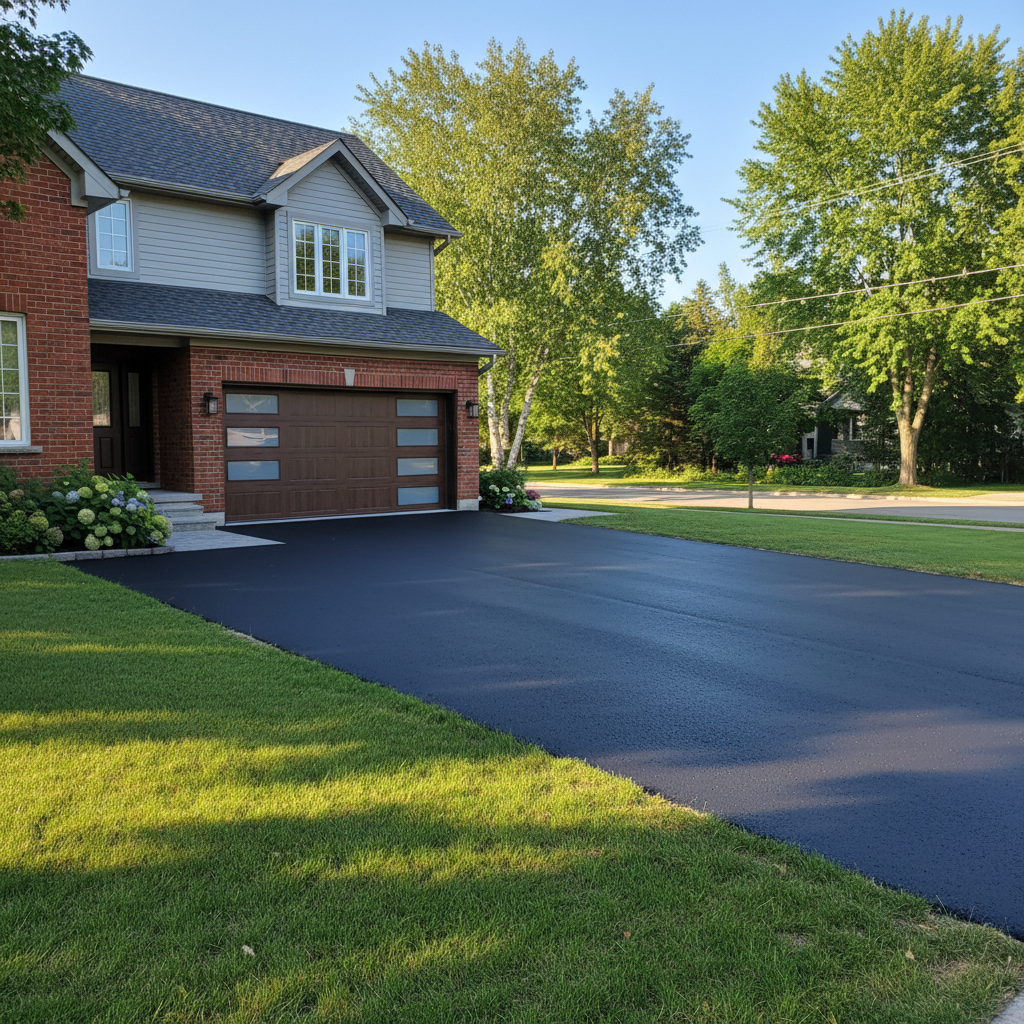
Driveway paving options and costs in Central Saanich
Central Saanich homeowners have several solid driveway paving paths, and the right choice usually comes down to how you’ll use the driveway, how much curb appeal you want, and what you’re willing to maintain. In Central Saanich, with 5,680 homeowner households (79.9% of households own) and a housing stock where 53.8% of dwellings are single-detached homes (Statistics Canada, 2021 Census), most private driveways are tied to detached properties—exactly where we see the most foot-traffic, vehicle turning, and seasonal water issues that can shorten pavement life.
On Vancouver Island and the Coast, costs are shaped by a mild coastal climate, but frost and drainage still matter. Frost depth is relatively shallow compared with Ontario or Alberta, so we generally don’t need the very deep granular bases used in harsher freeze zones; however, Central Saanich still sees localized freezing and repeated freeze-thaw cycles. That’s why we focus on proper excavation, well-graded, compacted road base, and drainage attention around the driveway profile and at the tie-in to the road. In areas with heavier rainfall and runoff—like around the Sidney North Saanich Road corridor and the more mature neighbourhoods near Central Saanich Centre—contractors often get busier during the drier stretches, and scheduling can tighten mid-season.
Below is a practical comparison of typical material options and “installed” budget ranges to help you interpret quotes when comparing like-for-like scope. Use these bands as a backbone, then refine with your access, base condition, and whether there’s excavation or full tear-out.
| Material |
Lifespan |
Maintenance |
Best For |
Price per sq ft |
| Asphalt (new installation, proper base) |
15–25 years |
Sealcoat every 3–5 years starting after cure period |
Fast install, smooth ride, good value |
$10–$20 |
| Asphalt (overlay on existing gravel base) |
10–18 years |
Sealcoat as required; monitor edges and any weak spots |
Limited demolition, stable base already in place |
$9–$17 |
| Interlocking concrete pavers |
25–35 years |
Occasional re-leveling of small areas; joint sand top-ups |
Curb appeal, replaceable sections, vehicle turning resilience |
$25–$45 |
| Poured concrete (broom finish) |
20–30 years |
Minor crack monitoring; periodic cleaning; limited sealing if desired |
Clean look, straightforward maintenance |
$18–$35 |
| Exposed aggregate concrete |
20–30 years |
Clean and re-seal selectively depending on finish and staining |
Textured traction, upgraded appearance |
$22–$40 |
| Gravel / crushed stone (budget option) |
2–6 years |
Re-grade and replenish 1–3 times per year depending on washouts |
Short-term solution, drainage-first approach |
$5–$12 |
Prices are estimates only and vary by project scope, site access and material selection.
What affects the price of paving in Central Saanich
It’s very common to see driveway quotes that differ by 30–50% for what looks like the “same” job in Central Saanich. The main reason isn’t only the finish—it’s the unseen scope: how much excavation is required, what the soil and drainage look like once we open it up, and how difficult access is for trucks and compactors. Across Vancouver Island and the Coast, we also pay a market premium for aggregate and asphalt trucking to Island markets, and labour availability tightens in peak summer windows when the ground is workable.
Frost and freeze-thaw cycles are decisive cost factors even with our relatively shallow frost line. In colder regions, deeper frost typically forces thicker compacted granular bases (often 6–12 inches in Ontario/Alberta); on Vancouver Island we usually aim closer to a 4–6 inch compacted granular thickness when subgrade is stable, but we may increase thickness or improve base when soils are wet or spring-saturated. If base and drainage aren’t engineered, freeze-thaw heaving and cracking can show up sooner, and that’s when “cheap” paving becomes expensive—fast. Asphalt mix design matters too: a freeze-thaw-rated asphalt cement mix costs more, and it’s one reason your asphalt quote might land closer to the higher end of the local $10–$20 per sq ft band.
Concrete costs can swing as well. For example, an older driveway (common in areas with 46.4% of homes built before 1981 (Statistics Canada, 2021 Census)) often hides utility trenches, soft pockets, or unsupported edges, which means more base and re-forming. A straightforward broom-finished concrete job might stay in the $18–$35 per sq ft band when thickness and reinforcement are right; but if we need full tear-out and re-grading, the budget can jump toward the upper end quickly. Once you understand these levers, comparing the numbers in your quote becomes much more straightforward.
| Price Factor |
Why It Matters |
Cost Impact |
| Driveway area in sq ft |
Material and labour scale directly with square footage |
High (primary driver) |
| Base depth required |
Frost line and local subgrade conditions determine granular thickness |
High (can change by thousands) |
| Grading and drainage work |
Slope corrections and drainage improvements prevent standing water and freeze-thaw damage |
Medium to high |
| Tear-out of existing surface |
Breaking/hauled concrete or old asphalt adds equipment and disposal |
Medium to high |
| Edge restraints and curbing |
Edges hold the system together and stop paver spreading |
Medium |
| Sealing requirement |
Asphalt should be sealed after curing (often 6–12 months) to protect from UV and water ingress |
Low to medium (ongoing) |
| Site access |
Narrow lots, steep driveways, or overhead obstacles slow down equipment movement |
Medium |
| Asphalt mix specifications |
Freeze-thaw-rated mixes improve durability in coastal freeze cycles |
Low to medium (but matters for longevity) |
Permits & regulations in British Columbia
In British Columbia, paving a private driveway within your own property usually does not require a building permit—especially when you’re resurfacing or replacing the driveway surface without changing major grades or affecting municipal infrastructure. Where you should expect approval is any work in the municipal right-of-way (or that impacts it), such as creating or modifying a curb cut, altering boulevard drainage, changing stormwater flow paths, or modifying municipal ditches/culverts. Central Saanich may also enforce lot-grading expectations through municipal bylaws, which can affect how close finished hard surfaces can be to property lines and how drainage is managed.
Step 1: before excavation, always have utility locates done. In BC, call BC 1 Call so the underground services are marked. Step 2: ask your contractor to clearly state whether the scope includes right-of-way work and whether a municipal application/permit is required. Step 3: verify the contractor’s licence status and compliance, then confirm insurance. For a homeowner in Central Saanich, you can check a contractor’s registration/licence information through the applicable BC registry (the contractor should provide proof upfront). Then request a current certificate of insurance listing you as additional insured (if offered) or at least showing liability coverage that matches the job scope.
Finally, confirm workforce coverage: in practice, reputable paving contractors will provide evidence of WCB clearance/coverage for workers on site. Ask for the clearance letter or proof of coverage and ensure it covers the correct legal entity. If they can’t supply these documents before pricing, that’s a red flag.
Asphalt vs pavers vs concrete for Central Saanich driveways
Choosing between asphalt, interlocking concrete pavers, and poured concrete in Central Saanich comes down to upfront cost versus long-term flexibility—especially under our coastal freeze-thaw conditions. Asphalt is typically the lowest upfront option and gives a smooth, quiet ride, but it performs best with a sealed surface cycle. Plan on sealing every 3–5 years (often after the driveway has cured), because water penetration at the surface can accelerate freeze-thaw wear. In contrast, interlocking pavers cost more up front, but they’re repairable: if a section settles or lifts, we can lift and re-compact that localized area without replacing the entire driveway. Pavers also shine for curb appeal in neighbourhoods around Central Saanich Centre and older detached home pockets where owners expect a “finished” front elevation.
Poured concrete is mid-range in cost and is easy to maintain, but it can crack with freeze-thaw and movement if the slab isn’t detailed correctly—air-entrainment and proper jointing matter. De-icing salt use can worsen surface scaling; on Vancouver Island, homeowners sometimes use sand more than salt, but plowing and traction products still influence wear. For any of the three, base preparation is the foundation: even with a shallow frost line, we still build to handle repeated freezing and water movement. When drainage is engineered (consistent slope away from the house, well-graded base, and clean runoff management), asphalt and concrete can last long; when drainage is ignored, all materials can fail early.
Here’s a realistic budget example: if your driveway runs 500 sq ft, asphalt at $10–$20 per sq ft typically lands around $5,000–$10,000 for the surface plus associated base prep where required, while pavers at $25–$45 per sq ft could come closer to $12,500–$22,500. That extra cost is justified when you want curb appeal, easier panel-by-panel repairs, and strong performance under vehicle turning and seasonal wetting.
| Material |
Frost Resistance |
Curb Appeal |
Repair Method |
Lifespan |
Price Band |
| Asphalt (sealed regularly) |
Good when base and drainage are engineered |
Moderate (clean, uniform look) |
Patch and re-surface localized areas |
15–25 years |
$10–$20 |
| Interlocking concrete pavers |
Excellent with proper base compaction |
High (varied patterns and colours) |
Lift and replace affected units/area |
25–35 years |
$25–$45 |
| Poured concrete (air-entrained) |
Good to very good with joints and air-entrainment |
Moderate (clean but less decorative) |
Crack repair and targeted patching |
20–30 years |
$18–$35 |
| Exposed aggregate concrete |
Good when sealed/maintained and joints are correct |
High (textured, upscale finish) |
Surface restoration or localized patching |
20–30 years |
$22–$40 |
| Permeable pavers (drainage grid) |
High for water management; depends on subgrade |
High (modern drainage-conscious look) |
Replace grid sections/units if needed |
20–30 years |
$30–$55 |
| Chip seal / tar-and-chip |
Moderate; best as a resurfacing approach |
Low to moderate (utility finish) |
Spot-reseal and re-chip as it wears |
8–15 years |
$8–$16 |
How to choose a paving contractor in Central Saanich
When you’re choosing a paving contractor in Central Saanich, start by verifying they’re legitimate on the essentials: coverage, documentation, and written scope. In BC, a contractor should be able to provide proof of licence/registration status (where applicable), general liability insurance, and evidence of worker coverage. Ask to see the certificate of insurance and confirm it’s current and relevant to the named company. Then request a WCB clearance letter/proof of coverage for the time of the job. Don’t accept verbal assurances—ask for documents before you sign anything.
Next, get 2–3 itemised written quotes. The best quotes break down labour and materials separately (excavation, base, asphalt/concrete, pavers, jointing sand, sealcoat allowance, and disposal). Avoid a “lump sum” only quote unless the scope is so detailed that it removes ambiguity. Carefully check what’s excluded: permit fees (if right-of-way work applies), utility locating, disposal, site protection, and whether the contractor includes edge restraints/curbing or only “surface” material. For asphalt, ensure the quote states sealing timing; it’s commonly needed after cure (often 6–12 months). For concrete, clarify air-entrainment/jointing and whether it includes any cut/saw joints to control cracking.
Warranty matters too: confirm workmanship warranty length, whether it covers labour for failures tied to installation, and how manufacturer warranties apply to materials. Ask if warranties are transferable if you sell your home. For payment, never pay more than about 10–15% upfront; use a holdback until completion and walkthrough sign-off. Finally, lock in a start date and realistic completion timeline in writing—Island scheduling can tighten in peak dry periods.
- Ask for proof of insurance and request it before work starts.
- Request WCB clearance/proof of coverage for workers assigned to your site.
- Confirm the exact scope: excavation depth, base type, and compaction requirements.
- Clarify disposal: will they haul away concrete/asphalt debris or is it extra?
- Check whether utility locates are included or whether you’re expected to arrange them.
- Make sure right-of-way work vs on-property work is stated clearly.
- Verify edge restraints/curbing are included where needed.
- For pavers, confirm joint sand type and re-screed/re-compaction steps.
- For asphalt, confirm sealcoat allowance and expected cure time.
- Ask how they handle drainage at the driveway-to-street transition.
- Review warranty terms in writing, including exclusions.
- Use a payment schedule with a holdback until final completion.
In Central Saanich, common red flags include: quotes that don’t describe base depth and drainage corrections; promises to skip proper excavation/compaction “to save money”; starting without current insurance/WCB paperwork; payment demands that exceed 10–15% upfront; and vague timelines (“sometime this month”) without a written start and completion estimate.
Frequently asked questions — paving in Central Saanich
Is it worth sealing a new driveway right away in Central Saanich?
In Central Saanich, it’s usually not worth sealing immediately after asphalt placement. Asphalt needs time to cure so the sealant can bond properly; most crews plan sealing after the driveway has cured, commonly within a 6–12 month window depending on weather and mix. The coastal climate is mild, but our freeze-thaw cycles still push water into small voids when surfaces aren’t protected. Sealing is a cost-effective maintenance step, and it helps you protect your investment that starts in the local asphalt range of $10–$20 per sq ft. If your contractor is offering a same-week sealcoat, ask for their cure timeline and product instructions in writing.
What is a chip seal driveway and is it suited to Central Saanich?
Chip seal (also called tar-and-chip) is a light asphalt binder sprayed onto a prepared surface, then topped with aggregate chips that lock in as it sets. For Central Saanich, it can be suited as a resurfacing approach, especially where you want a practical, lower-cost surface and you’re managing expectations on texture and long-term aesthetics. It’s not typically the first choice for a high-finish detached-home driveway compared with asphalt paving or pavers, but it can work on driveways where speed and budget matter. Pricing is often in a lower band than full asphalt paving—think roughly $8–$16 per sq ft—and performance depends heavily on base condition and drainage. If your driveway base is weak or water pools, chip seal will deteriorate faster.
How much does driveway crack repair cost in Central Saanich?
Crack repair costs vary by crack width, length, and whether water is getting under the surface. For Central Saanich, small asphalt crack sealing or patching is commonly priced by the length and quantity of repair areas, and you’ll often see minimum charges based on mobilization. As a practical planning figure, many homeowners treat this as a separate “maintenance” cost rather than a full replacement decision—especially if the base is still solid. If cracks are isolated and the driveway is otherwise stable, repairs can be relatively modest. But if you have repeating freeze-thaw heaving, edge breakdown, or pumping, patching alone won’t solve the underlying drainage/base issue. In that case, the repair quote may point you toward a more durable resurfacing or full base rebuild.
What base thickness do I need for pavers in Central Saanich?
For pavers in Central Saanich, base thickness depends on subgrade condition and drainage, not just frost line charts. With our relatively shallow frost line, we often can use a thinner compacted granular base when soils are stable; however, if the area is wet, soft, or previously undermined, we’ll increase base and improve drainage to prevent freeze-thaw movement. A common target is a compacted granular base in the ballpark of 4–6 inches on stable sites, plus proper bedding sand and jointing sand for the paver system. The best quotes explain the proposed excavation depth, base type, and compaction method after they inspect your existing driveway. That’s how you avoid paver heaving and settlement that can start within seasons when water is trapped.
How do I get the most accurate paving quote in Central Saanich?
To get a precise Central Saanich quote, ask for an on-site assessment and an itemised breakdown—don’t rely on a phone estimate. The contractor should measure driveway area, confirm access limits for a bobcat/skid-steer and a dump truck, and evaluate existing base and drainage. Make sure the quote states scope details: excavation depth, base depth and material, whether they include tear-out, disposal, edge restraints, and how the driveway ties into the road profile. If the job involves any municipal right-of-way work (like a curb cut change or drainage alteration), confirm permit responsibility up front. Finally, require proof of insurance and WCB coverage before scheduling starts. When scope is clear, pricing for asphalt typically lands in the $10–$20 per sq ft band (or pavers higher), and you can compare apples-to-apples.
How much does it cost to pave a driveway in Central Saanich?
Driveway paving costs in Central Saanich depend mainly on square footage, base condition, and site access. For asphalt new installation with proper base engineering, homeowners often budget within the local asphalt band of $10–$20 per sq ft. Pavers are typically higher upfront, commonly $25–$45 per sq ft, because the system includes restraints, base layers, bedding, and hand-finish work. Poured concrete commonly falls in the $18–$35 per sq ft range, with the finish and any reinforcement/jointing details affecting where you land. If your existing driveway is failing and requires tear-out and drainage correction, total project cost can increase well beyond a “surface-only” number. The fastest way to narrow your budget is to request 2–3 itemised, scoped quotes after a site visit.