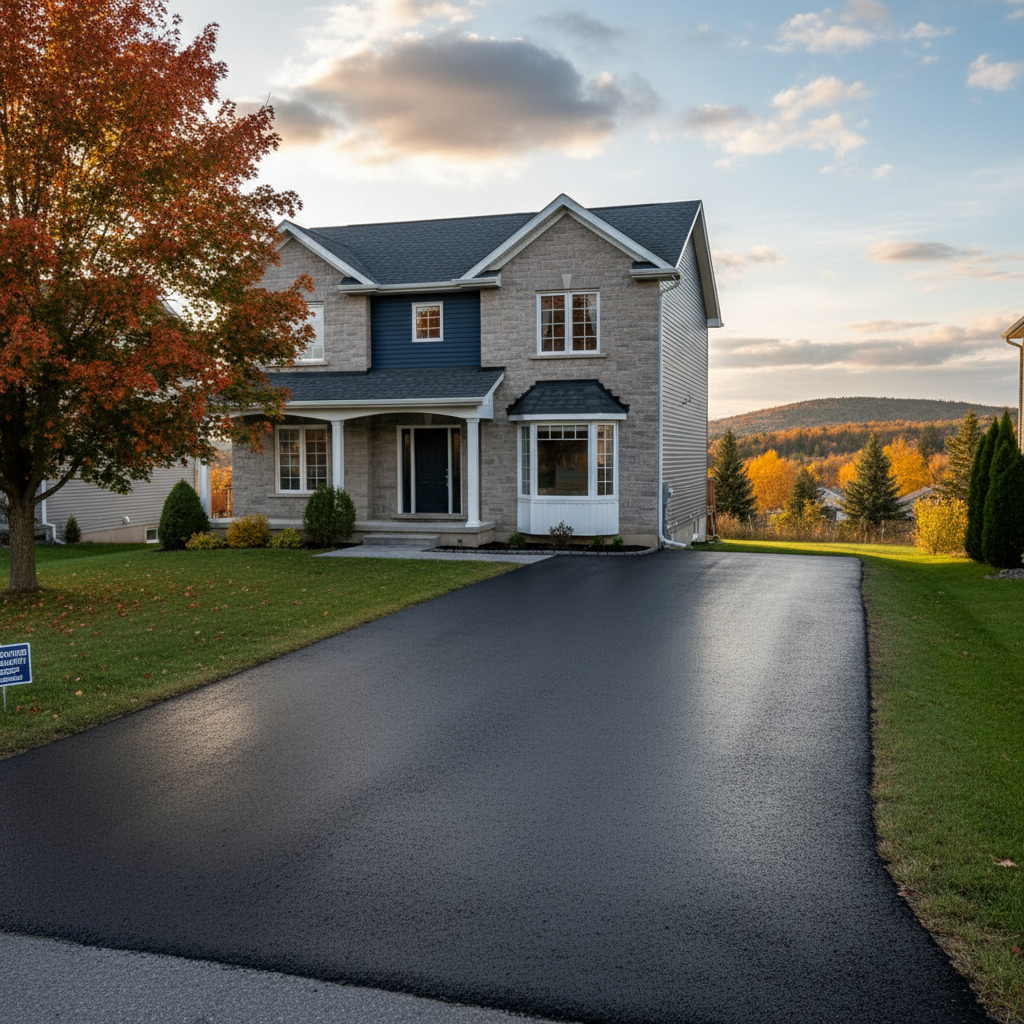
Driveway paving options and costs in Valemount
Valemount homeowners usually have three practical driveway paths: asphalt, interlocking pavers, or concrete—each performing differently under Cariboo winters. With single-detached houses making up 63.7% of dwellings and homeowner households at 68.9% (Statistics Canada, 2021 Census), most private driveways in town are tied to detached homes where access, plowing patterns, and drainage reliability really matter.
In the Cariboo, cold winters and repeated freeze–thaw cycles are a major cost driver. To reduce heaving, rutting, and cracking, granular bases often need to be built thicker and with clean, well-graded aggregate—commonly 12–18 inches or more under driveways—so the structure sits below the frost-susceptible zone. That base requirement, plus shorter paving season windows (spring thaw and early fall frosts), concentrates contractor scheduling and increases mobilization costs when work has to happen fast.
You’ll feel this most in higher-traffic areas where driveways get hammered by heavy snow storage and regular plowing, such as the Valemount townsite around downtown-access lots. If you’re comparing quotes, the material choice matters, but base preparation, drainage design (ditching/edge drainage where needed), and removal of poor gravel are what typically separate a driveway that lasts from one that needs early repairs.
Below is a practical comparison of typical installed ranges for Valemount, so you can benchmark your contractor’s proposal before you ask for clarifications.
| Material |
Lifespan |
Maintenance |
Best For |
Price per sq ft |
| Asphalt (new installation, proper base) |
15–25 years |
Seal every 3–5 years; patch as needed |
Lowest upfront cost with good longevity if base/drainage are right |
$12 – $20 |
| Asphalt (overlay on existing gravel base) |
10–20 years |
Seal and mill/patch sooner if underlying base is weak |
When existing grade is stable and drainage is proven |
$14 – $22 |
| Interlocking concrete pavers |
25–40 years |
Re-level joints; replace individual stones if damaged |
Curb appeal and easier localized repairs for ploughing impacts |
$20 – $35 |
| Poured concrete (broom finish) |
20–30 years |
Minor crack repair; avoid early de-icing abuse |
Clean, low-maintenance surface with strong structural capacity |
$18 – $30 |
| Exposed aggregate concrete |
25–35 years |
Reseal only if specified; spot patch for chips |
Better slip resistance and a premium look |
$22 – $38 |
| Gravel / crushed stone (budget option) |
3–10 years |
Re-grade and top up; weed control |
Short-term solution or sloped sites needing drainage rebuilding first |
$5 – $10 |
Prices are estimates only and vary by project scope, site access and material selection.
What affects the price of paving in Valemount
In Valemount, two quotes for “the same driveway” can easily land 30–50% apart across the Cariboo and broader British Columbia because the cost drivers aren’t just the surface material—they’re the structure beneath it and how hard the job is to build. A contractor’s base design, drainage scope, equipment mobilization, and how much demolition is required will swing total pricing, especially in a town with a smaller local workforce and a short workable asphalt window.
For freeze–thaw regions like the Cariboo, frost penetration and repeated thawing are decisive. Deeper frost requires a thicker compacted granular base; you’ll see stronger base builds compared with coastal BC where the frost impact is milder. In Valemount, you should plan for granular thickness more like the “northern” approach: thick, compacted layers with clean, well-graded aggregate to keep moisture from sitting in frost-susceptible soils. That’s why good drainage design (ditching/edge drainage and geotextile where needed) often adds cost, but it also prevents the soft, wet subgrade conditions that lead to rutting and early cracking.
Concrete examples: a driveway over older, poorly drained fill may require extra excavation and replacement (raising poured concrete costs), while a driveway on solid native material with straightforward grade control can lower the bill. Also, if your home’s driveway area was built before 1981 (57.3% of homes in the area; Statistics Canada, 2021 Census), it’s common to encounter settled bases, buried utilities at unknown depths, or edge erosion that increases prep work.
Finally, your choice interacts with price bands. Asphalt is often the entry point near the $12 – $20 per sq ft band when base and drainage are done correctly; pavers can jump into the $20 – $35 per sq ft band, but the ability to repair individual units can be worth it in high-plow-wear locations.
| Price Factor |
Why It Matters |
Cost Impact |
| Driveway area in sq ft |
Most labour and material scale directly with square footage |
High |
| Base depth required |
Frost conditions determine granular thickness to prevent heaving |
High |
| Grading and drainage work |
Slope corrections and water control prevent saturated subgrade damage |
Medium to high |
| Tear-out of existing surface |
Breaking/hauling old asphalt or concrete adds disposal and equipment time |
Medium to high |
| Edge restraints and curbing |
Prevents paver spread and helps asphalt hold its edges |
Medium |
| Sealing requirement |
Asphalt needs seal coat after cure (often 6–12 months) for protection |
Low to medium |
| Site access |
Narrow/tight lots slow equipment movement and increase labour hours |
Medium |
| Asphalt mix specifications |
Freeze–thaw-rated mixes cost more and require correct placement temps |
Medium |
Permits & regulations in British Columbia
In British Columbia, paving a private driveway within your own property usually does not require a building permit. However, permits and approvals can apply when the work affects public infrastructure or changes how stormwater drains toward municipal systems.
Work that typically requires municipal approval includes: new or modified curb cuts/driveway crossings in the municipal right-of-way; any alteration to boulevard surfaces; and changes to storm drainage patterns (for example, re-routing drainage that could impact adjacent properties or ditches). Some municipalities also have lot-grading expectations or bylaw requirements that restrict how close a hard surface can come to property lines or how stormwater must be handled—so you should confirm lot-grading rules before excavation.
Step-by-step for Valemount homeowners: (1) schedule utility locates by calling BC 1 Call before any digging; (2) ask your contractor whether the project touches any municipal right-of-way and, if it does, confirm the approval process up front; (3) request the contractor’s written scope showing what’s included (excavation, disposal, drainage measures); and (4) verify credentials before work starts.
To verify a British Columbia licence (where applicable), check the contractor’s listing through the province’s contractor licensing registry (as provided by the company) and always request a certificate of liability insurance. For coverage proof, ask for a clearance letter and confirm they carry WSBC coverage where required for their workers.
Asphalt vs pavers vs concrete for Valemount driveways
For Valemount’s freeze–thaw climate, asphalt, interlocking pavers, and concrete can all work—but they serve different homeowner priorities. Asphalt is usually the lowest upfront option and, when built over a properly compacted granular base with good drainage, it handles plough wear well. The catch is maintenance: asphalt sealing is typically needed every 3–5 years to protect binder and reduce weather-raveling in repeated winter cycles.
Interlocking concrete pavers cost more up front, but they’re often the best “repairable” choice for areas that get scoured by winter traffic. If a section settles or gets damaged, pavers can be lifted, re-leveled, and reset without replacing the entire surface—useful in Cariboo conditions where saturated subgrade or localized frost effects can show up over time.
Poured concrete is a mid-range option with strong structural capacity, but it’s susceptible to cracking if the mix isn’t air-entrained and the base isn’t well-drained and compacted. De-icing practices matter: excessive salt and repeated freeze–thaw at the surface can accelerate surface deterioration if the concrete isn’t specified and finished for winter exposure.
Base and drainage drive performance in the Cariboo for all three materials. If your driveway sits over older, moisture-prone fill (common in homes built decades ago), you’ll pay more for excavation and thicker base—but you’ll also reduce future heave and pothole-style failures.
Where is the price difference justified? For example, if asphalt is quoted near the $12 – $20 per sq ft band and pavers come in around the $20 – $35 per sq ft band, that premium can make sense where curb appeal matters and where you want the ability to replace a small section rather than committing to full-surface resurfacing after early localized failure.
| Material |
Frost Resistance |
Curb Appeal |
Repair Method |
Lifespan |
Price Band |
| Asphalt (sealed regularly) |
Good when base/drainage are engineered for frost–thaw |
Medium |
Cut/patch and re-seal; localized asphalt repairs |
15–25 years |
$12 – $20 |
| Interlocking concrete pavers |
Very good; flexible joints tolerate minor movement |
High |
Lift, re-base/re-level, and replace individual units |
25–40 years |
$20 – $35 |
| Poured concrete (air-entrained) |
Good when properly air-entrained and well-drained |
Medium |
Crack patching and patch pours; larger cracks may require sections replaced |
20–30 years |
$18 – $30 |
| Exposed aggregate concrete |
Good; durable surface texture for winter slip resistance |
High |
Spot patch for chips/cracks; may be less uniform after repairs |
25–35 years |
$22 – $38 |
| Permeable pavers (drainage grid) |
Very good with engineered sub-drainage |
High |
Replace units and maintain sub-drain media |
20–35 years |
$24 – $40 |
| Chip seal / tar-and-chip |
Fair; more sensitive to early aging and surface ravelling |
Low to medium |
Rework surface and add additional chip seal layers |
8–15 years |
$8 – $16 |
How to choose a paving contractor in Valemount
Choosing the right paving contractor in Valemount comes down to proof and process. Start by verifying British Columbia licensing details as applicable for the work, then request a certificate of liability insurance and confirm WSBC/WCB coverage for workers. Practically, you should look for: (1) a current insurance certificate matching the named insured; (2) written confirmation of WSBC coverage or clearance documentation for labour; and (3) licensing or registration information tied to the contractor’s legal name (so it matches the quote and invoice).
Next, get 2–3 itemised written quotes. Not a lump sum—ask for labour and materials breakdown (excavation, base materials, geotextile if used, compaction, asphalt/paver/concrete supply, forms, delivery, and disposal). Make sure the scope states what’s included: permit pull (if required due to right-of-way or drainage changes), utility locates (who booked them), and disposal (landfill fees and hauling). In Valemount’s short season, misunderstandings about schedule and cure times can also cost money—so insist on a start date and an estimated completion date in writing.
Warranty matters too. Ask for the workmanship warranty length and whether it’s transferable to future owners. For asphalt, confirm the sealing plan (often after 6–12 months) so you’re not paying to “fix” premature weather damage.
Finally, keep payment sensible: never pay more than 10–15% upfront; request a holdback until completion and final inspection. If someone pressures you to rush without proper base construction and drainage, treat that as a red flag.
- Use itemised quotes with line-by-line materials and labour.
- Verify licence/registration details and that the legal name matches the contract.
- Confirm liability insurance certificate is current and includes your address as certificate holder if offered.
- Request WSBC/WCB proof (clearance letter or coverage documentation).
- Ask who books BC 1 Call utility locates and how locates are protected on site.
- Insist on a written drainage plan (ditching/edge drainage and geotextile where needed).
- Confirm base depth and compaction specs (and whether they remove unsuitable material).
- Clarify tear-out limits: how far they remove and where they stop.
- Confirm edge restraints/curbing details for pavers and asphalt termination.
- Specify asphalt mix design for freeze–thaw performance and placement temperature requirements.
- Ask about cure and cold-weather handling: start/stop criteria for asphalt/concrete.
- Check warranty terms: workmanship, product specs, transferability, and exclusions.
Red flags in Valemount: contractors who won’t show base thickness/compaction details, who skip drainage or geotextile discussions, who quote asphalt without confirming sealing timing, who ask for large deposits before any excavation, and who refuse to provide itemised written scope for disposal, tear-out, and restoration.
Frequently asked questions — paving in Valemount
Do I need a permit to pave my driveway in British Columbia?
In most cases, paving a private driveway within your own property in British Columbia does not require a building permit. That said, permit or approval needs can apply when the work touches the municipal right-of-way—such as a new or modified curb cut/driveway crossing, changes to the boulevard, or alterations to storm drainage patterns. For Valemount homeowners, the safe approach is to ask your contractor whether the scope includes any right-of-way work and whether drainage will connect or redirect toward municipal ditches. Also confirm any local lot-grading expectations before excavation. Finally, ensure utility locates are booked before digging (through BC 1 Call) to avoid service strikes and delays.
How long before I can drive on new asphalt?
For new asphalt in Valemount, typical cure/traffic timing depends on temperature, thickness, and whether it’s a binder/course vs. full surface. Often, you can drive on it relatively quickly after compaction when temperatures are warm and the surface isn’t flushing, but many crews still restrict heavy vehicle traffic for longer to prevent rutting. Ask your contractor for their exact placement and traffic plan. In Cariboo conditions, crews also watch air temps and wind because cold weather slows curing. If your driveway is scheduled late in the season, it may affect how soon you can use the surface. A well-sealed driveway is also part of long-term protection; sealing is commonly done after cure—often within about 6–12 months—using a process that helps it last through freeze–thaw cycles.
What causes potholes and how are they repaired?
Potholes usually start from water. In Valemount’s freeze–thaw climate, moisture can get into small voids or weak spots under asphalt—especially where drainage is poor or the base wasn’t compacted evenly. When the ground freezes, heaving and micro-cracking occur; during thaw, those openings expand and lose support, then you end up with loss of asphalt and potholes. Repair typically involves removing the failed asphalt to reach sound material, stabilizing or replacing the affected base (and sometimes adding drainage), then placing and compacting new asphalt in lifts. A proper patch is more than a “top-up,” because the goal is to restore structural support so the same area doesn’t re-fail. If you’re choosing asphalt, staying on a sealing cycle (commonly every 3–5 years) helps reduce water intrusion.
How do I prepare for a paving project?
Preparation is mostly about access, utilities, and decisions. First, confirm where vehicles need to go during construction and whether you’ll need temporary parking off-site. Next, protect landscaping and ensure downspouts aren’t discharging onto areas proposed for paving unless the contractor is redesigning drainage. Before any digging, ensure utility locates are arranged through BC 1 Call, and ask the contractor how they plan to mark/avoid services. Collect photos and any prior service notes, especially if your home is older (many Valemount homes were built before 1981). Then, review the written scope line-by-line: tear-out limits, disposal, base depth, and whether sealing is included or scheduled later. If your project is near a right-of-way or involves drainage changes, discuss approvals early so you aren’t delayed after excavation begins.
How do I compare paving quotes fairly?
Compare quotes like-for-like. Ask each contractor for an itemised breakdown (materials and labour), not only a total price. Confirm the driveway square footage, base thickness, and whether unsuitable material will be removed and replaced. Drainage scope should be described clearly—ditching, edge drainage, and any geotextile—because in the Cariboo, saturated subgrade accelerates frost-related failures. Also check the surface spec: asphalt mix design for freeze–thaw durability, thickness of lifts, and compaction requirements; for concrete, confirm air-entrainment and finishing method; for pavers, confirm restraints and edge details. Finally, verify what’s included in schedule and warranty. If one quote is near the asphalt band (for example, around $12 – $20 per sq ft) but skips base/drainage details, it may be lower upfront but higher risk.
Can asphalt be laid in cold weather in Valemount?
Cold weather affects asphalt placement, and in Valemount you should expect stricter scheduling. Hot-mix asphalt generally requires adequate air temperatures to place and compact properly; crews commonly need conditions roughly above 10°C air temperature to achieve correct laydown and compaction. When temperatures drop, curing slows and the mix can cool too fast, increasing the risk of weak compaction, premature raveling, and early surface cracking during freeze–thaw cycles. The workable season in the Cariboo is shorter than coastal BC, so late-season installs can be delayed. If a contractor proposes paving during marginal conditions, ask what cold-weather plan they follow (heating/production adjustments, temperature monitoring, and cut-off times). A good contractor will align the schedule to performance, not just the calendar.