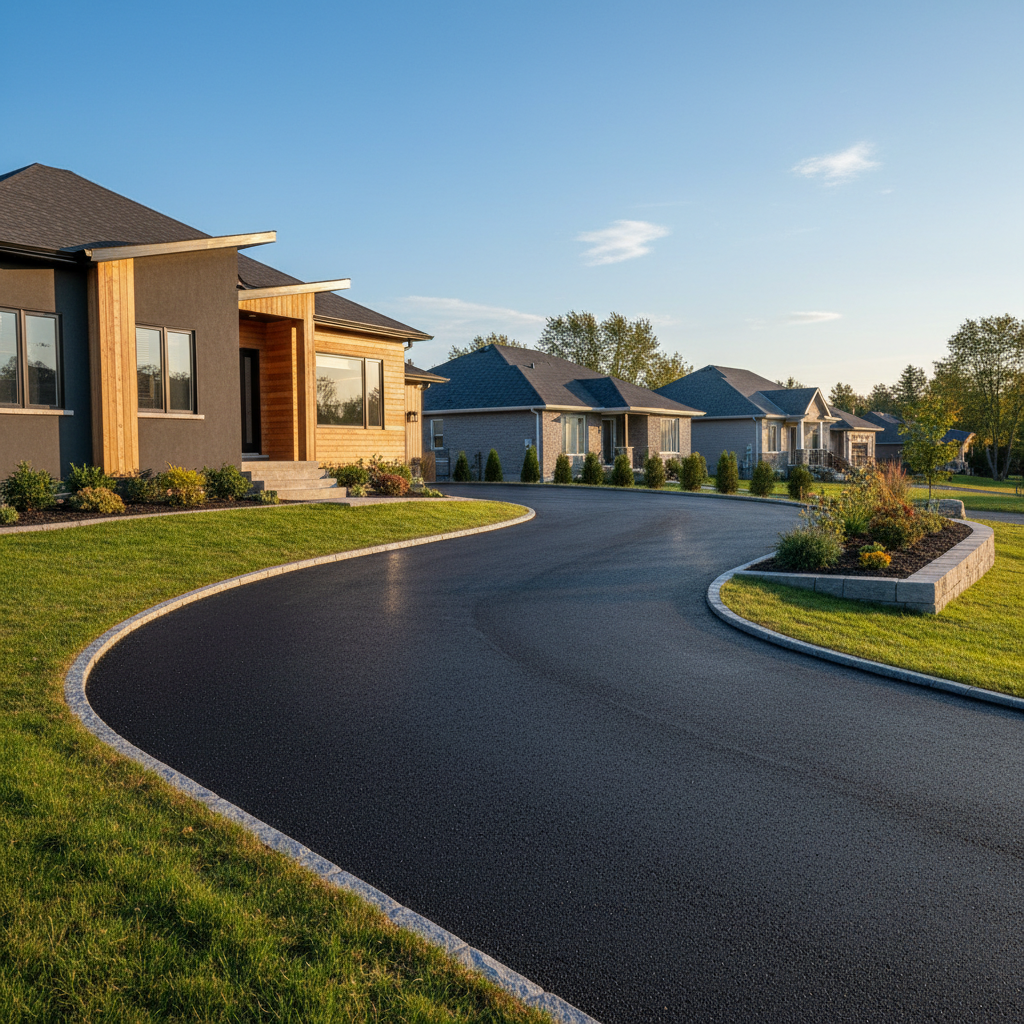
Driveway paving options and costs in Armstrong
Armstrong is a great place to raise a family, and with 83.5% of local households owning their homes (Statistics Canada, 2021 Census), most driveways get built, improved, or resurfaced as part of long-term property care. Armstrong’s housing stock is also heavily single-detached—about 69.3% of dwellings are single-detached—so you’re typically paving an attached private driveway where vehicle weight, access, and drainage matter from day one.
In the Thompson–Okanagan, pricing moves more than you might expect because driveway construction has to be engineered for repeated freeze–thaw cycles and local frost conditions. Even though the BC Building Code frost line for structures is commonly referenced around 18 inches in much of the interior, the paved surface and slab sections see higher moisture exposure and traffic loading. That means contractors generally build a thicker, well-compacted granular base than a “minimum” section to reduce heaving, rutting, and cracking. The shorter paving season in the interior also tightens scheduling; crews protect air temps and weather windows because hot-mix asphalt typically needs favourable conditions (often above 10°C) to place and compact properly.
In Armstrong, demand is especially steady around the residential core and near the downtown approach—anywhere traffic access is frequent and drainage issues show up quickly on older lots. If your existing base is failing, the cost difference between “resurface” and “rebuild” can be significant, so it helps to compare options side-by-side using current local price bands. Below is a practical snapshot of typical costs to plan your project.
| Material |
Lifespan |
Maintenance |
Best For |
Price per sq ft |
Price Range |
| Asphalt (new installation, proper base) |
15–20 years |
Sealcoat every 3–5 years; patch minor cracks |
Smooth, lowest upfront option with good durability |
$5.50–$10.50 |
$4,500–$9,000 |
| Asphalt (overlay on existing gravel base) |
10–15 years |
Sealcoat every 3–5 years; monitor settlement |
When base is stable and excavation can be limited |
$4.75–$9.00 |
$4,250–$8,500 |
| Interlocking concrete pavers |
25–35 years |
Weed control, occasional re-leveling of sections |
Curb appeal and “repairable” driveway sections |
$10.00–$18.50 |
$6,500–$14,000 |
| Poured concrete (broom finish) |
20–30 years (with proper base/air-entrainment) |
Crack sealing as needed; avoid de-icing overuse |
Clean look and solid, long-term flatwork |
$10.50–$20.00 |
$7,000–$15,000 |
| Exposed aggregate concrete |
25–30 years |
Seal as specified; routine crack monitoring |
Slip resistance and premium appearance |
$12.00–$23.00 |
$8,000–$16,500 |
| Gravel / crushed stone (budget option) |
3–7 years (depends on grading and drainage) |
Regrade/refresh annually; add fines and top up |
Temporary solution or low-budget access |
$2.50–$4.50 |
$2,500–$5,500 |
Prices are estimates only and vary by project scope, site access and material selection.
What affects the price of paving in Armstrong
In Armstrong and across the Thompson–Okanagan, you’ll sometimes see the “same” driveway quoted with a 30–50% difference. That’s usually not because one contractor is overpriced—it’s because the real work scope changes: base depth, drainage corrections, tear-out size, and the quality of mix/specification that’s appropriate for Armstrong’s freeze–thaw pattern. In the larger BC interior market, mobilization and weather risk also matter more than on the coast, since crews must schedule around temperature and precipitation windows.
Two technical items tend to decide cost: frost conditions and moisture management. Where deeper frost or higher moisture exposure drives a thicker compacted granular base, labour and materials increase. Thompson–Okanagan driveways often require substantially more engineered granular thickness than coastal BC surfaces to control heaving and cracking. If your site has clayey soils, poor drainage, or a slope, you may need deeper excavation and upgraded base materials—this is one reason a rebuild can land nearer the upper end of the asphalt band (for example, closer to $4,500–$9,000) or push you into concrete/ paver territory.
Concrete examples in Armstrong: if the sub-grade is soft or pumping, a concrete option may require added base and potentially geotextile to prevent fines migration (which raises cost but protects the slab). Conversely, if your existing base is already well-compacted and drainage is sound, poured concrete can price closer to the lower end of its band (often around $7,000–$15,000) because the pour is straightforward. The age of many Armstrong homes is part of the story too—around 42.7% of dwellings were built before 1981 (Statistics Canada, 2021 Census), and older sites commonly have outdated drainage patterns that must be corrected before any hard surface goes down.
| Price Factor |
Why It Matters |
Cost Impact |
| Driveway area in sq ft |
The larger the footprint, the more excavation, base, and surface you need |
Highest cost driver (often the biggest line item) |
| Base depth required |
Freeze–thaw needs enough compacted granular thickness to prevent heaving |
Can add material and labour; commonly a major swing factor |
| Grading and drainage work |
Correct slope and water control reduce deterioration and rework |
Extra excavation, forming, and drain adjustments |
| Tear-out of existing surface |
Old asphalt/concrete must be broken, hauled, and disposed properly |
Adds trucking, disposal fees, and machine time |
| Edge restraints and curbing |
Prevents paver spread and asphalt raveling at borders |
Higher for pavers; ensures long-term shape |
| Sealing requirement |
Asphalt needs sealcoat after installation to protect against water intrusion |
Ongoing cost but significantly reduces premature wear |
| Site access |
Narrow drives and obstacles slow equipment and increase handling |
May require smaller equipment and more labour hours |
| Asphalt mix specifications |
Freeze–thaw-rated asphalt mix can cost more but holds up better |
Moderate increase with better long-term performance |
Permits & regulations in British Columbia
For a private driveway in British Columbia, paving within your own property typically does not require a building permit. Where you usually do need approvals is when work touches municipal infrastructure or alters how water flows in the roadway or boulevard area. That includes creating or changing curb cuts, modifying the boulevard, and any work that affects storm drainage patterns. If your driveway apron connects to a municipal sidewalk/road edge, the municipality may require permission and inspections—so it’s important to confirm this before excavation starts.
Here’s a practical step-by-step approach for homeowners in Armstrong. First, call for utility locates before any digging (in BC, that’s commonly arranged through BC 1 Call). Next, ask the contractor to clearly define what portion of the work is on your property versus the municipal right-of-way (apron, drainage ties, boulevard adjustments). Then verify whether lot-grading bylaws apply—some municipalities restrict how close a hard surface can be to property lines and may require drainage to remain consistent with approved grading.
Finally, verify contractor credentials in BC. Check licensing using the appropriate online registry for contractors in your area, then request proof of liability insurance (certificate of insurance with limits shown) and confirm coverage status for workplace claims (WSIB/WCB coverage where applicable). A clearance letter or current proof document should be provided before work begins. If they can’t show paperwork up front, that’s a red flag.
Asphalt vs pavers vs concrete for Armstrong driveways
When you’re choosing among asphalt, interlocking pavers, and concrete in Armstrong, your decision should start with how each material handles Thompson–Okanagan freeze–thaw and winter maintenance. Asphalt typically offers the lowest upfront cost and a smooth ride, but it performs best when installed on a well-built granular base and then sealed regularly—usually every 3–5 years. In Armstrong’s interior conditions, water intrusion is a key enemy; sealing helps slow moisture penetration that can accelerate cracking. Interlocking concrete pavers usually cost more at the start, but they are repairable: if a section settles, you can lift and re-bed just that area instead of replacing the entire surface.
Poured concrete sits in the mid-range for cost and can be very durable when air-entrained mix design and proper sub-grade preparation are used. Still, concrete is more sensitive to cracking if base preparation is poor or if drainage is wrong—freeze–thaw plus trapped moisture can widen joints and create visible cracks. Exposed aggregate adds texture and slip resistance, but it still depends on base quality.
With Armstrong’s older housing stock and interior drainage realities, base design is where most differences become justified. A well-prepared base with correct compaction and drainage can make asphalt last toward the top of its typical lifespan; skimp on base depth and you’ll see early failures. For a realistic dollar comparison: if asphalt is quoted closer to $4,500–$9,000 but the same contractor recommends a full rebuild plus upgrade materials pushing you toward the higher end, that is often where pavers become competitive—pavers at $6,500–$14,000 can make sense if you want long-term curb appeal and easier spot repairs.
| Material |
Frost Resistance |
Curb Appeal |
Repair Method |
Lifespan |
Price Band |
| Asphalt (sealed regularly) |
Good with proper base and sealing; moisture control is critical |
Medium (clean, dark finish) |
Patch/re-melt small areas; re-seal periodically |
15–20 years |
$4,500–$9,000 |
| Interlocking concrete pavers |
Very good when edged and installed on compacted base |
High (variety of colours/patterns) |
Remove and re-bed individual units/sections |
25–35 years |
$6,500–$14,000 |
| Poured concrete (air-entrained) |
Good with air-entrainment and correct drainage |
Medium to high (broom finish or upgrades) |
Crack repair/seal; localized patching as needed |
20–30 years |
$7,000–$15,000 |
| Exposed aggregate concrete |
Good; texture helps reduce slipperiness |
High (premium look) |
Patch is visible; often maintained with seal/coatings |
25–30 years |
$8,000–$16,500 |
| Permeable pavers (drainage grid) |
Very good if the underdrain system is designed correctly |
High (modern look, engineered drainage) |
Lift/re-bed grid sections; serviceable underlayer (design dependent) |
20–30 years |
$10,000–$18,000 |
| Chip seal / tar-and-chip |
Moderate; depends heavily on base and traffic management |
Low to medium (utility-focused) |
Spot patch and re-surface as needed |
7–12 years |
$3,500–$7,500 |
How to choose a paving contractor in Armstrong
Choosing a paving contractor in Armstrong comes down to verification and clarity. In British Columbia, first confirm licensing using the correct provincial registry for contractors and trade status. Then request a certificate of liability insurance showing active coverage and limits appropriate for paving work. For workplace claims coverage (WSIB/WCB coverage where applicable), ask for proof—some contractors can provide a clearance letter or current account status. If a contractor hesitates to provide documents, it’s safer to move on.
Next, get 2–3 itemised written quotes, ideally with a breakdown for excavation, base material and compaction, granular base depth, disposal, asphalt/paver/concrete supply, and finishing (including sealing if asphalt is being installed). Avoid “lump sum only” quotes where you can’t tell if drainage upgrades or tear-out are included. Pay attention to exclusions: is hauling/disposal included? Are utility locates included or required by you? Is a permit/municipal approval pull included where required?
Warranty matters for workmanship: ask how long the contractor covers settling, base-related failures, or installation defects. Clarify whether product/manufacturer warranty is separate from workmanship and whether it’s transferable to future owners (helpful given Armstrong’s long-term ownership patterns). For payment, never pay more than 10–15% upfront, and hold back a portion until the job is complete and cleaned up. Finally, request an actual start date and a completion estimate in writing, recognizing the interior weather window for proper asphalt placement and curing.
- Confirm BC licensing status and request the contractor’s registration details.
- Ask for a certificate of liability insurance (current date and coverage limits visible).
- Provide proof of WSIB/WCB coverage (or clearance letter/account status).
- Get 2–3 quotes with itemized labour/materials—not just a total price.
- Require the quote to specify base depth, material type, and compaction approach.
- Ask how drainage and grading will be corrected (show proposed slope).
- Check whether tear-out and disposal are included (not “assumed”).
- For asphalt, confirm sealing timing and whether initial sealing is included or an allowance.
- Verify edge restraints/curbing details for pavers to prevent spreading.
- Confirm asphalt mix specification meets local freeze–thaw expectations.
- Review the warranty terms for workmanship and what “excluded” means.
- Use a written payment schedule with a small holdback until completion.
In Armstrong, red flags include: quoting only a “per square foot” number without base depth, refusing to show insurance/licensing documents, vague drainage/grading plans, starting without verified utility locates, and asking for large deposits (beyond about 10–15%) before any materials arrive.
Frequently asked questions — paving in Armstrong
How do I compare paving quotes fairly?
To compare paving quotes fairly in Armstrong, make sure the scopes match: same driveway area (sq ft), same removal/tear-out (if any), and the same granular base depth and drainage corrections. In Thompson–Okanagan projects, the biggest quote swings typically come from frost-protection build-up—if one estimate proposes a thinner base, it may look cheaper now but fail sooner under freeze–thaw. Also compare how asphalt will be sealed: a driveway that lands in the $4,500–$9,000 range should still be sealed on schedule, and sealing allowances can change the total. Finally, ask for an itemized breakdown of disposal/trucking, compaction, and edge restraints. If one contractor provides only a lump sum without those details, it’s hard to know what you’re really buying.
Can asphalt be laid in cold weather in Armstrong?
Asphalt placement in Armstrong must account for air temperature, surface conditions, and curing time. Hot-mix asphalt typically needs favourable conditions—often around 10°C or higher—so the mix can be placed and compacted properly. If it’s too cold or damp, you risk poor compaction and reduced durability, which can accelerate raveling and cracking once Armstrong’s freeze–thaw cycles begin. The crew will also watch for frost or ice on the surface and may schedule around weather windows to keep the work on track. If your driveway needs paving outside the ideal temperature range, you may still be able to do certain prep steps (like excavation and base work), but the asphalt surface itself should only go down when conditions support proper compaction and curing. Ask your contractor for their weather threshold and curing plan.
What is a driveway apron and do I need one in Armstrong?
A driveway apron is the transition area where your driveway meets the road or sidewalk edge. In Armstrong, whether you need an apron depends on how your driveway currently ties into municipal curb/road features and whether storm drainage is affected. If you’re changing the curb cut, altering the boulevard, or modifying drainage routing near the road edge, municipal approval and an apron design are commonly involved. If the apron is on municipal right-of-way, approvals are more likely required. On private-property-only paving, an apron may be less relevant—however, drainage and slope still matter so water doesn’t run under the base. A good contractor will identify the tie-in area during the site walk and tell you what portion is on your property versus the right-of-way, so there are no surprises when excavation starts.
How do I maintain my driveway through Armstrong winters?
Winter maintenance in Armstrong is mainly about keeping water out and avoiding damage from de-icing and plowing. For asphalt, keep sealing maintenance on schedule—after install, sealcoat is typically done once the surface has cured (often within a year), then re-seal every 3–5 years depending on wear. When shovelling or plowing, avoid aggressive metal scraping that lifts edges or damages the surface. Use de-icing thoughtfully; overuse of aggressive salts can worsen deterioration, especially on concrete. For pavers, avoid dragging heavy equipment across joints and keep the edge restraints intact so stones don’t migrate. The most important habit is to watch drainage: if water ponds at any point, you’ll want it corrected early because freeze–thaw will magnify the problem. If your home is older (many Armstrong homes predate modern drainage practices), pay extra attention to low spots.
Is it worth sealing a new driveway right away in Armstrong?
In Armstrong, sealing is usually worth planning, but “right away” has a timing caveat. Asphalt needs time to cure so the sealcoat bonds properly; sealing too soon can trap moisture and reduce performance. Your contractor will typically recommend a window based on temperature and the asphalt’s cure stage—often within the first year after paving. The benefit is protecting against water intrusion, which matters in Thompson–Okanagan freeze–thaw cycles. If you’re budgeting, sealing and repair commonly falls into the $500–$4,000 range depending on driveway size and what needs fixing. The lowest-cost path is usually: proper base and paving first, then seal on the recommended schedule, followed by re-sealing every 3–5 years so cracks don’t expand prematurely.
What is a chip seal driveway and is it suited to Armstrong?
Chip seal (tar-and-chip) is a surface treatment where asphalt binder is sprayed and aggregate is broadcast, then rolled. In Armstrong, it can be a good option where you want a more budget-friendly, low-look-cost approach, but it’s not always the best for a driveway that sees frequent turning or heavy traffic loads. Freeze–thaw performance depends on base preparation and drainage; if the granular base and slope are correct, chip seal can hold up reasonably well. If the base is unstable or water ponds, chip seal can fail faster due to aggregate loss or uneven wear. Costs often start lower than full asphalt paving—commonly in the lower band (for reference, still below the typical asphalt driveway range)—but you should plan for periodic maintenance. If curb appearance and long-term durability are top priorities, asphalt resurfacing, pavers, or properly built concrete may be the better match for Armstrong winters.