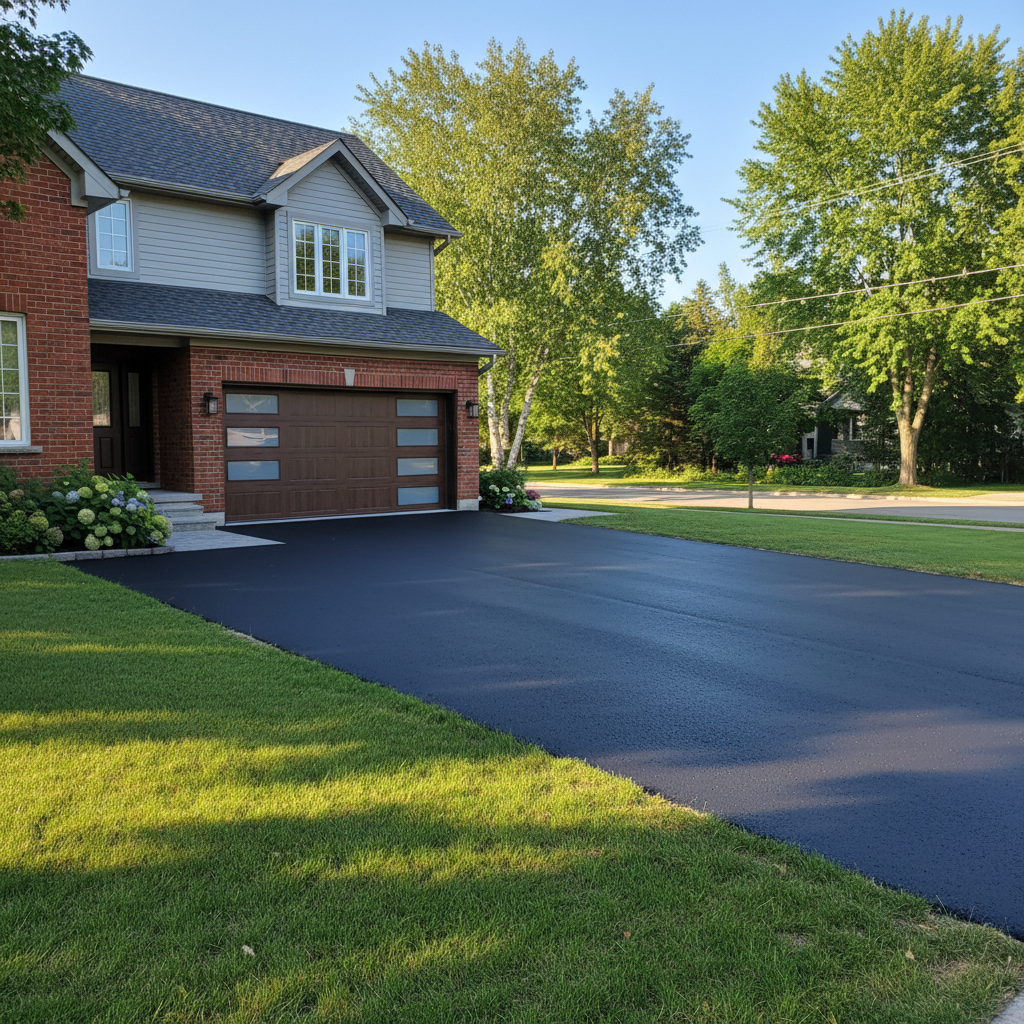
Driveway paving options and costs in Lantzville
Lantzville homeowners have a lot of driveway choices, but the right one usually comes down to how your site handles water and how your home is built for the coast. With 94.1% of dwellings being single-detached houses (Statistics Canada, 2021 Census), most private driveways here are tied to detached properties—meaning customers typically want safe winter traction, clean curb lines, and a surface that won’t fail early due to moisture trapped under the pavement. Roughly 51.0% of homes were built before 1981 (Statistics Canada, 2021 Census), too, which matters because older lots often have mature drainage patterns and legacy fill that can require extra excavation and base rebuilding.
On Vancouver Island and the Coast, we work in a mild coastal climate, but frost and drainage still control long-term performance. Even with a relatively shallow frost line, localized freeze-thaw around Nanaimo area corridors and up-island weather swings can still heave weak sections—especially at driveway edges, where runoff meets the street transition. Scheduling can also tighten in shoulder seasons, because air temperatures need to support proper asphalt placement, and wet ground slows excavation and compaction. Labour and trucking costs on the Island are also a real factor, so “same square footage” quotes can differ noticeably when access is tight or when the contractor has to dig out poor subgrade.
In the table below, compare realistic material options and typical price bands, then we can match the option to your base conditions and finish preference in Lantzville.
| Material |
Lifespan |
Maintenance |
Best For |
Price per sq ft |
Price Range |
| Asphalt (new installation, proper base) |
12–20 years |
Seal once 6–12 months after paving, then every 3–5 years |
Lowest upfront cost with a clean, continuous finish |
$10–$16 |
$6,500–$14,500 |
| Asphalt (overlay on existing gravel base) |
10–16 years |
Seal within the first 6–12 months; patching as needed |
When excavation is limited and your base is already stable |
$12–$18 |
$7,500–$15,800 |
| Interlocking concrete pavers |
25–35 years |
Re-screed joints as needed; occasional lifting/replacing for repairs |
Maximum curb appeal and easy spot repairs |
$25–$45 |
$12,500–$28,500 |
| Poured concrete (broom finish) |
20–30 years |
Occasional crack monitoring; sealing optional (often every 5–7 years) |
Modern look with straightforward maintenance |
$18–$32 |
$11,000–$24,500 |
| Exposed aggregate concrete |
20–30 years |
Sealing recommended; crack monitoring |
High traction finish and premium appearance |
$22–$35 |
$13,500–$27,000 |
| Gravel / crushed stone (budget option) |
3–10 years (varies widely) |
Re-grade and top up; weed control; periodic replenishment |
Short-term budget solution or steep slopes where paving waits |
$6–$12 |
$3,500–$9,500 |
Prices are estimates only and vary by project scope, site access and material selection.
What affects the price of paving in Lantzville
In Lantzville, the same driveway size can land at very different totals because Vancouver Island and the Coast pricing is driven by site conditions, frost-protection strategy, and how tight the construction window becomes. It’s not unusual to see quotes vary by 30–50% when one contractor assumes “like-for-like” overlay while another recognizes that the subgrade is soft, drainage is incorrect, or the base must be rebuilt to handle freeze-thaw. Island material and trucking costs also add pressure, and labour availability can tighten when weather turns favourable, especially after wet stretches around Nanaimo-area communities.
Frost line depth and freeze-thaw cycles are decisive cost factors here. In coastal BC, the frost line is relatively shallow compared with Ontario/Alberta, so we typically aim for a 4–6 inch compacted granular base for many driveway situations. In colder zones with deeper frost, projects often require 6–12 inches of granular thickness to prevent heaving and cracking—on the Island we still engineer for freezing and repeated thaw around the edges, transitions, and low spots. Where freeze-thaw is expected, asphalt mix design matters: a freeze-thaw-rated asphalt or appropriate binder and gradation generally costs more, but it’s one of the few ways to avoid premature raveling.
Two concrete examples that commonly change costs in Lantzville: (1) if your driveway ties into an existing slope that sheds water toward the garage instead of away, we’ll often need grading and a drainage correction before we pave; that adds excavation and disposal. (2) older properties built before 1981 (Statistics Canada, 2021 Census) sometimes have thicker organics or fill—digging back to stable material can turn a straightforward asphalt job into full-depth base rebuild work. When that happens, you’ll often move from a more budget-friendly paving range like $6,500–$14,500 toward the upper end, while paver projects typically remain in a higher band because restraint, setting bed, and detail labour can’t be skipped.
| Price Factor |
Why It Matters |
Cost Impact |
| Driveway area in sq ft |
Most materials and production are priced by square footage. |
Often the largest driver (bigger drives swing totals most). |
| Base depth required |
Frost protection depends on engineered thickness and compaction. |
Can add significant excavation, hauling and compaction time. |
| Grading and drainage work |
Water must shed away; low spots cause early failure. |
Raises costs when regrading, culverts, or subdrains are needed. |
| Tear-out of existing surface |
Old asphalt or concrete must be broken and disposed properly. |
Demolition and hauling can be a major add-on. |
| Edge restraints and curbing |
Prevents paver movement and asphalt edge breakdown. |
Material + labour adds, but it protects the investment. |
| Sealing requirement |
Asphalt needs sealing after placement to reduce moisture damage. |
Small additional cost up front; large payoff in longevity. |
| Site access |
Narrow lots slow trucks and limit equipment. |
Increases labour time and sometimes changes equipment size. |
| Asphalt mix specifications |
Freeze-thaw-rated performance mixes cost more. |
Higher materials cost, often worth it in coastal climates. |
Permits & regulations in British Columbia
In British Columbia, paving a private driveway within your own property usually does not require a building permit. Most homeowners can move forward with asphalt, pavers, or concrete work when it stays entirely within the property limits and does not alter municipal infrastructure. However, work that touches the municipal right-of-way does require approvals in many cases—especially if you’re adding or changing a curb cut, modifying the boulevard area, or altering storm drainage patterns near the roadway.
Also pay attention to lot-grading rules. Some municipalities in BC restrict how close hard surfaces can be placed to property lines and how grading must be handled so water doesn’t cross onto neighbouring lots or into protected drainage systems. The key is to treat drainage as a regulated design issue, not just a cosmetic one.
Before excavation, always call for utility locates using BC 1 Call. Next, verify the specific contractor scope in writing: ask whether they’re responsible for any required municipal approvals (if your project involves the right-of-way), and confirm how runoff will be managed during and after the job.
To verify your contractor’s compliance in BC, do three things step-by-step: (1) confirm licence/registration for the paving or general contracting work through the proper BC online registry; (2) request a certificate of insurance showing general liability with adequate limits and the contractor named correctly; and (3) verify coverage through WSBC/WCB for workers—ask for a clearance letter or proof of account status so you’re not exposed if something goes wrong on site.
Asphalt vs pavers vs concrete for Lantzville driveways
For Lantzville driveways, asphalt, interlocking pavers, and concrete all work—but they don’t “fail” the same way in our Vancouver Island and Coast freeze-thaw reality. Asphalt is usually the lowest upfront cost and gives a smooth, quiet ride. The trade-off is that asphalt needs sealing—typically every 3–5 years after an initial seal—to protect against moisture intrusion that accelerates damage in wet coastal conditions. Interlocking concrete pavers cost more up front, but they’re the most forgiving for repairs: individual stones can be lifted, the base corrected, and the area put back without replacing the entire surface. Poured concrete sits in a mid-range position; it can last a long time when properly air-entrained and cured, but freeze-thaw movement and de-icing impacts (especially where plows leave sand/salt residue) can trigger cracking if the base and drainage aren’t engineered.
Base prep matters across all three. Even though the frost line is relatively shallow on the Coast, we still design the granular base and compaction around water management—particularly at driveway edges and transitions to the street where water collects. Where drainage is corrected and the subgrade is stable, asphalt can hold up well; where homeowners value long-term aesthetics and straightforward spot repairs, pavers usually win. If your household plows or frequently uses sand/ice melt, we lean toward concrete air-entrainment and good jointing detail, while asphalt still needs a disciplined seal cycle.
A practical example: if a 400 sq ft driveway is quoted at asphalt in the $6,500–$14,500 range, switching to pavers in the $12,500–$28,500 range can be justified if you want curb appeal and the ability to fix localized base issues without full replacement. If your budget is tight and the base is sound, asphalt can be the smarter initial investment—then you can plan resurfacing later rather than paying for paver detailing now.
| Material |
Frost Resistance |
Curb Appeal |
Repair Method |
Lifespan |
Price Band |
| Asphalt (sealed regularly) |
Good when base is engineered and drainage is correct |
Medium (clean and continuous) |
Patch and re-seal localized areas |
12–20 years |
$10–$20/sq ft |
| Interlocking concrete pavers |
Excellent for freeze-thaw when set on a stable base |
High (design options) |
Lift/replace affected units; re-screed joints |
25–35 years |
$25–$45/sq ft |
| Poured concrete (air-entrained) |
Good, especially with correct base and air-entrainment |
Medium–high (broom finish or textures) |
Crack repairs and seal; may require patching |
20–30 years |
$18–$35/sq ft |
| Exposed aggregate concrete |
Good when properly cured and sealed |
Very high (premium texture) |
Patch with matching finish (limited spot repairs) |
20–30 years |
$22–$40/sq ft |
| Permeable pavers (drainage grid) |
Very good for water management when detailed correctly |
Medium (functional look) |
Replace sections as needed; inspect underdrain |
20–30 years |
$30–$55/sq ft |
| Chip seal / tar-and-chip |
Moderate (surface wears; base quality is critical) |
Low–medium |
Re-chip or overlay when worn |
6–12 years |
$8–$15/sq ft |
How to choose a paving contractor in Lantzville
Choosing the right paving contractor in Lantzville starts with verifying credentials the homeowner can check. In British Columbia, you should confirm the contractor’s licensing/registration for the type of work, then request proof of general liability insurance (certificate of insurance showing coverage and correct named insured). For workers, verify WSBC/WCB clearance or proof of coverage—ask for documentation you can keep with your contract. This protects you if a worker is injured or if there’s accidental property damage during excavation.
Next, get 2–3 itemised written quotes, not a single lump-sum number. A good quote breaks out labour and materials: excavation, granular base supply and compaction, asphalt or concrete placement, reinforcement or edge restraints, and disposal. It should also spell out what’s excluded (for example, tree roots removal, high volumes of unsuitable subgrade, or additional drainage corrections). Ask whether permits or municipal approvals for any right-of-way work are included—if your scope involves a curb cut or drainage modifications, that should be stated clearly. Asphalt sealing scheduling should also be discussed so you don’t lose warranty by skipping early sealing.
On payment, never pay more than 10–15% upfront. A reasonable holdback is released after completion and cleanup. Insist on a written start date and completion estimate, because Island scheduling can shift with wet conditions.
- Ask for licence/registration details and confirm they match the contractor on your contract.
- Request a current certificate of insurance and review the coverage limits.
- Verify WSBC/WCB clearance or proof of coverage before work begins.
- Get itemised quotes (excavation/base/materials), not just total price.
- Confirm disposal is included for broken concrete/asphalt and spoils.
- Ask what the base spec is (depth, compaction method, and how it’s proven).
- Clarify drainage/grading responsibility and what slope is being built.
- Check edge restraint details (paver edging/curbs/asphalt saw-cut and transition).
- Ask about traffic control and driveway access during the cure/seal period.
- Verify workmanship warranty length and what actions void it.
- Confirm product/manufacturer warranty terms and whether they transfer to you.
- Set payment milestones: small deposit, progress payments, and holdback on completion.
Red flags I see around Lantzville: contractors who won’t provide written itemization, vague base specifications (“we’ll do it properly” without depth/compaction details), no proof of WSBC/WCB coverage, pushing high upfront deposits, and promising timelines without checking seasonal conditions for excavation and asphalt placement.
Frequently asked questions — paving in Lantzville
How do I get the most accurate paving quote in Lantzville?
For the most accurate quote in Lantzville, start by giving the contractor site access and a clear measurement of the driveway area (length × width) plus any irregular edges. Ask for a site visit so they can check base condition, drainage, and the driveway-to-street transition—those details often change costs more than material choice. If you’re repaving, tell them what’s currently there (gravel, asphalt overlay, or old concrete) and whether you see soft spots after rain. In our coastal freeze-thaw conditions, poor drainage can turn an “overlay” into full-depth base rebuild. Also confirm what’s included: excavation and disposal, compaction, and (for asphalt) when sealing will be done, since sealing after placement is part of a proper long-term plan.
How much does it cost to pave a driveway in Lantzville?
Cost depends mainly on square footage, base depth, and access. For asphalt, many Lantzville driveway projects commonly land in the $6,500–$14,500 range, assuming a proper base and normal demolition. If you want interlocking pavers, expect a higher upfront budget—often around $12,500–$28,500—because restraint, setting bed, and finishing details are labour-heavy. Concrete is usually in the middle: poured or exposed aggregate often sits within the broader $11,000–$27,000 type totals, depending on finish and removal. If your current surface is failing badly, tear-out and drainage corrections can push any option upward, especially on older lots built before 1981 (Statistics Canada, 2021 Census).
Asphalt vs interlocking pavers vs concrete — which is best in Lantzville?
There isn’t one “best” material, but each fits a different homeowner priority in British Columbia. If you want the lowest upfront cost and a straightforward look, asphalt is usually the best value when it’s built on the right compacted base and sealed on schedule. For the highest curb appeal and the easiest repairs, interlocking pavers are hard to beat—if a section is affected by freeze-thaw movement later, pavers can be lifted and reset without replacing the full driveway. Poured concrete (air-entrained) is a strong option when you value a hard, uniform surface, but cracking risk increases if drainage is incorrect or the base is under-designed for freeze-thaw. In Lantzville’s climate, drainage and base engineering decide more than brand names.
How long does a paved driveway last in Lantzville?
With proper base preparation and water management, typical service lives in Lantzville look like this: sealed asphalt often lasts 12–20 years; interlocking concrete pavers commonly reach 25–35 years; and air-entrained poured concrete typically lasts 20–30 years. The reason numbers swing is freeze-thaw stress at the edges and at low spots—water expands when it freezes, and weak subgrade gets pushed over time. That’s why we plan base thickness and compaction carefully even though the frost line is relatively shallow on the Coast. Maintenance also matters. Asphalt sealing (often after 6–12 months, then about every 3–5 years) protects against moisture-related deterioration. Pavers need joint attention, while concrete benefits from correct curing and jointing detail.
When is the best time of year to pave in Lantzville?
The best time in Lantzville is usually late spring through summer—when excavation soils are workable and temperatures support asphalt placement. Asphalt generally needs warm conditions for placement and compaction; cold snaps and damp ground can slow production and increase the risk of poor compaction. On Vancouver Island and the Coast, shoulder-season weather can be wetter and cooler, which tightens the paving window and may shift start dates. For concrete, warmer, stable conditions help curing and reduce variability. If you’re planning pavers, installation still depends on site conditions, but the schedule is often more flexible than asphalt because you’re not relying on asphalt temperature targets. Regardless of season, good drainage rough-in before the finish layer is critical.
How deep should the base be for Lantzville's frost?
In coastal BC like Lantzville, the frost line is relatively shallow compared with interior and prairie provinces, so we often target a 4–6 inch compacted granular base for many driveways—provided the subgrade is stable and drainage is corrected. If soils are weak, if there’s significant water infiltration, or if there’s concern about repeat freeze-thaw at the driveway edges and transitions, we may need additional excavation and a thicker, engineered base build-up. The exact depth depends on what’s under your driveway today, not just the climate. A contractor should measure and base their recommendation on site conditions—especially on older properties where fill and organics may be present (Statistics Canada, 2021 Census). If someone quotes a fixed base depth without checking your site, ask questions before you sign.