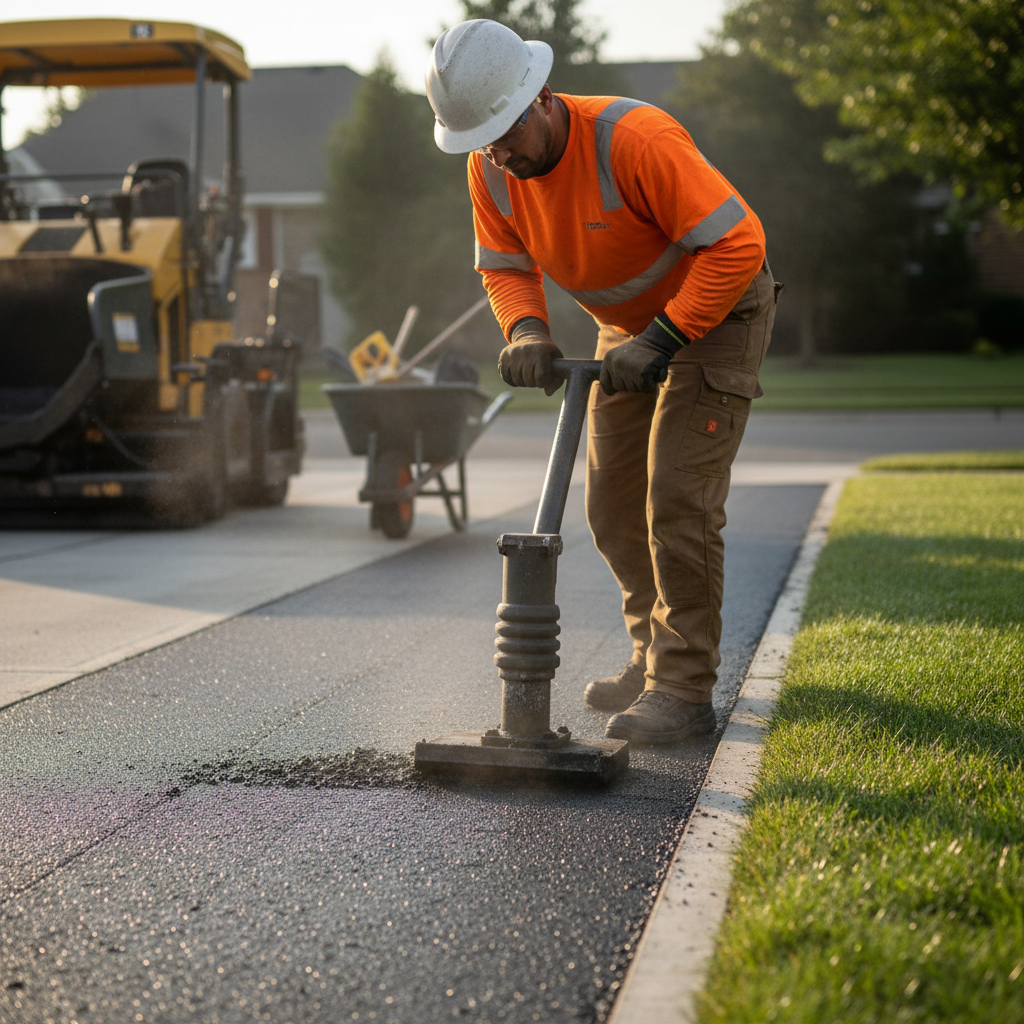
Driveway paving options and costs in Dawson Creek
Dawson Creek driveways are mostly built to serve homeowners in older single-detached neighbourhoods, and in 2021 the Northeast community had 3,145 homeowner households with 58.2% of households owning their homes (Statistics Canada, 2021 Census). With 61.1% of dwellings being single-detached houses, most projects we price are attached driveways that must handle heavy winter wear from ploughing, studded tires, and freeze–thaw stress. That matters because Dawson Creek sits in a part of British Columbia where frost penetration and freeze–thaw cycling can be severe, so contractors plan for thicker granular base, better subgrade preparation, and positive drainage rather than “thin pavement over fill.”
Because the effective paving season is shorter, crews need to schedule around warm, dry windows when hot-mix asphalt can be placed properly and concrete can cure without cold setbacks. Freight for aggregate and asphalt mix to Northeast communities, along with limited plant/crew availability compared with the Lower Mainland, is another reason per-square-foot pricing can come in higher here. If you’re in the South Dawson Creek area or near the downtown corridor where access is tighter, mobilization and equipment time can also add cost.
Below are the most common options homeowners compare in Dawson Creek, along with realistic lifespan and maintenance expectations—then you can use the scope notes to sanity-check whether your quote is appropriately priced before you decide.
| Material |
Lifespan |
Maintenance |
Best For |
Price per sq ft |
| Asphalt (new installation, proper base) |
15–25 years |
Seal every 3–5 years; patch small failures as needed |
Cost-effective, smooth surface for ploughing |
$7.50 – $13.50 |
| Asphalt (overlay on existing gravel base) |
10–18 years |
Seal within 6–12 months; monitor edge raveling |
When you want paving sooner and can meet base prep |
$6.00 – $11.00 |
| Interlocking concrete pavers |
25–35 years |
Replace individual stones; joint sand top-up as needed |
Curb appeal and easy repairs without full replacement |
$13.00 – $24.00 |
| Poured concrete (broom finish) |
20–30 years |
Caulking/spot repairs; consider coating if desired |
Low-maintenance, long-lasting flat surface |
$15.00 – $28.00 |
| Exposed aggregate concrete |
20–30 years |
Sealer as recommended; clean and repair spalls early |
Better traction and a decorative finish |
$18.00 – $32.00 |
| Gravel / crushed stone (budget option) |
2–8 years (varies a lot with drainage) |
Re-grade and add stone every few years |
Short-term solution or rural/temporary access |
$3.00 – $7.00 |
Prices are estimates only and vary by project scope, site access and material selection.
What affects the price of paving in Dawson Creek
In Dawson Creek and the wider Northeast economic region, it’s common to see quotes for the “same” driveway come in 30–50% apart once you account for base build-up, drainage corrections, tear-out, and how the contractor prices weather risk. A Lower Mainland-style quote often looks cheaper on paper, but the Northeast requires heavier-duty sections because deep frost lines and freeze–thaw cycles can punish any weakness in the subgrade. When frost heaves under thin aggregate or poor drainage, you get pumping, edge cracking, and potholes that force expensive future repairs.
For design, frost can demand a thicker compacted granular base—often in the 6–12 inch range for many cold-climate driveway builds—whereas coastal areas may manage with less due to milder temperatures. In practical terms, that means more excavation, more hauled aggregate, more compaction time, and sometimes geotextile and insulation for problem soils. The paving season is also shorter here: hot-mix asphalt should be placed when air temperatures are generally above 10°C, so scheduling is tighter. Contractors price that tighter window into mobilization and crew staging, and cold-weather ground thawing (when required) can add cost.
Concrete examples that change your budget quickly: a driveway over saturated soils may require undercut and replacement before any pour, which pushes concrete toward the $9,000 – $18,000 band for typical driveways. Meanwhile, a well-prepared asphalt base can land closer to the $4,500 – $8,500 range, but if your quote assumes “overlay” without proper granular rehab, the later cracking risk increases.
| Price Factor |
Why It Matters |
Cost Impact |
| Driveway area in sq ft |
Most material and labour scale directly with area |
High (often the biggest driver) |
| Base depth required |
Frost line determines how much granular thickness is needed |
Medium–High (more excavation + aggregate) |
| Grading and drainage work |
Correct slope and positive drainage reduce pumping and heaving |
Medium (can become high on saturated sites) |
| Tear-out of existing surface |
Breaking and hauling concrete or old asphalt adds labour/equipment |
Medium–High depending on material thickness |
| Edge restraints and curbing |
Pavers need edge restraint; asphalt needs containment to resist raveling |
Low–Medium (but essential for longevity) |
| Sealing requirement |
Asphalt requires seal coat after initial curing to protect binder |
Low upfront, adds a planned follow-up cost |
| Site access |
Narrow lots slow equipment movement and can extend setup time |
Low–Medium (higher where equipment can’t stage) |
| Asphalt mix specifications |
Freeze–thaw-rated mix design costs more and performs better locally |
Low–Medium (improves performance in northern winters) |
Permits & regulations in British Columbia
In British Columbia, paving a private driveway within your own property generally does not require a building permit when you’re staying within existing lot lines and not altering municipal infrastructure. Typically, replacing the surface (asphalt, pavers, or concrete) on your own driveway area, or doing excavation strictly within your property footprint, is “usual homeowner work” that proceeds without a permit.
Where permits/approvals do come up is when you work in the municipal right-of-way or change how water flows to municipal systems. Examples include new or modified curb cuts, changes to boulevard/roadway edges, or any alteration to storm drainage that affects municipal infrastructure. Some municipalities also regulate lot grading, and they may restrict how close hard surfaces can be to property lines or how drainage is directed.
Step-by-step for Dawson Creek homeowners: first, request utility locates before any excavation (BC 1 Call). Next, ask the contractor to confirm whether your scope touches the boulevard/ditch line or changes drainage routing. Then verify the company’s British Columbia licensing and insurance:
- Confirm licensing status using the relevant provincial registry for contractors (ask for their licence number and evidence).
- Ask for a Certificate of Insurance naming you as applicable and showing current general liability.
- Confirm worker coverage through WSIB/WCB (ask for clearance documents or the equivalent proof they carry).
- Request warranty terms in writing and ensure product/manufacturer documentation is included.
Asphalt vs pavers vs concrete for Dawson Creek driveways
For Dawson Creek’s freeze–thaw climate, all three driveway materials can work well, but they behave differently once winter testing begins. Asphalt is usually the lowest upfront option and can give a smooth, plough-friendly surface; its trade-off is that it needs sealing regularly (commonly every 3–5 years) to protect the binder and reduce moisture damage. Interlocking concrete pavers cost more up front, but they shine when you need localized repairs: stones can be lifted and reset without tearing out the entire driveway. Poured concrete typically lands mid-range cost, but it’s more sensitive to cracking if the base and air-entrainment aren’t handled correctly—freeze–thaw cycles demand proper mix design, and de-icing habits matter.
Northeast frost design also affects base preparation depth and drainage. If your site has weak or saturated subgrade, the best material can still fail early. Dawson Creek driveway builds typically benefit from correct subgrade compaction, a thicker granular base, and a drainage plan that sheds water rather than letting it sit beneath the slab or asphalt. For winter maintenance, the reality is that plough blades and salt/sand mix can be rough on edges; pavers with correct restraint systems often tolerate edge wear better, while asphalt needs more attention to sealing to resist moisture infiltration.
Where the price difference makes sense: if an asphalt driveway is quoted in the $4,500 – $8,500 range but pavers come in around the $8,000 – $16,000 band, the extra cost is usually justified if you want the easiest repair path and highest curb appeal in a neighbourhood where driveways are highly visible year-round (including during thaw and spring breakup).
| Material |
Frost Resistance |
Curb Appeal |
Repair Method |
Lifespan |
Price Band |
| Asphalt (sealed regularly) |
Good with thick base + drainage |
Medium (clean, uniform look) |
Patch potholes/seams; seal and spot repairs |
15–25 years |
$4,500 – $8,500 |
| Interlocking concrete pavers |
Excellent with correct bedding and restraints |
High (wide colour/style options) |
Lift/replace individual pavers or sections |
25–35 years |
$8,000 – $16,000 |
| Poured concrete (air-entrained) |
Good with air-entrainment and proper base |
Medium–High (broom finish or decorative) |
Crack control via repairs; patching spalls |
20–30 years |
$9,000 – $18,000 |
| Exposed aggregate concrete |
Good with correct curing and base prep |
High (texture and traction) |
Spot patch/spall repair; maintain seal as advised |
20–30 years |
$10,000 – $20,000 |
| Permeable pavers (drainage grid) |
Very good where drainage design is correct |
Medium–High (clean modern look) |
Replace damaged units; maintain infill if needed |
25+ years (site-dependent) |
$10,000 – $18,000 |
| Chip seal / tar-and-chip |
Moderate (surface treatment, not a full rebuild) |
Low–Medium |
Re-chip or overlay; periodic maintenance |
8–15 years |
$3,500 – $7,500 |
How to choose a paving contractor in Dawson Creek
Choosing the right contractor in Dawson Creek starts with proof, not promises. In British Columbia, verify that the paving company is properly licensed for the work they’re doing, and that their liability insurance is current for your project. Then confirm worker coverage (WSIB/WCB). Practical checks: ask for their licence details up front; request a Certificate of Insurance (and check the dates and coverage amounts); and ask for clearance documents showing worker coverage is in good standing.
Next, get 2–3 itemised written quotes that separate labour and materials: excavation, hauling, base material/compaction, geotextile (if included), asphalt/concrete/pavers, disposal, and any curing/sealing. Avoid “lump sum” quotes that don’t show what base thickness you’re getting or whether drainage corrections are included. Carefully read scope exclusions—things like permit handling (if any right-of-way approvals are needed), disposal of removed material, and the type of asphalt mix or concrete air-entrainment requirements.
Warranty should be clear on workmanship and how long it covers settlement cracks, edge failures, or joint issues (for pavers). Ask whether the warranty is transferrable if you sell your home. For payment, don’t pay more than 10–15% upfront; hold back a portion until completion and final cleanup. Finally, insist on a start date and realistic completion estimate in writing—especially in Northeast BC, where weather can shift work plans quickly.
- Provide written proof of BC licensing before work begins.
- Share a current Certificate of Insurance (liability) for your project.
- Confirm WSIB/WCB clearance or equivalent proof of coverage.
- Get 2–3 itemised quotes with base thickness stated in inches.
- Ask what happens if weather delays push the schedule—any cost changes?
- Confirm disposal of old asphalt/concrete is included (or priced separately).
- Verify sealing timing for asphalt (usually after curing; commonly 6–12 months).
- Confirm concrete mix includes air-entrainment if you’re doing poured concrete.
- For pavers, confirm edge restraint and joint sand specs.
- Ask about subgrade testing/inspection and what triggers extra base or undercut.
- Request detailed warranty terms in writing (workmanship vs material).
- Use a payment schedule that includes a holdback until final acceptance.
Red flags we see too often in Dawson Creek: vague scope (“we’ll prep it properly” without base thickness), no written warranty or warranty that’s only marketing, inability to provide insurance/licence/coverage proof, no disclosure of sealing requirement for asphalt, and requests for large upfront deposits with minimal scheduling details.
Frequently asked questions — paving in Dawson Creek
How do I get the most accurate paving quote in Dawson Creek?
To get the most accurate quote in Dawson Creek, start by having the contractor visit the site and measure the driveway area and thickness of the existing surface. Ask them to describe the base build-up they’re proposing (not just the finish). In Northeast BC, frost and freeze–thaw mean base and drainage choices drive cost, so request specifics on excavation depth, compaction method, and whether geotextile/insulation is recommended for your soil. For apples-to-apples comparisons, ask for an itemised breakdown of labour and materials, including disposal. Also confirm whether they include sealing for asphalt (commonly within a planned window after curing) and whether any drainage adjustments are part of the scope.
How much does it cost to pave a driveway in Dawson Creek?
Typical Dawson Creek driveway paving costs depend mostly on square footage, base preparation, and whether there’s tear-out. As a practical homeowner reference, asphalt driveway paving often comes in around $4,500 – $8,500 when the base is built correctly. Interlocking concrete pavers commonly land higher, often around $8,000 – $16,000, because you’re paying for bedding, restraints, and the paver system. Poured concrete is frequently in the $9,000 – $18,000 range depending on finish and thickness. If you’re only repairing or sealing, sealing & repair work typically falls around $400 – $1,800. Your final total should match the quote’s stated base depth and drainage work.
Asphalt vs interlocking pavers vs concrete — which is best in Dawson Creek?
There isn’t one “best” material for every Dawson Creek driveway, because your soil and winter maintenance routine matter as much as the finish. Asphalt is often the best value if you’re okay with regular sealing and you get a thick, well-compacted granular base for frost and drainage. Interlocking concrete pavers are a strong choice when you want high curb appeal and repairs that don’t require ripping out the entire driveway—important if you expect seasonal heave in a challenging section. Poured concrete (air-entrained) can be durable, but it must be built on a properly prepared base to reduce cracking from freeze–thaw cycles. If you want the simplest decision rule: choose asphalt for lowest upfront, pavers for maximum repairability, and concrete when you want a firm, flat surface with careful mix and base specs.
How long does a paved driveway last in Dawson Creek?
With correct base preparation and good drainage, Dawson Creek pavements can last many years, but lifespan depends heavily on how well the system resists moisture movement during freeze–thaw cycles. Asphalt commonly lasts about 15–25 years when sealed and maintained; skipping sealing accelerates binder aging and moisture damage. Interlocking pavers often provide 25–35 years of service because localized repairs are straightforward when a section settles. Poured concrete generally lasts about 20–30 years when air-entrainment and base compaction are done right, and when you address cracks early. If drainage is poor or the base is too thin for the frost depth, even premium materials can fail sooner—so longevity is as much about under-structure as the surface.
When is the best time of year to pave in Dawson Creek?
In Dawson Creek, the best time is typically during the warm, dry window when asphalt plants can deliver hot-mix and contractors can place it when temperatures support proper compaction and curing. Asphalt work generally requires air temperatures around or above 10°C, and placing too late in the season increases the risk of cold joints, poor compaction, and early raveling. Concrete placement also benefits from mild conditions because freezing temperatures during early curing can damage strength development. Because the Northeast paving season is shorter, it’s wise to book ahead and ask the contractor for a weather contingency plan. If your quote is conditional on temperature, get that condition stated clearly in writing.
How deep should the base be for Dawson Creek's frost?
Base depth is project-specific in Dawson Creek, because frost response depends on subgrade condition, groundwater, soil type, and drainage. That said, many northern driveway builds require a thicker compacted granular base (often in the 6–12 inch range for cold-climate driveway performance) compared with milder coastal areas, so the pavement has a stable frost-resistant layer. The contractor should explain what they’re doing to address frost heave risk: how deep they’re excavating, whether they’re replacing saturated soils, and whether you’ll have adequate slope and positive drainage away from the driveway structure. If your site is wet or poorly draining, you should expect deeper base work and possibly additional layers before any asphalt or concrete goes down.