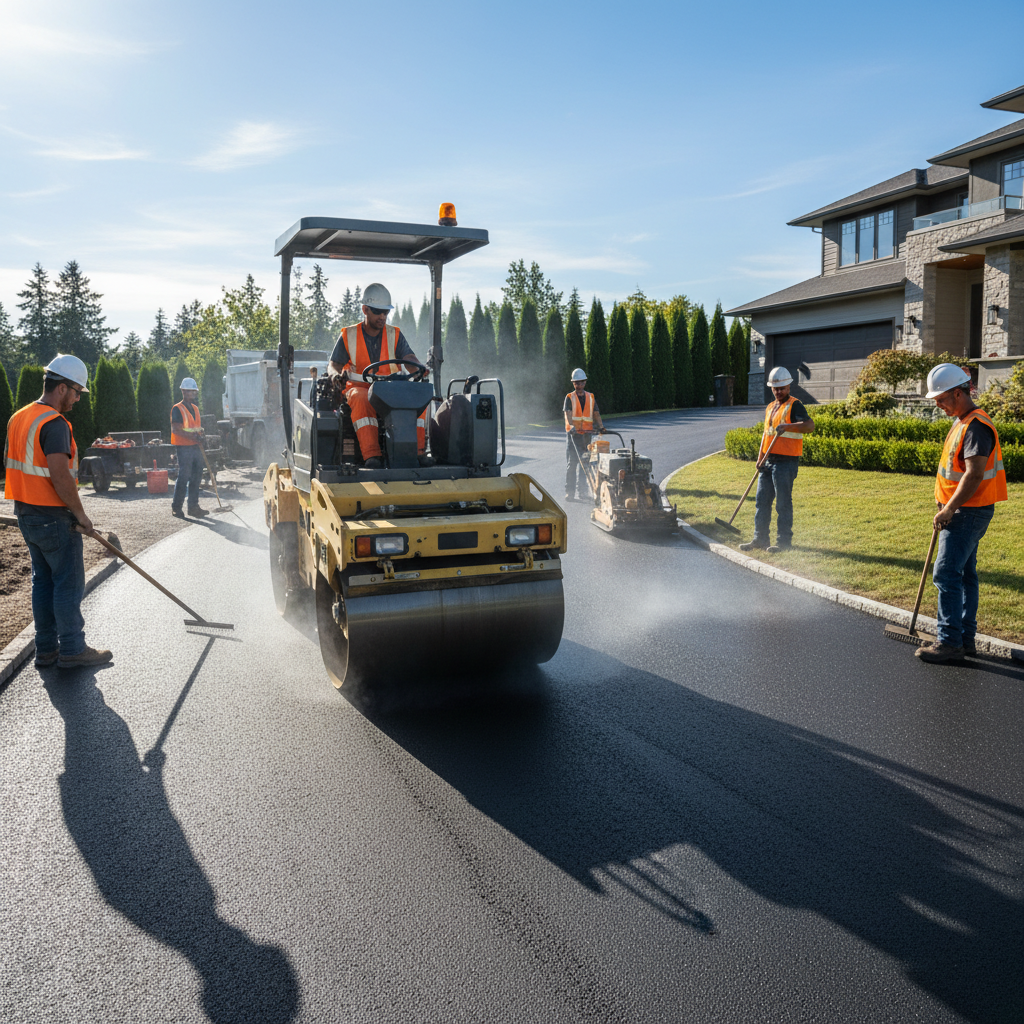
Driveway paving options and costs in Chineside
Chineside homeowners typically start their driveway decision by balancing upfront cost with how the surface will handle Lower Mainland–Southwest weather. With a population of 2,929 in the area (Statistics Canada, 2021 Census), most driveway work is tied to owner-occupied homes, and private driveways are usually associated with single-detached and townhouse neighbourhood streets where vehicle access is expected to stay neat year-round. In this part of British Columbia, pricing is driven more by intense rainfall and drainage than by deep frost. Frost penetration is comparatively shallow versus Interior or Northern BC, but local practice still assumes a frost-line order of about 18 inches for sensitive infrastructure—so the base and footings need to be built below typical freeze depth in exposed conditions. Repeated freeze–thaw near that zone, plus clay-heavy soils in parts of the Fraser Valley, is what leads to heaving, rutting, and cracking when contractors skimp on granular thickness or drainage.
Trade demand is especially steady in everyday-access pockets such as the North Chilliwack / Fairfield area, where busy streets and frequent shoulder-season storms can compress paving schedules. That pressure is why you’ll see wider contractor availability in summer, but more variability in quotes in late fall. Once the excavation and drainage are done correctly, the surface choice becomes clearer: asphalt is the lowest upfront option, interlocking pavers and concrete are higher investment, and budget gravel is only realistic where you truly want a short-term solution.
Use the table below as a practical comparison for typical Lower Mainland driveway projects, then we can tighten it to your site conditions (access, base condition, and drainage needs).
| Material |
Lifespan |
Maintenance |
Best For |
Price per sq ft |
Price Range |
| Asphalt (new installation, proper base) |
15–25 years |
Seal every 3–5 years; prompt crack filling |
Lower upfront cost with good long-term performance |
$12–$18 |
$4,800–$10,500 |
| Asphalt (overlay on existing gravel base) |
12–20 years |
Seal every 3–5 years; monitor settlement |
When gravel base is stable and properly graded |
$10–$16 |
$3,600–$8,900 |
| Interlocking concrete pavers |
25–35 years |
Weed control; occasional panel replacement |
High curb appeal and easier spot repairs |
$20–$35 |
$7,500–$18,500 |
| Poured concrete (broom finish) |
20–30 years |
Crack monitoring; occasional patching; seal if desired |
Straightforward look and durable surface |
$18–$30 |
$6,800–$16,000 |
| Exposed aggregate concrete |
25–35 years |
Less frequent surface wear issues; patch as needed |
Slip-resistant texture and premium appearance |
$22–$35 |
$8,500–$19,500 |
| Gravel / crushed stone (budget option) |
1–5 years (varies widely) |
Regrade and top-up; weeds management |
Lowest first cost while you plan a long-term build |
$6–$12 |
$2,200–$6,200 |
Prices are estimates only and vary by project scope, site access and material selection.
What affects the price of paving in Chineside
It’s normal to see driveway quotes for the “same” job vary by 30–50% across Lower Mainland–Southwest and other parts of British Columbia. The biggest driver isn’t just the surface material—it’s the amount of excavation, base build-up, compaction effort, and drainage correction required to keep the surface stable through winter. In Chineside and the surrounding Lower Mainland–Southwest market, intense rain events and saturated subgrades can also force contractors to stage work differently, which tightens scheduling and can raise labour costs at peak times.
Frost line depth and freeze–thaw cycles are decisive cost factors in this region. Even though coastal BC is milder, local practice still assumes a frost line on the order of 18 inches for exposed conditions, so bases and footings often need to be built with sufficient compacted granular thickness. When that depth needs to increase due to soft soils, you’re effectively paying more for granular material, more excavation, and more compaction passes. In practice, asphalt driveways typically land around 6 inches of compacted granular base and about 2.5–3 inches of asphalt; if the site requires deeper base, that pushes the project toward the top end of the asphalt driveway band of $12,XXX – $20,XXX depending on surface thickness and access. Asphalt mix design also matters: freeze–thaw-rated mixes can cost more, but they reduce premature rutting and cracking.
Concrete examples from Chineside: (1) air-entrained concrete and proper joint spacing can cost more upfront, but they help manage moisture movement and cracking through freeze–thaw cycles; (2) if you need to correct slope or add drainage, poured concrete may end up closer to the higher concrete band of $18–$35 per sq ft once we account for formwork and regrading. For context on housing stock, the local private housing base in Chineside supports steady demand for driveway replacement and overlays, so competition is higher in summer—but drainage-related add-ons still commonly separate “low” and “real” quotes by thousands of dollars.
| Price Factor |
Why It Matters |
Cost Impact |
| Driveway area in sq ft |
Most costs scale directly with surface area plus excavation volume |
Major (often 40–70% of total) |
| Base depth required |
Frost-line assumptions and soil stability dictate granular thickness |
High (can add thousands) |
| Grading and drainage work |
Correct slope, underdrains, and outlet control prevent water pooling |
High (drainage corrections are labour-heavy) |
| Tear-out of existing surface |
Breaking/hauling asphalt or concrete increases labour and disposal fees |
Medium to high |
| Edge restraints and curbing |
Prevents paver spread and maintains line and grade over time |
Medium |
| Sealing requirement |
Asphalt needs sealcoat after curing (typically 6–12 months) |
Medium (time + material) |
| Site access |
Narrow lots and long pushes slow equipment and increase labour time |
Medium |
| Asphalt mix specifications |
Freeze–thaw-rated mixes improve durability in wet winters |
Medium (material premium) |
Permits & regulations in British Columbia
In British Columbia, paving a private driveway on your own property usually does not require a building permit when you’re simply replacing an existing driveway surface and keeping the same general footprint and drainage direction. However, you do need municipal approval when the work touches the public realm or changes drainage patterns. Examples that typically do require a permit or approval include: cutting or widening a curb cut, changing the boulevard area, adding or modifying storm drainage connections, or altering lot grading in a way that affects runoff toward municipal drains.
A practical, step-by-step approach for homeowners in Chineside: (1) confirm with the municipality whether your driveway work affects the boulevard, curb cut, or storm system; (2) have utilities located before excavation by calling BC 1 Call (or the current provincial utility locate process); (3) ask your contractor for proof of coverage and licensing; and (4) review the lot-grading rules, because some municipalities restrict how close hard surfaces can be to property lines and how runoff must be managed.
To verify a contractor’s status in BC, check their BC licence (where applicable to the work scope), request a current certificate of liability insurance naming you as an additional insured if possible, and ask for their worker coverage (WSIB/WCB coverage). Then ask for a clearance letter or a coverage verification document and confirm the expiry date. Finally, confirm in writing who handles disposal and whether permits/approvals (if required) are included or are your responsibility.
Asphalt vs pavers vs concrete for Chineside driveways
For Chineside driveways, the decision usually comes down to how you want the surface to perform through wet winters and how you’d like to handle repairs. In Lower Mainland–Southwest conditions, asphalt has the lowest upfront cost and a smooth ride, but it relies on maintenance: seal it regularly (often every 3–5 years) and keep up with crack filling to stop water from reaching the base. Interlocking concrete pavers cost more up front, but they shine when you want high curb appeal and the ability to replace only a section after a service issue—without tearing out the entire driveway. Poured concrete sits in the middle cost-wise; it can be durable, but it needs air entrainment and correct jointing to manage freeze–thaw movement and moisture expansion.
Base preparation remains the foundation (literally) for all three options. Even though coastal frost is milder, we still design with freeze–thaw in mind, which means adequate compacted granular base thickness and good drainage. Where drainage is poor or soils are clay-heavy, you’ll often see settlement and surface cracking sooner, regardless of whether you choose asphalt, pavers, or concrete. In terms of winter maintenance routines in Chineside—plowing, sand use, and occasional de-icing—pavers tolerate localized repairs well, while concrete without proper air entrainment and good sealing strategy can show surface wear or micro-cracking.
Where the price difference is justified: if you’re deciding between asphalt and pavers, a paver driveway might run roughly $7,500–$18,500 compared with $4,800–$10,500 for asphalt (typical project ranges). That extra spend makes sense if you value curb appeal, expect potential future utility or drainage work, or want the ability to fix one bad area without replacing everything. If you’re primarily trying to control first cost and you’ll commit to sealing and crack maintenance, asphalt often provides the best value long-term.
| Material |
Frost Resistance |
Curb Appeal |
Repair Method |
Lifespan |
Price Band |
| Asphalt (sealed regularly) |
Good with proper base and seal maintenance |
Medium (smooth, clean finish) |
Crack fill and patch; localized resurfacing |
15–25 years |
$12–$20 per sq ft |
| Interlocking concrete pavers |
Very good; flexible joints handle movement |
High (variety of colours/patterns) |
Remove and replace individual pavers/panels |
25–35 years |
$20–$40 per sq ft |
| Poured concrete (air-entrained) |
Good when air-entrained and properly jointed |
Medium to high (depends on finish) |
Patch cracks; full repair may require slab work |
20–30 years |
$18–$35 per sq ft |
| Exposed aggregate concrete |
Good; texture can reduce slip issues |
Very high (premium finish) |
Targeted patching; finish-matching required |
25–35 years |
$22–$35 per sq ft |
| Permeable pavers (drainage grid) |
Very good for wet sites with designed drainage |
High (modern drainage aesthetic) |
Replace affected units; inspect/maintain infill |
20–30+ years (system-dependent) |
$28–$45 per sq ft |
| Chip seal / tar-and-chip |
Fair to good; depends on aggregate and binder |
Low to medium (functional finish) |
Top-up or re-chip sections |
8–15 years |
$10–$18 per sq ft |
How to choose a paving contractor in Chineside
Choosing the right contractor is where homeowners protect both their budget and their long-term performance—especially in British Columbia, where drainage and freeze–thaw behaviour can expose shortcuts quickly. Start by verifying the contractor’s licence status for the work they’re doing (and how they’re legally set up to contract in BC), plus their liability insurance. Ask for a current certificate of insurance and ensure it covers the driveway scope; then request proof of worker coverage (WSIB/WCB) and a clearance letter or coverage verification document. Don’t accept expired documents—confirm the dates.
For pricing, get 2–3 itemised written quotes. A good quote breaks down labour and materials separately (excavation, granular base, asphalt/concrete placement, compaction, forms, disposal, and any drainage work). Make sure the scope is clear on what’s included: is tear-out included? Are compacted base depths specified? Is hauling and disposal included? Is a permit/municipal approval included if you’re changing the curb cut or altering boulevard drainage? Also ask about warranty specifics: workmanship warranty length, whether the surface material comes with a manufacturer warranty, and whether it’s transferable to future owners.
Payment schedule matters. Never pay more than 10–15% upfront; hold back until the job is complete, inspected, and cleaned. In Chineside, weather can shift start dates—so get the expected start date and completion estimate in writing. Finally, request references from similar Lower Mainland driveways built on comparable soil conditions.
- Confirm BC licensing/authorization for the scope they’re quoting.
- Request liability insurance certificate (check expiry and coverage).
- Provide WSIB/WCB coverage proof and a clearance/verification letter.
- Get 2–3 itemised quotes with labour/material breakdown (not one lump sum).
- Ensure excavation depth and compacted base thickness are written into the scope.
- Ask how they manage drainage (slope, outlets, and any subdrains if needed).
- Confirm disposal/hauling is included for tear-out and excess material.
- For asphalt: confirm sealcoat plan (often after 6–12 months) and who does it.
- For pavers: specify edge restraints and whether bedding sand depth is included.
- Confirm jointing plan for concrete (control joints, spacing, and finish type).
- Get warranty in writing: workmanship length and what voids it.
- Agree on payment milestones (max 10–15% deposit; holdback for completion).
Red flags in Chineside: they won’t provide itemised pricing, they refuse to state base depths or compaction requirements, they quote “overlay” without confirming base stability, they don’t show insurance/coverage documents, or they pressure you to pay a large deposit before any work begins.
Frequently asked questions — paving in Chineside
What is a driveway apron and do I need one in Chineside?
A driveway apron is the transition area at the street/curb where your driveway meets the curb line—often including the curb cut and the paved section that helps prevent edge breaking and water from cutting under the driveway. In Chineside, whether you “need” an apron depends on whether your existing driveway already has a properly formed curb opening and drainage path. If you’re changing the curb cut, widening the approach, or regrading toward the boulevard, you’ll typically need municipal approval and the work must be done to maintain stormwater flow. If you’re overlaying asphalt or replacing within your private lot without modifying the curb/boulevard, you may not. A contractor should also confirm slope and drainage so the apron doesn’t become a water collection point in heavy Lower Mainland rainfall.
How do I maintain my driveway through Chineside winters?
For British Columbia winters around Chineside, the biggest maintenance task is protecting drainage and stopping water intrusion. For asphalt, keep crack filling up to date and consider sealcoat after the initial curing window (often 6–12 months after install, then every 3–5 years). During wet freeze–thaw shoulder seasons, avoid flooding the driveway with meltwater and don’t let ruts become “ponding bowls.” If you plow, use sensible push timing so you don’t shave aggregate off the surface. For pavers, pull weeds early in joint lines and keep edge restraints intact so movement doesn’t open gaps. For concrete, watch for small cracks and patch promptly—air-entrained concrete helps, but moisture movement still drives deterioration when repairs are delayed.
Is it worth sealing a new driveway right away in Chineside?
In Chineside and across the Lower Mainland–Southwest, sealing too early is a common mistake. New asphalt needs time to cure and release moisture; most reputable contractors schedule sealcoat after the asphalt has properly cured and dried—often in the 6–12 month window. That timing improves adhesion and helps the sealcoat form a protective barrier against rain intrusion and ongoing freeze–thaw movement. If your driveway was installed late in the season, some homeowners choose to wait until the next suitable dry period rather than rushing. You can budget sealing as a smaller line item compared to the driveway build—sealing and repair work typically falls around $2,XXX – $6,XXX depending on driveway size and condition. The best approach is to follow the contractor’s cure/temperature schedule rather than “right away.”
What is a chip seal driveway and is it suited to Chineside?
Chip seal (also called tar-and-chip) is a surface treatment where asphalt binder is sprayed and coated with stone chips, creating a textured driving surface. It can be a cost-effective option where you want a functional finish and accept more frequent maintenance. In Chineside, it can work on certain driveways, especially if drainage is well designed and the base is stable—however, it typically isn’t as smooth or long-lived as full asphalt paving. Freeze–thaw and heavy rainfall can loosen chips if the base is weak or if water ponds. If your goal is maximum curb appeal and easy long-term maintenance, asphalt or pavers often outperform. If your goal is a budget-friendly, serviceable surface, chip seal can fit—just plan for potential rework sooner than you would with asphalt resurfacing or new asphalt installation.
How much does driveway crack repair cost in Chineside?
Crack repair pricing in Chineside generally depends on crack length, whether the crack is “active” (continuing to move), and how deep water has likely penetrated into the base. Small, stable cracks are often addressed with cleaning and crack filling, while wider or spreading cracks may need localized patching and, in some cases, base correction before sealing. As a budget reference, sealing & repair is typically in the $2,XXX – $6,XXX range for common homeowner repairs, but larger areas and tear-out add cost. If your driveway is asphalt, early crack filling is cheaper than waiting for edges to fail or for water to undermine the base. In clay-prone or poorly drained locations, contractors may recommend drainage correction as part of the repair plan to reduce the chance the cracks return.
What base thickness do I need for pavers in Chineside?
For paver driveways in Chineside, base thickness is driven by both drainage and freeze–thaw performance. A common residential approach in the Lower Mainland–Southwest is about 6 inches of compacted granular base, topped with bedding sand and the paver unit thickness (often totaling roughly 2.5–3.5 inches of pavers, depending on the style). If soils are weak, saturated, or if the contractor finds clay that can hold water, they may need deeper excavation and more granular thickness to keep the system stable through wet winters and repeated freeze–thaw near the design frost zone. Proper compaction is non-negotiable—pavers fail when the base moves, not just when the surface looks uneven. A good contractor will measure, specify base depth in the written quote, and explain how they’ll achieve correct slope and drainage.