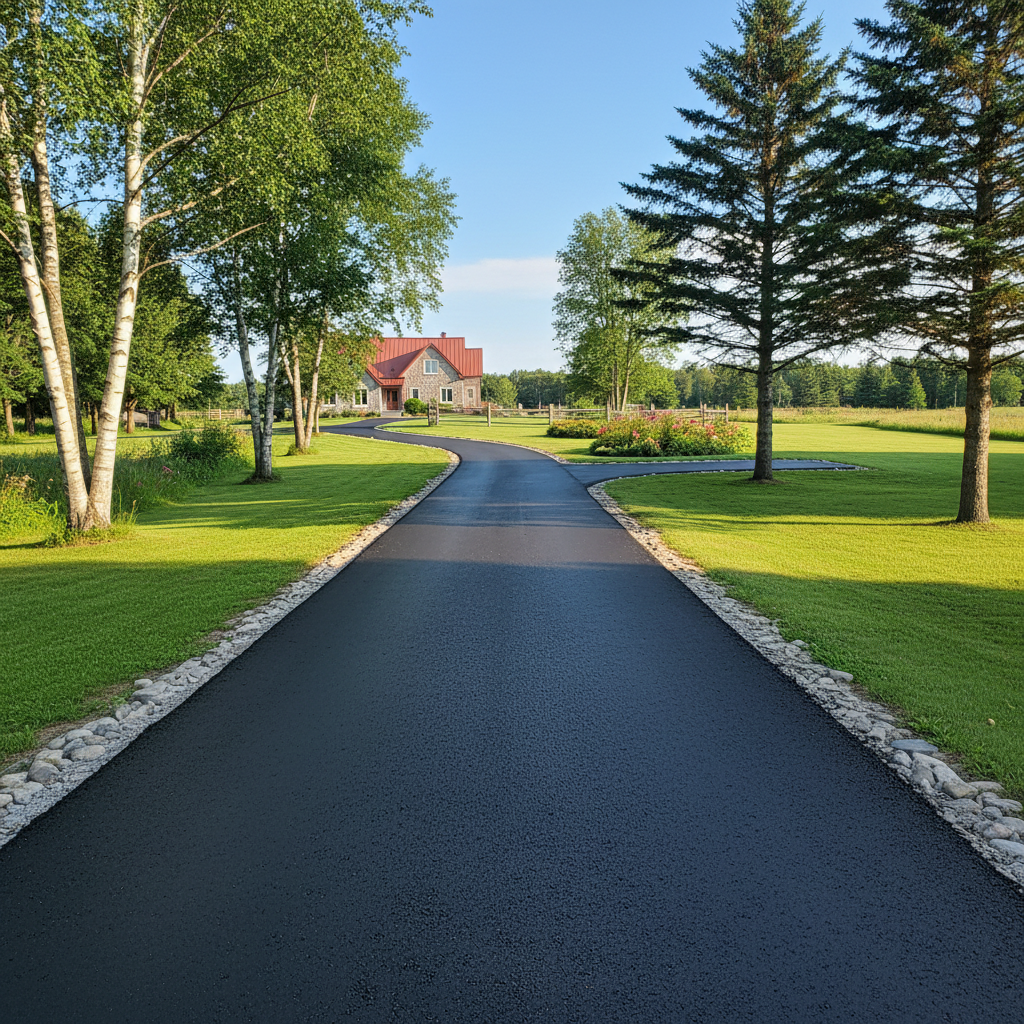
Driveway paving options and costs in Lumby
In Lumby, British Columbia, choosing the right driveway finish is mostly about matching your budget to the way Thompson–Okanagan freeze–thaw seasons test pavements every winter. Lumby has a homeowner-heavy mix—about 83.8% of households own their home (Statistics Canada, 2021 Census)—and roughly 66.7% of dwellings are single-detached houses, which is why private driveways are such a common paving job. You’ll also see a lot of established properties: around 42.5% of homes were built before 1981 (Statistics Canada, 2021 Census). Older lots often have deeper weeping/settling issues or outdated drainage paths, so paving tends to cost more once excavation and base upgrades are included.
Pricing here is shaped by the interior climate and frost behaviour. Even though the BC Building Code frost line for structures is often referenced around 18 inches in much of the interior, driveways sit under higher moisture exposure and traffic loads, so contractors build a thicker, frost-resistant granular base and pay close attention to grading and edge drainage. The paving season is shorter than on the coast—hot-mix asphalt production and placement generally need warmer air—so spring/summer scheduling and crew mobilization can also add to your final number. In Lumby, demand is especially steady around the village core and along Hwy 6 access routes, where many driveways tie directly into tight, busy streets and require careful traffic control.
Below is a practical cost comparison for common driveway options you’ll hear about in Lumby. Your final quote depends on total square footage, sub-grade condition, and how much base and drainage work your site needs.
| Material |
Lifespan |
Maintenance |
Best For |
Price per sq ft |
Price Range |
| Asphalt (new installation, proper base) |
15–25 years |
Sealcoat every 3–5 years |
Lowest upfront cost with strong durability when built right |
$4.75–$7.50 |
$4,500–$9,000 |
| Asphalt (overlay on existing gravel base) |
12–20 years |
Sealcoat every 3–5 years; monitor edge raveling |
Sites with acceptable existing base and good drainage |
$4.50–$7.25 |
$4,500–$9,000 |
| Interlocking concrete pavers |
25–40 years |
Occasional re-leveling; replace individual stones if needed |
Repairability and curb appeal |
$9.00–$14.50 |
$6,500–$14,000 |
| Poured concrete (broom finish) |
20–30 years |
Keep joints sealed as needed; occasional patching |
Clean, uniform look with good overall performance |
$8.25–$13.00 |
$7,000–$15,000 |
| Exposed aggregate concrete |
20–30 years |
Sealer periodically; patch carefully to match finish |
Upgraded finish and skid resistance |
$10.00–$15.50 |
$7,500–$16,500 |
| Gravel / crushed stone (budget option) |
5–10 years (varies heavily with maintenance) |
Rake/top up annually; manage drainage to avoid mud |
Short-term or low-budget approach |
$2.00–$4.25 |
$2,500–$6,000 |
Prices are estimates only and vary by project scope, site access and material selection.
What affects the price of paving in Lumby
In the Thompson–Okanagan, quotes for the “same driveway” can swing by roughly 30–50% between bids because the expensive part is rarely the asphalt or concrete—it’s the preparation required to survive winter. A driveway that looks level on a summer visit can have soft, clayey pockets, poor sub-drainage, or an edge that’s already failing. Once you excavate, correct grading, and rebuild a frost-resistant base, the cost moves quickly.
Freeze–thaw cycles are decisive here. When water gets into the structure, it expands during freezing and contracts during thawing, which leads to heaving, cracking, and rutting. To prevent that, deeper frost conditions and a wetter sub-grade typically require a thicker compacted granular base—commonly in the 8.5–9 inch total structure range for residential asphalt in this interior climate, with about 6 inches of compacted base. (That’s more substantial than the coastal approach, where the risk profile is different.) Asphalt mix design also matters: you’ll generally pay more for a freeze-thaw-rated asphalt mix compared with a basic mix that may not meet local performance expectations.
In concrete, two common cost drivers in Lumby are reinforcement and jointing. Air-entrained concrete and proper control joints help manage freeze damage, but they add material and labour. Meanwhile, projects on slopes or with drainage problems can cost more because excavation extends deeper and more base material must be hauled in.
If your site needs a full tear-out, the budget jumps further. For example, a driveway near the lower end of asphalt pricing might land around the local asphalt band of $4,500–$9,000, but once excavation, upgraded base, and drainage correction are required, the job can trend toward the top of that range or move you toward pavers at $6,500–$14,000.
| Price Factor |
Why It Matters |
Cost Impact |
| Driveway area in sq ft |
Most line items scale directly with square footage |
High: often the #1 driver |
| Base depth required |
Frost-resistant granular thickness prevents heaving and cracking |
High: additional inches mean more hauling and compaction |
| Grading and drainage work |
Interior freeze–thaw punishes poor slope and trapped water |
Medium to high: added excavation, ditching, and sub-drain |
| Tear-out of existing surface |
Breaking and hauling concrete or old asphalt takes time and disposal |
Medium to high depending on thickness and volume |
| Edge restraints and curbing |
Stops paver spread and helps asphalt/stone stay in place |
Medium: materials + extra form/installation labour |
| Sealing requirement |
Asphalt typically needs sealcoat after 6–12 months, then periodically |
Low to medium, but affects lifecycle cost |
| Site access |
Narrow lots slow equipment movement and increase handling time |
Medium: extra labour and smaller batch deliveries |
| Asphalt mix specifications |
Freeze-thaw-rated mix costs more and performs better locally |
Low to medium: noticeable on larger areas |
Permits & regulations in British Columbia
In British Columbia, paving a private driveway within your own property usually does not require a building permit. For most Lumby homeowners, asphalt or paver replacement on the existing footprint is considered routine private works. That said, there are important exceptions. Work in the municipal right-of-way—such as new or modified curb cuts, changes to a boulevard area, or alterations that affect storm drainage—typically requires municipal approval. Some municipalities also enforce lot-grading or drainage bylaws that limit how close to property lines a hard surface can be, and they may require that runoff be handled properly so it doesn’t impact neighbouring properties.
Before digging, always have utilities located. In B.C., call BC 1 Call (or follow your local utility notification process) so contractors can mark gas, power, and communications. Then, confirm lot-grading rules with the municipality—especially if your driveway ties into a ditch or swale.
To verify a contractor in Lumby, ask for: (1) proof of their B.C. business registration and any applicable trade qualification they hold for the work, (2) liability insurance showing adequate coverage for property damage and bodily injury, and (3) proof they have workers’ compensation coverage—coverage details can be checked through the relevant workers’ compensation registry. Collect certificates of insurance (COI) before work starts, and request a clearance letter where the insurer or contractor provides it.
It’s also smart to request the start date, how they’ll handle disposal, and whether the quote includes any required municipal approvals for right-of-way impacts.
Asphalt vs pavers vs concrete for Lumby driveways
For Lumby driveways, asphalt, interlocking pavers, and concrete all can last—if the base and drainage are designed for Thompson–Okanagan freeze–thaw. Asphalt usually offers the lowest upfront cost, but it performs best when it’s sealed regularly (typically every 3–5 years). Without sealcoat, asphalt can oxidize faster under interior temperature swings and the repeated expansion/contraction cycle.
Interlocking concrete pavers are the curb-appeal winner and are highly repairable. If a section fails due to settlement or a localized drainage issue, pavers can be lifted and re-laid without tearing out the entire surface. That repair-friendly approach matters on older Lumby properties (about 42.5% built before 1981) where sub-grade conditions can be uneven. The trade-off is higher initial cost, often reflected in the local band of $6,500–$14,000.
Poured concrete is typically mid-range in cost (often $7,000–$15,000) and gives a clean finish, but it’s more vulnerable to cracking if control joints, air-entrainment, and base compaction aren’t handled correctly. In cold interior climates, de-icing practices and winter salt exposure can worsen surface scaling if concrete isn’t properly air-entrained and cured.
All three materials rely on a properly compacted granular base. In this region, that often means building beyond the “minimum frost” thinking because paved surfaces see more moisture and traffic. With normal snow plowing and winter maintenance, pavers and asphalt usually cope well as long as edges are restrained and drainage is right, while concrete needs good joint spacing and curing discipline.
Where the price difference is justified: if your driveway is likely to have localized settlement (common with older lots), spending toward pavers can save money later because you can repair sections instead of replacing an entire asphalt panel or cracked concrete run.
| Material |
Frost Resistance |
Curb Appeal |
Repair Method |
Lifespan |
Price Band |
| Asphalt (sealed regularly) |
Good with frost-resistant base and sealing |
Medium |
Patch and overlay; mill/resurface for larger issues |
15–25 years |
$4,500–$9,000 |
| Interlocking concrete pavers |
Excellent when edges are restrained and base is compacted |
High |
Remove and relay affected stones |
25–40 years |
$6,500–$14,000 |
| Poured concrete (air-entrained) |
Good with air-entrainment, proper joints, and base |
Medium to high |
Patch and reseal; larger repairs may require section replacement |
20–30 years |
$7,000–$15,000 |
| Exposed aggregate concrete |
Good with correct mix, curing, and base prep |
Very high |
Targeted patching; match texture is labour-intensive |
20–30 years |
$7,500–$16,500 |
| Permeable pavers (drainage grid) |
Very good for wet sites with engineered drainage |
High (modern look) |
Replace grid/pavers in localized sections |
20–35 years |
$8,000–$16,000 |
| Chip seal / tar-and-chip |
Moderate; depends heavily on base quality and maintenance |
Low to medium |
Localized rework; resurfacing when binder fails |
8–15 years |
$3,500–$7,500 |
How to choose a paving contractor in Lumby
Start by verifying the contractor’s B.C. credentials and insurance. Ask for their liability insurance certificate and confirm the coverage includes property damage and bodily injury for the project. For workers’ compensation, request proof of coverage (and any clearance documentation they can provide), since a contractor must have workers’ compensation in place for their employees. You can also validate their business standing using public online registries where applicable, and request that the certificate shows Lumby (or your specific address) as the job/project location where it matters.
Next, get 2–3 itemised, written quotes. The quote should break down labour and materials separately (excavation, base supply and compaction, geotextile if used, asphalt/concrete, restraints, disposal, and any traffic control). Avoid “one number covers everything” bids unless the scope is detailed enough that you can compare apples to apples.
Read exclusions carefully: does the quote include tear-out, hauling/disposal, compacted base depth targets, grading/drainage correction, utility locates, and edging? Confirm whether permits or municipal approvals are included if the work touches the right-of-way. For warranty, ask for workmanship warranty length (how long they stand behind compaction and installation) and product/manufacturer warranty terms where relevant. Also ask whether warranties are transferable if you sell your home.
On payment schedule, never pay more than about 10–15% upfront. Hold back a portion until the job is complete and final grading is accepted. Finally, get a start date and an estimated completion timeline in writing, because interior weather in Thompson–Okanagan can delay hauling and paving.
- Request proof of liability insurance and workers’ compensation coverage before signing.
- Confirm the quote includes a specified compacted base depth (not just “base included”).
- Ask how they handle drainage: slope plan, edge drains/ditch correction, and compaction targets.
- Ensure utility locates are responsibility of the contractor and included in scope.
- Check whether tear-out and disposal are included (and where debris will be hauled).
- Verify edge restraints/curbs are in the quote for pavers or where asphalt meets features.
- For asphalt, confirm sealcoat timing and whether a 6–12 month first seal is included or advised.
- Ask for mix type/specification suited to freeze–thaw (not “generic asphalt”).
- Confirm sub-grade prep: geotextile use (if needed), moisture management, and proof-rolling/compaction checks.
- Get a written timeline with what happens if weather disrupts the paving season.
- Confirm warranty terms are in writing, including workmanship and settlement/heaving response.
- Make sure the payment schedule is staged with holdback until final acceptance.
Red flags I see around Lumby include: contractors who won’t show insurance/coverage documents, vague quotes that don’t state base depth or disposal, skipping drainage discussion, starting work without utility locates, and pushing large upfront deposits with no written scope or timeline.
Frequently asked questions — paving in Lumby
Why does my driveway crack and heave in winter?
Cracking and heaving usually come back to water and base performance. In Lumby and the broader Thompson–Okanagan, repeated freeze–thaw cycles can pull moisture into the driveway structure, especially if grading allows water to pond or if edges aren’t properly restrained. If the compacted granular base is too thin or not well-compacted, the surface can shift as ice forms and thaws. Sometimes older properties have hidden soft spots or drainage paths that weren’t corrected when the original driveway was built. The result is often alligator cracking, diagonal cracks, or localized heaving near the low points.
Do I need a permit to pave my driveway in British Columbia?
Most of the time in British Columbia, replacing or paving a private driveway within your own property footprint does not require a building permit. Where it changes, is if you’re working in the municipal right-of-way—for example, new or modified curb cuts, altering boulevard grading, or changes tied to storm drainage infrastructure. Lumby homeowners should also be mindful of lot-grading and runoff rules, since hard surfaces can alter how water flows to ditches or neighbours. Before excavation, utilities must be located through the proper calling system (BC 1 Call). Your contractor should also tell you if any municipal approvals are needed based on the exact location of your driveway access.
How long before I can drive on new asphalt?
With new hot-mix asphalt, most crews allow traffic after the mat has cooled enough to prevent tracking—often within a short window on the same day, but your contractor’s guidance matters. As a practical rule, driveway compaction, weather (wind and temperature), and the thickness of the lift can change the cure/settle time. For a first sealcoat, asphalt typically needs a waiting period—commonly 6–12 months—before sealing so the pavement binder can properly cure and you don’t trap excess volatiles. If you want budgeting clarity, many homeowners plan for sealing as part of long-term care rather than assuming the install cost ends everything.
What causes potholes and how are they repaired?
Potholes develop when water infiltrates around a weak spot and undermines the base. In interior B.C., freeze–thaw accelerates this: the freeze expands water, and the thaw loosens material, eventually leaving a void. Heavy vehicle loads, poor drainage, and small surface defects left unpatched can turn a small deterioration into a pothole. Repairs are typically localized: remove loose asphalt to reach stable base, re-compact granular material, then replace asphalt and compact to match the surrounding grade. A recurring issue can indicate a deeper base/drainage problem, which may justify a larger patch or even a resurfacing rather than repeated small fixes.
How do I prepare for a paving project?
Preparation starts with clear access and honest site details. Remove vehicles, plan for equipment access (especially if your driveway is narrow or there are obstacles), and flag sprinklers, landscaping, and any items near the work zone. If you have drainage issues—ponding after rain or ice buildup in winter—tell your contractor; it affects how deep the excavation needs to go and what base/grading they design. Ensure utilities are marked before any digging. Then, ask for confirmation of what’s included: tear-out and disposal, granular base depth targets, edge restraints, and how they’ll protect landscaping during work. For asphalt, plan around the schedule because sealing typically follows after cure time.
How do I compare paving quotes fairly?
To compare quotes fairly in Lumby, match the scope line-by-line. Confirm the total square footage, the specified compacted base depth, and whether drainage/grading corrections are included. A low price can be misleading if the quote doesn’t include tear-out, disposal, proper base thickness, or edge restraints. For asphalt, check whether the mix is described in a way that meets freeze–thaw expectations and whether sealcoat is addressed (often recommended after 6–12 months). For context, typical asphalt driveway projects often fall within $4,500–$9,000, while interlocking pavers commonly start higher and may land in $6,500–$14,000. The best quotes explain workmanship warranty, payment schedule, and a written timeline—not just a single total.