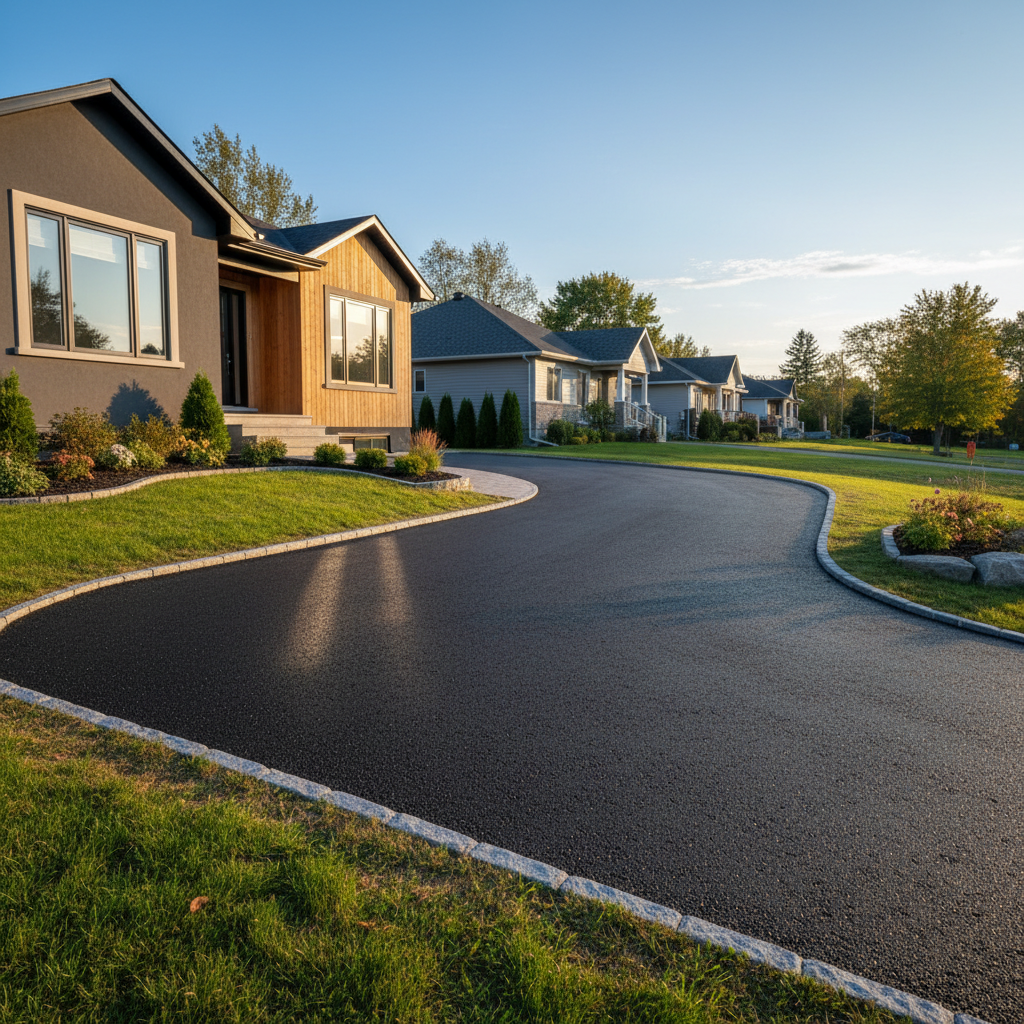
Driveway paving options and costs in Vauxhall
In Vauxhall, Alberta, homeowners typically choose between asphalt, interlocking concrete pavers, and concrete—because most driveways sit on single-detached properties and need to handle Alberta’s freeze–thaw winters without heaving or early surface cracking. In the Lethbridge–Medicine Hat area, single-detached houses make up 80.5% of dwellings, so the driveway market is largely made up of private, owner-managed projects (Statistics Canada, 2021 Census). With 76.1% of households owning their homes, many property owners prefer a durable surface they can maintain reliably through the spring thaw and summer heat.
Cost in Vauxhall isn’t just about how big the driveway is. The local region commonly sees about 6 ft of frost penetration, so contractors plan a deeper, well-compacted granular base and robust drainage to keep water from migrating up into the pavement structure. Cold winters also mean repeated freeze–thaw cycles; without the right base thickness and grading, you often see potholes, edge breaking, and cracking sooner. On top of that, the paving season is effectively late spring through early fall, and scheduling pressure can tighten when weather windows open—especially for small residential jobs.
If you’re in the Vauxhall core and areas with straightforward access for trucks and a dump trailer, pricing is often more competitive. In more constrained lots—think narrower lanes or driveways that require extra maneuvering—labour time increases and can push the project toward the upper end of the ranges. Use the table below to compare typical installed options for your driveway, then we’ll break down why quotes vary in the next section.
| Material |
Lifespan |
Maintenance |
Best For |
Price per sq ft |
Price Range |
| Asphalt (new installation, proper base) |
15–25 years |
Seal every 3–5 years (as needed) |
Best cost-to-performance; smooth driving surface |
$6.00–$10.50 |
$6,000–$12,000 |
| Asphalt (overlay on existing gravel base) |
10–18 years |
Seal every 3–5 years; monitor drainage |
When the existing base is stable and firm |
$5.50–$9.50 |
$5,500–$10,500 |
| Interlocking concrete pavers |
20–30 years (often longer) |
Re-sand joints as needed; occasional panel reset |
Curb appeal and easy spot repairs |
$10.50–$16.00 |
$9,000–$18,000 |
| Poured concrete (broom finish) |
20–35 years |
Minor patching; reseal if desired |
Clean lines and long-lasting, low-fuss maintenance |
$10.00–$14.50 |
$8,000–$16,000 |
| Exposed aggregate concrete |
20–35 years |
Seal periodically for stain resistance |
Non-slip texture and a premium finish |
$12.00–$18.00 |
$10,000–$18,000 |
| Gravel / crushed stone (budget option) |
3–8 years (depends on grading) |
Top up annually or as rutting occurs |
Lowest upfront cost; flexible access routes |
$3.00–$6.50 |
$2,500–$7,500 |
Prices are estimates only and vary by project scope, site access and material selection.
What affects the price of paving in Vauxhall
Even when two quotes look like they cover the “same” driveway, it’s common in Vauxhall and across the Lethbridge–Medicine Hat region to see differences of 30–50% once you compare the details. The biggest reasons are how each contractor addresses frost depth, how much base and drainage work is included, and how tight the scheduling is during the short Alberta paving window. In practice, a properly built structure in a frost-prone area costs more upfront, but it’s what prevents early failures after the spring thaw.
In this region, frost line depth and freeze–thaw cycles are decisive cost factors. Because freeze penetration can be around 6 ft, the design typically calls for deeper, thicker compacted granular base and careful moisture control. Contractors often aim for a deeper base build-up (and well-compacted subgrade) to reduce heaving and cracking risk, especially where clay or poorly drained soils hold water. On top of that, asphalt needs air temperatures above 10°C for proper placement, so when the weather window tightens, labour rates and production efficiency can change quickly—pushing installed unit pricing toward the higher end. That same freeze–thaw environment also affects mix design expectations, so freeze-thaw-rated asphalt specifications can carry a material premium.
Local examples that change price in Vauxhall: (1) a driveway that currently has standing water or soft spots will require added grading, drainage correction, and more aggregate—often moving a project closer to the upper end of the $6,000–$12,000 asphalt band. (2) An older home built before 1981 (67.0% of homes in the area) often means you may encounter settled subgrade, patched prior surfaces, or older base that must be rebuilt—adding tear-out and hauling. (3) If you’re going to pavers, tight access that slows equipment can raise labour even if the total square footage is similar.
| Price Factor |
Why It Matters |
Cost Impact |
| Driveway area in sq ft |
Most costs scale directly with square footage and thickness. |
High (primary driver) |
| Base depth required |
Frost control depends on granular thickness and compaction. |
High to very high |
| Grading and drainage work |
Correct slope and water shedding protect the structure. |
Medium to high |
| Tear-out of existing surface |
Breaking, loading, and hauling asphalt or concrete takes time. |
Medium to high |
| Edge restraints and curbing |
Prevents pavers from shifting and keeps asphalt edges from raveling. |
Medium |
| Sealing requirement |
Asphalt performance depends on sealing after curing. |
Low to medium (adds scheduled maintenance cost) |
| Site access |
Narrow lots increase equipment moves and labour hours. |
Medium |
| Asphalt mix specifications |
Freeze–thaw-rated materials resist cracking and raveling longer. |
Low to medium (but can be noticeable on small jobs) |
Permits & regulations in Alberta
In Alberta, paving a private driveway within your own property usually does not require a building permit. Where permits typically come into play is work that affects the municipal right-of-way—especially if you’re changing how water drains from the boulevard area or modifying curb elements. In Vauxhall, that means new or changed curb cuts, alterations to boulevard drainage, and any work that impacts stormwater flow typically require municipal approval before excavation. Some municipalities also have lot-grading rules that restrict how close a hard surface can sit to property lines or how grading must be managed to prevent runoff onto neighbouring properties.
Before any contractor digs, step one is always utility locates. In Alberta, confirm services through Alberta One-Call so you avoid hits to gas, power, water, or telecom lines. Step two is contractor verification: ask for their Alberta licence details (where applicable), their certificate of liability insurance, and their Workers’ Compensation coverage (WCB) or clearance where required for the work crew.
How to verify quickly: (1) ask for their current certificate of insurance and ensure it matches your job address; (2) confirm WCB coverage or provide the appropriate clearance documentation; (3) request the contractor’s licence information and insurance company contact details so you can cross-check if needed. Finally, confirm with the municipality whether any boulevard/grading items apply to your specific driveway plan, and get that approval in writing before construction starts.
Asphalt vs pavers vs concrete for Vauxhall driveways
For Vauxhall driveways, asphalt, interlocking pavers, and concrete all can work—but the best choice depends on your tolerance for maintenance and your need for repair flexibility during Alberta’s freeze–thaw winters. Asphalt is usually the lowest upfront option, typically landing in the $6,000–$12,000 driveway band, and it delivers a smooth ride. The catch is routine upkeep: sealing every 3–5 years helps protect the binder from moisture and oxidation so it holds up through spring thaw and cold snap cycles.
Interlocking concrete pavers cost more upfront and often align with the $9,000–$18,000 range, but they’re highly repairable. If a soft spot forms or you need future access, individual units can be lifted, corrected, and reset without tearing up the entire driveway—useful in areas with older subgrade or where drainage needs careful attention. Pavers also shine for curb appeal, which matters in neighbourhoods with more visible front approaches.
Poured concrete is commonly a mid-range option (often within the $8,000–$16,000 band) and can be durable when properly designed. However, freeze–thaw performance relies on proper air entrainment, a well-prepared base, and correct jointing. In Vauxhall, the deeper frost conditions mean all three materials need the right granular base and drainage design; if water isn’t managed, even premium materials can crack or heave early.
A concrete example: if your driveway is straightforward and you’re comparing asphalt ($6,000–$12,000) to pavers ($9,000–$18,000), the additional cost can be justified if you want easier panel repairs or higher curb appeal. If you prefer the lowest upfront cost and you’re comfortable with sealing and routine maintenance, asphalt is often the practical fit.
| Material |
Frost Resistance |
Curb Appeal |
Repair Method |
Lifespan |
Price Band |
| Asphalt (sealed regularly) |
Good with proper base and drainage |
Medium |
Patch-replace localized sections |
15–25 years |
$6,000–$12,000 |
| Interlocking concrete pavers |
Very good when base is engineered and compacted |
High |
Lift-reset individual pavers |
20–30 years |
$9,000–$18,000 |
| Poured concrete (air-entrained) |
Good with air entrainment and joints |
Medium–High |
Patch with targeted repairs |
20–35 years |
$8,000–$16,000 |
| Exposed aggregate concrete |
Good with proper design and base |
High |
Patch color-matched areas (smaller than full replacement) |
20–35 years |
$10,000–$18,000 |
| Permeable pavers (drainage grid) |
Very good when drainage is properly directed |
High (if installed cleanly) |
Replace affected units and maintain infill |
15–25 years |
$10,000–$20,000 |
| Chip seal / tar-and-chip |
Fair to good; depends heavily on base |
Low–Medium |
Spot repairs; re-chip sections as needed |
7–12 years |
$4,000–$9,000 |
How to choose a paving contractor in Vauxhall
Choosing the right contractor is especially important in Vauxhall because the foundation (subgrade, base depth, and drainage) is what determines whether your driveway survives repeated freeze–thaw cycles. Start by verifying Alberta coverage and paperwork. Ask for their certificate of liability insurance—make sure the policy is current and lists coverage for the work type. Next, confirm Workers’ Compensation (WCB) status: request the clearance letter or proof of active coverage for the company and, if subcontractors are involved, for their crews as well.
Then get 2–3 itemised written quotes. You want a breakdown that separates excavation and haul-away, granular base materials, compaction, asphalt or concrete supply, and surface finishing. Avoid lump sums that don’t explain what’s included. Pay close attention to exclusions: is disposal included for old concrete/asphalt? Is permit support included if the work touches the boulevard drainage or curb cut area? Are geotextile fabric and drainage considerations included where soft subgrade is present?
Warranty should be clear and in writing: workmanship warranty length, what defects are covered, and whether it applies to the full rebuild area. Product/manufacturer warranty is separate—confirm what the manufacturer covers (typically materials) versus what the contractor covers (installation). Payment schedule matters too: never pay more than about 10–15% upfront; use a holdback until the job is complete and the surface is accepted.
Finally, timeline: get the start date and an estimated completion window in writing, with weather contingencies noted for the late-spring to early-fall season.
- Confirm liability insurance is current and request a copy (with the job address if possible).
- Verify WCB coverage/clearance for the contractor and any listed subcontractors.
- Ask for proof of Alberta work experience in similar frost conditions and driveway sizes.
- Require an itemised quote: excavation, base, drainage/grading, surfacing, and finishing.
- Check what base build-up thickness is proposed and why (frost protection rationale).
- Confirm compaction methods (roller type and passes) and that subgrade moisture is addressed.
- Ensure disposal/haul-away of old material is included if tear-out is required.
- Verify whether edge restraints/curbing are included where needed.
- Ask how slope and water shedding will be handled away from the house and neighbour lines.
- Confirm asphalt curing time and when sealing is recommended (often after 6–12 months).
- Review warranty coverage in writing for workmanship and any exclusions.
- Agree on a payment schedule with a holdback until final inspection and cleanup.
In Vauxhall, red flags include: (1) quotes that skip detailed base depth or drainage/grading notes; (2) refusing to provide insurance/WCB documentation; (3) offering a very low price without itemising tear-out, compaction, and aggregate; (4) pushing for large upfront payments; and (5) no written timeline or warranty terms.
Frequently asked questions — paving in Vauxhall
What is a chip seal driveway and is it suited to Vauxhall?
A chip seal (tar-and-chip) is a layered surface where asphalt binder is sprayed and then topped with stone. It’s typically used where a cost-controlled surface is acceptable and where the base has already been built correctly for frost and water movement. In Vauxhall and the Lethbridge–Medicine Hat region, chip seal can work on certain driveways, but it’s more sensitive to poor drainage and soft subgrade—because freeze–thaw cycles can loosen aggregate if water gets into the pavement structure. If you’re considering chip seal, it should be priced as a proper system: prepared base, correct slope, and drainage plan. Budget ranges vary, but chip seal often sits below full asphalt paving—commonly around the $4,000–$9,000 type band for smaller residential driveways. For a long-term front approach, asphalt or pavers often provide more predictable durability.
How much does driveway crack repair cost in Vauxhall?
Driveway crack repair in Vauxhall depends on whether you’re dealing with hairline cracking (often seal and minor patch) or structural cracking that comes from base movement and freeze–thaw. For surface-level cracks, many contractors clean the crack, apply bond material, and do a targeted patch; for wider cracks, they may widen, remove loose material, and fill with proper asphalt patch mix. As a budgeting guide, small repairs may fall into the lower hundreds, while more extensive patching and edge repair can run higher once tear-out and re-compaction are needed. If your driveway is nearing the end of its service life or drainage is failing, a full overlay or re-build can be more cost-effective than repeated patching. If you want a meaningful number, the key is a contractor assessment of base stability—especially in older properties. Tell your contractor whether the crack appears after spring thaw and whether you see water pooling.
What base thickness do I need for pavers in Vauxhall?
For interlocking pavers in Vauxhall, base design is driven by frost penetration and moisture control. While exact thickness depends on your soil type and how the driveway drains, you should expect a deeper, engineered granular base with strong compaction because freeze–thaw can be severe in this part of Alberta. Contractors typically build a compacted subgrade preparation step, then a graded granular base designed to prevent frost heave and reduce water movement upward. If you have clay or poorly drained areas (common in older neighbourhoods), the base and drainage work often needs to be more substantial. The safest way to confirm base thickness is to have the contractor explain their proposed layer build-up and compaction approach during quoting—along with whether they will include drainage corrections. Also note that edge restraints matter; without them, pavers can spread and joints can open, letting water in.
How do I get the most accurate paving quote in Vauxhall?
To get an accurate quote in Vauxhall, ask for an itemised estimate that shows what’s included and what isn’t. Provide measurements (or let the contractor measure), and clearly state access constraints for equipment. The most accurate quotes come after a site walk where they check drainage, identify soft spots, and assess whether your existing surface is stable or needs tear-out. Make sure the quote includes base preparation details: granular thickness plan, subgrade preparation, and compaction methods. Ask whether disposal of old asphalt/concrete is included, and whether they’ll need to re-grade to direct water away from the house and property lines. For asphalt, request the freeze–thaw mix approach and confirm curing/sealing timing—sealing is commonly recommended after the driveway settles, often within about 6–12 months. If you want a price anchor, you can compare whether the proposal aligns with realistic installed bands, such as $6,000–$12,000 for asphalt driveway paving or $9,000–$18,000 for interlocking pavers.
How much does it cost to pave a driveway in Vauxhall?
Driveway paving cost in Vauxhall mainly depends on square footage, how much base and drainage work is needed, and whether there’s tear-out of an existing surface. Asphalt driveway paving commonly lands in the $6,000–$12,000 installed range for typical residential-scale jobs in this region when the base is built properly for frost control. Pavers are usually higher upfront, often in the $9,000–$18,000 band, but you’re paying for a surface that can be repaired without full replacement. Concrete and exposed aggregate often fall around the $8,000–$16,000 band, with premium finishes higher. In older lots—note that 67.0% of homes were built before 1981 (Statistics Canada, 2021 Census)—hidden base issues can add excavation and haul-away, pushing costs toward the upper range. Get an itemised quote so you can see the cost drivers rather than comparing only a single total price.
Asphalt vs interlocking pavers vs concrete — which is best in Vauxhall?
In Vauxhall, “best” usually means the right combination of frost durability, maintenance comfort, and repair flexibility. Asphalt is often the best choice if you want the lowest upfront cost (commonly within the $6,000–$12,000 range) and you’re willing to seal regularly—typically every 3–5 years. Interlocking concrete pavers are a top pick if you value curb appeal and want the ability to repair small sections without tearing up the whole driveway; they typically cost more, often within the $9,000–$18,000 band. Poured concrete is durable and relatively low-maintenance, but it depends heavily on air-entrainment, proper base preparation, and joint design to manage freeze–thaw cracking. Across all options, drainage and base depth are what matter most in this region’s cold winters. If your priority is minimal maintenance and long life with good base work, concrete can be strong; if you anticipate future access or want repairability, pavers usually win.