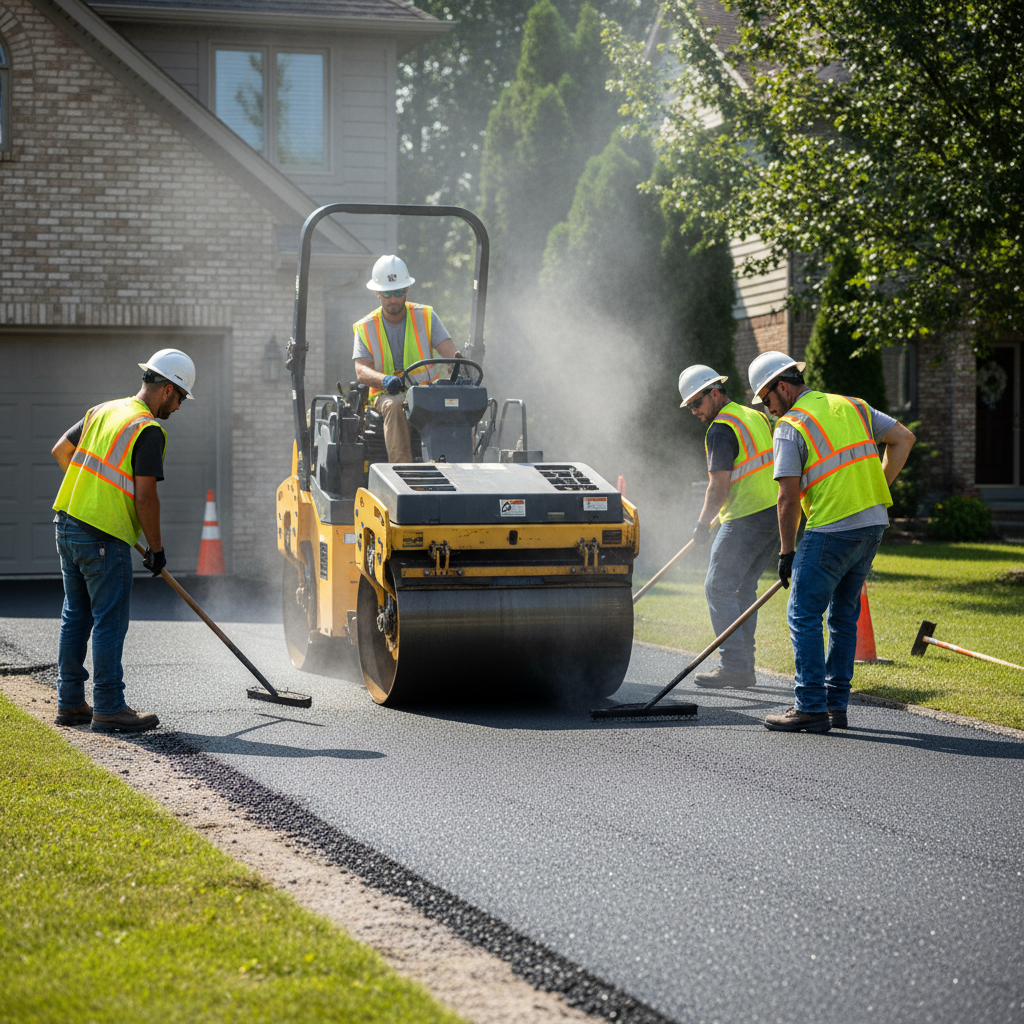
Driveway paving options and costs in Penhold
Penhold, Alberta is a community where driveways see real freeze-thaw stress every winter. With 68.7% of dwellings in the area being single-detached houses, most homes you’ll see are owner-occupied and typically have a dedicated private driveway—so there’s strong demand for dependable surface performance (Statistics Canada, 2021 Census). In 2021, Penhold had 1,060 homeowner households, which matters because paving is usually planned around long-term curb appeal and maintenance budgets rather than just the cheapest upfront bid.
In the Red Deer economic region, contractors price driveway work differently than in milder parts of Canada because frost action is a design factor, not an afterthought. Practical implications show up as more excavation, thicker compacted granular base, and better drainage detailing to reduce heaving and edge failure. The paving season also feels shorter in central Alberta, which can tighten scheduling in spring and early summer when crews and hot-mix supply are busy.
If you’re planning a new installation or replacement, work is especially in demand around established residential pockets such as the East Penhold area, where many lots are suited to either asphalt expansion joints and clean edges or paver layouts that highlight finished borders. With that in mind, here’s a homeowner-friendly comparison of common materials and what you can typically expect to spend in Penhold.
| Material |
Lifespan |
Maintenance |
Best For |
Price per sq ft |
| Asphalt (new installation, proper base) |
15–25 years |
Seal every 3–5 years; patching as needed |
Most cost-conscious driveways with good drainage |
$5.50–$12.50/sq ft |
| Asphalt (overlay on existing gravel base) |
10–18 years |
Seal after 6–12 months, then every 3–5 years |
Upgrading when you can build a sound base |
$6.25–$14.00/sq ft |
| Interlocking concrete pavers |
25–35 years |
Re-sand joints; replace individual stones if damaged |
High curb appeal and repairability |
$12.00–$22.00/sq ft |
| Poured concrete (broom finish) |
20–30 years |
Light sealing optional; crack monitoring and patching |
Clean, solid look and straightforward maintenance |
$10.00–$20.00/sq ft |
| Exposed aggregate concrete |
20–30 years |
Seal periodically; patching as needed |
Non-slip texture and decorative finish |
$12.50–$24.00/sq ft |
| Gravel / crushed stone (budget option) |
5–10 years |
Regrade and top up annually; weed control |
Short-term or lowest-budget access before hardscaping |
$2.50–$5.50/sq ft |
Prices are estimates only and vary by project scope, site access and material selection.
What affects the price of paving in Penhold
In Penhold and across the Red Deer region, two driveways that look “about the same size” can end up 30–50% apart once you price the hidden work: frost protection design, excavation, disposal, drainage corrections, and the time equipment spends getting in and out of tight lots. On top of that, Alberta’s hard-winter conditions mean contractors must treat freeze-thaw cycling as a structural requirement. When frost penetration is deeper, you need more compacted granular base and better water management to reduce heaving and cracking—especially where water runs toward the driveway edges.
As a rule of thumb for central Alberta, teams often design granular base thickness around the frost line concept (commonly discussed as roughly 1.2 metres in parts of the Edmonton area rule-of-thumb, with deeper practical penetration in colder stretches). In practice for Penhold, that typically translates to more excavation and a thicker, properly compacted base system than you’d see in milder markets. It’s one reason asphalt paving in the Red Deer economic region commonly lands in the $5,500–$12,000 driveway range, and why concrete and pavers can move higher depending on base, rebar expectations, and finishing.
Concrete examples that can raise cost include poor drainage forcing additional subdrain work and soil stabilization before pouring, or a wider driveway requiring more formwork and finishing time. Costs can be lower if your existing base is firm and well-drained, allowing a clean tear-out and rebuild that doesn’t require extensive subgrade correction. On the asphalt side, overlays can cost less—when the underlying base is truly sound—while a failed base pushes you toward full-depth reconstruction that narrows the gap.
| Price Factor |
Why It Matters |
Cost Impact |
| Driveway area in sq ft |
Material and compaction time scale directly with surface area |
Major (often the biggest portion of the quote) |
| Base depth required |
Frost line determines granular thickness to prevent heaving and cracking |
High; deeper frost can require more excavation and base tonnes |
| Grading and drainage work |
Slope and outlet location control water movement during spring melt |
Moderate to high; can include subdrain, geo-fabric, or regrading |
| Tear-out of existing surface |
Breaking, hauling, and disposal of old asphalt or concrete add labour |
Moderate to high depending on thickness and access |
| Edge restraints and curbing |
Stops paver spread and protects asphalt/concrete edges from washout |
Moderate; can be essential for longevity |
| Sealing requirement |
Asphalt needs sealing to resist Alberta surface oxidation and winter wear |
Low to moderate; typically scheduled 6–12 months after paving |
| Site access |
Narrow drives slow equipment movement and increase manual handling |
Moderate; can affect crew efficiency and productivity |
| Asphalt mix specifications |
Freeze-thaw-rated mix costs more to meet local performance expectations |
Moderate; impacts material cost and long-term durability |
Permits & regulations in Alberta
For homeowners in Penhold, private driveway paving on your own property typically does not require a building permit. However, the moment you alter anything in the municipal right-of-way, you should expect municipal approval. Examples that commonly require permission include new or changed curb cuts, any modification to boulevard areas, and work that affects storm drainage patterns. If your driveway project involves changing how water flows off-site (for instance, tying into or altering drainage infrastructure), treat that as a “permit/approval first” item.
Another Alberta check many people miss is lot grading and surface runoff rules. Some municipalities enforce lot-grading bylaws that restrict how close hard surfaces can be to property lines and how runoff must be managed to prevent flooding or neighbour impacts. Because Penhold is part of the broader Red Deer area, confirm these requirements with the local municipality before excavation—especially if you’re changing elevations.
Step-by-step, here’s how you verify a contractor is set up properly: first, ask for their Alberta business information and confirm their registration status using the appropriate online business registry resources. Next, request a current certificate of insurance showing general liability coverage for the work scope. Then ask for proof of workers’ coverage (WSIB/WCB clearance letter or equivalent documentation) before they start. Finally, insist on utility locates: call Alberta One-Call (or your local utility locators) so excavators mark buried services prior to any digging.
Asphalt vs pavers vs concrete for Penhold driveways
In Penhold’s central Alberta freeze-thaw climate, the “best” driveway material depends on how you want to balance upfront cost, appearance, and repair strategy. Asphalt usually wins on lowest upfront installation cost and tends to be the simplest to resurface, but it requires sealing every 3–5 years to maintain flexibility and resist winter oxidation and minor cracking. Interlocking concrete pavers typically cost more up front, yet they shine in Alberta because the base can be designed properly and individual units can be reset or replaced without tearing out the whole driveway—useful if you ever see frost-related movement at a localised spot. Poured concrete sits in the middle on initial price, but it must be air-entrained and detailed to handle freeze-thaw cycling and repeated de-icing use; if the base and drainage aren’t right, cracking can show up sooner.
Base preparation is where Red Deer-area pricing often diverges: deeper frost action requires a properly compacted granular base and good drainage for any of the three. Asphalt and concrete both perform best when water drains away from the slab/edge rather than pooling. Pavers handle small movements better due to their segmented structure and jointing, provided the restraint system is installed correctly.
A concrete example: a typical asphalt driveway might land in the $5,500–$12,000 range, while interlocking pavers commonly fall into $9,000–$22,000. That extra paver budget is often justified when you want high curb appeal, plan to keep the home long-term, or value the ability to do targeted repairs instead of full replacement after settlement.
| Material |
Frost Resistance |
Curb Appeal |
Repair Method |
Lifespan |
Price Band |
| Asphalt (sealed regularly) |
Good with proper base and drainage |
Moderate (clean and simple finishes) |
Cold patch and localized overlays |
15–25 years |
$5,500–$12,000 |
| Interlocking concrete pavers |
Very good; forgiving when base is built correctly |
High (varied patterns and borders) |
Lift/replace specific units and re-sand joints |
25–35 years |
$9,000–$22,000 |
| Poured concrete (air-entrained) |
Good to very good with air-entrainment and drainage |
Moderate to high (finish dependent) |
Crack patching or section repair |
20–30 years |
$8,500–$18,000 |
| Exposed aggregate concrete |
Good with correct mix and base |
High (textured decorative face) |
Localized patching and sealing touch-ups |
20–30 years |
$10,000–$20,000 |
| Permeable pavers (drainage grid) |
Excellent drainage; reduces trapped water under load |
High (modern layouts) |
Replace affected pavers; inspect drainage layer |
25–35 years (system dependent) |
$12,000–$24,000 |
| Chip seal / tar-and-chip |
Fair; best for interim or lower-traffic areas |
Low to moderate (utility look) |
Re-chip and surface rejuvenation |
5–12 years |
$3,500–$8,500 |
How to choose a paving contractor in Penhold
Choosing a paving contractor in Penhold is about confirming three things: competence, coverage, and clarity. In Alberta, verify licensing/registration status using the appropriate online registry before the job starts, then request a certificate of insurance with the right coverages for paving and excavation work. Ask specifically for proof of workers’ compensation coverage (WSIB/WCB clearance letter or equivalent) so you’re not exposed if someone gets injured on-site.
Get 2–3 itemised written quotes, not a single lump sum. The best quotes break down labour and materials separately (excavation, granular base, asphalt/paving material, reinforcements if applicable, and surface finish/compaction). Read the scope for exclusions: is permit/municipal approval help included (where required), is disposal included, and is saw-cutting or proper formwork included when needed? Also check whether their base design accounts for drainage improvements—this is crucial in a frost-driven region where shallow or water-logged subgrades lead to edge failure.
Warranty matters too: ask for a workmanship warranty length and whether the manufacturer warranty applies to the specific product used. Confirm whether warranties are transferable to future homeowners if you sell. On payment, never pay more than 10–15% upfront; a holdback until substantial completion (or final inspection) is a healthy practice. Finally, require a start date and completion estimate in writing so scheduling pressure doesn’t turn into month-long delays after spring work begins.
- Ask to see recent driveway project photos in central Alberta with similar base conditions.
- Confirm insurance certificates match your address and job scope before excavation.
- Request WSIB/WCB clearance documentation and keep copies.
- Ensure the quote includes detailed base construction materials and compaction method.
- Verify drainage plan: slope direction, outlets, and any subdrain/geo-fabric items.
- Check tear-out and disposal are included (especially concrete breaking and hauling).
- Look for edge restraint details (curb, locking border, or restraint system) to prevent spread.
- Confirm asphalt sealing requirements and who does the initial seal coat timing.
- Ask who supplies and places granular base and whether it’s compacted in lifts.
- Confirm accessibility assumptions: can equipment reach the entire footprint safely?
- Write down the material specs (air-entrainment for concrete; freeze-thaw rated mix for asphalt).
- Get the warranty in writing, including what “repairs” cover and timelines for call-backs.
Red flags to watch for: vague “we’ll make it work” base descriptions, missing insurance/WSIB paperwork, quotes that omit disposal or drainage changes, no written start/completion dates, and no clear warranty terms for workmanship versus materials.
Frequently asked questions — paving in Penhold
How much does driveway crack repair cost in Penhold?
Crack repair pricing in Penhold depends on whether you’re dealing with a hairline asphalt crack, an edge separation, or a wider concrete crack that indicates base movement. For asphalt, small crack sealing or routing and filling is often considered a maintenance item; for deeper failures, you may need a patch or a partial section rebuild. In Alberta’s freeze-thaw climate, repairs can range from a few hundred dollars for spot sealing to a much higher amount when excavation and base correction are required. As a budgeting reference, most “sealing & repair” jobs fall in the $500–$3,500 range, but a section cut-out can push costs upward if drainage is also corrected. A contractor should inspect the crack width, location (edge vs centre), and whether water is sitting along the driveway line (Statistics Canada, 2021 Census).
What base thickness do I need for pavers in Penhold?
For pavers in Penhold, base thickness is driven by frost action and drainage quality, not just driveway thickness trends you might see online. The key is building a well-compacted granular base system that stays stable through freeze-thaw cycling, because trapped water and weak subgrade are what lead to settlement and cracked edges in central Alberta. Contractors typically design using a frost-protection mindset: deeper frost protection usually means more excavation and a thicker compacted granular layer, along with geo-fabric and proper slope/drainage control. If your site has good drainage and firm soil, you may avoid extra stabilization; if the subgrade is soft or water collects, expect additional base and possibly drainage correction. Your best step is to request a quote that explicitly states base layers and thicknesses, not just “we’ll put down a base” (Statistics Canada, 2021 Census).
How do I get the most accurate paving quote in Penhold?
To get the most accurate paving quote in Penhold, prepare for the fact that contractors price by site conditions first: soil type, drainage, existing surface condition, and access. Before quotes, have the driveway measured (length and width) and take clear photos of any failures (ponding, soft spots, edge lifting). Then ask each contractor to do a site assessment and confirm whether they will include tear-out, disposal, base rework, and drainage correction. Request an itemised breakdown separating labour and materials, and ask whether permit/approval support is needed if any work touches municipal right-of-way areas. In Alberta, utility locates should be completed before excavation; ensure their plan includes that step. Finally, confirm your quote includes a written start date estimate and a workmanship warranty. This is the fastest way to avoid “quote creep” that often happens after frost-protection needs are discovered on-site (Statistics Canada, 2021 Census).
How much does it cost to pave a driveway in Penhold?
Driveway paving cost in Penhold usually depends on size, base depth needed for frost protection, whether you’re paving over gravel or replacing an existing surface, and the material choice. For asphalt, the common driveway range is around $5,500–$12,000 for typical residential lots, assuming a properly prepared base. For interlocking pavers, budgeting often starts closer to $9,000–$22,000 because of the labour-intensive base and edge restraints plus the paver system. Concrete driveway projects commonly fall around $8,500–$18,000, depending on finish and reinforcement needs. If you’re planning repairs or sealing before resurfacing, smaller scope work generally fits within $500–$3,500. A contractor should recommend the right solution after checking drainage and base stability, since Alberta freeze-thaw cycles can exaggerate shallow base issues quickly (Statistics Canada, 2021 Census).
Asphalt vs interlocking pavers vs concrete — which is best in Penhold?
In Penhold, asphalt is often the best fit for homeowners who want the lowest upfront cost and are comfortable budgeting for routine maintenance like sealing every 3–5 years. Interlocking concrete pavers are usually the best choice when curb appeal and repairability matter—if a localized frost movement happens, you can lift and reset sections without replacing the entire driveway. Poured concrete is a strong option when you want a crisp, solid finish, but it must be air-entrained and built on a stable base with good drainage to manage freeze-thaw stresses. De-icing and ploughing habits can also affect longevity, so detailing matters. A practical way to decide is to compare total lifecycle value: for example, moving from asphalt at roughly $5,500–$12,000 into pavers at $9,000–$22,000 is often justified if you plan to stay long-term and want fewer disruptive repairs. The right “best” depends on your soil and drainage, not just material preference (Statistics Canada, 2021 Census).
How long does a paved driveway last in Penhold?
The lifespan of a paved driveway in Penhold depends mainly on base construction, drainage, and maintenance—not just the surface material. With proper base and sealing, asphalt commonly lasts about 15–25 years. Interlocking concrete pavers often reach 25–35 years because individual units can be replaced and the system handles minor movement better when properly restrained. Poured and exposed aggregate concrete typically last 20–30 years, but cracking risk increases if the base is shallow or water is allowed to pond along edges during spring melt. In central Alberta, repeated freeze-thaw cycles can expose weak drainage quickly through settlement and edge failure, so a driveway built with the right frost-protection approach and slope design tends to outlast one that’s only “surface-perfect.” Your best predictor is how your contractor addresses drainage and granular base thickness during the quote and site assessment (Statistics Canada, 2021 Census).