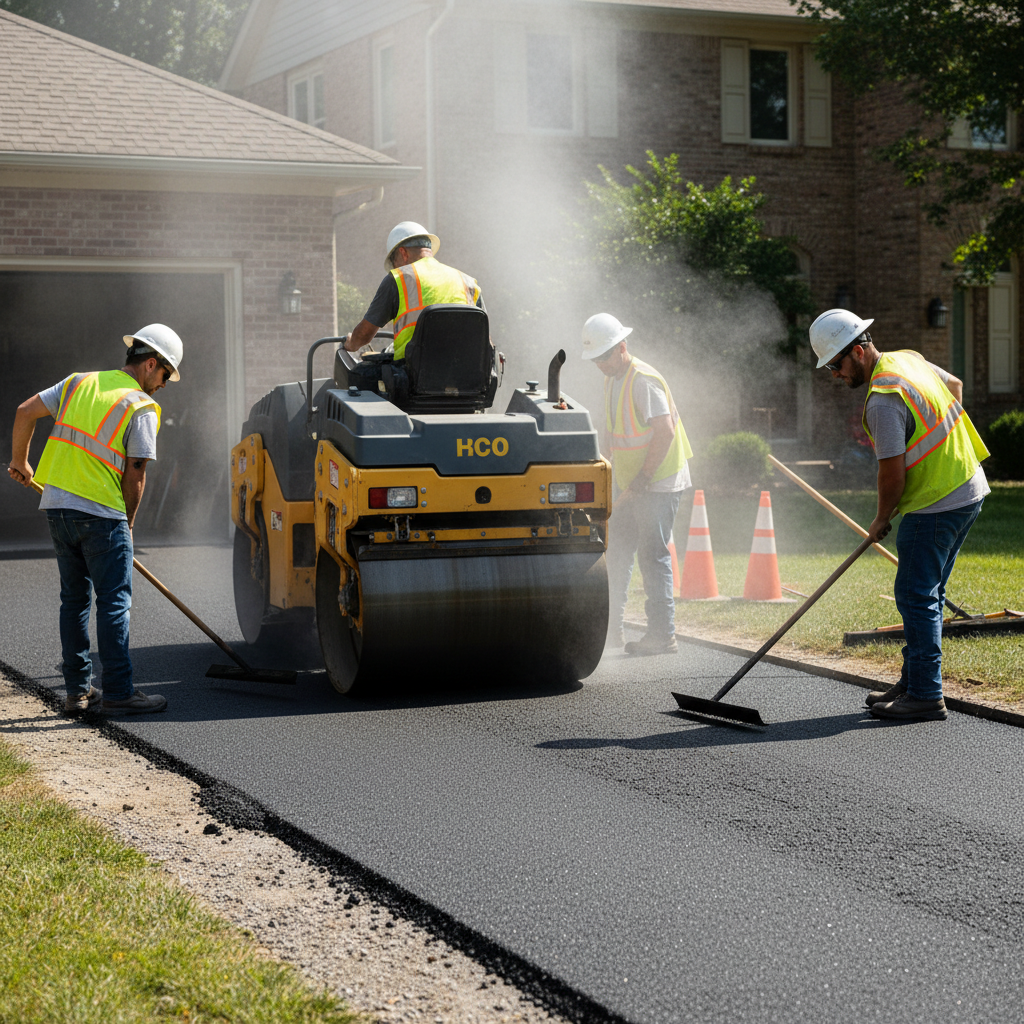
Driveway paving options and costs in Bonnyville
Bonnyville is a busy northern community, and driveway paving is one of the first things homeowners notice—especially on single-detached homes, which make up 63.7% of local dwellings. With 1,525 homeowner households (60.2% of households own), there’s a steady demand for durable, easy-to-maintain surfaces that can handle deep frost and frequent freeze–thaw cycling across the Wood Buffalo–Cold Lake economic region. In practice, that climate forces contractors to overbuild the base and drainage compared with milder parts of the province, because water infiltration and frost heave are what typically cause premature rutting and cracking.
In addition, Bonnyville’s effective paving window is shorter—often late spring through summer—so scheduling pressure and weather risk can raise the installed cost for the same driveway. Work near popular streets and mature neighbourhoods (for example, the older housing pockets closer to the downtown core and along established residential corridors) tends to be in higher demand because many of those lots have older, less-consistent base conditions. Homes built before 1981 account for 44.2% of the housing stock, so tear-out and base upgrades are common before any asphalt overlay, new asphalt build, or paver installation.
Below is a practical cost comparison you can use when reviewing quotes—then we’ll break down what specifically drives price differences in this region.
| Material |
Lifespan |
Maintenance |
Best For |
Price per sq ft |
| Asphalt (new installation, proper base) |
15–25 years |
Seal every 3–5 years; patch as needed |
Lowest upfront cost for a properly built base |
$3.75–$6.50 |
| Asphalt (overlay on existing gravel base) |
10–18 years |
Seal when warranted; crack-fill/patch |
When the existing base is sound and drainage is good |
$3.25–$5.75 |
| Interlocking concrete pavers |
25–30+ years |
Re-level/replace individual stones as needed |
Curb appeal and easy localized repairs |
$7.00–$11.50 |
| Poured concrete (broom finish) |
20–30 years |
Crack repairs as needed; sealed if desired |
Low-maintenance, clean look |
$6.00–$10.50 |
| Exposed aggregate concrete |
20–30 years |
Occasional cleaning/sealer; crack repair if needed |
Higher slip resistance and decorative finish |
$7.00–$12.00 |
| Gravel / crushed stone (budget option) |
3–8 years (typical) |
Re-grade and top up annually; weed control |
Temporary or lowest cost while planning full rebuild |
$2.25–$4.00 |
Prices are estimates only and vary by project scope, site access and material selection.
What affects the price of paving in Bonnyville
In Bonnyville (and across the Wood Buffalo–Cold Lake economic region), quotes for the “same” driveway can swing by 30–50% because the scope hidden under the surface changes—especially the depth and quality of compacted granular base and the amount of drainage and grading work required. Two contractors can both propose asphalt, but one might design for deeper frost protection with more granular depth and better side-slope shedding, while another may price a thinner build that looks fine in August but struggles once freeze–thaw accelerates in fall and spring.
Frost line depth and freeze–thaw cycles are decisive cost factors here. Northern Alberta guidance puts frost penetration roughly in the 1.2–1.5 m range, meaning you typically need a thicker, well-compacted base and robust subgrade preparation to prevent heaving and differential settlement. As a rule of thumb, deeper frost protection means more aggregate and more compaction passes—often more comparable to “overbuilt” base approaches than what many people expect from southern Alberta. Also, hot-mix asphalt requires air temperatures above 10°C, so the shorter paving season concentrates demand (and labour/equipment availability), which pushes labour and mobilization into the price.
Concrete pricing can move too. For older homes built before 1981, you’ll often find weaker soils or prior drainage patterns that force additional excavation and regrading; that can push a concrete driveway toward the higher band, such as $8,000–$15,000 for a typical residential pour once base and formwork are included. On the other hand, if your subgrade is already stable and your drainage is corrected, asphalt can stay closer to $6,000–$12,000 depending on square footage and access. Asphalt mix design also matters—freeze–thaw-rated binder and proper mix selection can cost more, but it reduces early failure.
| Price Factor |
Why It Matters |
Cost Impact |
| Driveway area in sq ft |
Most materials and paving time scale directly with surface area |
High (often the biggest driver) |
| Base depth required |
Frost protection needs thicker, compacted granular thickness in deep frost zones |
High (more aggregate + compaction) |
| Grading and drainage work |
Slopes and edge drainage keep meltwater from infiltrating joints and cracks |
Medium to high (more excavation and rework) |
| Tear-out of existing surface |
Breaking and hauling old asphalt or concrete adds labour and disposal costs |
Medium (can become high on larger pads) |
| Edge restraints and curbing |
Pavers need restraints to stop lateral movement and washout |
Medium (materials + careful forming) |
| Sealing requirement |
Asphalt performance in freeze–thaw improves with sealing after curing |
Low to medium (small add-on, big performance value) |
| Site access |
Narrow lots or long haul distances slow equipment movement and raise setup time |
Medium (fuel, mobilization, time) |
| Asphalt mix specifications |
Freeze–thaw-rated mix and correct binder/gradation can cost more |
Low to medium (but reduces early failures) |
Permits & regulations in Alberta
In Alberta, paving a private driveway on your own property usually does not require a building permit. If you’re resurfacing within your existing hard-surface limits (like a driveway replacement on your lot), contractors typically proceed without a permit. However, work that affects the municipal right-of-way generally does require municipal approval. Examples that commonly require a permit or approval include new or modified curb cuts (approaches/driveway access in the boulevard), changes to boulevard grading that affect drainage, alterations to storm drainage connections, and any work that impacts municipal drainage infrastructure.
Because rules can vary by municipality, the safest path for a Bonnyville homeowner is to verify before excavation: confirm whether your driveway tie-in crosses the boulevard and whether any lot-grading bylaws limit how close a hard surface can be to property lines or how water must be shed. Also, regardless of permit requirements, always call for utility locates through Alberta One-Call before digging.
To verify a contractor is legitimate, homeowner checks should be step-by-step:
- Confirm their Alberta licence/registration (use the province’s public business/contractor registry or the trades listing the company is claiming).
- Request a certificate of insurance for general liability and ensure coverage is current (don’t rely on verbal confirmation).
- Ask for WSIB/WCB clearance or coverage confirmation—then read the dates and coverage details on the document.
- Match the insured name to the quote/contract and keep copies for your records.
This is especially important in Bonnyville, where winter-season timelines are tight and driveway work often involves heavy base excavation and transport.
Asphalt vs pavers vs concrete for Bonnyville driveways
For Bonnyville’s freeze–thaw climate, asphalt, interlocking pavers, and concrete can all work—but they fit different priorities. Asphalt is the lowest upfront option and typically performs well when built on a robust base; the trade-off is maintenance. In northern Alberta conditions, asphalt should be sealed every 3–5 years, and cracked areas may need crack-filling during shoulder seasons. Interlocking concrete pavers cost more upfront, but they’re the most repair-friendly: if a section heaves or a utility trench settles, stones can be lifted, corrected, and reset without replacing the entire driveway. Poured concrete sits in the middle price-wise and can be durable, but freeze–thaw demands proper air-entrainment, correct finishing (like broom finish for traction), and good drainage to reduce surface scaling and cracking—especially if you rely on salt and sand during winter.
Base preparation is where Bonnyville projects separate from “cookie-cutter” jobs. With deep frost penetration and water-sensitive subgrades, you should expect thicker granular base and careful slope/drainage design for all three options. In the Wood Buffalo–Cold Lake market, that often means more excavation than homeowners see in southern Alberta. Where asphalt sometimes looks cheaper on paper—say a typical driveway landing in the $6,000–$12,000 band—pavers or concrete can be justified when you factor long-term repairability or surface quality, particularly if your lot has older soils or you anticipate future driveway adjustments.
Concrete and pavers can also hold up better with frequent plowing if restraints are correct and edges are detailed; asphalt needs the seal coat to manage permeability. If your winter maintenance involves regular plow passes, that’s another reason base compaction and edge stability matter as much as the surface choice.
| Material |
Frost Resistance |
Curb Appeal |
Repair Method |
Lifespan |
Price Band |
| Asphalt (sealed regularly) |
Good with proper granular base and freeze–thaw-rated mix |
Moderate |
Mill and patch localized failures; crack-fill and seal |
15–25 years |
$6,000–$12,000 |
| Interlocking concrete pavers |
Very good when laid on a correct base and restrained edges |
High |
Remove and reset individual pavers/sections |
25–30+ years |
$9,000–$18,000 |
| Poured concrete (air-entrained) |
Good when properly air-entrained, drained, and finished |
Moderate to high |
Crack repair/seal; localized patching if feasible |
20–30 years |
$8,000–$15,000 |
| Exposed aggregate concrete |
Good when base/drainage are correct; good traction in snow |
High |
Surface patching with cosmetic matching; targeted repairs |
20–30 years |
$9,000–$16,000 |
| Permeable pavers (drainage grid) |
Very good drainage control when installed with correct underdrain |
High |
Localized stone replacement; maintain drainage layers |
20–30+ years |
$11,000–$20,000 |
| Chip seal / tar-and-chip |
Moderate; relies heavily on base stability and maintenance |
Low to moderate |
Spot repairs; re-seal/re-chip over time |
7–15 years |
$5,000–$10,000 |
How to choose a paving contractor in Bonnyville
Choosing the right paving contractor in Bonnyville is mostly about verifying credentials and making sure the scope is written clearly. First, confirm Alberta licensing/registration appropriate to the work they’re bidding, then check liability insurance—ask for a current certificate and confirm the coverage dates. Next, verify WSIB/WCB coverage: request a clearance document or coverage confirmation, and read it yourself rather than accepting a screenshot with missing details. This matters because paving jobs involve excavation, hauling, and heavy equipment movement around residential properties.
Second, get 2–3 itemised written quotes. “Itemised” should mean labour and materials broken down (base preparation, asphalt/concrete quantities, compaction, disposal/tire-breaker or sawcut allowances, and any traffic control). Avoid a lump sum that doesn’t explain what happens if you uncover soft subgrade or if the tear-out expands. Ask whether the quote includes permit pull (if needed), utility locate costs (usually separate), and disposal of old asphalt/concrete.
Third, scrutinize warranty and payment timing. Workmanship warranties should be stated in writing with a clear duration; product/manufacturer warranties should also be specified and confirm whether they’re transferable if you sell your home. For payment schedule, don’t pay more than about 10–15% upfront, and request a holdback until substantial completion and final cleanup. Finally, ask for a written start date and estimated completion date—important in Bonnyville where the short paving window and weather swings can delay crews.
- Request itemised quantities and unit prices (not just totals).
- Confirm base depth and compaction requirements in writing.
- Ask how they handle poor drainage or wet subgrade they discover.
- Verify disposal is included (and where material is hauled).
- Check that edge restraints/curbs are included where needed.
- For asphalt: confirm tack coat use, paving lift thickness, and sealing plan.
- For pavers: confirm geotextile/subbase layers and joint sand specification.
- For concrete: confirm air-entrainment and reinforcement/expansion joint plan.
- Ensure traffic control and protection of landscaping is included.
- Get insurance and WSIB/WCB clearance documents in your name/specific job.
- Ask for photos of similar Bonnyville projects and references.
- Clarify warranty start date (substantial completion vs final inspection).
Red flags to watch in Bonnyville: (1) they won’t provide insurance/WSIB/WCB clearance documents, (2) they refuse to describe base thickness or drainage details, (3) they demand large upfront payments, (4) they give a vague “lump sum” without itemization or allowances for tear-out, and (5) they dismiss freeze–thaw risks without discussing granular base and slope management.
Frequently asked questions — paving in Bonnyville
Is it worth sealing a new driveway right away in Bonnyville?
In Bonnyville, sealing is usually worth it—but timing matters. For most asphalt driveways, contractors typically wait until the asphalt has cured and the surface is ready to accept the seal coat (often after the initial season and after testing for adequate dryness). Sealing too early can trap moisture and interfere with proper curing, which is risky in a freeze–thaw climate. A properly built asphalt driveway often has a service life that improves with sealing done on schedule; many homeowners plan for sealing every 3–5 years rather than trying to “seal immediately” after paving. If you’re comparing quotes, ask whether the contractor includes an initial seal plan and whether it affects the upfront price.
What is a chip seal driveway and is it suited to Bonnyville?
Chip seal (also called tar-and-chip) is an asphalt binder sprayed over a base, followed by aggregate chips broadcast and compacted into the binder. It can be a cost-effective option, often landing in the lower paving bands (for example, around $5,000–$10,000 for a typical residential scope), but it’s more maintenance-sensitive than thicker asphalt or concrete. In Bonnyville, deep frost and winter freeze–thaw cycling can loosen chips if the base and drainage aren’t excellent. It can be suited to areas where you’re comfortable with periodic rework and you want a durable “top layer” rather than a long-term finished surface. If your subgrade is weak or drainage is poor, chip seal will usually underperform compared with a new asphalt build with robust granular base.
How much does driveway crack repair cost in Bonnyville?
Crack repair pricing varies by crack width, length, and whether water is tracking along the crack (which suggests base/drainage issues). For small, localized repairs, many contractors price crack filling/patching as a per-linear-foot allowance, with mobilization affecting the total for small driveways. For planning, think of crack repairs as a smaller line item compared with full resurfacing, but if the driveway is older or poorly drained you may need more than sealing—sometimes additional base stabilization or localized rebuild. If you’re budgeting repairs alongside maintenance, it can be practical to set aside funds in the range of $400–$1,500 for typical sealing/repair work depending on what’s included. Always ask the contractor to identify whether the crack is surface-only or symptomatic of subgrade movement tied to frost heave.
What base thickness do I need for pavers in Bonnyville?
For pavers in Bonnyville, the right base thickness depends on soil conditions, drainage, and the frost-susceptibility of your subgrade. In deep frost areas, you should expect a thicker, well-compacted granular build than what homeowners see in milder climates. While exact thickness must be confirmed after site assessment, a common approach is to build multiple layers (subbase plus bedding and joint sand), with the granular depth increased where soils are weak or where drainage is challenging. The key is compaction and drainage continuity—pavers perform best when water is managed so it can’t infiltrate and freeze under the pavement. Ask your contractor to specify base depth, layer materials, and compaction targets in writing, and ensure edge restraints are included to prevent lateral spreading during freeze–thaw.
How do I get the most accurate paving quote in Bonnyville?
To get an accurate quote in Bonnyville, make sure the contractor measures and inspects your site—especially existing base conditions and drainage. Provide driveway dimensions and confirm whether there’s any slope toward the garage or house, because meltwater management is critical in the Wood Buffalo–Cold Lake freeze–thaw environment. Request 2–3 itemised written quotes with labour and material breakdown, including base prep quantities, tear-out/disposal, and what’s included for site access (narrow gates, long pulls, or limited staging). Ask how they’ll handle soft subgrade or wet spots once excavation starts. Also confirm whether a seal coat is included or excluded for asphalt (timing and cure matter), and what warranty is provided for workmanship. Finally, verify the contractor’s Alberta licence/registration, liability insurance, and WSIB/WCB coverage before signing.
How much does it cost to pave a driveway in Bonnyville?
For Bonnyville, typical driveway costs depend on size, base prep, and tear-out requirements. As a practical planning range, asphalt driveway paving commonly falls within $6,000–$12,000 when the base can be built or corrected as required. Interlocking concrete pavers are usually higher, often within $9,000–$18,000, because of additional materials, base layers, and setting/finishing labour. Poured concrete often lands in $8,000–$15,000 depending on thickness, reinforcement/joints, and how much excavation is needed. If your existing surface has issues, expect base upgrades to push you toward the upper end. If you want a tighter number, ask for a quote based on square footage and specified base thickness—not just the surface material.