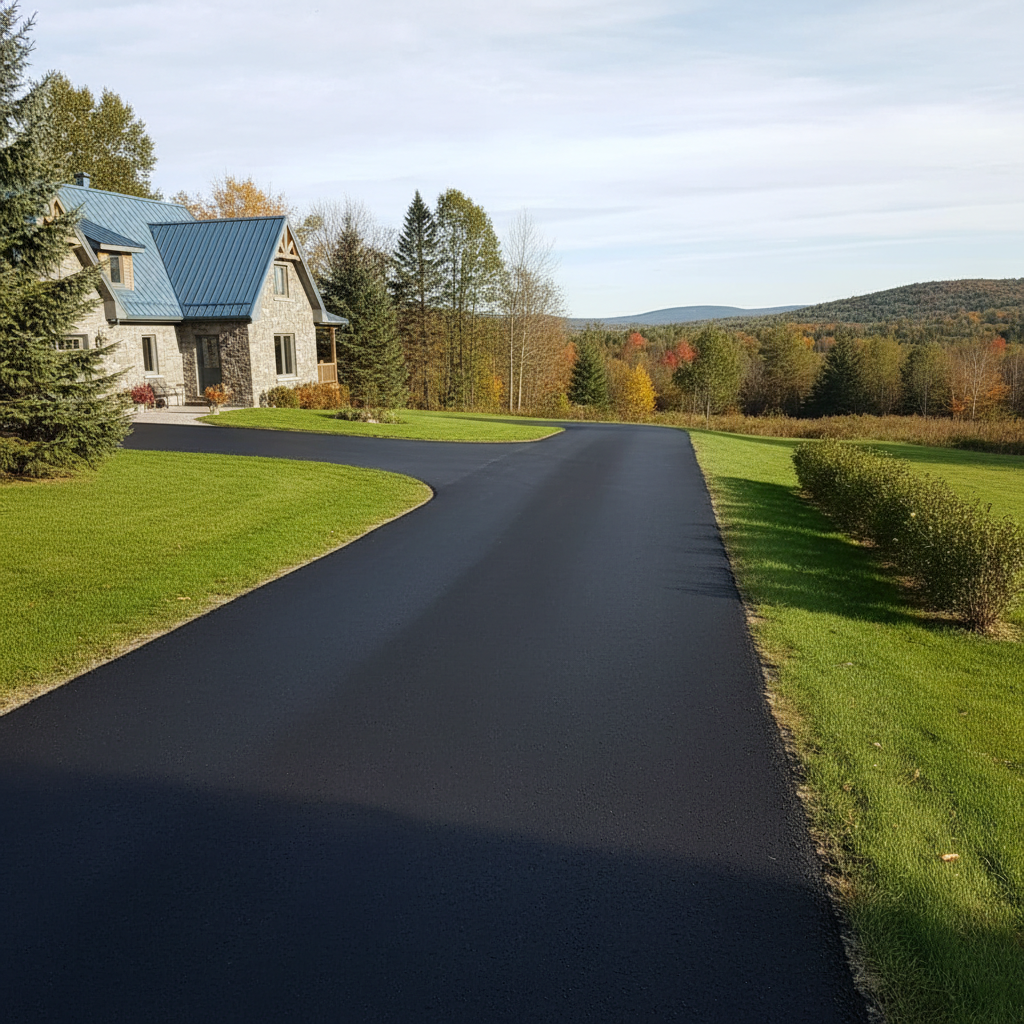
Driveway paving options and costs in Nanton
Nanton is a small Alberta community where most private driveways are tied to single-detached homes—81.6% of local dwellings are that type, and there are 765 homeowner households overall (Statistics Canada, 2021 Census). That matters because paving demand is steady, but driveway lots here often need the kind of heavier base work that protects against frost movement. In the Lethbridge–Medicine Hat economic region, frost depth and repeated freeze–thaw cycles drive up excavation and granular base requirements, plus the need for solid drainage under asphalt and concrete. The paving season is also shorter (typically late spring to early fall), so contractors plan tightly; scheduling pressure can affect labour availability and turn project starts into a “window” problem in spring.
In Nanton, you’ll see the trade especially active around the older residential core and established lanes where many driveways pre-date the 1980s—52.9% of homes were built before 1981 (Statistics Canada, 2021 Census). Older driveways commonly have compacted base that’s settled, mild drainage issues, and edges that weren’t restrained from day one, which means extra tear-out and base rebuild to reach a long-lasting finish.
To help you compare apples-to-apples, the table below shows typical installed ranges for standard residential-scale projects, assuming proper base preparation and drainage. Use it as a starting point before you request a site-specific quote.
| Material |
Lifespan |
Maintenance |
Best For |
Price per sq ft |
| Asphalt (new installation, proper base) |
15–25 years |
Seal every 3–5 years; patch as needed |
Good value, smooth ride, fast install |
$6.50 – $10.50 |
| Asphalt (overlay on existing gravel base) |
8–15 years |
Seal 3–5 years; monitor for base settlement |
Cheaper refresh when base is sound |
$5.00 – $8.50 |
| Interlocking concrete pavers |
25–40 years |
Re-level or replace individual stones as needed |
Curb appeal and easy repairs |
$10.00 – $15.50 |
| Poured concrete (broom finish) |
20–30 years |
Minor crack repairs; reseal if desired |
Low upkeep, clean traditional look |
$9.50 – $14.00 |
| Exposed aggregate concrete |
20–30 years |
Clean and occasional sealer refresh |
Slip resistance and decorative durability |
$11.00 – $16.50 |
| Gravel / crushed stone (budget option) |
3–7 years |
Re-grade and add stone 1–3 times per season |
Lowest upfront cost, temporary solution |
$2.50 – $4.50 |
Prices are estimates only and vary by project scope, site access and material selection.
What affects the price of paving in Nanton
In Nanton and across the Lethbridge–Medicine Hat economic region, you can see the same driveway quoted 30–50% apart, even when the visible surface looks similar. The difference usually comes from what’s underneath: frost depth-driven base thickness, drainage correction, and how much existing material must be removed. Southern Alberta’s freeze–thaw cycles matter because water expands as it freezes, pushing up weak layers and stressing the asphalt or concrete surface. In this region, frost penetration is commonly in the 6 ft range, so contractors typically build a thicker, well-compacted granular base than you’d see in milder coastal climates; that means more trucking, more excavation, and more labour to reach the designed subgrade condition.
Another driver is scheduling and mix design. Hot-mix asphalt requires air temperatures above about 10°C to place properly, so late-spring and early-fall weather windows concentrate demand—small residential jobs can cost more per square foot when crews are booked tightly. Asphalt also needs to be freeze–thaw-rated for local performance; if you’re comparing bids, ask what mix and base are being used.
Here are a few Nanton-specific examples that move price up or down: (1) If your driveway base has settled or has low spots that hold water, drainage work (cut/fill and subdrain considerations) can add cost quickly; (2) if your current asphalt has extensive alligator cracking, tear-out and haul-off often pushes projects toward the higher end of the asphalt band, while overlays only make sense when the gravel base is still firm and uniform; (3) older driveways (many pre-1981) may have inadequate edge restraint, which can increase the cost of curbing, geotextile, or full border reconstruction. For budget context, asphalt installations often land in the broader $6,000 – $12,000 range, while interlocking pavers commonly start higher—often in the $9,000 – $18,000 band—because of excavation depth, bedding sand, and labour-intensive placement.
| Price Factor |
Why It Matters |
Cost Impact |
| Driveway area in sq ft |
Most materials and paving labour scale directly with area |
High (often the biggest variable) |
| Base depth required |
Frost line dictates granular thickness to resist heave and cracking |
Medium to high |
| Grading and drainage work |
Correct slope and keep water from ponding under pavement |
Medium to high |
| Tear-out of existing surface |
Breaking, hauling, and disposal add equipment time and trucking |
Medium to high |
| Edge restraints and curbing |
Prevents paver spread and asphalt raveling at borders |
Medium |
| Sealing requirement |
Asphalt benefits from a timely seal to reduce oxidation and water intrusion |
Low to medium (over time) |
| Site access |
Narrow lanes or tight turns slow equipment and increase labour time |
Low to medium |
| Asphalt mix specifications |
Freeze–thaw-rated mix can cost more but improves service life |
Low to medium |
Permits & regulations in Alberta
In Alberta, paving a private driveway within your own property typically does not require a building permit when you are staying entirely on your lot and not altering municipal drainage infrastructure. The work that most often does require municipal approval is anything that affects the municipal right-of-way or how water is managed in the boulevard. Examples include creating or changing a curb cut/driveway approach, altering boulevard grading, and modifying storm drainage connections or culvert arrangements.
Because rules can vary by municipality, your safest step is to ask Nanton-area municipal staff what applies to your exact location—especially if your driveway ties into a boulevard or if you plan any re-grading that changes how runoff flows during spring melt.
Before excavation, always do utility locates. In Alberta, confirm services with the Alberta One-Call process (and follow any marking requirements the utilities provide). Then, as a homeowner, verify your contractor’s paperwork so you’re protected during excavation and paving.
Step-by-step checks:
- Licence: confirm the contractor’s Alberta business registration and any trade requirements they claim to have, using the relevant online registry sources available to the public.
- Liability insurance: request a current certificate of insurance naming you (or the property/owner) as appropriate under the contractor’s policy terms.
- WCB/WSIB coverage: ask for proof of Alberta WCB coverage (or equivalent clearance/coverage evidence). If they provide a clearance letter or account proof, review it for validity dates.
- Keep documents: save the COI and coverage proof in case of an incident or dispute.
Asphalt vs pavers vs concrete for Nanton driveways
For Nanton homeowners, the choice between asphalt, interlocking pavers, and concrete should be driven by freeze–thaw performance, drainage, and how you winter-maintain your driveway. Asphalt usually has the lowest upfront cost and can be very practical in a limited paving season, but it relies on staying protected: seal it regularly (typically every 3–5 years) to slow oxidation and water penetration that leads to surface breakdown after cycles of freezing and thawing. Interlocking concrete pavers cost more upfront, yet they hold up well because individual units can be lifted and reset if settlement occurs; that’s a real advantage when freeze–thaw exposes small base imperfections over time. Poured concrete sits in the middle for cost and appearance, but it must be properly designed—air-entrained concrete and good jointing help resist freeze damage and reduce cracking.
In the Lethbridge–Medicine Hat region, base preparation is non-negotiable. Expect contractors to build a frost-resistant granular base and ensure the subgrade is well-compacted and drained; the required base thickness is commonly thicker here due to deeper frost penetration and repeated freeze–thaw stress. Good edge restraint matters too: without solid borders, even “perfect” pavements can shift.
Which material best fits local winter routines (plowing, sand, and de-icing)? Typically, pavers and properly finished concrete are more forgiving if you do heavier snow clearing, while asphalt demands consistent sealing and prompt patching of any small defects. A common decision point: if an asphalt driveway quote lands near $6,000 – $12,000 and pavers come in around $9,000 – $18,000, the price gap can be justified if you value curb appeal, want easy localized repairs, or have a driveway footprint with drainage challenges where re-leveling may be needed later. If your priority is the best value and your base/drainage plan is solid, asphalt is usually the strongest “first-cost” choice.
| Material |
Frost Resistance |
Curb Appeal |
Repair Method |
Lifespan |
Price Band |
| Asphalt (sealed regularly) |
Good with proper base and sealing |
Medium |
Patch and re-compact localized areas |
15–25 years |
$6,000 – $12,000 |
| Interlocking concrete pavers |
Excellent (units allow targeted fixes) |
High |
Remove and replace individual stones |
25–40 years |
$9,000 – $18,000 |
| Poured concrete (air-entrained) |
Good with air-entrainment and joints |
Medium to high |
Crack repair with sealants/patching |
20–30 years |
$8,000 – $16,000 |
| Exposed aggregate concrete |
Good to very good with proper finishing |
High |
Localized patching; reseal refresh |
20–30 years |
$10,000 – $18,000 |
| Permeable pavers (drainage grid) |
Very good where drainage is a chronic issue |
Medium to high |
Remove/re-level blocks; maintain drainage reservoir |
20–35 years |
$12,000 – $22,000 |
| Chip seal / tar-and-chip |
Fair to good; surface can wear in freeze cycles |
Low to medium |
Spot re-chip or re-surface |
7–12 years |
$4,000 – $9,000 |
How to choose a paving contractor in Nanton
Choosing the right contractor in Nanton matters because the “hidden work” is where freeze–thaw performance is won or lost. Start with Alberta coverage and documentation. Ask for their Alberta WCB coverage evidence (or a clearance letter/proof they can provide for current coverage) and request liability insurance as a certificate of insurance. If anything is unclear—like whether their crew is covered for excavation and equipment operation—pause and ask again. For licensing, confirm the contractor’s legal business information and any required registrations/credentials they state for the work they will perform.
Next, get 2–3 itemised written quotes, not just one lump number. You want a labour + materials breakdown that shows excavation, base supply/placement, compaction, granular depth, asphalt mix or concrete type, reinstatement, and disposal/haul. Also confirm what’s included for site access and any municipal-facing items: permit pull (if needed), inspection timing, and whether edge restraints/curbs are included. Your quote should also state exclusions clearly—things like unforeseen rock, changes to drainage, or utility relocations.
Warranty should be in writing with clear limits. Ask about workmanship warranty length, what the manufacturer warranty covers (if any), and whether it’s transferable to future owners. For payment, keep it practical: never pay more than 10–15% upfront, and hold back a meaningful amount until completion and final grading/cleanup. Finally, ask for a start date and completion estimate in writing so you can plan around the late-spring and early-fall weather windows.
- Provide itemised quote with granular depth and compaction steps.
- State what asphalt mix spec is being used for freeze–thaw performance.
- Show how drainage will be handled (slope/crossfall and water pathways).
- Include disposal/haul for tear-out materials if removal is required.
- Confirm whether geotextile is used and where (if needed).
- List edge restraint method (paver edging, curb, or asphalt termination).
- Clarify if core samples, base assessment, or spot excavation is included.
- Ask for weather placement rules (temperature/curing conditions).
- Provide workmanship warranty details in writing.
- Request proof of WCB coverage and valid liability insurance.
- Require a written timeline and a point of contact for schedule changes.
- Verify payment schedule: small deposit, substantial holdback.
Red flags in Nanton: a quote that ignores base depth/drainage and jumps straight to surface thickness; refusal to provide COI/WCB proof; “one price for everything” without exclusions or assumptions; pushy payment demands (large upfront deposits); and vague start dates with no written completion window.
Frequently asked questions — paving in Nanton
How often should I seal my asphalt driveway?
In Nanton and across the Lethbridge–Medicine Hat region, most properly built asphalt driveways benefit from sealing every 3–5 years. The exact timing depends on how much sun exposure you get, how much sand is tracked in, and whether the surface is exposed to repeated meltwater in spring thaw. If you seal late, water can work its way into small voids and accelerate aging, which is when freeze–thaw starts to show up as raveling or small cracks. Plan to budget sealing as routine upkeep, not a “repair crisis” expense. If your driveway was recently installed and you’re comparing bids, ask whether the contractor’s warranty includes the recommended sealing window—this is especially important for older homes with driveways that already had base settlement (52.9% of Nanton homes were built before 1981) (Statistics Canada, 2021 Census).
Why does my driveway crack and heave in winter?
Cracking and heaving in Nanton usually comes back to water and frost. When the driveway base isn’t built thick and compact enough for local freeze depth (frost penetration is commonly around 6 ft in southern Alberta), water gets into weak layers. During repeated freeze–thaw cycles, expansion can lift the surface, and once the surface lifts, new cracks form and widen as traffic loads the pavement. Drainage problems make this worse—low spots that hold water are classic trouble spots. Another contributor is poor edge restraint, which allows the edges to spread and creates stress lines. If you’re seeing rapid failure, it’s often not just a surface issue; it’s a base and drainage correction issue. That’s why good asphalt quotes include proper base preparation rather than a simple patch to the visible area.
Do I need a permit to pave my driveway in Alberta?
For most homeowners in Alberta, paving within your own property boundary typically does not require a building permit. However, if your project affects the municipal right-of-way—such as creating/changing a curb cut, altering boulevard grading, or changing storm drainage connections—municipal approval is often required. In Nanton, you should confirm requirements with your local municipality before the first shovel goes in, especially if you’re changing how runoff flows during spring melt. Regardless of permits, you should always arrange utility locates before excavation. When you request quotes, ask if the contractor will handle the permit/approval paperwork (where required) and whether it’s included in their scope. A well-written scope prevents delays and reduces the risk of rework.
How long before I can drive on new asphalt?
After asphalt is placed, you’ll typically be able to drive on it after it has cooled and reached safe strength, often the same day. Contractors manage this with temperature checks and traffic control—light pickup access may be allowed sooner than heavy vehicles. Placement conditions matter here because southern Alberta spring mornings can be cool; hot-mix asphalt also requires warm air temperatures (roughly above 10°C) for proper installation. If you’re working around the narrow paving window late spring through early fall, contractors usually schedule so curing time is achievable before weather changes. If you’re getting a sealing step included, note that sealing is commonly done months after placement, not immediately, because premature sealing can trap moisture and harm long-term performance.
What causes potholes and how are they repaired?
Potholes typically start when water infiltrates small cracks or weak spots in asphalt. In Nanton’s freeze–thaw climate, water expands as it freezes, breaking up the surrounding pavement and base. Once the base loses support, traffic accelerates the failure into a deeper void. The repair approach depends on whether the damage is shallow or indicates base failure. For small potholes, crews usually saw-cut the perimeter, remove the failed asphalt, address any wet or unstable base material, compact new base/asphalt, and then restore surface thickness. If the pothole is recurring in the same spot, it’s a sign your drainage or base might be underbuilt. That’s one reason reputable asphalt work tends to fall in the realistic installed range (often $6,000 – $12,000 for standard residential projects), because the base and compaction are what prevent repeat failures.
How do I prepare for a paving project?
Preparation is where homeowners can protect schedule and reduce change orders. First, confirm site access: measure gate widths and turn radius, and make sure excavation areas are cleared of vehicles, stored materials, and landscaping that could be damaged. Mark sprinkler lines and tell your contractor about any drainage issues you’ve noticed (ponding, soggy spots after rain, or icy patches in winter). If you’re tearing out an existing driveway, decide where the removed material will be hauled and whether any topsoil/landscaping reinstatement is included. Arrange utility locates and ensure the contractor knows where services run. Then, request itemised written quotes (labour + materials), confirm what’s excluded (like rock removal or permit steps), and set expectations for the weather window in Alberta—paving crews often can’t place asphalt when conditions aren’t right. In many cases, a sealing plan for asphalt should be discussed before the first lift goes down, so you’re not surprised later.