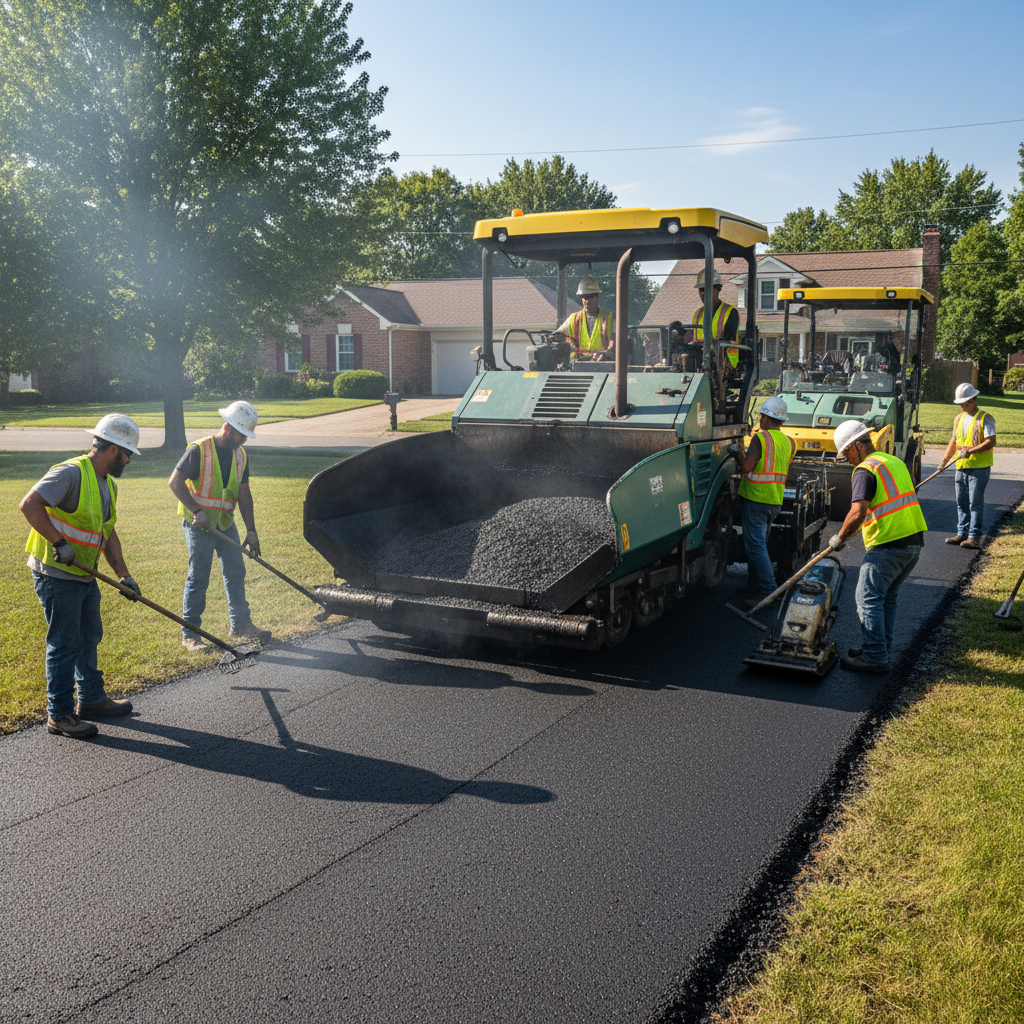
Driveway paving options and costs in Grande Cache
Grande Cache homeowners typically have three practical choices for a durable driveway: asphalt, interlocking concrete pavers, and concrete. With a population of 3,276 (Statistics Canada, 2021 Census), the town is small enough that scheduling can get tight in the short paving season, but it’s large enough that contractors are familiar with recurring issues like frost heave at weak subgrades. In most private residential settings, driveways are attached to detached homes—so your driveway surface has to handle frequent vehicle loads, plowing, and winter moisture movement over the same freeze–thaw cycles year after year. In the Grande Cache area, cold continental weather and frost penetration (to roughly 1.2 m / 4 ft in the broader region) mean the base build-up and drainage detailing often matter as much as the surface material. If water can’t get off the driveway quickly, it freezes, expands, and pushes the surface upward, leading to cracking or raveling and higher maintenance costs.
Because the paving window is usually late spring through early fall (and hot-mix asphalt placement relies on adequate air temperature), contractors often prioritize larger, more efficient jobs first. That can affect pricing on smaller driveways in peak months, plus travel and mobilization to the surrounding region. Trade is especially in demand in and around downtown/central Grande Cache, where many properties need upgrades to older, failing asphalt or gravel approaches.
Below is a realistic comparison of common driveway options and where each one tends to land on cost per square foot in Alberta’s cold-climate conditions, setting you up to discuss the right scope with a local contractor.
| Material |
Lifespan |
Maintenance |
Best For |
Price per sq ft |
| Asphalt (new installation, proper base) |
15–25 years |
Seal every 3–5 years; patch minor cracks |
Best value when the base and drainage are done right |
$12 – $20 |
| Asphalt (overlay on existing gravel base) |
10–18 years |
More frequent patching; seal within 6–12 months |
Budget upgrade when you’re not ready for full rebuild |
$10 – $17 |
| Interlocking concrete pavers |
25–35 years |
Replace individual pavers if needed; reset minor areas |
Curb appeal and easy repair without full replacement |
$18 – $30 |
| Poured concrete (broom finish) |
25–30 years |
Crack filling as needed; keep edges well maintained |
Low maintenance look; strong long-term surface |
$15 – $25 |
| Exposed aggregate concrete |
25–30 years |
Seal/maintain appearance; crack repair as needed |
Slip resistance and a higher-end finish |
$20 – $32 |
| Gravel / crushed stone (budget option) |
3–8 years (typical before major regrading) |
Rake and top up annually; manage washboarding |
Temporary solution or overflow parking |
$4 – $10 |
Prices are estimates only and vary by project scope, site access and material selection.
What affects the price of paving in Grande Cache
In Grande Cache and across the Calgary economic region, it’s common to see quotes for the “same” driveway differ by 30–50% once you compare how each contractor handles the details. The biggest reasons are base depth and drainage design (both driven by frost and water), the amount of tear-out and disposal, how the site can be accessed by equipment, and whether you’re getting an actual freeze–thaw-rated asphalt mix or a cheaper substitute. In a cold continental climate, frost doesn’t just sit at the surface—it penetrates deeply. When water gets into the base and freezes, it expands and pushes the surface, so contractors need a well-graded granular base and positive drainage to limit heaving, cracking, and surface raveling. For the “cold continental” reality here, deeper, compacted granular layers are typically required (often more than you’d see in milder areas), and the granular thickness becomes a major cost driver.
The paving season is also compressed. Asphalt placement usually requires air temperatures above 10°C for good compaction and finishing, so crews are busier in late spring and summer. That increases scheduling pressure, and smaller projects can cost more per square foot because mobilization and crew time don’t scale down as neatly. On concrete, the same freeze–thaw cycles can raise the need for proper air-entrainment and jointing strategy; if they’re skipped or rushed, you may see cracking sooner. In Grande Cache, a driveway that includes landscaping tie-ins, culvert corrections, or regrading for runoff can move you from the lower end of asphalt pricing (around $12 – $20) toward the upper end once base and drainage work are included.
For a practical example: if asphalt is proposed at the low end, but the quote assumes you’ll keep the existing base, you may later pay for additional base correction or a full overlay. If instead you’re rebuilding the base properly, the cost may feel higher up front, but it protects against the kind of freeze–thaw water movement that drives early failures and repeat patching.
| Price Factor |
Why It Matters |
Cost Impact |
| Driveway area in sq ft |
Most labour and material are measured by surface area and thickness |
Highest impact; drives the total project price |
| Base depth required |
Frost line and freeze–thaw cycles determine granular thickness to prevent heaving |
Can swing cost significantly on the same surface area |
| Grading and drainage work |
Correct slope and positive drainage keep water from freezing under the surface |
Often adds noticeable labour and rock/soil removal |
| Tear-out of existing surface |
Breaking, hauling, and disposal take equipment time and tipping fees |
Can add major cost versus resurfacing |
| Edge restraints and curbing |
Prevents paver spread, asphalt edge breakdown, and soft shoulders |
Moderate to high cost, depending on length |
| Sealing requirement |
Asphalt should be sealed after curing (commonly 6–12 months) to reduce moisture damage |
Adds a future maintenance line item |
| Site access |
Narrow lots slow equipment movement and increase hand labour |
Usually raises labour cost on small drives |
| Asphalt mix specifications |
Freeze–thaw-rated mix design improves durability in cold cycles |
Can increase material cost but improves service life |
Permits & regulations in Alberta
In Alberta, most driveway paving within your own property typically does not require a building permit. However, the moment the work affects areas under municipal control, you may need approvals. That commonly includes paving or changing a work in the municipal right-of-way—for example, creating a new curb cut, modifying the boulevard area, or changing storm drainage patterns that connect to municipal infrastructure. If your driveway project involves altering stormwater flow, adjusting grading within the right-of-way, or making changes that impact ditch/catchment function, you should expect municipal review before construction begins.
Even where a permit isn’t required, Alberta rules still come with good practice: call for utility locates before you dig. In Alberta, use Alberta One-Call so services like gas, power, and telecom can be located and marked. Then confirm any lot-grading restrictions or setbacks with the local municipality (the details can affect how close you can place hard surfaces and how runoff must be directed).
How a Grande Cache homeowner can verify a contractor (step-by-step): (1) Ask for the contractor’s Alberta business/contracting licence information and confirm it through the appropriate online registry. (2) Require liability insurance—request a current certificate of insurance showing coverage for the job. (3) Verify WSIB/WCB coverage for workers; ask for the clearance letter/verification number. (4) Get these documents before work starts so you’re protected if an injury or damage claim arises. Finally, ensure the quote clearly states who handles excavation, disposal, and any approvals tied to right-of-way impacts.
Asphalt vs pavers vs concrete for Grande Cache driveways
For Grande Cache’s freeze–thaw winters and winter maintenance routine (plowing, sand, and salt in many areas), the “best” driveway material is the one that stays stable under water and vehicles—not just the one with the lowest first cost. Asphalt is usually the lowest upfront option and can be a strong performer when the base is compacted properly and drainage is correct. The trade-off is maintenance: you’ll want to plan for sealing every 3–5 years, and you should expect crack patching as the driveway naturally ages. In the cold continental climate, a weak or poorly drained base is what usually shortens asphalt’s life.
Interlocking concrete pavers typically cost more up front, but they’re very repairable. If a section suffers from localized subgrade movement, pavers can be removed, the base corrected, and the units reset without tearing out the whole driveway—an advantage in areas where soils can vary. Poured concrete sits in the middle for pricing, but concrete must be air-entrained and correctly jointed. If it isn’t, freeze–thaw can lead to cracking, and de-icing salts can accelerate surface wear.
For Calgary-region frost conditions, base preparation is usually the deciding factor. A properly built base that sheds water well is what helps all three options perform. If your contractor is proposing asphalt at $12 – $20 per sq ft but offers minimal base thickness and no drainage corrections, you may see early failure and repeated repairs. In contrast, paying for a full rebuild that aligns with cold-climate specs can make the price difference worthwhile. For example, moving to interlocking pavers from asphalt can be justified when you expect frequent maintenance access or you want curb appeal that repairs easily—where asphalt repairs often blend over time.
| Material |
Frost Resistance |
Curb Appeal |
Repair Method |
Lifespan |
Price Band |
| Asphalt (sealed regularly) |
Good when base is well-drained and mix is freeze–thaw rated |
Medium (clean, uniform finish) |
Cut and patch; seal to blend and protect |
15–25 years |
$12 – $20 |
| Interlocking concrete pavers |
Excellent due to modular replacement and edge restraint |
High (custom patterns and colours) |
Lift affected area; rework base; reset pavers |
25–35 years |
$18 – $30 |
| Poured concrete (air-entrained) |
Good with proper air entrainment, jointing, and curing |
Medium (depends on finishing) |
Patch or replace slabs where cracking occurs |
25–30 years |
$15 – $25 |
| Exposed aggregate concrete |
Good with proper mix and curing; slip-resistant finish |
High (texture and premium look) |
Localized patching or slab replacement as needed |
25–30 years |
$20 – $32 |
| Permeable pavers (drainage grid) |
Very good when designed to manage runoff and infiltration safely |
High (modern look) |
Remove/re-level sections; clean drainage media |
20–35 years |
$22 – $38 |
| Chip seal / tar-and-chip |
Moderate; depends heavily on base quality and maintenance |
Low to medium |
Spot repairs; recoat or re-seal as it wears |
7–15 years |
$10 – $16 |
How to choose a paving contractor in Grande Cache
Choosing the right contractor matters in Grande Cache because cold weather amplifies mistakes—thin bases, poor drainage, and rushed compaction can show up as cracking or heaving sooner than you expect. Start by verifying Alberta coverage requirements. Ask for the contractor’s WSIB/WCB clearance (or proof of coverage) and a copy of their liability insurance certificate with job coverage noted. To verify, review the certificate details (policy number, effective dates, insured party) and confirm the clearance letter/verification number is current and matches the contractor you’re hiring. If a contractor won’t provide documents promptly, that’s a serious warning sign.
Next, get 2–3 itemised written quotes rather than a single lump-sum price. Itemization should include labour and materials breakdown: excavation, granular base (type and depth), compaction, asphalt mix type, paving thickness, edge restraints, forms, rebar (if concrete), and disposal/tipping fees. Carefully check what’s excluded: are permits included (if right-of-way changes are involved), is disposal included, and are underground services protected?
Warranty is another big filter. Ask for the workmanship warranty length, whether the product/material warranty is separate, and if it’s transferable if you sell the home. Payment schedule should protect you: never pay more than 10–15% upfront. Hold back remaining funds until the job is complete and you’ve reviewed the final grade, edges, and any punch-list items. Finally, insist on a timeline in writing: requested start date, weather contingency expectations, and an estimated completion date—especially important during the short Alberta paving season.
- Confirm Alberta licensing/registration details before signing.
- Request liability insurance certificate and verify effective dates.
- Verify WSIB/WCB clearance for workers (current letter/number).
- Ask for an itemised quote: base materials, thickness, compaction, and disposal.
- Confirm whether tear-out includes breaking, hauling, and tipping fees.
- Ask about drainage: slope, ditch/catch basin tie-in, and culvert considerations.
- Require edge restraint details (curb, form, or proper paver locking).
- For asphalt, ask what mix design is used for freeze–thaw durability.
- For concrete, verify air-entrainment, joints, and finishing specs (broom/aggregate).
- Clarify warranty: workmanship length and who honours material claims.
- Set payment terms: 10–15% max upfront; holdback until final acceptance.
- Get a written start date and completion estimate with weather contingencies.
In Grande Cache, watch for red flags like: a quote that doesn’t specify base depth or drainage details, refusing to show WSIB/WCB or insurance documentation, promising “same-week” installs without confirming material placement temps and scheduling constraints, skipping line-item disposal/tear-out costs, or offering a one-year warranty that covers workmanship but not common early issues like edge breakdown or poor compaction.
Frequently asked questions — paving in Grande Cache
How do I maintain my driveway through Grande Cache winters?
In Grande Cache, winter maintenance is mainly about controlling water and avoiding surface damage. Start with drainage: keep the driveway’s slope directed so runoff doesn’t pond near garages or edges—standing water freezes and drives heaving. For snow removal, plow with care and avoid scraping too aggressively; repeated gouging can expose aggregate and speed up raveling on asphalt. Use sand instead of excess salt when possible, since salt and moisture accelerate surface wear, especially on concrete. If you have asphalt, plan to re-seal on schedule (typically every 3–5 years). If you notice small cracks after freeze–thaw cycles, patch early rather than waiting for water to pump under the surface. Finally, if you ever see a soft spot, don’t ignore it—localized base movement often means drainage or compaction needs correction before the next season.
Is it worth sealing a new driveway right away in Grande Cache?
Usually, yes—but timing matters. For asphalt, sealing is commonly recommended after the new pavement has cured, often after 6–12 months, so the binder stabilizes and you don’t trap excess moisture in the surface. In Grande Cache’s cold continental climate, sealing too early can reduce the seal’s effectiveness and make future wear less predictable. If your quote includes sealing as an add-on, it may cost less than “reactive” maintenance later, especially because asphalt failures often start where water enters. If you’re comparing costs, asphalt driveway paving typically falls around $12 – $20 per sq ft, while sealing and repair projects often land in a separate range such as $400 – $1,500 depending on surface area and crack treatment. The best approach is to seal once curing is complete and then keep up with annual inspections and minor crack patching.
What is a chip seal driveway and is it suited to Grande Cache?
Chip seal (also called tar-and-chip) is a layered system where a binder is sprayed and topped with aggregate chips. It can be suited to rural-style drive approaches when you’re managing a smaller budget and can accept a shorter service life than asphalt. In Alberta’s freeze–thaw conditions, chip seal performance depends heavily on base prep and drainage; if water ponds, the surface can break down sooner. For Grande Cache properties where plowing is frequent, chip seal may require more monitoring and patching. If you’re looking for longevity comparable to asphalt, interlocking pavers, or air-entrained concrete, chip seal usually won’t be the first choice—though it can work where you need a temporary upgrade or overflow parking surface. If you’re considering it, ask for a clear scope: base depth, compaction method, binder type, aggregate size, and how they’ll keep edges from breaking up after winter.
How much does driveway crack repair cost in Grande Cache?
Crack repair cost in Grande Cache varies by crack type (active versus non-moving), length, and whether the contractor needs to cut, clean, and re-seal affected areas. For small, localized cracks, repairs are often priced as a short mobilization plus material and labour—so the minimum charges can matter more than you’d expect. As a practical planning range, sealing and repair line items commonly fall between $400 – $1,500, especially when a contractor includes crack cleaning/prep and a targeted sealant application. If cracking is widespread or tied to drainage/base movement, “spot repair” may not last and the cost can rise toward resurfacing or larger base correction. The best move is to get a quote that includes a brief assessment of whether the cracks are surface-only or suggest subgrade movement from freeze–thaw and water infiltration.
What base thickness do I need for pavers in Grande Cache?
For pavers in the Grande Cache area, base thickness is driven by frost and freeze–thaw moisture movement. While the exact build-up should follow your contractor’s design based on soil and drainage, colder regions typically require a deeper, well-compacted granular base than you’d see in mild climates to prevent heaving and settlement. The key is not just “thickness,” but also gradation (well-graded aggregates), compaction testing, and proper slope away from the house. If your site has poor drainage or variable soils, you may need additional base work and stronger edge restraint to keep paver edges from shifting during winter. When you get quotes, insist on base depth and materials in writing (what aggregate, how thick, and what compaction method). If someone won’t specify those details, treat it as a risk—especially with Alberta frost exposure to roughly 1.2 m in the broader region.
How do I get the most accurate paving quote in Grande Cache?
To get an accurate quote in Grande Cache, start with details that control cost: driveway dimensions (measure length and width), an estimate of thickness/condition of the existing surface, and photos showing cracking, ponding, or edge breakdown. Ask for 2–3 itemised quotes so you can compare base depth, drainage changes, haul-away/disposal, and finishing. A reliable contractor will include freeze–thaw considerations: proper granular base, positive drainage, and (for asphalt) a freeze–thaw-rated mix and compaction plan. Make sure the quote clearly states what’s included (permit approval if right-of-way impacts are involved, disposal/tipping, and any utility locates they rely on). For price reference, asphalt driveway paving often lands in the $12 – $20 per sq ft band, while pavers commonly sit in the $18 – $30 per sq ft band. Finally, request a written timeline and weather contingency because Alberta’s paving season is short.