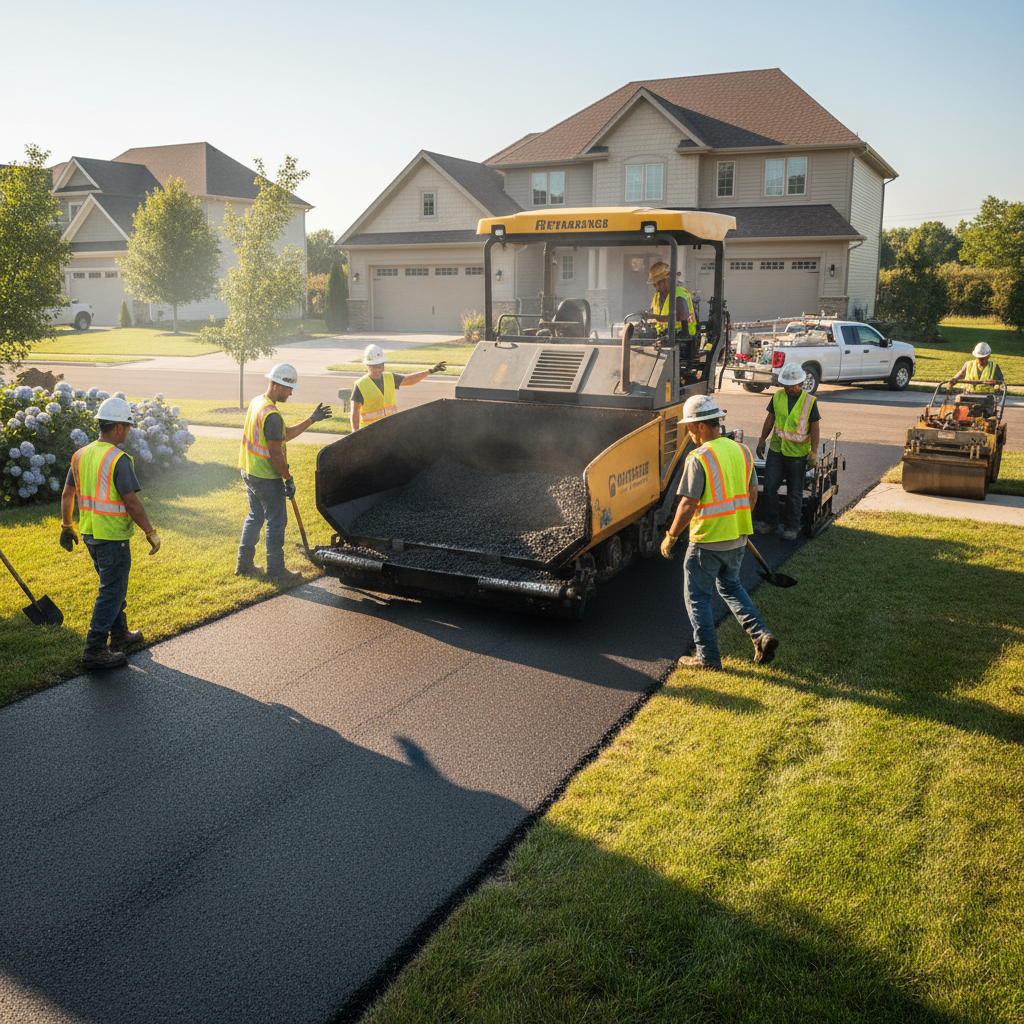
Driveway paving options and costs in Pincher Creek
Pincher Creek driveways are a good match for many homeowners because most properties here are single-detached homes—81.9% of the dwelling stock—so there’s a steady demand for private driveway paving. With 77.0% of households owning their homes (Statistics Canada, 2021 Census), you’ll also find owners planning multi-year maintenance, not just “quick fixes.”
In the Lethbridge–Medicine Hat economic region, pricing is shaped by frost depth, freeze–thaw cycles, and a shorter working season. Southern Alberta commonly sees frost penetration around the 6 ft range, so contractors plan for thicker, well-compacted granular bases and robust drainage to reduce frost heave and surface cracking. Because hot-mix asphalt typically needs air temperatures above 10°C, fall and early spring weather windows can tighten scheduling, especially for smaller residential jobs near places like downtown Pincher Creek and along Veterans Avenue, where access and parking/turnaround can be limited.
That means two driveways that look similar on paper can price differently once we include excavation depth, base preparation, drainage corrections, and tear-out/haul-off. The table below gives realistic installed cost ranges you can use to compare quote options, from budget gravel to higher-curb-appeal paving systems.
| Material |
Lifespan |
Maintenance |
Best For |
Price per sq ft |
| Asphalt (new installation, proper base) |
15–25 years |
Seal coat every 3–5 years; patch minor raveling |
Value-focused driveways with good subgrade/base prep |
$6.00–$12.00 |
| Asphalt (overlay on existing gravel base) |
8–15 years |
More frequent patching; sealing when oxidized |
Short-term upgrade when base conditions are limited |
$7.50–$13.50 |
| Interlocking concrete pavers |
25–40 years |
Re-seat individual pavers; occasional joint sand top-up |
Higher curb appeal, easier localized repairs |
$10.00–$20.00 |
| Poured concrete (broom finish) |
20–30 years (air-entrained) |
Small crack management; re-seal as needed |
Low maintenance, long-term straightforward finish |
$11.00–$22.00 |
| Exposed aggregate concrete |
20–30 years |
Re-seal periodically; surface cleaning |
Premium look with improved traction |
$14.00–$26.00 |
| Gravel / crushed stone (budget option) |
2–7 years (depends on drainage/grade) |
Annual top-up; re-grade; weed control at edges |
Temporary or cost-sensitive installs; low traffic |
$2.50–$6.00 |
Prices are estimates only and vary by project scope, site access and material selection.
What affects the price of paving in Pincher Creek
In Pincher Creek, the same “driveway replacement” can come in 30–50% apart between quotes because contractors price different assumptions about the subgrade, drainage, excavation depth, and how much labour is needed to get the base right for freeze–thaw. In a colder region like Lethbridge–Medicine Hat, frost depth and freeze–thaw cycles are decisive cost factors: deeper frost means thicker compacted granular base (often 6–12 inches for asphalt, depending on subgrade conditions and design) to prevent heaving, edge settlement, and early cracking. In coastal or milder areas you’ll sometimes see thinner sections, but in southern Alberta you typically pay for added excavation, aggregate, and compaction time.
The paving season is also shorter—hot-mix asphalt generally requires air temperatures above 10°C—so contractors can’t always “fit” jobs any time of year. That scheduling pressure can push unit rates, particularly for smaller residential drives where equipment mobilization is a bigger part of the total.
Concrete costs in Pincher Creek can also move based on whether the contractor includes air-entrainment and proper curing, plus whether they need steel reinforcement, dowels at garage transitions, or subdrain work for clay or poorly drained soils. If your home is from the pre-1981 era (69.2% of homes were built before 1981, Statistics Canada, 2021 Census), older lots often have older drainage patterns and fewer compacted base layers under the existing surface—so excavation and base rebuild can be higher. In many typical residential scopes, asphalt installed projects commonly land in the region of $6,000–$12,000, while interlocking pavers often price higher, commonly $9,000–$18,000, once the base and edge restraints are done correctly.
| Price Factor |
Why It Matters |
Cost Impact |
| Driveway area in sq ft |
Most materials and paving labour scale directly with square footage |
High (often the biggest swing, sometimes 2× between small vs. large drives) |
| Base depth required |
Frost line dictates granular thickness to prevent frost heave and cracking |
High (extra inches of compacted base add aggregate + compaction time) |
| Grading and drainage work |
Correct slopes and drainage keep water from saturating subgrade |
Medium–High (can mean subdrains, regrading, or ditch/boulevard tie-ins) |
| Tear-out of existing surface |
Breaking and hauling concrete or old asphalt affects disposal and labour |
Medium–High (varies widely by thickness and site access) |
| Edge restraints and curbing |
Prevents paver spread and asphalt edge failure at transitions |
Medium (especially important for pavers and near drive/sidewalk edges) |
| Sealing requirement |
Asphalt must be sealed after oxidation/raveling timing windows, typically 6–12 months after install |
Low–Medium (small cost now vs. reduced long-term maintenance later) |
| Site access |
Narrow lots slow equipment movement and may increase labour time |
Medium (truck/mixer access can change the method of placement) |
| Asphalt mix specifications |
Freeze–thaw-rated mix can cost more but improves performance in Alberta winters |
Medium (better durability reduces early failures) |
Permits & regulations in Alberta
In Alberta, paving a private driveway within your own property usually does not require a building permit. Most homeowners can replace or install a driveway surface on their lot without a formal permit, as long as you’re not altering municipal infrastructure.
Where permits/approvals do typically apply is any work affecting the municipal right-of-way or public drainage. That includes new or modified curb cuts, changing the boulevard or approach in a way that alters municipal drainage patterns, and any modifications that affect stormwater flow or pipe connections. If your driveway ties into a ditch or culvert area, you should confirm requirements with the City/municipality before excavation.
Also call for utility locates before any digging—Alberta One-Call is the right step so excavation crews don’t hit buried services.
For contractor due diligence, verify the basics before you sign:
- Alberta licence: confirm the contractor’s registration/credentials through the appropriate provincial/industry registry listings and ask for the licence number.
- Liability insurance: request a current Certificate of Insurance showing the contractor is insured for paving operations.
- WSIB/WCB coverage: in Alberta this is handled through WCB coverage—ask for proof/clearance and ensure it covers the specific work crews.
- Written documentation: keep copies of the COI and clearance letter as part of your quote file.
Asphalt vs pavers vs concrete for Pincher Creek driveways
For Pincher Creek winters, the big decision is how you want the driveway to behave through freeze–thaw and how you plan to maintain it over time. Asphalt is usually the lowest upfront option because you’re paying for hot-mix asphalt placement over a designed granular base. It typically needs sealing every 3–5 years to protect against oxidation and water intrusion—important in southern Alberta where repeated freezing and thawing can open up pathways for moisture.
Interlocking concrete pavers cost more up front, but they’re the most homeowner-friendly if you ever need localized repairs. With pavers, you can remove and re-pack only affected sections (often where drainage fails or where settlement occurs). That matters in areas where older drainage patterns—common on pre-1981 homes—can create soft spots after spring melt.
Poured concrete sits in the middle on price, and it can perform very well if it’s air-entrained and finished/curing practices are correct. The downside is that concrete can crack under freeze–thaw and subgrade movement; the key is proper base and drainage, not just the surface finish.
In Lethbridge–Medicine Hat’s frost conditions, all options depend on drainage and a properly prepared base designed to resist heaving. If your contractor is cutting corners on base depth or leaving standing water, you’ll see failures regardless of whether you choose asphalt, pavers, or concrete. A common example: moving from asphalt (often $6,000–$12,000 for many residential drives) to interlocking pavers (often $9,000–$18,000) is justified when you want maximum curb appeal and easier repairs—especially if you expect future landscaping or want the ability to lift and re-set portions. But if your site has straightforward access and drainage, asphalt can be the most cost-effective long-term value when properly sealed.
| Material |
Frost Resistance |
Curb Appeal |
Repair Method |
Lifespan |
Price Band |
| Asphalt (sealed regularly) |
Good with proper base + sealing |
Moderate (clean lines, black finish) |
Patch potholes/cracks; re-surface when needed |
15–25 years |
$6,000–$12,000 |
| Interlocking concrete pavers |
Very good when base is compacted and edged |
High (wide design selection) |
Remove affected pavers, re-base, re-set and re-sand |
25–40 years |
$9,000–$18,000 |
| Poured concrete (air-entrained) |
Good when air-entrained and well-prepped |
Moderate–High (depends on finish) |
Crack repair and patching; deep repairs can be localized or panel-based |
20–30 years |
$8,000–$16,000 |
| Exposed aggregate concrete |
Very good with correct mix and curing |
High (decorative texture) |
Localized patching; surface can be harder to “match” invisibly |
20–30 years |
$10,000–$20,000 |
| Permeable pavers (drainage grid) |
Good—helps manage surface water when designed correctly |
High (modern look) |
Remove/repack sections; maintain drainage stone and filters |
20–35 years |
$12,000–$22,000 |
| Chip seal / tar-and-chip |
Fair–Good; depends on frequent maintenance |
Low–Moderate (utility look) |
Re-chip patches; re-surface periodically |
6–12 years |
$5,000–$10,000 |
How to choose a paving contractor in Pincher Creek
Choosing the right contractor matters in Pincher Creek because freeze–thaw failures often trace back to base prep, drainage details, and workmanship—not just the top surface. Start by verifying Alberta credentials. Ask for:
- Alberta licence/registration: request the licence number and confirm it through the relevant online registry/resources where applicable.
- Liability insurance: ask for a current Certificate of Insurance (COI) before work begins.
- WCB coverage: request proof/clearance for workers performing the paving scope.
- Clear documentation: keep copies of COI and WCB clearance in your files.
Next, get 2–3 itemised written quotes. You want a breakdown of labour and materials (excavation, hauling, base rock, asphalt/pavers/concrete, compaction, disposal) rather than a single lump-sum number. Carefully review what’s included: base depth, disposal location, grading to achieve proper slope, and whether edging/restraints are included. Also ask whether a permit/municipal approval is needed for any right-of-way or drainage-related work and whether the contractor handles the paperwork or if you do.
Warranty should be clear: ask for the workmanship warranty length, what product/manufacturer warranties apply to materials, and whether warranties transfer to future owners. For payments, avoid large deposits—typically keep upfront to 10–15% and hold back the remainder until the driveway is completed and any final adjustments are done. Finally, insist on a written timeline with a start date window and a completion estimate so weather impacts don’t leave you guessing.
- Confirm proposed base thickness and compaction method.
- Ask how they handle frost-susceptible soils or clay (what base replacement is planned).
- Require a clear drainage plan (where water will go and how slopes will be set).
- Check whether utility locates are included in their process.
- Get disposal/haul-off included (or clearly excluded) in writing.
- Verify edge restraints are in the scope (especially for pavers).
- Confirm asphalt sealing timing (usually after 6–12 months for a new asphalt drive).
- Request details on crack control: control joints/tie-ins where applicable for concrete.
- Ask who supplies the materials and what specifications are used (freeze–thaw rated where relevant).
- Make sure ploughing access is considered (staying within your property line and edge protection).
- Confirm warranty terms for workmanship and how repairs are performed if something fails early.
- Get an equipment plan for access constraints (small lots may need smaller trucks or phased work).
In Pincher Creek, red flags I commonly see include: quotes that ignore base depth and only talk about the surface layer; no written scope for drainage and disposal; missing or outdated insurance/WCB documentation; vague warranty wording (“we stand behind our work” without dates/coverage); and scheduling that promises an install regardless of seasonal temperatures or curing requirements.
Frequently asked questions — paving in Pincher Creek
How much does it cost to pave a driveway in Pincher Creek?
For Pincher Creek driveways, realistic installed pricing depends heavily on square footage, tear-out (if any), and the granular base thickness required for Alberta’s freeze–thaw cycles. As a practical homeowner benchmark, asphalt driveway paving commonly lands in the $6,000 – $12,000 range for standard residential-scale projects when base prep and drainage are done properly. If you’re upgrading to interlocking pavers, a common installed band is $9,000 – $18,000, because you’re paying for pavers, bedding sand, and typically more detailed edging/edge restraints. Sealing and repair budgets often start around $300 – $2,500 depending on crack patching and whether a full seal coat is needed.
Asphalt vs interlocking pavers vs concrete — which is best in Pincher Creek?
In Pincher Creek, “best” depends on whether you prioritize lowest upfront cost, curb appeal, or easiest repairs. Asphalt is usually the best fit when you want a straightforward, cost-effective driveway and you’re willing to plan for sealing every 3–5 years (and often a first seal after 6–12 months). Interlocking concrete pavers are a strong choice if you want the highest curb appeal and the ability to replace only damaged sections without redoing the whole driveway—helpful when freeze–thaw or drainage issues create localized movement. Poured concrete can be an excellent mid-range option if it’s properly air-entrained and placed over a well-compacted base. If your lot has older drainage patterns—common in the area where many homes were built before 1981—drainage corrections and base depth will matter more than the surface material alone.
How long does a paved driveway last in Pincher Creek?
Lifespan in Alberta is mainly about base prep and water management during freeze–thaw. With proper granular base, compaction, and drainage, asphalt commonly performs for about 15–25 years; interlocking pavers often last 25–40 years because repairs are localized, and concrete typically sits around 20–30 years when air-entrained and cured correctly. If sealing is skipped or delayed, asphalt can oxidize faster, and small cracks can grow as water penetrates and freezes. In Pincher Creek, the spring melt period is when poorly drained areas reveal themselves first, especially on sites with clay or older subsurface conditions. Quotes that don’t clearly state base thickness and drainage slopes are the ones most likely to see early failures.
When is the best time of year to pave in Pincher Creek?
The best time is usually late spring through early fall. Hot-mix asphalt generally needs air temperatures above 10°C, so installing too early in spring or too late in fall can affect compaction and long-term performance. Contractors also need a weather window to keep surfaces dry during placement and to allow proper curing. Concrete projects similarly require attention to temperature and curing conditions to reduce cracking risk. If you’re planning a driveway, aim for a time when grading and base work can be completed, then paving can happen promptly afterward—this reduces the risk of moisture infiltration into subgrade during the cold-warm swings Pincher Creek experiences.
How deep should the base be for Pincher Creek's frost?
Pincher Creek’s region commonly plans around a significant frost depth (southern Alberta often in the 6 ft range), but the driveway base depth you’ll see in quotes is the practical, engineered thickness needed to protect the asphalt or concrete and keep the subgrade from heaving. In most residential scopes in Lethbridge–Medicine Hat conditions, you should expect a compacted granular base in the ballpark of several inches to more substantial depths (commonly 6–12 inches for asphalt depending on design and subgrade), plus proper drainage and grading. Clay or saturated soils can require increased base replacement. The key is that the contractor should state base thickness and explain how they’ll manage water—without that, “frost protection” is just a promise, not a plan.
How often should I seal my asphalt driveway?
For asphalt in Pincher Creek, sealing is typically planned after the new surface has cured—often around 6–12 months after installation—depending on how quickly the asphalt oxidizes and your weather exposure. After that, many homeowners budget for a seal coat every 3–5 years. The freeze–thaw cycles and spring melt season in the Lethbridge–Medicine Hat region make water intrusion a big risk, so sealing helps keep small voids from turning into cracks that can expand during freeze periods. If you plough often, avoid driving heavy equipment across soft edges and keep water from ponding at the driveway crown or near transitions. A good contractor will recommend the right timing based on how your asphalt looks, not just a calendar date.