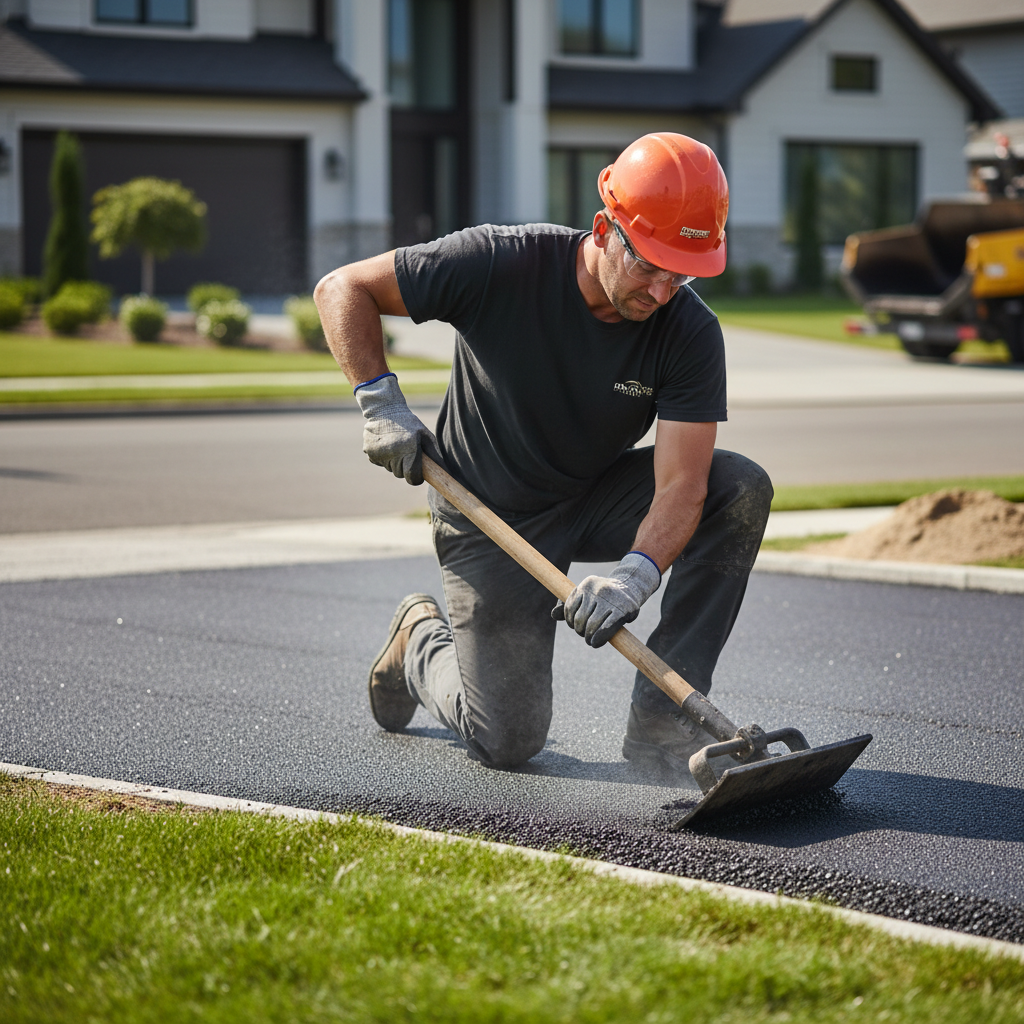
Driveway paving options and costs in Medicine Hat
Medicine Hat homeowners have a solid mix of driveway types, largely because most private driveways serve detached homes—single-detached dwellings make up 63.4% of the housing stock (Statistics Canada, 2021 Census). With 19,285 homeowner households, paving work is in steady demand, especially in older neighbourhoods where driveways were originally built with thinner bases or limited drainage. In Medicine Hat and the wider Lethbridge–Medicine Hat region, costs are pushed up by frost depth and freeze–thaw cycling: winters regularly drive pavement and subgrade through repeated expansion and contraction, and southern Alberta frost penetration can reach about 6 ft, so bases and drainage must be built to sit below the frost-affected zone. That means more excavation, more granular supply, and more compaction time than in milder climates.
Contractor availability also tightens because the practical asphalt window is short—hot-mix asphalt typically needs air temperatures above about 10°C—so crews often schedule in late spring to early fall. In areas with heavier soil or where drainage was never upgraded, like around the Ross Glen and Varsity Park areas, we commonly see spring patching and rework if a driveway was paved over a weak base. For that reason, the most cost-effective jobs are usually those that include proper base preparation, not just surface paving.
Below is a realistic comparison of installed options for a typical residential-scale driveway in Medicine Hat, Alberta—use it to sanity-check quotes before you book site measurements.
| Material |
Lifespan |
Maintenance |
Best For |
Price per sq ft |
| Asphalt (new installation, proper base) |
15–25 years |
Seal every 3–5 years; patch spot repairs as needed |
Lower upfront cost with good longevity when base + drainage are right |
$6–$12 |
| Asphalt (overlay on existing gravel base) |
10–20 years |
Seal every 3–5 years; increased patching if base is weak |
When excavation is limited but base can be corrected and compacted |
$5–$9 |
| Interlocking concrete pavers |
25–40 years |
Re-sand and re-level as needed; occasional replace of paver units |
Curb appeal, repairability, and better tolerance of localized movement |
$9–$18 |
| Poured concrete (broom finish) |
20–30 years |
Seal when appropriate; crack repair as needed |
Clean, simple finish and solid durability with air-entrainment |
$8–$16 |
| Exposed aggregate concrete |
20–30 years |
Seal optional; routine cleaning and crack repairs |
Anti-slip surface texture and upgraded look |
$10–$20 |
| Gravel / crushed stone (budget option) |
3–10 years |
Re-grade and top up annually; weed control |
Temporary solution or when budget is tight |
$2–$5 |
Prices are estimates only and vary by project scope, site access and material selection.
What affects the price of paving in Medicine Hat
In the Lethbridge–Medicine Hat region, it’s common to see quotes for the “same” driveway swing by 30–50% once you look beyond the surface material. That’s because Medicine Hat pricing is driven by the subgrade and frost design work—not just asphalt or concrete. Two contractors can both say “asphalt driveway,” but one includes a full tear-out, thicker compacted granular base, and drainage correction while the other only paves over what’s there. With a shorter season and real weather risk (cold snaps that can delay compaction and curing), crews also price in scheduling pressure, which can push unit rates higher for smaller jobs.
Frost depth and freeze–thaw cycles are decisive factors. In southern Alberta, deeper frost penetration means granular base thickness is often increased so the pavement stays supported through winter movement. In practical terms, that often translates to a deeper, well-compacted base than you’d see in milder regions, and it can bring the total installed cost into the $6,000–$12,000 asphalt band rather than a bare-bones number. If you’re comparing $9,000–$18,000 interlocking pavers, the higher upfront cost is usually justified where repairability matters—pavers can be lifted and re-laid if settlement happens near a service cut or drainage spot.
Concrete examples that change cost in Medicine Hat: first, homes built before 1981 are more likely to have older, narrower ditches or driveway culverts sized for past drainage patterns. Second, clay or poorly drained soils can require additional excavation and replacement with a free-draining base to reduce pumping and heaving. Finally, site conditions—like tight access off a rear lane or distance from aggregate delivery—raise labour and trucking costs during the short paving window.
| Price Factor |
Why It Matters |
Cost Impact |
| Driveway area in sq ft |
Most materials and paving labour scale directly with square footage |
High (often the biggest line item) |
| Base depth required |
Frost-affected movement demands thicker, compacted granular thickness |
High (more excavation + aggregate + compaction time) |
| Grading and drainage work |
Proper slope and subdrainage prevent water pooling and early failure |
Medium to high |
| Tear-out of existing surface |
Breaking, hauling, and disposal add time and equipment needs |
Medium to high |
| Edge restraints and curbing |
Restraints stop paver migration and asphalt raveling |
Medium |
| Sealing requirement |
Asphalt needs sealcoat within the right window to protect binder |
Low to medium (planned maintenance cost) |
| Site access |
Narrow lots slow equipment movement and increase manual handling |
Medium |
| Asphalt mix specifications |
Freeze–thaw-rated mixes cost more but perform better in Alberta winters |
Medium |
Permits & regulations in Alberta
In Alberta, most private driveway paving done entirely within your own property typically does not require a building permit. For example, replacing an existing driveway surface (asphalt overlay, full-depth asphalt, pavers, or concrete) within your lot lines generally falls under normal private property improvements. However, you should expect municipal approval when the work affects the city-owned right-of-way or public infrastructure.
Work that usually does require a municipal permit or approval includes: creating or changing a curb cut/approach where it ties into the boulevard, altering storm drainage patterns (new driveway culvert, reworking catch basins), modifying municipal sidewalks/boulevards, or any grading that changes how runoff enters municipal drainage. If your lot grading must be adjusted to meet municipal standards, that can also trigger approval.
Step-by-step, here’s how a Medicine Hat homeowner can verify the contractor correctly: (1) verify the contractor is properly licensed/authorized through the applicable Alberta business listings and trade credentials, (2) request a current certificate of insurance showing general liability limits appropriate for driveway work, and (3) confirm they carry required worker coverage (WSIB/WCB) for their crews—ask for documentation and match it to the company name on the quote. Before any digging, insist on utility locates through the appropriate Alberta utility locate service (Alberta One-Call) and confirm the contractor marks and protects all buried lines.
Doing this up front protects you from delays and safety issues when frost-season excavation and tie-ins are involved.
Asphalt vs pavers vs concrete for Medicine Hat driveways
In Medicine Hat, the “best” driveway material depends on how you want to balance upfront cost, appearance, and winter resilience. Asphalt is typically the lowest upfront option, but it performs best when you seal it regularly (often every 3–5 years) and maintain crack patching so water can’t get under the surface. Interlocking concrete pavers usually cost more initially, but they’re extremely repairable: if a settlement issue shows up near a service line or drainage spot, sections can be lifted, corrected, and reset without tearing out the entire driveway. Poured concrete sits in the middle on cost and looks clean, but it must be properly air-entrained and built with good base support to reduce cracking from freeze–thaw and de-icing exposure.
Local frost depth means base preparation is not optional for any option. In this region, you should plan for excavation and a thicker compacted granular base designed to resist frost-related movement, along with a well-shaped slope and drainage so the driveway can shed meltwater and rainfall. Salt and sanding from winter maintenance can be harder on surfaces if the mix and curing weren’t done correctly—especially on concrete.
Where interlocking pays off: if your property has frequent utility access, or the soil tends to hold water, pavers can be worth the higher total cost in the $9,000–$18,000 range because repairs are localized. If your site is straightforward and the base can be fully rebuilt, asphalt in the $6,000–$12,000 band can be the smartest balance—provided you seal on schedule and don’t skip the drainage fixes.
| Material |
Frost Resistance |
Curb Appeal |
Repair Method |
Lifespan |
Price Band |
| Asphalt (sealed regularly) |
Good with frost-rated mix + deep, compacted base |
Medium (clean, uniform look) |
Cut, patch, and re-tack/seal |
15–25 years |
$6,000–$12,000 |
| Interlocking concrete pavers |
Very good; accommodates minor movement without total failure |
High (premium appearance and colours) |
Lift and re-lay affected units |
25–40 years |
$9,000–$18,000 |
| Poured concrete (air-entrained) |
Good with correct mix design and base support |
Medium to high (sleek finish) |
Crack repair, partial patching |
20–30 years |
$8,000–$16,000 |
| Exposed aggregate concrete |
Good; durable surface texture with correct mix |
High (textured look) |
Patch sections; surface refinishing limited |
20–30 years |
$10,000–$20,000 |
| Permeable pavers (drainage grid) |
Very good where water management is critical |
High (feature drainage look) |
Replace modules as needed; clean outlets |
20–35 years |
$10,000–$22,000 |
| Chip seal / tar-and-chip |
Moderate; depends heavily on maintenance and binder aging |
Low to medium (utility look) |
Top-up layers or spot repairs |
6–12 years |
$5,000–$10,000 |
How to choose a paving contractor in Medicine Hat
Choosing a paving contractor in Medicine Hat starts with confirming they’re properly set up to do the work safely and legally. Ask for their Alberta business credentials and verify they can show current certificate of insurance (general liability) that covers driveway excavation, material hauling, and any landscaping impact. Also confirm they carry required worker coverage for their crews (WSIB/WCB) and that the coverage applies to the specific project—request documentation rather than taking verbal assurances.
Next, get 2–3 itemised written quotes. The best quotes break out labour and materials separately (excavation, base material, compaction equipment, asphalt or concrete supply, paving, disposal, and any drainage adjustments). Avoid lump sums that don’t explain what’s included, especially for jobs on older lots where hidden issues—like poor drainage or soft subgrade—can drive extra costs. Ensure the scope answers: is disposal included for tear-out? Is permit pulling included if the work reaches the right-of-way? Are edge restraints included for pavers? What’s the sealing schedule for asphalt?
Check warranty terms carefully. A workmanship warranty should be in writing with a clear duration, and you should understand whether it applies to subgrade prep too. Payment schedule matters: never pay more than about 10–15% upfront, and use a holdback until the job is complete and acceptable. Finally, insist on a written timeline with a start date target and completion estimate—short seasons in southern Alberta can shift schedules, but good contractors plan around weather risk rather than disappearing mid-project.
- Ask for proof of current insurance (certificate) and ensure company name matches the quote.
- Confirm required worker coverage (WSIB/WCB) for all crews assigned.
- Get an itemised quote: excavation, base thickness, compaction, paving, and disposal listed.
- Require a written scope stating what’s included/excluded (topsoil, regrading, drainage corrections).
- Ask how they handle utility locate markings and protection during excavation.
- For asphalt, confirm freeze–thaw-rated mix and whether sealcoat is planned after curing (typically 6–12 months).
- For pavers, confirm base and bedding sand specs, edge restraints, and polymeric jointing (if used).
- For concrete, confirm air-entrainment and finishing method (broom finish) plus jointing plan.
- Ask about equipment: compaction type and lift thickness control (not “we just paved it”).
- Clarify warranty length for workmanship and how product/manufacturer warranty applies.
- Use a payment schedule with a holdback until clean-up, punch list, and final grade are accepted.
- Request start/completion timing in writing and confirm weather contingency practices.
Red flags to watch for: vague scopes that don’t list base depth or drainage work; demanding a large upfront payment; no written warranty terms; refusing to provide insurance/worker coverage documents; and crews that won’t discuss frost-related base design or how they’ll protect slopes and edges during installation.
Frequently asked questions — paving in Medicine Hat
How do I maintain my driveway through Medicine Hat winters?
In Medicine Hat, maintenance is mostly about preventing water from getting into cracks and joints during freeze–thaw cycles. For asphalt, keep on top of crack patching and avoid letting meltwater pond on low spots—grading and drainage fixes during paving are what make winter maintenance easier. Use sand for traction if possible and limit de-icing chemicals that can accelerate surface wear, especially on concrete. If you have pavers, clear debris from joints and keep edge restraint tight so movement doesn’t open gaps. Also, don’t plough too aggressively; repeated impact can ravel asphalt edges and loosen paver units. If you’re seeing early surface break-up after a spring thaw, that’s usually a base or drainage issue showing up, not just “old age.”
Is it worth sealing a new driveway right away in Medicine Hat?
Generally, yes—but not immediately. For asphalt driveways in Alberta, sealing is typically done after the pavement has cured enough and after the surface is ready (commonly within a window that lands around 6–12 months for first sealing, depending on conditions). Sealing too early can trap moisture and reduce bond, which may shorten life rather than extend it. The key is choosing the right sealcoat product for Alberta freeze–thaw performance and applying it once the driveway is stable. If you’re paying in the asphalt range of $6,000–$12,000, plan a maintenance budget for sealing—skipping it often leads to binder aging, faster raveling, and more expensive patching. For concrete and pavers, sealing is optional and depends on your finish and how much staining you get from winter tracking.
What is a chip seal driveway and is it suited to Medicine Hat?
Chip seal (tar-and-chip) is an asphalt binder sprayed onto a prepared surface, followed by aggregate chips rolled in. It can work for low-cost or transitional applications, but it needs maintenance and isn’t as “set and forget” as full-depth asphalt or pavers in Medicine Hat’s freeze–thaw environment. In Alberta, repeated winter expansion can loosen chips if the base prep isn’t strong, and ploughing can disrupt the surface. That’s why chip seal is usually best where traffic loads are modest and where you’re okay with periodic top-ups. If your budget goal is lower, it can sit roughly in the $5,000–$10,000 type range for residential jobs, but for longer service life and fewer cold-weather surprises, many homeowners move to full asphalt in the $6,000–$12,000 band or to pavers when curb appeal and repairability matter most.
How much does driveway crack repair cost in Medicine Hat?
Crack repair pricing in Medicine Hat depends on crack type, crack width, and how much preparation is needed (cleaning and routing). Narrow, isolated cracks are usually cheaper because they can be cleaned and sealed or filled with minimal excavation. More involved work—where you need saw-cutting, removing loose asphalt/concrete edges, and replacing sections—costs more because it becomes a small reconstruction rather than a simple seal. Typical residential crack repair commonly falls in the $300–$2,500 maintenance range when treated properly early, but larger failures or multiple areas can climb. If cracks re-open after a spring thaw, it often points to base movement or drainage problems, so it’s worth getting the contractor to assess subgrade conditions, not just patch the surface.
What base thickness do I need for pavers in Medicine Hat?
For paver driveways in Medicine Hat, base thickness is driven by frost protection and your soil’s ability to drain. The practical approach in this region is to excavate to stable subgrade, then rebuild with a compacted granular base in layers designed to resist frost-related movement during Alberta winters. Because southern Alberta frost penetration can reach about 6 ft, contractors focus on placing the paving system on properly compacted, free-draining layers rather than assuming “one size fits all.” In quotes, you should expect discussion of excavation depth, granular type, lift compaction, and a correct bedding layer for pavers. If a contractor can’t explain the base build-up and drainage plan, be cautious—pavers can be repairable, but doing them over weak base leads to repetitive re-laying and ongoing settlement. Ask for the base specs in writing before work starts.
How do I get the most accurate paving quote in Medicine Hat?
To get an accurate Medicine Hat paving quote, start by asking for an itemised written estimate that includes what the contractor will do for base prep, drainage, tear-out/disposal, edge restraints, and (for asphalt) sealcoat timing. Provide site details: driveway dimensions, access constraints, and photos of current surface conditions, especially where water pools. If you can, mark where downspouts, utility covers, or service cuts are located. Also ask the contractor to confirm they’ll complete utility locates before excavation and to describe how they’ll address frost-prone areas with a deeper compacted granular base. Since the region’s season is tight and freeze–thaw cycles are decisive, workmanship details matter: compaction methods and lift thickness should be explained. Finally, compare apples-to-apples across quotes; if one quote lands near the low end of the asphalt band ($6,000–$12,000) but excludes drainage corrections, the “savings” can come back after the first thaw.