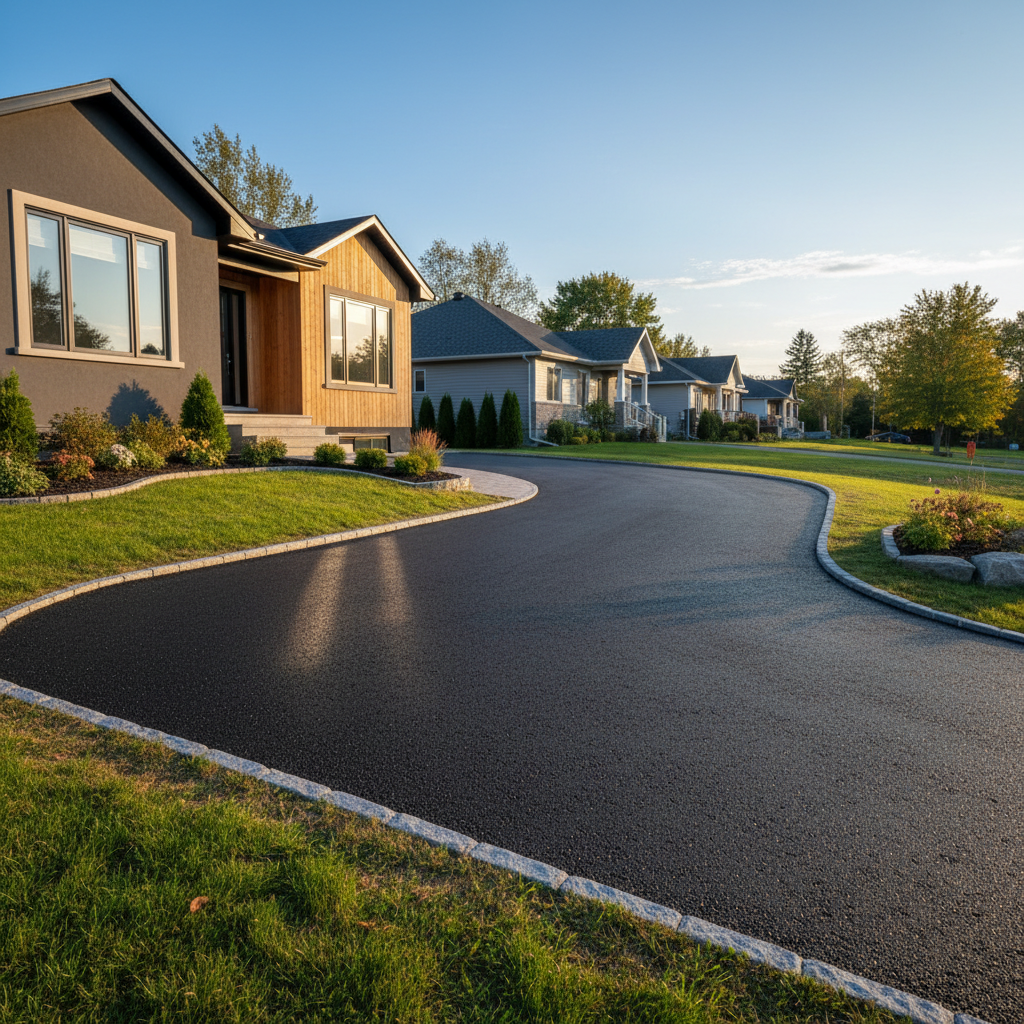
Driveway paving options and costs in Cochrane
Cochrane homeowners have a few reliable driveway pathways—mainly asphalt, interlocking concrete pavers, and concrete—each priced differently and each affected by our cold continental freeze–thaw cycles. With Cochrane’s population at 32,199 (Statistics Canada, 2021 Census), there’s steady demand for private driveway upgrades in established neighbourhoods like Bow Ridge and areas near highway access where vehicle traffic is heavy. The housing mix matters too: single-detached homes make up 59.8% of dwellings, so most driveways start as an attached-garage apron and a longer lane to the street. (Statistics Canada, 2021 Census)
In Calgary’s region, frost can penetrate to about 1.2 m (4 ft), which is why quotes in Cochrane often hinge on base thickness, drainage correction, and compaction quality—not just the surface material. A properly built granular base and well-graded aggregates help resist heaving and surface cracking caused by repeated water expansion in winter. Also, the paving season here is compressed: hot-mix asphalt typically needs warm conditions (often above 10°C air temperatures) to place and compact well, so spring and early summer scheduling can tighten and push costs upward on smaller jobs.
As a ballpark, asphalt driveway paving often lands in the $12–$20 per sq ft range, while interlocking pavers frequently price higher due to edge restraints, setting materials, and labour intensity (commonly $18–$30 per sq ft). Concrete sits between those two in many cases, with final cost depending on thickness, reinforcement, and finish type. Use the comparison below to align materials with your budget and maintenance tolerance.
| Material |
Lifespan |
Maintenance |
Best For |
Price per sq ft |
| Asphalt (new installation, proper base) |
15–25 years |
Seal every 3–5 years; crack fill as needed |
Best value with a solid base and routine sealing |
$12–$20 |
| Asphalt (overlay on existing gravel base) |
10–18 years |
Seal every 3–5 years; monitor subgrade settlement |
Budget option when the old base is stable |
$10–$16 |
| Interlocking concrete pavers |
25–35 years |
Weed control; replace a few units if needed |
High curb appeal and easy spot repairs |
$18–$30 |
| Poured concrete (broom finish) |
20–30 years |
Keep it sealed if salt/sanding is frequent |
Clean, straightforward maintenance |
$15–$25 |
| Exposed aggregate concrete |
20–30 years |
Seal periodically to reduce staining |
Slip-resistant surface and premium look |
$18–$28 |
| Gravel / crushed stone (budget option) |
5–12 years (depends on drainage) |
Regrade and replenish annually; weed control |
Lower upfront cost while you decide later |
$6–$12 |
Prices are estimates only and vary by project scope, site access and material selection.
What affects the price of paving in Cochrane
Even when two contractors quote the “same driveway,” you can easily see 30–50% differences across Calgary-area bids because the scope and the build quality behind the surface aren’t identical. In Cochrane, the biggest drivers are frost protection (base depth and granular gradation), drainage and grading accuracy, and how much work is required to remove and replace unsuitable material. A driveway that needs only resurfacing and tight compaction can come in closer to the asphalt $12–$20 per sq ft band, while a site with poor drainage or weak subgrade often pushes pricing toward the upper end—or beyond—because the base has to be rebuilt deeper and with more granular material.
Frost line depth and freeze–thaw cycles are decisive cost factors here: frost routinely penetrates to about 1.2 m (4 ft), so contractors typically target a deeper, well-compacted granular base to prevent heaving and cracking. In practice, that means more excavation and more aggregate hauled and compacted than what many homeowners expect. Concrete and asphalt mix design also has to suit local freeze–thaw conditions; for asphalt, that means a freeze–thaw-rated hot-mix and proper compaction.
Concrete examples from Cochrane: (1) homes built before 1981 (9.9% of dwellings, Statistics Canada, 2021 Census) may have older drainage patterns and settled subgrades where tear-out and base correction add cost; (2) driveways near slopes or swales often require grading changes so runoff doesn’t pool at the slab edges, which increases labour and disposal; (3) if you’ve been sanded heavily or salted, an older surface may be brittle, and tear-out becomes more extensive. When scheduling is tight, crews prioritize projects that fit the season—late spring through early fall—so mobilization and availability can affect per-square-foot pricing.
| Price Factor |
Why It Matters |
Cost Impact |
| Driveway area in sq ft |
Most costs scale with surface area and base excavation volume |
Primary driver; larger areas spread mobilization |
| Base depth required |
Frost protection depends on granular thickness and compaction |
More excavation/aggregate can add a significant portion |
| Grading and drainage work |
Slope and positive drainage prevent standing water and freeze damage |
Can add labour for regrading, pipe, or ditches |
| Tear-out of existing surface |
Breaking and hauling concrete/asphalt adds equipment time and disposal |
Often one of the biggest “surprise” costs |
| Edge restraints and curbing |
Prevents paver spread and asphalt edge deterioration |
Increases material and forms/blocks work |
| Sealing requirement |
Asphalt needs sealing after initial cure and periodically after |
Not always included upfront; affects lifecycle budget |
| Site access |
Narrow lots and limited turning slow equipment and raise labour time |
Can raise per sq ft on smaller driveways |
| Asphalt mix specifications |
Freeze–thaw-rated mix costs more and performs better in winter |
Premium mix typically adds modest cost but improves longevity |
Permits & regulations in Alberta
In Alberta, paving a private driveway within your own property typically does not require a building permit, especially when you’re working strictly on the driveway surface and base on your lot. However, permits and approvals can come into play when work affects the municipal right-of-way (the boulevard area), or when drainage and grading are altered in a way that could impact neighbours or municipal systems. For example, a new curb cut, changes to boulevard grading, modifications to storm drainage (such as adjusting catch basins or connecting new drain lines), or any work within the municipal right-of-way generally requires municipal approval before the first shovel moves.
Here’s how a Cochrane homeowner should verify contractor compliance step-by-step:
- Confirm the contractor’s licence status (where applicable) using provincial/industry listings or any trade registry they reference.
- Ask for a certificate of insurance for liability (and ensure it’s current for the project dates).
- Verify workers coverage: in Alberta, ensure WSIB/WCB coverage is in place (request the account number or clearance letter where available).
- Request the contractor’s written scope that clearly states what portion is on private property vs boulevard.
- Confirm utility locates have been ordered prior to excavation; even if it’s “just base work,” you need locates done.
Finally, confirm lot-grading rules with the municipality. Some areas restrict how close hard surfaces can be to property lines and how drainage must discharge. This matters in Cochrane because freeze–thaw damage is often triggered by ponding at slab or asphalt edges—so drainage compliance is both a regulation issue and a performance issue.
Asphalt vs pavers vs concrete for Cochrane driveways
Choosing the right driveway material in Cochrane usually comes down to three things: upfront cost, how well the surface handles freeze–thaw, and how much maintenance you’re willing to do. Asphalt is the lowest upfront option for many homeowners, often fitting the $12–$20 per sq ft band when the base is built correctly; it also requires sealing every 3–5 years to protect against winter wear and moisture infiltration. Interlocking concrete pavers cost more initially (commonly $18–$30 per sq ft), but they’re the most forgiving for repairs: if one section settles or gets damaged, you can lift and replace affected units without tearing up the entire driveway.
Poured concrete typically falls in the mid-range (often $15–$25 per sq ft depending on thickness and finish). In Cochrane’s climate, the key is air-entrainment and proper jointing so freeze–thaw can happen without random cracking. Salt and sanding from winter maintenance can accelerate deterioration if the slab isn’t designed and finished for harsh cycles. Across Calgary’s frost conditions, all three materials need a robust base and excellent drainage design; where they differ is how they tolerate movement and how repairs are handled once movement happens.
Where price difference is justified: if you’re quoted $18–$30 per sq ft for pavers but you anticipate future landscaping changes or want easy spot repairs, the higher upfront cost can make sense—especially on driveways with utility access or tighter turning that concentrates stresses. If your priorities are budget control and a straightforward upgrade, asphalt can be a strong choice—provided you plan for sealing and crack maintenance as part of your lifecycle cost.
| Material |
Frost Resistance |
Curb Appeal |
Repair Method |
Lifespan |
Price Band |
| Asphalt (sealed regularly) |
Good with freeze–thaw mix and proper base |
Moderate (sleek black finish) |
Mill and patch or crack fill |
15–25 years |
$12–$20 |
| Interlocking concrete pavers |
Very good; movement is managed by unit flexibility and base grading |
High (variety of patterns and edges) |
Lift and replace affected stones/edges |
25–35 years |
$18–$30 |
| Poured concrete (air-entrained) |
Good with air-entrainment, reinforcement, and joints |
Moderate to high (finish-dependent) |
Joint repair and patching |
20–30 years |
$15–$25 |
| Exposed aggregate concrete |
Good; slip-resistant but needs proper sealing strategy |
Premium look and texture |
Patch matching aggregate and sealer system |
20–30 years |
$18–$28 |
| Permeable pavers (drainage grid) |
Very good where drainage is challenging and base is engineered |
High (modern appearance) |
Unit replacement; inspect drainage layer |
25–35 years |
$22–$34 |
| Chip seal / tar-and-chip |
Fair to good; performance depends heavily on base and maintenance |
Low to moderate (rural/utility look) |
Spot recoating and re-chip sections |
6–12 years |
$10–$16 |
How to choose a paving contractor in Cochrane
For paving in Cochrane and across Alberta, you want a contractor who can prove they’re insured, properly covered for workers, and accountable for workmanship. Start by confirming they carry current liability insurance—ask for a certificate of insurance showing the policy is active for your project dates. Next, verify WCB/WSIB coverage (request a clearance letter or account verification when possible). Then, ask what equipment they’ll use for excavation, base compaction, and surface finishing. In cold climates, the “how” matters as much as the material.
Get 2–3 itemised written quotes. The best quotes break pricing into labour and materials (excavation, disposal, granular base, fabric/geotextile if required, asphalt/concrete or pavers, edging, and finishing). Avoid lump sums that don’t say what’s included. Clarify exclusions: will they haul away excavated material? Is permit/municipal approval assistance included if work touches the right-of-way? What about saw-cutting, patching ties into garage aprons, or replacing damaged curbs/edges?
Warranty should be in writing: ask the workmanship warranty length, whether product/manufacturer warranties apply, and if they’re transferable. For payment, don’t let the schedule become risky—never pay more than 10–15% upfront. Hold back a portion until the final grade, cleanup, and touch-up work are complete and approved. Finally, request a written start date and a completion estimate, keeping in mind the shortened paving season when freezing conditions can return quickly.
- Verify insurance certificate is current (liability) before work starts.
- Confirm WCB/WSIB coverage with a clearance letter or proof of account.
- Ask for Alberta contact info and project references in the Cochrane/Calgary area.
- Require a detailed scope: excavation depth, base type, compaction standards, and surface thickness.
- Confirm drainage responsibility—who fixes low spots and how runoff is directed.
- Ask whether utility locates are ordered before digging.
- Ensure tear-out and disposal are itemised and priced transparently.
- Get explicit line items for edging/restraints (especially for pavers).
- Clarify whether asphalt sealing is included after cure (or scheduled separately).
- Check warranty: workmanship duration, what’s covered, and claims process.
- Use a payment schedule with a holdback until final inspection.
- Confirm timeline in writing and plan for season/weather realities.
Red flags I see too often in the Cochrane market: a quote with no base specs, “we’ll grade it later” drainage promises, refusal to provide insurance/WCB proof, no itemised disposal or tear-out costs, and warranty terms that aren’t written or are limited to materials only.
Frequently asked questions — paving in Cochrane
Asphalt vs interlocking pavers vs concrete — which is best in Cochrane?
In Cochrane, the “best” choice depends on how you want to balance upfront cost, winter resilience, and repair flexibility. Asphalt is usually the most cost-effective at install—often aligned with the $12–$20 per sq ft band—so it works well if you’re willing to seal every 3–5 years and keep up with crack filling. Interlocking concrete pavers typically cost more (often $18–$30 per sq ft), but they’re ideal when you value curb appeal and easy spot repairs, especially if future access or localized settlement is a concern. Poured concrete is a strong middle ground and can last well when air-entrained and properly jointed, though it can crack if base prep or drainage isn’t right. Across Alberta’s freeze–thaw cycle, base build and drainage design are what determine long-term performance, regardless of the surface material.
How long does a paved driveway last in Cochrane?
Driveway lifespan in Cochrane hinges on base thickness, drainage, and whether the surface is maintained through winter cycles. With good installation and routine care, asphalt driveways commonly last 15–25 years. If you skip sealing and let water migrate into cracks, the surface can deteriorate faster. Interlocking pavers often reach 25–35 years because individual units can be replaced without removing the entire driveway. Poured concrete typically lasts 20–30 years when air-entrained, finished correctly, and protected by proper jointing and drainage to reduce ponding and freeze-related movement. Because frost penetration can reach about 1.2 m (4 ft), contractors should design deeper granular bases and ensure positive drainage to help prevent heaving and surface raveling.
When is the best time of year to pave in Cochrane?
The best window is late spring through early fall, when temperatures and ground conditions support compaction and proper curing. For asphalt, crews generally need warm enough air temperatures to place and compact hot-mix asphalt effectively—often around 10°C and up—otherwise you risk poor density and early failure. In Cochrane’s compressed season, demand can spike quickly, so booking early matters, especially for smaller driveways where mobilization is a bigger part of the total cost. Concrete also needs suitable temperatures for curing and finishing. If you plan a driveway upgrade during the shoulder months, ask your contractor how they handle weather delays and whether they schedule base work separately from surface placement.
How deep should the base be for Cochrane's frost?
There isn’t a one-size number, but the depth should be designed for Alberta’s freeze–thaw reality: frost can penetrate to about 1.2 m (4 ft). Practically, that means contractors must excavate to remove unsuitable material and then build a properly compacted, well-graded granular base. In Cochrane, if your site has clay, variable soil, or drainage issues, the required granular thickness typically increases because you need extra frost protection and water control to prevent heaving and cracking. A qualified paving quote should specify base thickness and materials, not just the surface price. If a contractor won’t clearly state the base depth and compaction approach, treat it as a major gap in the quote.
How often should I seal my asphalt driveway?
Sealcoating is part of the maintenance plan for asphalt in Cochrane. After the asphalt has cured, many homeowners plan sealing about 6–12 months after installation, then again every 3–5 years depending on sun exposure, traffic, and how often you sand/salt in winter. Sealing helps slow moisture infiltration into the asphalt surface, which reduces the chance of freeze–thaw damage and raveling at edges and cracks. If your driveway already has visible cracking, you may need crack filling before or as part of sealing. Cost-wise, sealing and repair budgets commonly run in the $400–$1,500 range depending on driveway size and surface condition, so it’s worth treating sealcoating as lifecycle budgeting—not an optional afterthought.
Why does my driveway crack and heave in winter?
Cracking and heaving in Cochrane usually come from a combination of water and movement. Freeze–thaw cycles cause water in the base or surface to expand when temperatures drop and contract when they rise. If drainage is poor (water pools near the slab edge or asphalt tie-in) or if the base is too shallow/poorly graded, the subgrade can shift, leading to heaving and tension cracking. Another common cause is inadequate compaction or a base that contains fines that hold water. Salt and sand don’t create the problem by themselves, but they can accelerate deterioration once cracks form, breaking down the surface over time. The best prevention is what you can’t see: engineered base depth, well-graded aggregates, and positive drainage—plus routine sealing to reduce water entry.