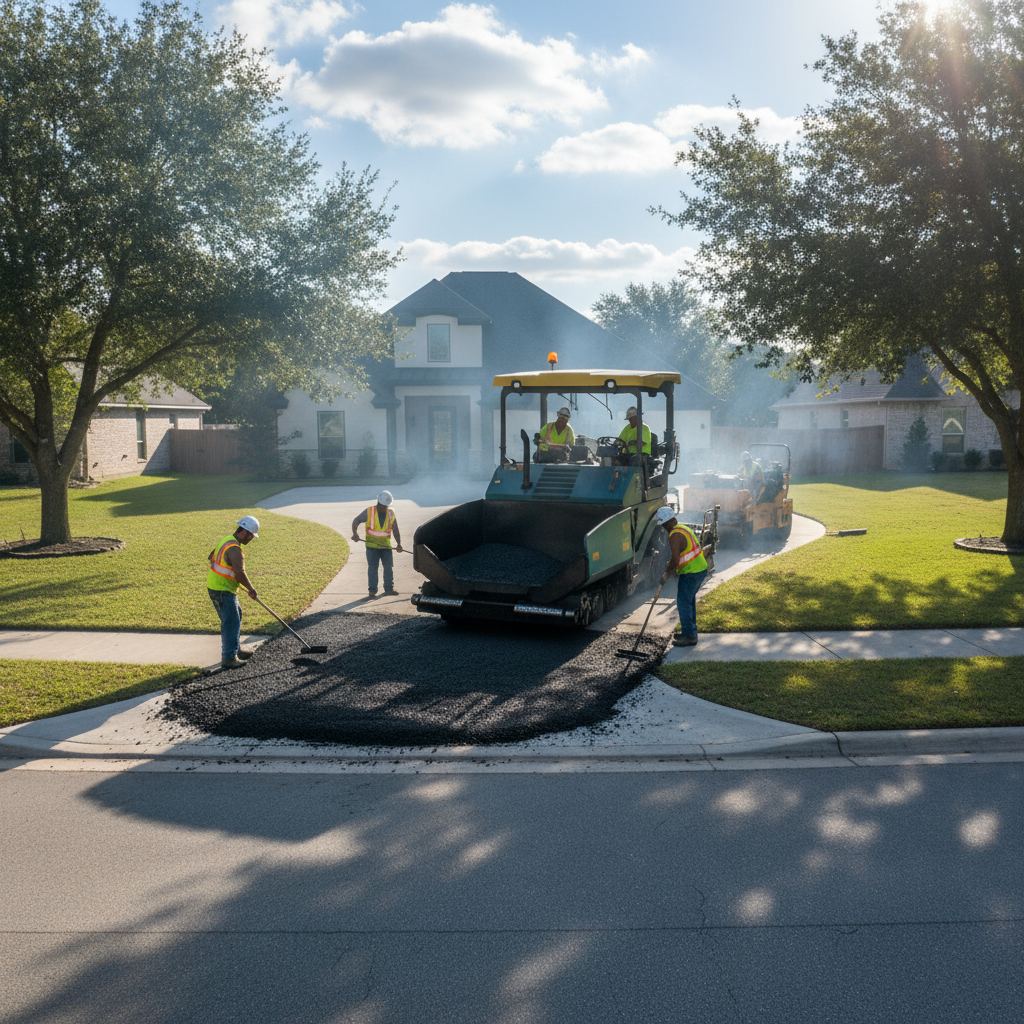
Driveway paving options and costs in Mayland Heights
In Mayland Heights, Alberta, choosing how to pave your driveway usually comes down to three trade-offs: upfront cost, how well the surface survives freeze–thaw, and how easily you can repair localized damage. With a population of 5,925 (Statistics Canada, 2021 Census), the neighbourhood market is small enough that crew availability can tighten quickly during peak spring installs, especially when multiple homeowners are trying to get work done before the summer traffic rush. Most private drives here are tied to detached homes, which is why the driveway business is consistently in demand for new builds and full replacements, not just patch jobs.
Calgary-area frost is a deciding cost driver. In our cold continental climate, frost can penetrate to about 1.2 m (4 ft), and repeated freeze–thaw cycles move moisture in and out of the subgrade. To reduce heaving, cracking, and surface raveling, contractors typically build a deeper, well-graded granular base and insist on positive drainage—work that costs more than it does in milder regions. On top of that, the paving season is compressed, since hot-mix asphalt generally needs suitable temperatures for compaction and curing (often above about 10°C air temperature). That shorter window can mean higher scheduling costs and tighter availability for smaller projects in late spring and early summer.
Below is a practical comparison of the main driveway materials homeowners consider in Mayland Heights. Use it to benchmark quotes, then we’ll break down what drives your final price and how to verify your contractor.
| Material |
Lifespan |
Maintenance |
Best For |
Price per sq ft |
| Asphalt (new installation, proper base) |
15–25 years |
Sealcoat every 3–5 years; crackfill as needed |
Most cost-effective full-surface option in winter-maintenance areas |
$12–$20 |
| Asphalt (overlay on existing gravel base) |
12–20 years |
Sealcoat every 3–5 years; monitor settlement |
Budget-minded upgrade when base is stable and drainage is corrected |
$10–$17 |
| Interlocking concrete pavers |
25–40 years |
Replace individual stones; re-sand joints as needed |
Curb appeal and easier repairs without full replacement |
$18–$30 |
| Poured concrete (broom finish) |
20–30 years |
Seal occasionally; joint maintenance and patching |
Low-maintenance look with predictable life if properly air-entrained |
$15–$25 |
| Exposed aggregate concrete |
20–30 years |
Seal periodically; minor patching blends in better |
Slip resistance and a higher-end surface texture |
$18–$28 |
| Gravel / crushed stone (budget option) |
3–8 years |
Top up annually; regrade; manage weeds/erosion |
Short-term solution or where you’re deferring hard-surface upgrades |
$6–$12 |
Prices are estimates only and vary by project scope, site access and material selection.
What affects the price of paving in Mayland Heights
In Mayland Heights and the broader Calgary region, it’s common to see quotes for the “same” driveway come in 30–50% apart. The gap usually isn’t the surface material alone—it’s the prep work (base depth, compaction, drainage corrections), the tear-out and disposal method, and how well the contractor matches the asphalt or concrete mix to freeze–thaw conditions. Labour availability also swings through the season: when the schedule tightens from late spring through early fall, smaller jobs can carry higher mobilization and minimum charges.
Frost line depth and freeze–thaw cycles are decisive cost factors here. With frost penetrating deeply in the Calgary area, contractors generally require a thicker, compacted granular base to prevent heaving and cracking. If a base is too thin for the winter moisture movement, you can get edge lifting and early surface deterioration—so the quote rises to reflect added aggregate, compaction passes, and sometimes underdrain or grading work. Concrete also needs the right mix design and joints to handle movement; air-entrainment is essential to keep freeze–thaw resistance high.
Two concrete examples of cost movement in Mayland Heights: first, if your driveway slopes toward the house or struggles to drain after spring thaw, drainage correction (regrading and sometimes new catch basins/pipe) can add significant line-item cost—but it reduces failure risk. Second, if your existing slab or asphalt is heavily deteriorated, tear-out and haul-away costs increase because breaking, loading, and disposal take time and equipment.
As a pricing anchor, many homeowners see asphalt installed and sealed in the general $12–$20 per sq ft range, while pavers often land in the $18–$30 per sq ft range because of higher labour and restraint/granular base requirements. For a 500 sq ft driveway, that material difference alone can shift your budget by roughly $3,000 to $9,000—before you even factor in how much prep the site actually needs.
| Price Factor |
Why It Matters |
Cost Impact |
| Driveway area in sq ft |
Most costs (materials + labour time + base) scale directly with surface area |
Highest overall driver—often sets your total budget |
| Base depth required |
Frost determines granular thickness needed to limit movement and water expansion |
Adding inches of base can materially increase aggregate + compaction labour |
| Grading and drainage work |
Fixing slope, swales, and runoff paths reduces future ponding and subgrade saturation |
Can add moderate to major costs depending on how much drainage must be rebuilt |
| Tear-out of existing surface |
Concrete/asphalt removal requires breaking, hauling, and disposal |
Frequently one of the most variable line items between quotes |
| Edge restraints and curbing |
Prevents paver spread and asphalt edge failure under freeze–thaw |
Increases material and labour but protects the perimeter lifespan |
| Sealing requirement |
Asphalt needs sealcoat after installation (and later) to resist water and oxidation |
Adds a recurring cost; good sealing often extends the asphalt life meaningfully |
| Site access |
Tight lots slow equipment placement and can require smaller machinery |
May trigger additional labour hours or minimum mobilization charges |
| Asphalt mix specifications |
Freeze–thaw-rated mixes and proper binder selection improve durability in winter conditions |
Upgraded mix can add cost but reduces early cracking/raveling |
Permits & regulations in Alberta
In Alberta, paving a private driveway within your own property typically does not require a building permit. However, work that affects the municipal right-of-way does require municipal approval. That usually includes changes such as new curb cuts, alterations to the boulevard area, or any modifications to storm drainage routing that impact public drainage. Some areas also apply lot-grading rules that restrict how close hard surfaces can be to property lines or how runoff must be directed. In Mayland Heights, where drainage performance matters in spring thaw, it’s smart to confirm grading expectations before you start.
Step one: call utility locates before excavation. In Alberta, use Alberta One-Call (or the current equivalent service) so locators mark underground services prior to saw-cutting or removing base material. Step two: verify what the contractor plans to do. If your scope includes trenching, pipe work, or any disturbance near boulevard/ROW areas, ask for written confirmation whether a permit/approval is required and who will handle it.
To verify the contractor properly, ask for and review: (1) their Alberta licence/registration details (where applicable for the work they’re performing), (2) a certificate of liability insurance with adequate limits for residential projects, and (3) proof of coverage for workers—typically WSIB/WCB status—so you’re protected if an injury occurs. If a contractor can’t provide current insurance documents on request, treat that as a serious warning and move on. Also request a clearance letter (when applicable) or the insurer/coverage confirmation your municipality or client documentation requires.
Asphalt vs pavers vs concrete for Mayland Heights driveways
For Mayland Heights driveways, all three options can work—but the best choice depends on how you expect the surface to perform in Calgary’s deep frost and how you handle winter maintenance. Asphalt is usually the lowest upfront cost and is a common fit for homeowners who want a clean, continuous finish without the premium look. The trade-off: asphalt requires sealing every 3–5 years and quick crack management to prevent water ingress during freeze–thaw cycles.
Interlocking concrete pavers cost more initially, but they’re repair-friendly. If a small section lifts or settles due to subgrade moisture, you can remove and reset only those units instead of replacing the full surface. That matters in a region where frost-driven movement and occasional drainage issues can show up at specific spots. Pavers also tend to hold curb appeal well, which is a big reason they’re popular in older residential pockets around local shopping and school access areas in the neighbourhood.
Poured concrete is a mid-range option that looks sharp and is generally durable if installed with proper air-entrainment and joints. Still, concrete can crack from freeze–thaw and movement if the base is weak or the mix/joint layout isn’t designed for winter loads and moisture. Exposed aggregate boosts traction, which can help in icy curb approach zones, but it doesn’t eliminate freeze–thaw risk without the right base.
Here’s where a dollar example helps: if asphalt lands near $12–$20 per sq ft, and pavers come in near $18–$30 per sq ft, that extra upfront cost is often justified if you value long-term repairability. For a 500 sq ft driveway, the difference can be roughly $3,000 to $5,000+—but you may avoid a full replacement later.
| Material |
Frost Resistance |
Curb Appeal |
Repair Method |
Lifespan |
Price Band |
| Asphalt (sealed regularly) |
Good when base is deep and sealed to resist water |
Mid to good |
Crackfill and patch; re-surface or overlay if needed |
15–25 years |
$12–$20 |
| Interlocking concrete pavers |
Very good with proper drainage and edge restraints |
High |
Remove and reset individual pavers or sections |
25–40 years |
$18–$30 |
| Poured concrete (air-entrained) |
Good with air-entrainment, correct base, and joints |
Mid to high |
Patch cracks; re-surface overlays are possible later |
20–30 years |
$15–$25 |
| Exposed aggregate concrete |
Good with the same requirements as poured concrete |
High |
Patch and blend; full replacement only if widespread failure |
20–30 years |
$18–$28 |
| Permeable pavers (drainage grid) |
Good when designed for soils and seasonal runoff patterns |
High (modern look) |
Replace localized sections; clean joints/grids |
20–35 years |
$22–$35 |
| Chip seal / tar-and-chip |
Moderate; performance depends heavily on base prep and weather |
Variable |
Maintenance re-sprays and spot patching |
6–12 years |
$8–$14 |
How to choose a paving contractor in Mayland Heights
Choosing the right paving contractor in Mayland Heights comes down to proof: proof they’re insured, proof they can execute the prep work that prevents winter failures, and proof their quote is itemised so you can compare apples to apples. In Alberta, you should request (and read) their documentation before work starts.
Start with Alberta licensing/registration where applicable for the scope, then verify liability insurance via a current certificate that names the insured party correctly and covers residential paving activities. Next, confirm worker coverage—commonly WSIB/WCB—with documentation that matches the date of the job. If they can’t provide these on request, don’t sign. For itemised quotations, ask for a breakdown of labour and materials (base materials, asphalt mix, paver units, concrete, restraints, geotextile if used, and disposal/tipping). A good quote won’t be a single lump number.
Read the scope carefully: what’s excluded (landscaping restoration, sidewalk approaches, regrading, cleaning)? Is permit/municipal approval included if the job touches the right-of-way? Is disposal of removed concrete/asphalt included? Warranty also matters: request the workmanship warranty length, whether there’s a separate manufacturer warranty for materials, and if the warranty is transferable to you as the homeowner. For payment, never pay more than 10–15% upfront—hold back until completion and final walkthrough.
Finally, insist on a written timeline with a start date and an estimated completion window. With Calgary’s compressed season, delays can happen, but reputable contractors will communicate realistically and adjust planning.
- Request proof of liability insurance (current certificate) before signing.
- Confirm WSIB/WCB coverage and ensure it’s active for the work period.
- Verify Alberta licence/registration for the type of work they’re performing (where applicable).
- Ask for 2–3 itemised quotes with labour + materials breakdown, not just a total price.
- Confirm base thickness, aggregate type, and compaction requirements in writing.
- Ensure drainage/grade corrections are included if your site has ponding or runoff concerns.
- Check whether tear-out and disposal/haul-away are explicitly included.
- Verify edge restraints/curbing are part of the scope for pavers and perimeter stability.
- For asphalt, confirm when sealcoat will be applied and whether crackfilling is included.
- Ask how they handle weather limits (temperature thresholds, rain plans, curing expectations).
- Confirm warranty terms: workmanship length, exclusions, and whether it transfers.
- Use a payment schedule with a small deposit (10–15%) and holdback until completion.
In Mayland Heights, common red flags include: quoting a full driveway without stating base depth or compaction method, skipping drainage correction while still promising long life, offering an “asphalt forever” warranty with no sealcoat plan, requiring large deposits upfront, and failing to provide current insurance/coverage documents when asked.
Frequently asked questions — paving in Mayland Heights
How long does a paved driveway last in Mayland Heights?
In Mayland Heights, driveway lifespan is largely about how well the base is built for frost and how your surface is maintained during Alberta winters. Asphalt installed on a proper granular base typically lasts about 15–25 years, but sealing is what really protects it from winter moisture. If you skip sealcoating, water works its way in during freeze–thaw and speeds up raveling and cracking. Pavers generally run longer—often 25–40 years—because localized repair is practical when small areas lift. Poured concrete is commonly 20–30 years when it’s air-entrained, joints are correct, and the subgrade drains well. If your driveway has standing water after thaw, expect a shorter life regardless of material.
When is the best time of year to pave in Mayland Heights?
The best time in Alberta is typically late spring through early fall, when soils can be compacted and materials can cure properly. For asphalt, contractors usually target stretches of weather where air temperatures are warm enough for effective compaction and for the mix to cool at the right rate—often meaning you’re watching for reliable daytime warmth (many crews plan around conditions above ~10°C). Calgary’s freeze–thaw cycle is the enemy of early installs: paving too early, when the subgrade is still cold or wet, can lead to premature settlement or surface defects. For concrete, you also need appropriate temperatures for curing and finishing, plus protection during cool nights. If you’re planning work, schedule sooner rather than later because the season is compressed and demand spikes.
How deep should the base be for Mayland Heights's frost?
Because frost in the Calgary region can reach around 1.2 m (4 ft), base depth and drainage aren’t “one size fits all” in Mayland Heights. In practice, contractors design the granular base thickness to control frost heave and moisture movement—usually resulting in a deeper, well-graded base than you’d see in milder climates. The exact depth depends on your existing soil conditions, driveway slope, how water drains off, and whether any underdrain or drainage corrections are needed. The key is that the base must be compacted in lifts to achieve density, using well-graded aggregate that resists movement. If a quote doesn’t clearly state base thickness (and the compaction approach), you should ask, because insufficient base is one of the most common reasons driveways fail early in Alberta winters.
How often should I seal my asphalt driveway?
For asphalt in Mayland Heights, sealcoat timing is critical. After a new asphalt installation, contractors typically recommend sealing after the surface has properly cured—often within the first 6–12 months depending on weather and mix, and then maintaining with re-seal cycles every 3–5 years. The reason is water control: freeze–thaw drives moisture into and through the asphalt, and sealing slows that pathway. If you live in a spot where runoff from spring melt hits the driveway more directly, you may need to stay on the earlier end of that interval. Expect crackfilling in addition to sealing—cracks should be addressed before water expands them during winter cycles. Sealing is also why asphalt life projections rely on maintenance, not just material choice.
Why does my driveway crack and heave in winter?
Cracking and heaving in Alberta winters usually comes from moisture + movement. During freeze–thaw cycles, water in the subgrade expands when temperatures drop, pushing the surface up or causing edges to lift. When the base is too thin, poorly graded, or not compacted correctly, it can’t resist that expansion. Drainage problems make it worse: if meltwater or rain ponds on or near the driveway, the subgrade stays saturated longer. Asphalt can also deteriorate faster if sealcoat is missed, because water gets into voids and weakens the pavement structure. Salt and traffic from plowing can contribute to surface wear, but the underlying cause is typically the frost-related performance of the base and drainage design.
Do I need a permit to pave my driveway in Alberta?
In Alberta, most homeowners paving a private driveway within their own property typically do not need a building permit. What often changes is whether the work touches the municipal right-of-way—like new curb cuts, altering boulevard areas, or changing storm drainage routes. In Mayland Heights, if your project includes drainage pipe work, curb/boulevard modifications, or anything near the ROW, confirm approvals with the municipality before excavation. Regardless of permits, always arrange utility locates through Alberta One-Call before breaking ground. As for cost: permit/approval work usually isn’t the biggest line-item, but it can affect scheduling, especially in peak spring. If your quote is around the common asphalt range of $12–$20 per sq ft, ensure the scope still includes the correct drainage and base work—permit issues shouldn’t be used as a substitute for good construction.