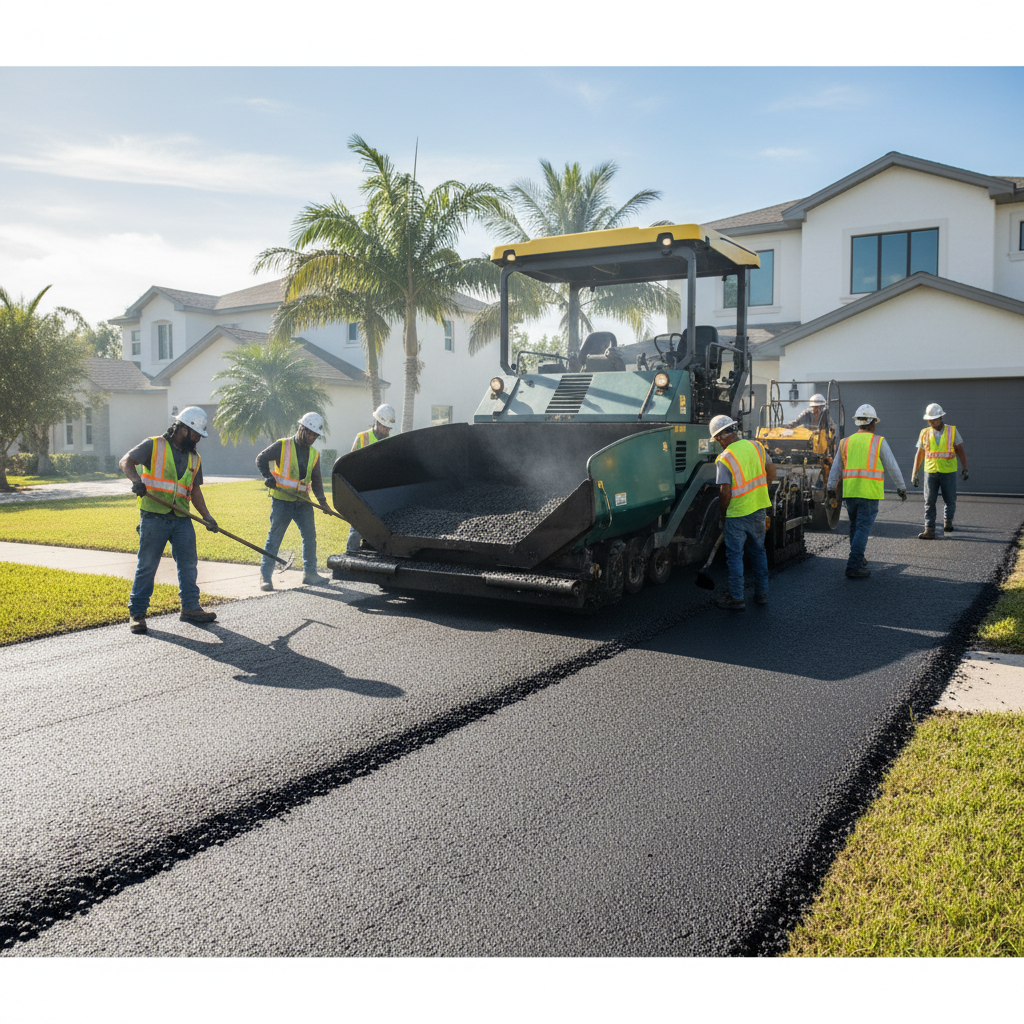
Driveway paving options and costs in Valley Ridge
Valley Ridge, Alberta is a small community within Calgary’s market, where driveways see frequent freeze–thaw movement and heavy winter maintenance. With a 2021 population of 5,365 (Statistics Canada, 2021 Census), most paving work here is tied to private single-family properties—where the driveway is often a key part of daily access and curb appeal. Calgary’s housing mix also means contractors commonly work around attached detached-home drive arrangements and fixed site layouts, which can make small-job mobilization surprisingly expensive compared with “one-size-fits-all” estimates.
In Calgary’s cold continental climate, frost can penetrate to about 1.2 m (4 ft). That drives the need for deeper, well-compacted granular base layers and positive drainage to limit heaving, cracking, and raveling. The paving season is also compressed: hot-mix asphalt needs warm conditions and proper curing, so spring and early fall scheduling can tighten and raise labour and equipment demand. On top of that, Valley Ridge crews often plan mobilization for nearby areas with similar soil variability, so access (gate width, turning radius, and haul distance) can shift your quote.
Demand tends to run higher in West Village–type pocket developments and newer infill pockets around Valley Ridge where homeowners want a finished, low-maintenance surface that holds up under plows and winter grit. Once you understand your base, drainage, and winter-use needs, you can compare the common surfaces below and match the right material to your budget and timeline.
| Material |
Lifespan |
Maintenance |
Best For |
Price per sq ft |
| Asphalt (new installation, proper base) |
15–25 years |
Seal coat every 3–5 years |
Most cost-effective, smooth driving surface |
$12–$20 |
| Asphalt (overlay on existing gravel base) |
12–20 years |
Seal coat every 3–5 years; monitor settlement |
When you’re keeping some existing material depth |
$10–$18 |
| Interlocking concrete pavers |
20–30+ years |
Joint sand refresh; re-level small areas as needed |
Curb appeal and easier localized repairs |
$18–$30 |
| Poured concrete (broom finish) |
20–30 years |
Crack monitoring; occasional caulking |
Clean, minimal maintenance look |
$15–$25 |
| Exposed aggregate concrete |
20–30+ years |
Sealer (as recommended by contractor); crack care |
Improved slip resistance and upgraded look |
$18–$28 |
| Gravel / crushed stone (budget option) |
2–8 years (surface level dependent) |
Re-grade and top-up annually |
Lowest upfront cost and temporary access |
$6–$12 |
Prices are estimates only and vary by project scope, site access and material selection.
What affects the price of paving in Valley Ridge
Even when homeowners pick the same finish—say, asphalt—Valley Ridge bids can land 30–50% apart across Calgary and the wider Alberta region. The spread usually comes down to what’s happening underneath the surface: base preparation quality, drainage corrections, soil conditions, and how much labour time is required to manage frost-sensitive subgrades. In winter-affected areas, two contractors may both “pave a driveway,” but one builds a thicker, well-graded base and addresses water control, while another leaves settlement and water pathways to cause early cracking.
Frost line depth and freeze–thaw cycles are decisive in the Calgary market. Repeated freezing and thawing can push moisture and expand water in marginal soils, so contractors often need deeper, properly compacted granular base layers (typically adding depth rather than shortcutting). Compared with milder climates, this means more aggregate, more compaction time, and better edge support. Asphalt also depends on a compatible mix design for cold weather freeze–thaw performance, and contractors may adjust the binder and gradation to match local specifications—mix choices that can increase material costs.
Concrete pricing can also swing. If your driveway has older settlement or poor drainage, the prep (excavation, subgrade stabilization, and form work) can erase the “lower material” advantage and push you toward the higher end of the $15–$25 concrete band. Conversely, a straightforward, flat access route with good existing base can keep asphalt near the $12–$20 range.
As a practical example, replacing a small 24 ft x 10 ft driveway (240 sq ft) that has pumping at edges with a full-depth asphalt build-out may justify the higher per-square-foot quote because you’re paying to stop water movement—rather than patching later.
| Price Factor |
Why It Matters |
Cost Impact |
| Driveway area in sq ft |
The larger the surface, the more materials and compaction passes required |
Highest driver; small projects feel pricier per sq ft in peak season |
| Base depth required |
Frost line depth influences granular thickness to prevent heaving and cracking |
More depth increases aggregate, trucking, and labour |
| Grading and drainage work |
Slope and runoff control reduce water infiltration during freeze–thaw |
Can add significant labour and materials for regrading |
| Tear-out of existing surface |
Removing old asphalt or breaking up concrete requires equipment and disposal |
Often one of the biggest “surprise” line items |
| Edge restraints and curbing |
Edges prevent lateral movement and paver spread, especially with plowing |
Improves longevity but increases material and form-work time |
| Sealing requirement |
Asphalt needs sealing after installation and periodically to limit oxidation |
Ongoing cost; best long-term value if included in plan |
| Site access |
Narrow lots, tight turns, or distance from laydown area slows placement |
Extra labour and equipment staging time |
| Asphalt mix specifications |
Freeze–thaw-rated cold climate mixes can cost more but resist premature failure |
Higher materials cost; usually improves durability |
Permits & regulations in Alberta
In Alberta, paving a private driveway within your own property usually doesn’t require a building permit. However, you should expect municipal approval in two common situations: when work touches the municipal right-of-way (ROW) and when you change how stormwater is handled at or near the curb/boulevard. Examples that typically DO require municipal authorization include new or altered curb cuts, modifications to boulevard areas, changes to driveway access points that affect roadside grading, and any drainage tie-ins that alter where runoff goes. Also be aware that some municipalities enforce lot-grading rules that can restrict how close a hard surface can be to property lines, ditches, or swales.
Step 1: call for utility locates before excavation. In Alberta, use Alberta One-Call (you’ll confirm services like gas, power, and telecom before any base work starts). Step 2: verify lot-grading requirements with the local municipality so your final slope and water direction match what’s allowed.
Step 3: verify your contractor’s Alberta compliance. Ask for their Alberta business details and check their licensing status using the appropriate online registry for contractors in your scope. Request a current Certificate of Insurance (general liability) naming you as an additional insured where applicable. Confirm workers are covered under WCB/WCB-equivalent coverage (commonly referred to as WCB in Alberta) by asking for a clearance letter or proof of account coverage. Finally, keep the insurance certificate and WCB documentation with your contract so you can quickly validate coverage if issues arise.
If a contractor says “no permit needed” without asking about curb cuts or drainage, that’s a yellow flag—especially in communities where drainage patterns and boulevard grading are regulated.
Asphalt vs pavers vs concrete for Valley Ridge driveways
For Valley Ridge homeowners, the three most common choices—asphalt, interlocking concrete pavers, and poured concrete—come down to upfront cost versus long-term resilience in Calgary’s freeze–thaw climate and how you handle winter maintenance (plowing, salt, and sand). Asphalt is typically the lowest upfront option and offers a smooth driving surface, but it must be sealed regularly (often every 3–5 years) to slow oxidation and help resist winter moisture intrusion. In Calgary’s cold conditions, a proper granular base and drainage design are what keep asphalt from “working” and cracking.
Interlocking concrete pavers are usually the highest initial investment, but they perform well when installed on a well-designed base and properly restrained edges. Their big advantage in Alberta is repairability: if a section settles or a utility needs access, contractors can lift and relay that area without replacing the entire driveway. That matters in neighbourhoods where soil variability and frost movement can create localized failures.
Poured concrete (especially when air-entrained) lands in the mid-range. With the right base, reinforcement strategy, and expansion/jointing, concrete can last decades. Still, it can be more susceptible to cracking if freeze–thaw moisture conditions aren’t controlled—or if salt and sanding practices are aggressive and the mix design isn’t cold-climate rated.
A concrete example: if you’re choosing between asphalt at roughly $12–$20 per sq ft and pavers at $18–$30, the extra cost is justified when you value curb appeal and easy spot repairs, or when you expect future re-grading or utility work. If your goal is the best value per season with a straightforward layout, asphalt is often the practical choice—provided the contractor builds the deeper base needed for frost performance.
| Material |
Frost Resistance |
Curb Appeal |
Repair Method |
Lifespan |
Price Band |
| Asphalt (sealed regularly) |
Good when base + drainage are engineered for freeze–thaw |
Medium (clean, uniform finish) |
Mill/patch localized areas |
15–25 years |
$12–$20 |
| Interlocking concrete pavers |
Very good with well-compacted base and restrained edges |
High (custom patterns and colours) |
Lift, re-level, and re-install affected blocks |
20–30+ years |
$18–$30 |
| Poured concrete (air-entrained) |
Good to very good if mix is cold-climate rated and joints are correct |
Medium (broom finish or upgrades) |
Resurface or patch; crack repair with caulking/patch compounds |
20–30 years |
$15–$25 |
| Exposed aggregate concrete |
Good; depends heavily on base and crack/joint detailing |
Very high (textured, premium look) |
Localized patching/repairs in affected panels |
20–30+ years |
$18–$28 |
| Permeable pavers (drainage grid) |
Very good for managing stormwater through the system |
High (modern drainage-focused look) |
Replace individual paver units; maintain drainage media |
20–30+ years (if maintained) |
$20–$35 |
| Chip seal / tar-and-chip |
Moderate; performance varies with base and workmanship |
Low to medium |
Spot patching; periodic re-surfacing |
5–12 years |
$8–$15 |
How to choose a paving contractor in Valley Ridge
Start by verifying the basics in Alberta. For licensing, ask the contractor for proof that they’re operating appropriately for the work they’re doing (especially if they’re performing excavation, hauling, or specialty paving). For liability insurance, request a current Certificate of Insurance and confirm coverage is active on your job start date. For workers, confirm WCB/WCB coverage: ask for a clearance letter or proof of account coverage before work begins. If you can’t get documentation early, that’s a sign to slow down.
Next, get 2–3 itemised written quotes. You want a labour + materials breakdown, not just a lump sum. Itemization should show excavation depth, base thickness, aggregate type/gradation, compaction method, asphalt mix type, and whether disposal and hauling are included. Also confirm scope exclusions: is curb work included? Are you paying separately for saw cutting, grinding, or removals? Will they repair subgrade pumping or only “pave over” suspect soil?
Warranty matters. Ask for a workmanship warranty length, what it covers (edge settlement? cracking? patch performance?), and whether it’s transferable if you sell your home. Product/manufacturer coverage may differ from workmanship coverage, especially for asphalt mix, paver units, or concrete mix components.
For payment, avoid large deposits: never agree to more than about 10–15% upfront for start-up costs, and request a holdback until the job is fully complete and cleaned. Finally, insist on a written timeline with a start date and an estimated completion date—Valley Ridge paving is weather-dependent in Calgary, so the more specific the plan, the fewer surprises you’ll see.
- Confirm Alberta proof of insurance and request a COI before signing.
- Verify WCB/WCB coverage with a clearance letter or proof of coverage.
- Require itemised quantities (base depth, asphalt thickness, excavation volume).
- Ask how they will confirm subgrade is dry and compactable before paving.
- Clarify disposal and haul-away costs for old asphalt or concrete.
- Specify drainage details: slope direction, tie-ins, and water shedding.
- Confirm edge restraints/curbing are included for pavers and to stabilize asphalt edges.
- Ask what compaction testing/verification they do (and provide results if available).
- Set a sealing plan for asphalt after installation (often 6–12 months timing).
- Get a written start/completion window and what triggers weather delays.
- Request warranty details in writing, including exclusions and coverage duration.
- Verify traffic control and site protection during the works (mud tracking, protection of landscaping).
Red flags in Valley Ridge include: a quote that doesn’t specify base thickness or drainage corrections, refusing to provide insurance/WCB documentation, “paving over” without assessing pumping or soft subgrade, quoting only a single blanket number with no breakdown, and pushing for large deposits early with no holdback tied to completion.
Frequently asked questions — paving in Valley Ridge
Do I need a permit to pave my driveway in Alberta?
In Alberta, most driveway paving done within your own property typically doesn’t require a building permit. Where you do need approval is when the work affects the municipal right-of-way—like changing a curb cut, altering boulevard grading, or modifying storm drainage patterns at/near the roadside. In Valley Ridge, confirm whether your driveway ties into any boulevard or changes how runoff flows, because lot-grading rules can limit slopes near property lines or ditches. Before excavation, always complete utility locates through Alberta One-Call. If your plan includes curb/ROW changes or drainage adjustments, ask your contractor to confirm the municipal steps they’ll follow and include any permit/approval responsibilities in the contract scope.
How long before I can drive on new asphalt?
For Valley Ridge asphalt installs, you can often drive on the surface the same day or after it cools enough for tire traffic—typically within several hours—depending on weather and the asphalt temperature. However, the safe “usable” period can be longer in cooler mornings or windy conditions because curing and set-up progress slower. A key detail is that asphalt performance is not just about immediate drive time; it’s about proper compaction and the ability of the mat to cool uniformly. For lifecycle maintenance, plan for seal coating after installation—commonly within 6–12 months—so you can protect the surface and avoid premature oxidation. If your quote lands near the $12–$20 range, ask whether sealing is covered in the plan or scheduled as a follow-up.
What causes potholes and how are they repaired?
Potholes usually start from water: freeze–thaw cycles pull moisture into weak base zones, then traffic expands that weakness into loss of material. In Calgary’s conditions, repeated freezing and thawing can lift the surface slightly, especially where base depth or drainage is inadequate. Sometimes contractors see potholes begin near edges where water collects or where edge support is missing. Repairs typically involve cutting out the failed area to sound material, removing loose base, rebuilding with compacted granular layers, and then patching asphalt with proper tack and compaction. If your driveway is underbuilt, patching may only last a season or two—so a good contractor will address the root cause (drainage and base), not just the hole.
How do I prepare for a paving project?
Preparation starts before the crew arrives. Clear vehicles, bikes, and planters from the driveway footprint and confirm where equipment will access your property (narrow gates can slow compaction and raise costs). Mark any utility lines you’re aware of and ensure you’ve completed Alberta One-Call locates if excavation is involved. Decide whether you’ll remove items like basketball hoops or decorative borders so landscaping won’t be damaged. You should also review drainage expectations: how you want meltwater and runoff directed so it doesn’t pond on the driveway. Finally, ask your contractor to provide an itemised scope and timeline in writing. In a cold continental climate where frost penetrates deeply, scheduling matters—work is usually timed to maximize asphalt and base compaction conditions in the short paving season.
How do I compare paving quotes fairly?
Compare quotes line by line, not by totals. For Valley Ridge and Calgary-area jobs, the biggest fairness issue is base and drainage scope: one contractor may include deeper granular base and slope corrections, while another may assume the existing subgrade is acceptable. Ask for asphalt thickness, base depth, aggregate type/gradation, disposal of removed material, and whether edge restraints are included (especially for pavers). Confirm whether a seal coat plan is included for asphalt (often after 6–12 months) and whether concrete includes jointing details and air-entrained mix. If a bid is much lower than others—outside typical $12–$20 asphalt or $15–$25 concrete bands—ask what they’re excluding. Fair quotes explain where the cost savings come from without skipping frost-and-water protections.
Can asphalt be laid in cold weather in Valley Ridge?
Asphalt installation in Valley Ridge is limited by temperature and curing conditions. Hot-mix asphalt generally requires air temperatures above about 10°C to place and compact properly, and the pavement needs adequate time to cool and set without trapping excess moisture. In Calgary’s fall shoulder season, crews often can work if the weather stays warm enough, but late-season cold snaps can force delays to protect quality. Freeze–thaw risk is a big reason contractors are cautious: if the base and mat can’t be properly compacted, you can see early cracking or raveling when the ground cycles. Your contractor should tell you the expected placement window and how they’ll manage weather. If you’re aiming for asphalt in the $12–$20 range, insist the quote includes the cold-weather precautions and that the crew won’t shortcut prep just to meet a date.