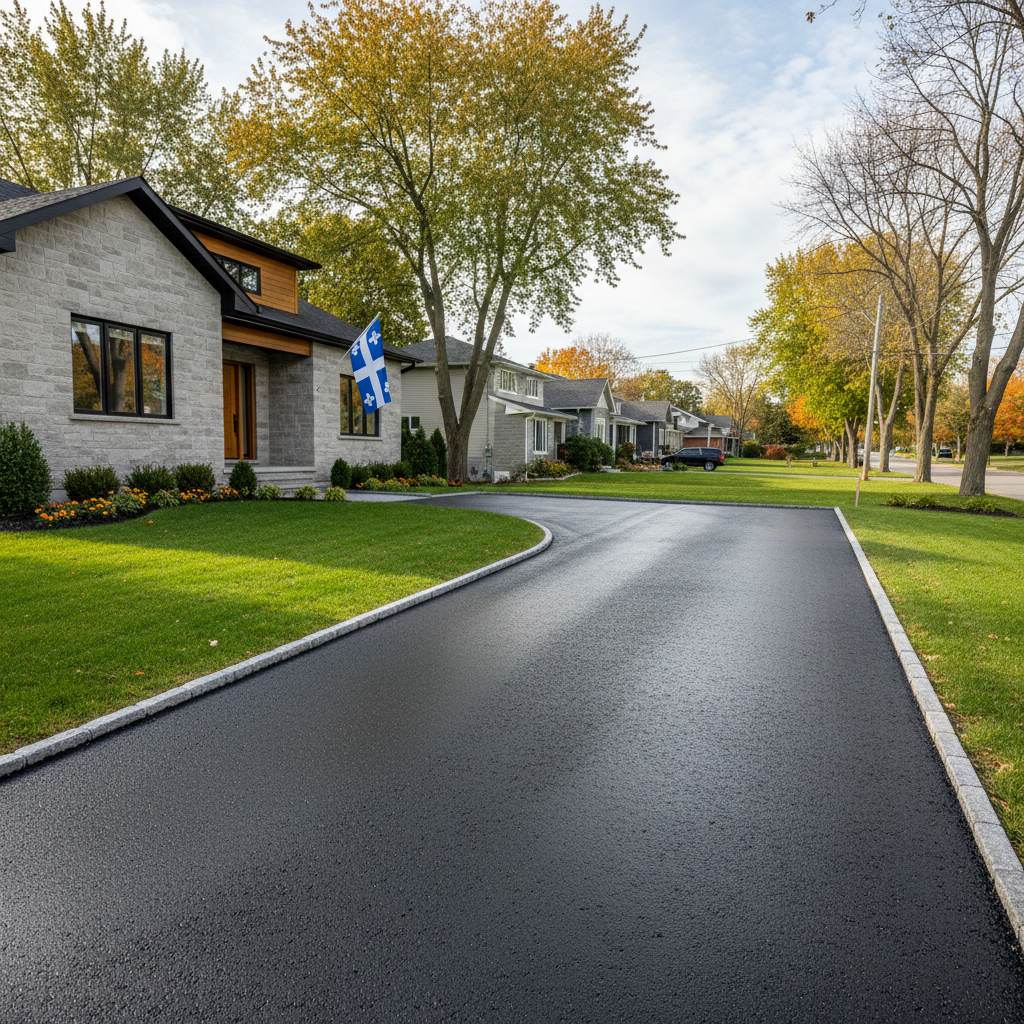
Driveway paving options and costs in Carstairs
Carstairs homeowners typically start with one question: what will it cost to pave a driveway that can handle Calgary-area freeze–thaw? In Carstairs, most homes are single-detached (79.9% of dwellings) and that matters because the vast majority of private driveways serve detached properties—an addressable market with consistent demand. With 1,590 homeowner households (86.4% of all households), there’s a steady flow of projects, especially as older homes (25.8% built before 1981) get renewed surfaces and updated drainage.
In the Calgary economic region, pricing is shaped by climate and timing. Frost in central Alberta commonly penetrates to about 1.2 m (4 ft), and water expansion during repeated freeze–thaw can lift a poorly built base, leading to cracking and raveling. That’s why contractors price “the base” almost as much as the asphalt or concrete surface. Also, the paving season is compressed—often late spring through early fall—so small jobs can cost more in peak months when crews and equipment are booked.
Within Carstairs, paving tends to be especially in demand around the more established residential pockets near Main Street and the broader town core, where driveways are older and access is tighter. If your existing driveway is failing, contractors may need extra excavation, granular base, and proper edge support before they can even touch the finished surface. Below is a quick, apples-to-apples comparison to help you budget before you request itemised quotes.
| Material |
Lifespan |
Maintenance |
Best For |
Price per sq ft |
| Asphalt (new installation, proper base) |
15–25 years |
Sealcoat every 3–5 years; crack fill as needed |
Balanced upfront cost and good performance with the right granular base |
$12–$20 |
| Asphalt (overlay on existing gravel base) |
10–18 years |
Sealcoat every 3–4 years; monitor settlement |
When you have a stable, well-draining gravel base and want a faster build |
$10–$16 |
| Interlocking concrete pavers |
25–40 years |
Occasional panel replacement; re-sanding joints as needed |
High curb appeal and repairs without replacing the whole driveway |
$18–$30 |
| Poured concrete (broom finish) |
20–30 years |
Crack sealing; surface cleaning; limited patching |
Clean look and solid long-term option if air-entrainment and base are correct |
$15–$25 |
| Exposed aggregate concrete |
20–30 years |
Seal periodically; spot patching for chips/cracks |
Slip resistance and premium curb appearance |
$18–$28 |
| Gravel / crushed stone (budget option) |
3–10 years |
Rake and top up seasonally; refresh geotextile as needed |
Lowest first cost while you decide on a long-term surface |
$4–$10 |
Prices are estimates only and vary by project scope, site access and material selection.
What affects the price of paving in Carstairs
Even when you’re comparing the “same size” driveway, Carstairs quotes can swing by 30–50% across Calgary and the wider province because the real cost driver isn’t just the surface—it’s what’s underneath. Two contractors might both say “asphalt,” but one includes deeper granular excavation, engineered drainage, proper compaction lifts, and quality freeze-thaw-rated mix design, while the other relies on thinner base and a simpler build-up. In a frost-heavy climate, that difference often shows up as earlier cracking or settlement, which then drives repeat repairs.
Frost line depth and freeze–thaw cycles are decisive in the Calgary region. With frost penetration around 1.2 m (4 ft), you generally need a thicker compacted granular base to prevent heaving and cracking, plus well-graded aggregates and positive drainage. Asphalt also depends on weather windows: hot-mix asphalt typically requires suitable air temperatures (often above 10°C) to place and compact properly, so the shorter season concentrates demand and can push spring scheduling pressure—and labour rates—up. On concrete work, the cost can rise when air-entrainment, control joints, and base preparation are treated as non-negotiables rather than optional.
Concrete examples that can raise or lower cost in Carstairs: (1) a driveway built on poorly drained soil may require additional granular drainage layer and regrading before concrete is poured; (2) if your existing apron or curb opening is misaligned, contractors may need extra tear-out and formwork; and (3) if you’re doing a full replacement on an older driveway built before 1981, more time is commonly spent breaking and hauling—especially if there’s reinforcement, frozen-in material, or old base contamination.
When you’re deciding between price bands, it helps to anchor expectations: asphalt typically lands around the $12–$20 per square foot band for new installation with proper base, while pavers commonly sit in the $18–$30 band. The “extra” often comes back to base layers, edge restraints, and how repairs will be handled years from now.
| Price Factor |
Why It Matters |
Cost Impact |
| Driveway area in sq ft |
Most costs scale directly with surface area plus base depth |
Largest variable; smaller jobs may cost more per sq ft in peak season |
| Base depth required |
Frost control depends on granular thickness and compaction |
Deeper excavation increases material and equipment time |
| Grading and drainage work |
Proper slope and runoff direction prevent water pooling under pavement |
More excavation, re-shaping, and sometimes additional drainage layers |
| Tear-out of existing surface |
Removing old asphalt or concrete reveals base condition |
Breaking, hauling, and disposal can add significant labour |
| Edge restraints and curbing |
Edges keep pavers and asphalt from spreading or migrating |
Additional materials, forms, and careful installation |
| Sealing requirement |
Asphalt needs a protective seal to slow oxidation and water intrusion |
Adds cost on the install lifecycle plan (usually 6–12 months after install) |
| Site access |
Equipment movement affects production rate and labour hours |
Narrow driveways or obstacles can raise the labour portion |
| Asphalt mix specifications |
Freeze–thaw-rated mixes resist cracking and raveling better |
Higher mix cost; typically priced into the “new installation” band |
Permits & regulations in Alberta
For most Carstairs homeowners, the “permit question” comes down to whether you’re working strictly within your own property limits or touching municipal assets. In Alberta, paving a private driveway within your own property usually does not require a building permit. What can require municipal approval is any work in the municipal right-of-way, such as new curb cuts, changing an existing driveway apron/approach opening, altering boulevard drainage patterns, or modifications that affect stormwater flow.
Another common factor is lot grading. Some municipalities have lot-grading rules that restrict how close a hard surface can be to property lines and how runoff must be directed to avoid impacts on neighbouring properties. Even when permits aren’t required, you should still confirm grading expectations before excavation so you don’t get forced into rework.
Before anyone digs, call for utility locates through Alberta One-Call. This step helps prevent costly utility damage and delays. Then, when you’re hiring a contractor, verify they’re properly set up to work in Alberta: check their Alberta business profile/registry details (if applicable), request a certificate of insurance naming you as additional insured where required, and confirm Workers’ Compensation coverage (WCB) for the crew. Step-by-step, ask for (1) proof of WCB/WCB clearance, (2) liability insurance certificate and limits, and (3) their licence or registration documentation related to contracting activities.
Getting those pieces confirmed early protects you during the compressed paving season when schedules slip quickly.
Asphalt vs pavers vs concrete for Carstairs driveways
In Carstairs, the “best” driveway material isn’t just about first cost—it’s about surviving long winters with freeze–thaw and the way residents maintain the driveway (ploughing, snow storage, de-icing habits, and water runoff). Asphalt usually has the lowest upfront cost in the local market, but it needs regular sealcoat cycles to stay watertight; in Calgary-area conditions, plan on sealing every 3–5 years. Interlocking concrete pavers cost more up front, but they’re repair-friendly: if one section settles or a base spot fails, individual paver sections can be lifted and reset rather than replacing an entire slab.
Poured concrete sits mid-range and can be very durable when the base is built for frost control and the mix is air-entrained. Without proper air-entrainment and control joints, freeze–thaw and de-icing salts can accelerate cracking and spalling. Exposed aggregate improves slip resistance (a practical win on snowy driveways), while permeable paver concepts can help drainage in problem soils when designed correctly—but they still require the right base build-up to prevent migration.
Base preparation depth and drainage are common to all three options in our region because frost penetration is significant. Where asphalt and concrete can be compromised by poor drainage, pavers often tolerate localized repair better, provided edge restraints are tight. For a concrete example of value: if asphalt comes in around the $12–$20 per sq ft range and pavers land closer to $18–$30, the extra can be justified when you want higher curb appeal and a repairable surface that matches typical homeowner expectations in a town with a lot of single-detached properties.
Bottom line: in Carstairs winters with frequent plowing and meltwater, asphalt performs best with a well-sealed surface, pavers perform best with stable base and strong edge containment, and concrete performs best when air-entrainment and jointing are done right from day one.
| Material |
Frost Resistance |
Curb Appeal |
Repair Method |
Lifespan |
Price Band |
| Asphalt (sealed regularly) |
Good when base and drainage are engineered; seal protects against water intrusion |
Mid (clean, uniform finish) |
Patch and re-seal localized areas |
15–25 years |
$12–$20 |
| Interlocking concrete pavers |
Very good with proper base and joint sand; tolerates minor base movement better |
High (colour, pattern, crisp edges) |
Lift and replace affected paver sections |
25–40 years |
$18–$30 |
| Poured concrete (air-entrained) |
Good with air-entrainment, proper base, and control joints |
Mid to high (can be broom or textured) |
Patch/patch + crack sealing; full replacement if structurally failed |
20–30 years |
$15–$25 |
| Exposed aggregate concrete |
Good when sealed and protected; surface resists wear from ploughing |
High (premium texture) |
Spot patch or resurfacing approaches depending on extent |
20–30 years |
$18–$28 |
| Permeable pavers (drainage grid) |
Good when designed for local soil; prevents pooling and reduces freeze–thaw stress |
High (modern look) |
Section lift and reset; repair grid components if needed |
20–35 years |
$22–$36 |
| Chip seal / tar-and-chip |
Moderate; surface can ravel sooner without proper maintenance |
Mid (not typical for premium residential curb appeal) |
Localized chip seal maintenance; re-spray as required |
8–15 years |
$10–$18 |
How to choose a paving contractor in Carstairs
Choosing the right contractor in Carstairs comes down to proof, clarity, and how they handle the “invisible” work: base prep, drainage, and cold-weather scheduling. First, verify Alberta coverage. Ask for their liability insurance certificate (and confirm limits are appropriate for your project), and request evidence of WCB coverage/clearance so you know the crew is properly registered. If they can’t produce paperwork quickly, that’s a serious warning—especially during the busy late-spring to early-fall window when scheduling slips and sub-contractors get shuffled.
Next, get 2–3 itemised written quotes rather than lump sums. You want a line-by-line breakdown: excavation and disposal, granular base type and depth, geotextile if used, asphalt mix type, compaction method, edge restraints, and—if asphalt—sealcoat timing (typically after the initial curing period, often 6–12 months). Ask whether grading and drainage corrections are included, and confirm what’s excluded (permit pulls, core samples, saw-cutting, disposal fees, backfilling around drains, or protection of landscaping).
Warranty should be clear and separate into workmanship and product/manufacturer coverage. Also ask whether the workmanship warranty transfers if you sell the home. For payment, never pay more than 10–15% upfront; holdback until the job is complete and cleaned up to standard. Finally, require a written timeline: start date and expected completion range—realistic for Alberta temperature swings and curing constraints.
- Request their WCB clearance or confirmation of coverage
- Provide a liability insurance certificate (confirm limits and coverage dates)
- Ask for references from comparable Carstairs driveways (not just large commercial jobs)
- Insist on an itemised scope: excavation, base, compaction, and drainage
- Confirm geotextile and granular type/gradation (not just “base gravel”)
- Verify asphalt mix specification is rated for freeze–thaw conditions
- Ask whether edge restraints/curbing are included
- Clarify disposal and haul-away is included in the quote
- Check who supplies and installs utility protection or locates protocols
- Confirm sealcoat plan and timing if you’re doing asphalt
- Get warranty details in writing (workmanship length and what triggers it)
- Use a payment schedule with a holdback until final grade and cleanup pass
Red flags I see too often in Carstairs: (1) quotes that don’t specify base depth or granular materials, (2) refusing to put the scope in writing (especially drainage and tear-out), (3) no proof of WCB/insurance, (4) pushing high upfront deposits beyond 15%, and (5) suggesting “we can pave whenever” without temperature and cure planning.
Frequently asked questions — paving in Carstairs
What causes potholes and how are they repaired?
Potholes in Carstairs usually start from water. When water gets into small cracks or weak spots, freeze–thaw expands it and breaks up the asphalt or the bond to the base. Over time, traffic concentrates the damage, especially where slopes or runoff channeling cause pooling. The most cost-effective repair typically isn’t just patching the surface: good contractors saw-cut to a clean boundary, remove failed material down to stable layers, rebuild with proper base/compaction, then pave and compact to match elevation. If the base is repeatedly wet, you may need drainage grading or a corrected base section to prevent the same area from coming back. Asphalt repairs often fall in the lower portion of typical asphalt pricing, but full base-corrective repairs can move closer to new-install pricing for that localized zone (for example, within the local $12–$20 per sq ft band for asphalt work).
How do I prepare for a paving project?
Preparation starts before crews arrive. Clear the driveway and keep pets and vehicles off the work zone. If you have landscaping near the edges, confirm in advance how sod/plant removal and reinstatement will be handled (some contractors include basic topsoil restoration; others do not). Mark any utilities or sprinkler heads you can see. Ask for a pre-construction walk-through so the contractor can confirm slope, drainage direction, and where snow storage will be. If you’re replacing an old driveway—common in Carstairs for homes built before 1981—expect more excavation and tear-out time. That’s the moment to decide whether you want to keep or adjust your driveway apron/approach alignment. Finally, plan for Alberta temperature windows: crews may schedule around heat and curing conditions, so having flexibility on start dates helps the job finish within the short season.
How do I compare paving quotes fairly?
Compare quotes like-for-like. Ask each contractor to provide an itemised breakdown: excavation and disposal, granular base type and depth, geotextile use (if required), compaction lifts, edge restraints, and the asphalt mix or concrete specification. Make sure tear-out scope is the same—removing old asphalt may be priced differently than breaking and hauling concrete. For drainage, confirm who handles grading and whether runoff control is included. For asphalt, check whether sealcoat is included and when it should be applied (often after the driveway cures, sometimes 6–12 months). If you’re comparing different materials, look at the full lifecycle: asphalt usually costs less to install but needs sealing every 3–5 years; pavers cost more up front (often within the $18–$30 band) but can be repaired section-by-section. A fair comparison also includes warranty terms, payment schedule, and what’s excluded in the contract.
Can asphalt be laid in cold weather in Carstairs?
In Carstairs, cold weather is the main reason asphalt crews plan their season carefully. Asphalt placement typically requires suitable air temperatures for proper compaction and curing—often above 10°C—because if it’s too cold, the mix can’t be compacted to the designed density, and voids can form. That can accelerate cracking from freeze–thaw and allow water intrusion. Even if an installer says they can “work through it,” improper temperatures can compromise the long-term performance you’re paying for. If you’re offered asphalt late in the fall, ask for the exact plan to meet temperature requirements and curing protection. In Alberta, it’s generally better to pave during the practical late spring to early fall window rather than trying to force the job; it protects your finish and reduces the risk of early repair costs that would otherwise erode value in the $12–$20 asphalt band.
What is a driveway apron and do I need one in Carstairs?
A driveway apron is the transition area between the street curb/boulevard and your driveway surface. In Carstairs (and across Alberta municipalities), whether you “need” an apron depends on your current curb opening, drainage situation, and how the driveway ties into the road allowance. If you’re changing the approach—such as creating a new curb cut or modifying drainage in the municipal right-of-way—you may require municipal approval. Even when no permit is required for work strictly within your property, any changes to how runoff reaches the boulevard can be regulated through municipal grading expectations. If your current apron is uneven, crumbling, or causing water to track onto the driveway, an apron upgrade can improve both durability and aesthetics. Ask your contractor whether their scope includes apron work and whether they’ll coordinate any required approvals before demolition begins.
How do I maintain my driveway through Carstairs winters?
Winter maintenance is mostly about preventing water and avoiding damage to the surface. Clear snow promptly (especially after freeze–thaw cycles start), and avoid scraping too aggressively with metal edges that can chip asphalt aggregate or damage paver edges. For asphalt, plan for sealcoat timing—typically sealing after the new surface cures and then repeating every 3–5 years—because a protected asphalt surface resists water penetration that leads to potholes. Use sand strategically rather than heavy salt applications; salt and grit can degrade concrete surfaces faster if joints are poorly sealed. For pavers, keep joint sand topped up so water doesn’t work under the units, and watch for edge settling where plowing forces snow loads. If you maintain properly, a well-built driveway in Carstairs can hold up for years; if it’s neglected, localized repairs often become more expensive quickly, nudging costs toward the higher end of the material bands (including the $18–$30 range for pavers when significant resetting is needed).