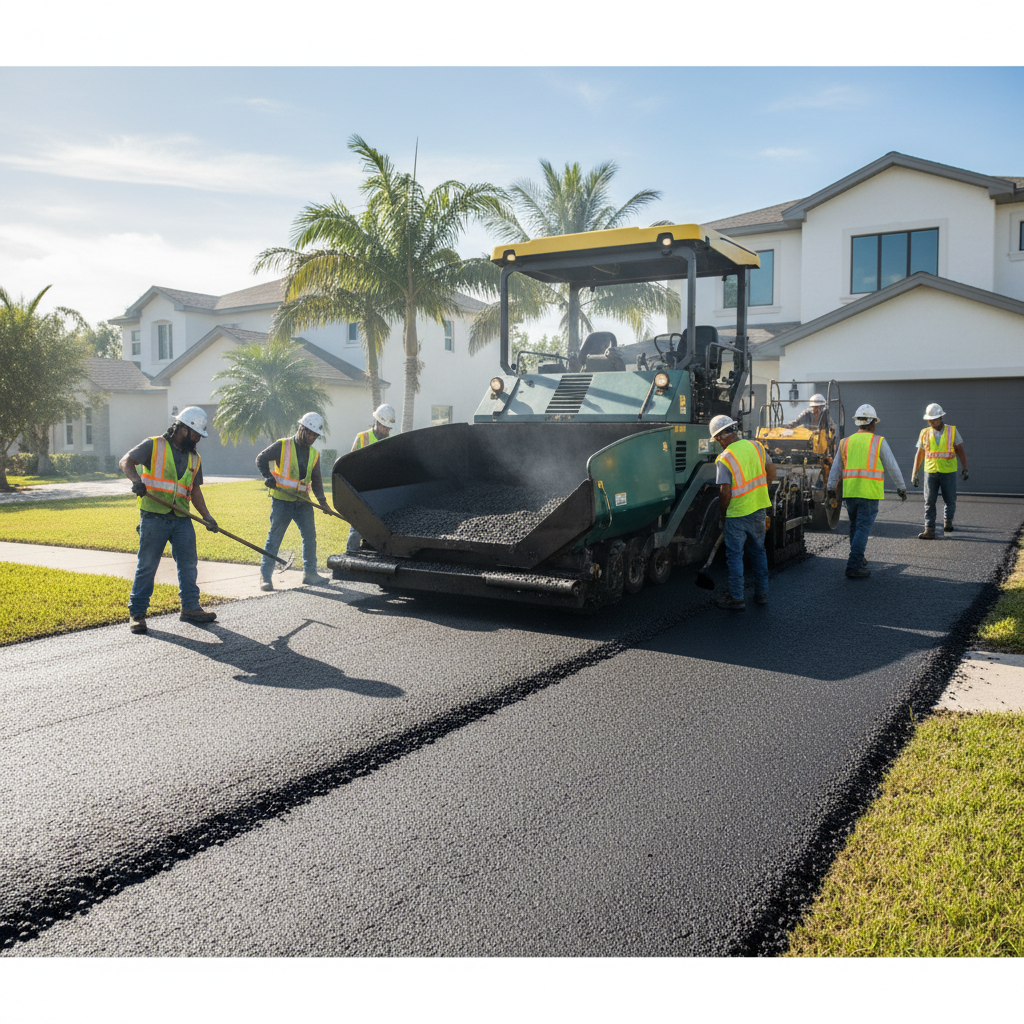
Driveway paving options and costs in Black Diamond
Black Diamond homeowners typically have three main paths when it comes to driveway paving: asphalt, interlocking concrete pavers, or concrete. Because 72.0% of local dwellings are single-detached homes and most households are homeowner-occupied (83.4%), private driveways are a big part of the local maintenance and improvement market. With a population of 2,730 (Statistics Canada, 2021 Census), contractors also manage a smaller-but-busy service base, and that can affect pricing when the paving season ramps up.
In Calgary’s cold continental climate, the frost line can reach about 1.2 m (4 ft). That means freeze–thaw is a decisive cost driver: contractors build deeper granular bases, improve drainage, and use well-graded aggregates to reduce heaving, cracking, and surface raveling. The compressed paving window—late spring through early fall—also concentrates demand. When crews are booked, smaller residential jobs in tight areas (or sites needing extra tear-out) can see higher labour and mobilization costs.
In Black Diamond, demand is especially noticeable around the newer residential pockets along/near the town’s main approach roads, where homeowners often replace aging gravel or early-1980s surfacing with a hard, winter-ready finish. Since 33.2% of homes were built before 1981 (Statistics Canada, 2021 Census), you’ll frequently see older driveways needing base corrections before any new asphalt or concrete goes down.
Below is a practical comparison of material options and typical per-square-foot ranges you’ll see for properly built work, then you can tighten the number with your measurements and site conditions in the estimate table.
| Material |
Lifespan |
Maintenance |
Best For |
Price per sq ft |
| Asphalt (new installation, proper base) |
15–25 years |
Sealcoat every 3–5 years; crack fill as needed |
Good value with a smooth surface for plowing |
$12–$20 |
| Asphalt (overlay on existing gravel base) |
10–18 years |
Sealcoat sooner; more frequent crack repairs if drainage is weak |
Budget refresh when base is stable |
$10–$16 |
| Interlocking concrete pavers |
25–40 years |
Re-level individual stones; joint sand top-up |
Curb appeal and repairs without full replacement |
$18–$30 |
| Poured concrete (broom finish) |
25–35 years |
Light sealing/patching; joint maintenance |
Low visual upkeep and solid performance when properly air-entrained |
$15–$25 |
| Exposed aggregate concrete |
25–35 years |
Sealing/spot repairs; joint plan is critical |
Non-slip texture and premium look |
$18–$30 |
| Gravel / crushed stone (budget option) |
5–10 years (depends on grading) |
Annual re-grade/top-up; weed control; re-compaction |
Temporary solution or simplest drainage-friendly base |
$3–$8 |
Prices are estimates only and vary by project scope, site access and material selection.
What affects the price of paving in Black Diamond
In the Calgary region, you can see quotes for the “same size driveway” vary by 30–50% because the real drivers aren’t just material choice—they’re how much base, drainage, and demolition your site needs. Two homeowners can have the same square footage, but one lot may drain properly and already have a stable granular base, while the other has soft spots, ponding, or an old asphalt section that’s fallen apart. In Black Diamond (and across Alberta), deeper frost protection and better water management typically push pricing upward on problem sites.
Frost line depth and freeze–thaw cycles are decisive in this region. With frost that can penetrate around 1.2 m, contractors generally rely on a thicker compacted granular base and well-graded aggregate to prevent heaving and cracking. That base build can be a major part of the cost because it increases hauling, compaction time, and the amount of stone required. Just as important, hot-mix asphalt needs warm conditions for proper placement—air temperatures generally need to be above about 10°C for reliable compaction and smooth finishing—so the shorter paving season tightens scheduling and can raise labour rates during peak months.
In practical terms, cost rises in Black Diamond when you have an older driveway from the pre-1981 housing stock (33.2% of homes) that needs full tear-out and base correction, or when runoff pathways are unclear and grading must be corrected for positive drainage. Costs can be lower if you’re overlaying an already-stable asphalt base (fewer trucks and less demolition), or if your site access is straightforward and the crew can place and compact efficiently. As a reference point, a properly built asphalt driveway often lands in the $12–$20 per-square-foot band, while premium paver jobs often sit higher, matching the $18–$30 per-square-foot reality for material and labour.
| Price Factor |
Why It Matters |
Cost Impact |
| Driveway area in sq ft |
Most costs scale with square footage and material quantities |
High (primary driver) |
| Base depth required |
Frost protection depends on compacted granular thickness and gradation |
High (can change total by thousands) |
| Grading and drainage work |
Correct slope and positive drainage prevent water retention and frost movement |
Medium to high |
| Tear-out of existing surface |
Breaking, hauling, and disposal add labour and equipment time |
Medium to high |
| Edge restraints and curbing |
Pavers need restraint to prevent spreading; asphalt needs stable edges |
Medium |
| Sealing requirement |
Asphalt should be sealed after curing (often 6–12 months) to extend life |
Low to medium (but critical over lifecycle) |
| Site access |
Narrow lots or long carries slow equipment movement and placement |
Medium |
| Asphalt mix specifications |
Freeze–thaw-rated mix design and proper thickness affect durability |
Medium (often worth it) |
Permits & regulations in Alberta
In Alberta, paving a private driveway within your own property usually does not require a building permit. Most homeowners can proceed with private-scope asphalt or concrete paving as long as the work stays on private land and you follow excavation best practices. However, approvals are typically required when you work in the municipal right-of-way or affect municipal infrastructure—such as creating or changing a curb cut, altering the boulevard, connecting to or changing storm drainage, or modifying ditches in a way that impacts municipal flow paths.
How to verify requirements in Black Diamond is straightforward: ask the paving contractor whether any portion of the work touches the right-of-way, then confirm with the town’s planning/engineering or roads department. Also note that some municipalities restrict how close a hard surface can be to property lines through lot-grading or development guidelines—so it’s wise to check lot-grading rules before finalizing the layout.
Before any excavation, ensure utility locates are called through Alberta One-Call. That’s your protection against accidental damage to buried services.
For contractor accountability, verify three things in Alberta: (1) Alberta licence or trade authorization where applicable, (2) liability insurance with coverage that matches project value and duration, and (3) WCB/WSIB coverage (Workers’ Compensation) for workers on site. Ask for an up-to-date certificate of insurance and a clearance letter, and confirm the certificate names the correct legal entity. You can also check licensing/registration through the appropriate Alberta registry and request the contractor’s policy details before you sign.
Asphalt vs pavers vs concrete for Black Diamond driveways
For Black Diamond driveways, the “best” material depends on how you want to handle winter maintenance and how long you want the initial investment to last under Calgary-area freeze–thaw. Asphalt is usually the lowest upfront option and gives a smooth, plow-friendly surface, but it needs regular sealing (commonly every 3–5 years) to protect the binder from oxidation and water penetration. In this climate, that sealing timing matters because trapped moisture can freeze and worsen surface deterioration.
Interlocking concrete pavers typically cost more upfront, but they offer the strongest long-term flexibility: if a section shifts, you can remove and re-set individual stones rather than replacing the whole surface. That repairability is a practical advantage in freeze–thaw areas with variable subgrade, especially where older homes may have had driveways built over inconsistent fill. Pavers also tend to hold curb lines well when properly restrained, which matters for neat snowbank management and runoff control.
Poured concrete is often mid-range in cost and performs well when it’s properly air-entrained and reinforced or jointed correctly. That said, concrete can crack as the ground moves during winter cycles, and it’s more sensitive to de-icing salt use if the surface and concrete mix weren’t designed for harsh exposure.
In local terms, if you’re comparing asphalt at $12–$20 per sq ft versus pavers at $18–$30 per sq ft, the price difference is usually justified when you value (a) curb appeal, (b) easier sectional repairs, or (c) a driveway layout that’s likely to need adjustments over time. If your base is well built and drainage is correct, asphalt can be the most cost-effective over the first 15+ years; if you expect heavier subgrade variability, pavers often hold up better to “patch-and-repair” life.
| Material |
Frost Resistance |
Curb Appeal |
Repair Method |
Lifespan |
Price Band |
| Asphalt (sealed regularly) |
Good when base and drainage are right; relies on sealing |
Moderate |
Patch small areas or re-surface if widespread deterioration |
15–25 years |
$12–$20 |
| Interlocking concrete pavers |
Very good with proper bedding and restraints |
High |
Remove and re-set individual stones/segments |
25–40 years |
$18–$30 |
| Poured concrete (air-entrained) |
Good with air entrainment and correct jointing |
Moderate to high |
Patch cracks/spalls; major issues may require slab replacement |
25–35 years |
$15–$25 |
| Exposed aggregate concrete |
Good with proper base and finishing |
High |
Spot patch or partial replacement depending on scale |
25–35 years |
$18–$30 |
| Permeable pavers (drainage grid) |
Good to very good if designed for soil and flow control |
High (modern look) |
Remove and re-set pavers; inspect stone layers as needed |
20–35 years (system-dependent) |
$20–$36 |
| Chip seal / tar-and-chip |
Variable; can ravel if not maintained |
Low to moderate |
Re-treat surface; targeted patching |
8–15 years |
$10–$16 |
How to choose a paving contractor in Black Diamond
Choosing the right contractor in Black Diamond is mostly about confirming capacity and accountability before the first truck shows up. In Alberta, verify the company can legally perform paving work and that it carries current liability insurance and WCB/Workers’ Compensation coverage for workers on your site. Ask for a certificate of insurance and a WCB clearance letter (or equivalent proof) and confirm the documents match the contractor’s legal business name—not just a trading name. For your records, keep copies of those documents and the signed scope of work.
Next, get 2–3 itemised written quotes that break down labour and materials, not a single lump number. You want clear line items for excavation/tier-out, base supply and compaction, asphalt/concrete or paver material, curb/edge restraints, and surfacing. Read exclusions carefully: is permit/approval coordination included, are disposal and hauling included, and is there a defined allowance for unknowns like soft subgrade or unstable fill? A “low price” quote often leaves you exposed on those items.
Warranty matters in this freeze–thaw region. Ask for workmanship warranty length and whether it covers base preparation and settlement issues. Confirm the product/manufacturer warranty (if any) and whether it’s transferable to future owners. For payment, never pay more than about 10–15% upfront; hold back a portion until the final walk-through and cleanup are done. Finally, request a start date and completion estimate in writing, since the short season affects scheduling and can change what “available” means.
- Confirm Alberta licensing/authorization (as applicable) before signing.
- Request liability insurance certificate showing coverage limits and effective dates.
- Provide WCB/Workers’ Compensation clearance proof for workers on your job.
- Use an itemised quote: base, materials, prep, labour, and disposal separate.
- Ask what’s included for grading and drainage corrections (not assumed).
- Confirm tear-out scope and hauling/disposal are included if needed.
- Verify base plan depth and compaction requirements for frost protection.
- Ask how edges will be restrained (pavers) or stabilized (asphalt).
- Clarify asphalt placement details: thickness, mix type, and curing/seal timing.
- Get a written timeline tied to weather/temperature constraints.
- Review warranty terms: workmanship length, exclusions, and claims process.
- Keep holdback until final inspection; avoid large progress payments.
In Black Diamond, typical red flags include: a quote with no breakdown of base and drainage work, refusal to provide insurance/WCB clearance documentation, missing start/finish dates, vague warranty terms that only cover material (not workmanship), and “cash-only” or unusually high upfront payment requests that exceed about 10–15%.
Frequently asked questions — paving in Black Diamond
How much does it cost to pave a driveway in Black Diamond?
For Black Diamond, a typical asphalt driveway commonly falls in the $12–$20 per-square-foot range when the base is built properly for Calgary-area freeze–thaw. Your total depends heavily on square footage, how much tear-out is needed, and whether drainage or grading corrections are required. If you’re upgrading to interlocking pavers, you’ll often see higher per-square-foot pricing in the $18–$30 range because of the materials, bedding, and edge restraints. Concrete is often in between, commonly around $15–$25. Since local homeowners frequently have older driveways (33.2% of homes built before 1981), some sites need base correction, which is where budgets move. Ask for an itemised quote so you can see excavation, base depth, and compaction included.
Asphalt vs interlocking pavers vs concrete — which is best in Black Diamond?
In Alberta’s cold continental winters, “best” usually means the option that matches your tolerance for maintenance and your tolerance for repair methods. Asphalt is cost-effective upfront and plow-friendly, but it needs sealcoating—generally within the first 6–12 months after install, then every 3–5 years—to protect against water penetration and freeze–thaw damage. Interlocking pavers cost more, but they’re easy to repair: you can lift and re-set a section without replacing the entire driveway, which is helpful if your subgrade shifts over time. Poured concrete (air-entrained and properly jointed) is durable, but cracking can happen if base/drainage aren’t right. For many Black Diamond homeowners, pavers win where curb appeal matters and future repairs are a priority; asphalt wins when the budget is tighter and you’re committed to sealing on schedule.
How long does a paved driveway last in Black Diamond?
With proper base preparation and drainage for the local freeze–thaw conditions, asphalt driveways commonly last 15–25 years, especially if you seal on schedule and address cracks early. If you skip sealing, water gets in, freezes, and starts damaging the surface and edges faster. Interlocking pavers often last 25–40 years because individual units can be re-levelled or replaced. Properly air-entrained poured concrete typically lasts 25–35 years when jointing and base support are done correctly. The age of your home can hint at driveway condition—Black Diamond has a sizable share of housing built before 1981 (33.2%); older driveways sometimes have inconsistent subgrade that shortens lifespan if base depth and compaction aren’t corrected. The biggest lifespan predictor is the quality of the granular base and positive runoff direction, not just the top surface.
When is the best time of year to pave in Black Diamond?
In Black Diamond and the wider Calgary area, the best time is late spring through early fall, when temperatures support good compaction and asphalt curing. Hot-mix asphalt generally needs air temperatures above roughly 10°C for reliable placement, and crews also watch ground moisture to avoid rutting during thaw. Scheduling is tight in peak months, so getting on the calendar early matters—especially for smaller driveways where mobilization and wait time can affect pricing. If the driveway needs extra tear-out and base work, it’s even more important to plan around the weather window so the stone base can be compacted and proofed before surfacing. Your contractor should provide a written start date range and a plan for how they’ll manage weather risk.
How deep should the base be for Black Diamond's frost?
Because the frost line can reach around 1.2 m in this region, base depth and construction details matter more than “one number” for everyone. In practice, contractors design a compacted granular base thickness based on soil conditions, drainage, and the asphalt/concrete system being installed. For many residential Calgary-area driveways, that means a significantly deeper base than what people assume from older gravel approaches, with well-graded aggregate and consistent compaction. If you have soft subgrade, poor drainage, or old fill, the required base can increase because you need to stabilize the underlying soil and reduce water retention. A good quote should spell out the base build (material types and thickness), not just the top paving. With Black Diamond’s freeze–thaw, skipping base depth is one of the fastest ways to end up with cracking and edge failures.
How often should I seal my asphalt driveway?
Asphalt sealing timing is important in Alberta. After installation, many contractors recommend sealing once the asphalt has cured—often within about 6–12 months depending on weather and mix. After that, sealing is commonly done every 3–5 years to protect the binder from oxidation and to slow water infiltration. Black Diamond driveways also see stress from snow storage, plowing, and repeated freeze–thaw, which accelerates surface aging around edges and low spots. If you already have shallow cracking or raveling, addressing it with crack filling and proper surface prep before sealing can extend service life. When you’re budgeting, remember sealing is part of lifecycle cost. If you’re comparing options, include sealing and minor repairs when you evaluate asphalt against pavers or concrete.