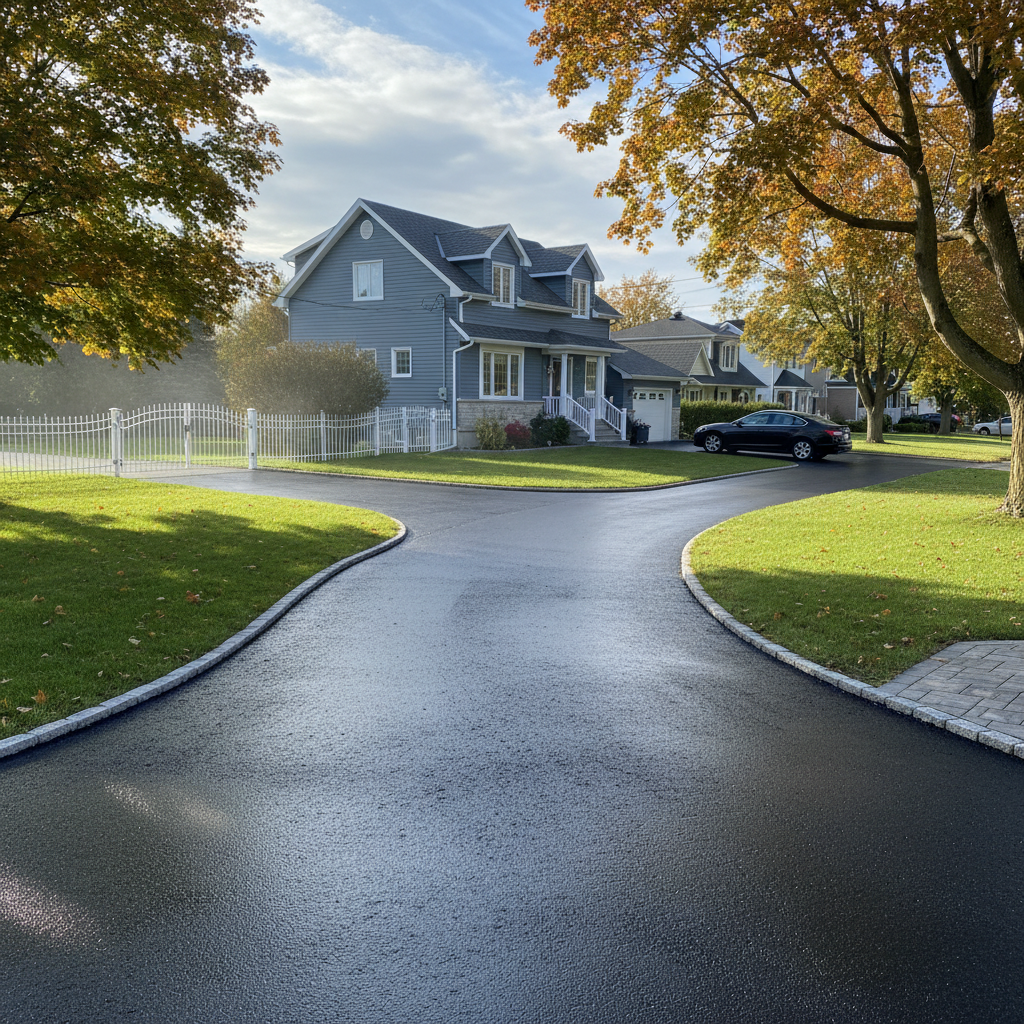
Driveway paving options and costs in Coaldale
Coaldale homeowners typically have three strong driveway choices: asphalt, interlocking concrete pavers, and concrete. With Coaldale’s housing stock leaning heavily toward single-detached homes—77.7% of dwellings—most private driveways are tied to detached properties and are sized for daily vehicle use rather than heavy commercial traffic. That matters because design choices (base thickness, drainage, and edge restraint) are driven by frost depth and freeze–thaw cycling on an exposed, wheel-loaded slab. Also, since 82.9% of households own their homes (Statistics Canada, 2021 Census), many homeowners prioritize longer-term performance and predictable maintenance rather than lowest first cost only.
In the Lethbridge–Medicine Hat area, costs are shaped by repeated freeze–thaw cycles and a frost penetration that commonly reaches about 6 ft. That usually means a deeper, well-compacted granular base and careful drainage detailing so the surface doesn’t lift, crack, or rut during thaw. The paving season is also relatively short (late spring through early fall), which tightens scheduling and can increase labour rates for smaller projects when weather windows are limited. If you’re in a busier service pocket such as legacy neighbourhood areas off Mayor Magrath Drive and near the downtown core, contractors often see quicker lead times in peak months—but excavation logistics and material haul distances can still move your final price.
Below is a practical cost snapshot for a typical residential-scale driveway, assuming proper subgrade prep and frost-aware construction. Use it as a baseline, then adjust for your driveway size, access, and whether there’s existing asphalt to overlay or concrete to tear out.
| Material |
Lifespan |
Maintenance |
Best For |
Price per sq ft |
| Asphalt (new installation, proper base) |
15–25 years |
Seal every 3–5 years; patch as needed |
Value, smooth ride, good long-term performance with sealing |
$4.50 – $7.50 |
| Asphalt (overlay on existing gravel base) |
10–18 years |
Seal every 3–5 years; patch low spots |
If your base is solid and drainage is already corrected |
$3.75 – $6.25 |
| Interlocking concrete pavers |
25–35 years |
Occasional panel/sand reset; reseal option for colour protection |
Curb appeal and easy spot repairs without full replacement |
$6.50 – $11.00 |
| Poured concrete (broom finish) |
25–35 years |
Minimal routine work; seal if you want stain/ice protection |
Durability and straightforward maintenance |
$6.00 – $10.50 |
| Exposed aggregate concrete |
25–35 years |
Periodic cleaning; reseal sometimes to keep appearance |
High traction and premium appearance |
$7.00 – $12.00 |
| Gravel / crushed stone (budget option) |
5–10 years |
Regrade and add material every 1–3 years |
Lowest cost while you plan for paving later |
$2.50 – $4.25 |
Prices are estimates only and vary by project scope, site access and material selection.
What affects the price of paving in Coaldale
In Coaldale (within the Lethbridge–Medicine Hat economic region), even two quotes for the “same” driveway can swing 30–50% because the unseen work is where the money goes: excavation depth, granular base quality, drainage corrections, and whether a crew can work efficiently in a tight yard. A 600 sq ft driveway might land near the lower end of asphalt pricing (for example, $6,000 – $12,000 installed as a typical regional band), but if you need full tear-out, additional base thickness, and longer trucking hours due to access, you can easily push toward the upper range or beyond—especially when the weather window narrows.
Frost depth and freeze–thaw cycles are decisive. In southern Alberta, frost penetration commonly reaches around 6 ft, so the granular base and subgrade prep are designed to resist heaving and cracking. That often means a deeper, well-compacted base than you’d see in milder climates, and it’s one reason asphalt in this region isn’t “cheap the way it is in warmer areas.” The paving season is also shorter: hot-mix asphalt needs suitable air temperatures (commonly above 10°C), so contractor scheduling gets tighter in spring and early fall. Asphalt mix design must be freeze–thaw rated for Alberta conditions, which can raise mix costs versus a generic “one-size-fits-all” product.
In Coaldale, two common cost drivers can push numbers up or down: (1) whether your yard drains properly away from the driveway. Poor drainage often leads to additional grading and under-drain work; (2) whether you have clay-leaning soils or older fill that needs more excavation and replacement. Homes built before 1981 are common here (40.7% of homes), and older lots sometimes have outdated drainage paths—one reason an asphalt overlay can look affordable at first, yet still require base correction to stay serviceable through another winter.
| Price Factor |
Why It Matters |
Cost Impact |
| Driveway area in sq ft |
Most asphalt/paver/concrete cost scales with square footage and thickness. |
Largest variable; can change overall cost by thousands |
| Base depth required |
Frost line depth drives granular thickness and compaction targets. |
+ material and excavation; can noticeably raise unit costs |
| Grading and drainage work |
Slope, swales, and drainage corrections prevent water pooling and freeze damage. |
Often adds days of labour and added aggregate |
| Tear-out of existing surface |
Removing old asphalt/concrete plus hauling affects labour and disposal fees. |
Can add significant cost versus overlay-only work |
| Edge restraints and curbing |
Edges prevent spreading, especially for pavers exposed to plough and traffic loads. |
Moderate-to-high impact depending on linear feet |
| Sealing requirement |
Asphalt needs sealing after installation/curing to protect from Alberta freeze–thaw. |
Adds planned long-term maintenance cost (but extends lifespan) |
| Site access |
Narrow driveways slow equipment movement and may require smaller equipment. |
Can raise labour hours and machine time |
| Asphalt mix specifications |
Freeze–thaw-rated mixes and proper binder selection reduce early failures. |
Higher material cost than basic mixes |
Permits & regulations in Alberta
In Alberta, paving a private driveway on your own property (for example, replacing asphalt or concrete on the driveway surface inside your lot lines) generally doesn’t require a building permit. The situation changes when the work touches the municipal right-of-way or impacts how storm water moves through the street frontage. In Coaldale, that means new or altered access points—such as a new driveway apron or changes to curb cuts—typically require municipal approval. If your project involves altering boulevard grading or changing storm drainage (like adding or re-routing weeping/drainage outlets tied into municipal systems), expect approval steps before construction.
Always verify utility locations before digging. In Alberta, you should call Alberta One-Call to have utilities marked so excavation doesn’t damage underground services. Also confirm any lot-grading or hard-surface rules with the municipality—some areas restrict how close hard surfaces can be built to property lines, especially where drainage must be controlled.
To protect yourself as a homeowner, verify the contractor’s Alberta credentials step-by-step before they start:
- Ask for their Alberta licence details (or the relevant registration) and confirm it using the province’s online resources.
- Request a Certificate of Insurance showing general liability coverage with your address/project listed if possible.
- Confirm WSIB/WCB coverage and ask for the proof clearance/letter where applicable to the trade and employees working on your site.
- Ensure the quote references who supplies aggregate, asphalt/concrete, and disposal—so you’re not left with extra bills after approval.
Asphalt vs pavers vs concrete for Coaldale driveways
For Coaldale’s freeze–thaw climate, the “best” driveway material is really the one that matches your priorities—lowest upfront cost, curb appeal, or easiest repairs after winter damage from ploughing and salts. Asphalt is usually the most affordable to install, but it depends on good sealing cycles (typically every 3–5 years) to protect the surface from oxidation and winter water infiltration. Interlocking concrete pavers cost more upfront, but they handle localized settlement well; if a section heaves or a utility repair happens, individual units can be lifted and reset without replacing the whole driveway.
Poured concrete sits in the middle on cost, though it’s more susceptible to cracking if it’s not air-entrained and if the base/drying conditions aren’t right. In a frost-driven region like Lethbridge–Medicine Hat, a proper granular base and drainage are what make concrete durable; if water is trapped, freeze–thaw stress shows up as cracking or surface scaling. Exposed aggregate can improve traction under snow and ice loads, but it still needs the same frost-aware base preparation.
Here’s a practical way to think about the money: a typical asphalt driveway might fit within the regional band of $6,000 – $12,000, while interlocking pavers commonly land in the higher driveway ranges (often closer to $9,000 – $18,000). That additional paver cost can be worth it if you want repairability and a crisp, upscale look—especially for older properties where lot settling is more common. If you want the simplest maintenance routine and you’re okay with minor joint/patch care, air-entrained concrete can be an excellent choice, but it must be installed with Alberta-ready mix and drainage.
| Material |
Frost Resistance |
Curb Appeal |
Repair Method |
Lifespan |
Price Band |
| Asphalt (sealed regularly) |
Good with deep base and proper drainage; sealing is key |
Medium (clean and smooth) |
Patch sections and re-surface small areas |
15–25 years |
$6,000 – $12,000 |
| Interlocking concrete pavers |
Very good; flexible joints help with minor movement |
High (distinct finish options) |
Lift and replace individual blocks |
25–35 years |
$9,000 – $18,000 |
| Poured concrete (air-entrained) |
Good when air-entrained and properly based |
Medium to high (finish dependent) |
Patch and, in severe cases, partial slab replacement |
25–35 years |
$8,000 – $16,000 |
| Exposed aggregate concrete |
Good; finish affects surface durability |
High (premium look) |
Patch with matched mix; may require finishing touch-ups |
25–35 years |
$8,500 – $17,000 |
| Permeable pavers (drainage grid) |
Excellent drainage potential when installed to spec |
High (modern look) |
Replace individual pavers; clean media as needed |
20–30 years |
$10,000 – $20,000 |
| Chip seal / tar-and-chip |
Variable; depends on binder, aggregate, and weather window |
Low to medium (more utilitarian) |
Spot roll-out and re-chip as needed |
8–15 years |
$5,000 – $10,000 |
How to choose a paving contractor in Coaldale
Choosing the right paving contractor in Coaldale comes down to verifying credentials and reading the scope like it’s part of your budget. Start with Alberta licensing and insurance: ask for their Alberta registration details (where applicable to their trade), then request a current Certificate of Insurance showing general liability. Next, confirm WSIB/WCB coverage—ask for proof or a clearance document so you’re not stuck with liability if a worker is injured onsite.
When you get quotes, insist on 2–3 itemised, written estimates—not a single lump sum. You want a breakdown that separates excavation/base work, drainage/grading, material supply, and paving itself. Also check what’s included: disposal of removed asphalt or concrete, compaction testing (if referenced), and whether the contractor includes utility coordination steps. If any work must be done in/near municipal right-of-way (like a driveway apron, curb cut changes, or drainage adjustments tied to street systems), confirm whether permit/approval handling is included in their scope or on your side.
Warranty matters too. Look for a workmanship warranty length (for example, how long they stand behind base prep and installation) and whether manufacturer coverage for materials is included. Ask if warranties are transferable to future owners. Payment scheduling should be conservative: don’t pay more than 10–15% upfront; request progressive milestones tied to completed work. Finally, get a start date and an estimated completion window in writing—seasonal scheduling delays happen, but you should know what “on time” means.
- Confirm Alberta licence/registration details and ask for the contractor’s business name as registered.
- Verify general liability insurance with your project address listed or referenced.
- Provide WSIB/WCB proof/clearance and match it to the crew who will be on your site.
- Get 2–3 itemised quotes with labour + materials separated.
- Ask if base depth and compaction targets are specified (not just “proper base”).
- Confirm whether drainage corrections are included or quoted as an add-on.
- Clarify tear-out scope: what gets removed, how deep, and what’s hauled away.
- Ask for edge restraint details for pavers (type and linear feet/estimate).
- Confirm whether asphalt sealing is included or excluded (and the recommended timing).
- Request warranty terms in writing, including exclusions and claim process.
- Agree to a payment schedule with no more than 10–15% upfront and a holdback on completion.
- Get a written timeline and weather contingency plan for freeze–thaw risk.
Concrete red flags to watch for in Coaldale: they won’t put base depth and drainage details in writing; they ask for full payment up front; they provide a “cheap” price without explaining overlay vs tear-out differences; they can’t produce insurance/WSIB/WCB proof; or they won’t discuss freeze–thaw sealing timing for asphalt (and how they’ll protect the surface after paving).
Frequently asked questions — paving in Coaldale
How do I prepare for a paving project?
Start by clearing the driveway footprint of vehicles, trailers, and landscaping materials so crews can work without repeated repositioning (which affects compaction and schedule). Locate and mark any items near the edges—sprinkler heads, handrails, low fences—and confirm you know where downspouts drain so water won’t be redirected onto the driveway. If you’re replacing old asphalt or concrete, ask the contractor whether tear-out and disposal are included, since that impacts access and how long the site will be disturbed. Because Coaldale winters bring freeze–thaw cycles, make sure drainage is addressed during construction, not “later.” It’s also smart to plan around the paving season: asphalt placement generally needs suitable conditions (often air temps above about 10°C) to compact correctly.
How do I compare paving quotes fairly?
Compare quotes using the same scope and assumptions. Ask each contractor for an itemised breakdown: excavation depth/base thickness, granular materials, drainage/grading changes, paving material, edges/curbs, and disposal. Don’t compare only the total—one quote may be an overlay while another includes full tear-out, which can swing cost by thousands. For reference, in the Lethbridge–Medicine Hat region, asphalt driveways often land in bands like $6,000 – $12,000, while pavers and higher-end concrete commonly extend upward. Ensure the base design is frost-aware, because the frost depth in southern Alberta drives granular thickness and compaction requirements. Lastly, verify warranty length and whether asphalt sealing is included or expected later.
Can asphalt be laid in cold weather in Coaldale?
In Coaldale, cold-weather paving can be risky. Hot-mix asphalt needs appropriate placement and compacting conditions—commonly air temperatures above about 10°C—so the mix can compact to density and resist early failures. In a freeze–thaw climate, if asphalt is laid too cold, you can get inadequate compaction and trapped moisture, leading to raveling or premature cracking after the first winter cycles. Good contractors also watch the forecast and crew readiness, because moisture and overnight cooling can stall progress. If you’re nearing the end of the season, ask your contractor how they manage curing and what they recommend for sealing timing. Sealing is typically planned after the pavement has cured, often about 6–12 months later depending on product and weather.
What is a driveway apron and do I need one in Coaldale?
A driveway apron is the section of paving at the curb/entry area that connects your private driveway to the roadway approach. In Coaldale, whether you need an apron often depends on how your existing curb cut is constructed and whether municipal drainage and grading are affected. If your project involves creating a new access point or changing curb cuts/boulevard grading, that typically requires municipal approval rather than being purely a private-lot driveway job. An apron also matters for preventing edge washouts and reducing the “dip” that can form at the transition during spring thaws. Before you sign a contract, ask the contractor whether apron work is included, and confirm which approvals are required for the part that touches the right-of-way.
How do I maintain my driveway through Coaldale winters?
Maintenance in Alberta is about managing water and reducing surface damage during freeze–thaw periods. For asphalt, keep edges clear of trapped debris (leaves and sand) so water can’t sit and freeze in place. Avoid using sharp metal scraping that gouges the surface when ploughing—small ruts become bigger potholes after a few winters. If you use de-icing materials, use them sparingly and follow the contractor’s guidance; heavy salt applications can accelerate surface deterioration, especially on concrete. For any driveway, watch for low spots where water ponds after rain or thaw—those need re-grading or base attention sooner rather than later. Regular inspections in late fall and after thaw cycles can catch early problems before they require full resurfacing.
Is it worth sealing a new driveway right away in Coaldale?
Usually, you don’t seal immediately “the next day.” Asphalt sealing is typically delayed until the pavement has cured sufficiently and surface conditions are right—commonly 6–12 months after installation, depending on the product, weather, and how quickly the surface oxidizes. Sealing too early can trap moisture and interfere with proper performance. In Coaldale’s freeze–thaw climate, sealing is often a cost-effective step because it protects asphalt from water infiltration, which can drive cracking and heaving during winter cycles. If your driveway is in the regional asphalt band of $6,000 – $12,000, sealing is generally a small planned add-on compared with the cost of premature repairs. Ask your contractor for the recommended sealing schedule for your exact mix and installation date.