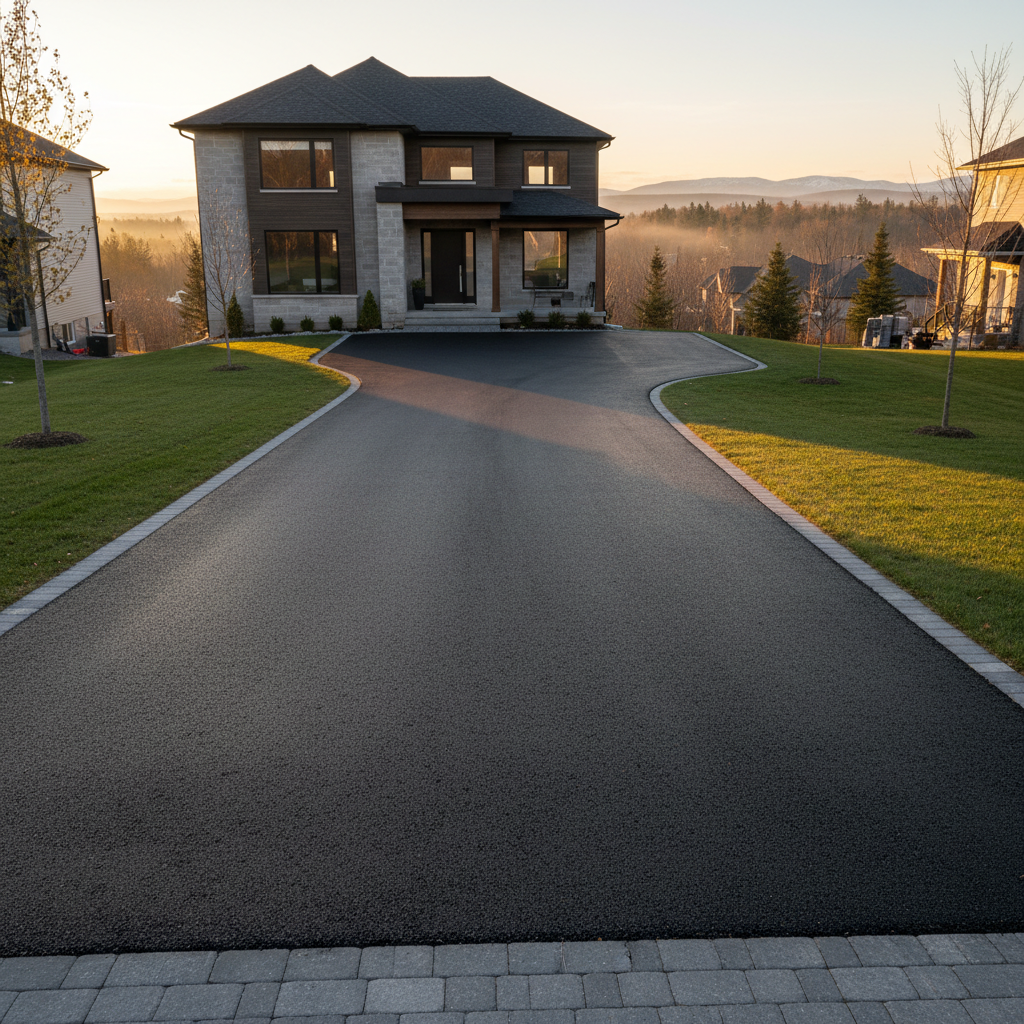
Driveway paving options and costs in Okotoks
Okotoks homeowners usually start by comparing asphalt, interlocking pavers, and concrete, but the “best” option depends on how your lot drains and how your driveway sees winter freeze–thaw. In Okotoks, most private driveways are tied to single-detached homes—77.7% of dwellings are this type, and homeowner households make up 85.7% of all households (Statistics Canada, 2021 Census). That’s a big reason demand stays strong each spring in neighbourhoods like Westmount Estates, where families run frequent snow removal and the driveway surface takes heavy wear.
Pricing in the Calgary region is shaped by frost penetration and repeated freeze–thaw. In cold continental conditions, frost routinely reaches about 1.2 m (4 ft), so contractors must build deeper, well-graded granular bases and keep drainage moving away from the driveway. If the base and slope aren’t right, you’ll see heaving, cracking, and raveling sooner—especially after wet snowmelt and late freezes in spring.
It’s also a market where the paving season is compressed. Hot-mix asphalt needs suitable air temperatures for compaction and proper curing, which concentrates crews and equipment into late spring through early fall. For smaller driveways or tight-access lots, mobilization can push per-square-foot costs toward the upper end of typical ranges. With that in mind, use the table below to compare typical lifespan, maintenance, and realistic price bands for Okotoks projects.
| Material |
Lifespan |
Maintenance |
Best For |
Price per sq ft |
| Asphalt (new installation, proper base) |
15–25 years |
Sealcoating every 3–5 years; crack repair as needed |
Lowest upfront cost with good durability when built on a deep granular base |
$12–$20 |
| Asphalt (overlay on existing gravel base) |
10–18 years |
Sealcoating and patching; more frequent monitoring for settlement |
Budget-conscious upgrades where the existing base is stable and well-drained |
$10–$16 |
| Interlocking concrete pavers |
25–40 years |
Joint sand top-ups; individual unit replacements |
Curb appeal and repairability (spot repairs without full replacement) |
$18–$30 |
| Poured concrete (broom finish) |
25–35 years |
Periodic sealing; crack monitoring and sealing where needed |
Long-lasting, uniform surface with good plow durability when air-entrained |
$15–$25 |
| Exposed aggregate concrete |
25–35 years |
Sealing as recommended; address small surface spalling early |
Premium appearance and texture for traction in winter |
$18–$28 |
| Gravel / crushed stone (budget option) |
2–7 years (varies widely) |
Re-leveling, edging, and top-ups; weed control |
Short-term solution or low-budget sites with easy regrading access |
$6–$12 |
Prices are estimates only and vary by project scope, site access and material selection.
What affects the price of paving in Okotoks
In Okotoks and the wider Calgary area, it’s common to see quotes for the “same driveway” vary by 30–50%. The difference usually comes down to how contractors handle the parts customers don’t always see: subgrade condition, base depth, drainage corrections, and disposal of old material. Two quotes can both say “asphalt” while one contractor builds a thicker, better-compacted base and the other tries to reuse an unstable base—those choices directly affect long-term cracking and settlement.
Frost line depth and freeze–thaw cycles are decisive cost factors in this region. With frost reaching about 1.2 m (4 ft), driveways need a properly engineered granular base to prevent heaving and water pumping. In practice, that means deeper granular and well-graded aggregates, plus tight compaction—often more substantial than people expect when they compare to milder climates. It’s also why contractors spend extra time on drainage: even a modest slope error can redirect meltwater under the surface and accelerate failure. On top of that, Calgary’s paving season is shorter. Asphalt typically requires suitable air temperature conditions (commonly above 10°C for placement and compaction), so scheduling pressure can push pricing toward the higher end of typical asphalt bands of $12–$20 per square foot, especially in peak months.
Concrete costs can also move based on winter-readiness details. For example, air-entraining admixture and proper curing timing help resist freeze–thaw; skipping or reducing these steps can raise future repair costs. Homes built before 1981 make up 11.2% of Okotoks housing stock (Statistics Canada, 2021 Census), and older lots often have older drainage patterns or less certain subgrade performance, which can add to prep costs. If you’re paying around $15–$25 for concrete, you should expect more emphasis on base preparation and proper jointing than a “quick pour.”
| Price Factor |
Why It Matters |
Cost Impact |
| Driveway area in sq ft |
Most materials and paving time scale directly with square footage. |
Major; often the biggest driver |
| Base depth required |
Frost heave risk increases if base is too thin for freeze–thaw conditions. |
Major to high; can change the total by thousands |
| Grading and drainage work |
Proper slope and outlet drainage prevent water from sitting under the pavement. |
Moderate to high depending on existing site |
| Tear-out of existing surface |
Old asphalt/concrete removal and hauling increases labour and disposal costs. |
Moderate to high |
| Edge restraints and curbing |
Pavers need solid restraint to stop movement; asphalt needs supported edges. |
Moderate; can affect longevity |
| Sealing requirement |
Asphalt sealcoat helps protect against oxidation and surface wear during winters. |
Low to moderate upfront, higher lifecycle value |
| Site access |
Narrow gates or tight turnaround slow trucks and compacting equipment. |
Moderate; can raise labour per hour |
| Asphalt mix specifications |
Freeze–thaw rated mixes perform better; they cost more to supply. |
Moderate; typically included in higher-end quotes |
Permits & regulations in Alberta
In Alberta, paving a private driveway within your own property typically does not require a building permit. Where it does get regulated is any work that affects municipal space or municipal services. For Okotoks homeowners, that usually means: if your project involves work in the municipal right-of-way (for example, creating or changing a curb cut/apron, altering boulevard grading, or changing storm drainage ties/inlets near the road), you should expect municipal approval. Also, some municipalities enforce lot-grading requirements that restrict how close a hard surface or grading change can be to property lines or how stormwater must be handled.
Before anyone excavates, always arrange utility locates through Alberta One-Call (and follow the marked utility depths). This isn’t just a “best practice”—it’s part of responsible construction and helps prevent accidental damage to gas, power, or communication lines.
To verify your contractor in Okotoks, follow a simple checklist. First, check their Alberta licensing status through the appropriate online contractor registration pathway (often done via provincial/public contractor listings). Second, ask for a current certificate of insurance showing adequate liability coverage naming you as applicable (or providing an endorsement where required). Third, confirm workers’ coverage (WSIB/WCB) by requesting documentation or a clearance letter, then ensure it matches the business name on the quote and invoices. Finally, ensure the contract clearly states who handles disposal, whether any permits/approvals are included, and what portion of work is “private property only” versus “right-of-way.”
Asphalt vs pavers vs concrete for Okotoks driveways
For Okotoks driveways, asphalt, interlocking pavers, and concrete each have trade-offs driven by freeze–thaw, traction needs, and how you maintain the surface during winter. Asphalt usually wins on upfront cost and speed of installation. When built correctly, it’s a solid choice for homeowners who want a clean, dark finish and can commit to sealcoating every 3–5 years. In cold climates, the value of asphalt is only realized when the granular base is deep enough and drainage is right—otherwise, water expands and contracts under repeated freezing cycles.
Interlocking concrete pavers cost more initially, but they’re the most flexible when it comes to repairs. If a section settles or a utility issue arises, individual units can be lifted and reset without replacing the entire driveway. That repairability matters in communities around Okotoks where subgrade conditions can vary lot-to-lot. For pavers, expect a higher upfront range of $18–$30 per square foot, but curb appeal is typically outstanding.
Poured concrete sits in the middle on cost, often around $15–$25 per square foot, but it needs air-entrainment and proper finishing/jointing to manage freeze–thaw. If you use de-icing salt and plow regularly, concrete performs best with correct mix design and curing practices. Exposed aggregate offers traction, while permeable pavers and drainage grids can help when your lot tends to stay wet.
Here’s a realistic example of when the price difference is justified: on a medium driveway, choosing pavers instead of asphalt may be an extra $6–$12 per square foot. That can make sense if you value long-term curb appeal and want the option for targeted repairs—especially on older lots where base variability is more likely.
| Material |
Frost Resistance |
Curb Appeal |
Repair Method |
Lifespan |
Price Band |
| Asphalt (sealed regularly) |
Good when base is properly designed and drainage is positive |
Medium (clean, dark finish) |
Patch and re-seal; overlay if needed |
15–25 years |
$12–$20 |
| Interlocking concrete pavers |
Excellent with compacted base and correct edge restraints |
High (wide style options) |
Replace individual pavers and re-level localized areas |
25–40 years |
$18–$30 |
| Poured concrete (air-entrained) |
Good to very good when properly air-entrained and jointed |
Medium to high (depends on finish) |
Crack repair/seal; partial replacement if needed |
25–35 years |
$15–$25 |
| Exposed aggregate concrete |
Good to very good with correct mix and curing |
Very high (textured “premium” look) |
Patch/grind and reseal; localized repair less visible than plain concrete |
25–35 years |
$18–$28 |
| Permeable pavers (drainage grid) |
Very good where drainage design manages meltwater |
High (modern look) |
Replace sections; service drainage layer if clogged |
20–35 years |
$22–$38 |
| Chip seal / tar-and-chip |
Fair; performance depends heavily on base and gradation |
Low to medium (more utilitarian) |
Spot patching and periodic re-seal layers |
7–15 years |
$10–$18 |
How to choose a paving contractor in Okotoks
Choosing the right contractor matters in Okotoks because freeze–thaw failure is often a “build-quality” problem, not a material problem. Start by verifying Alberta licensing (where applicable to the trade), then confirm liability insurance and workers’ compensation coverage. Ask for a current certificate of insurance and check the named insured matches the quoting company. For workers’ compensation, request documentation or a clearance letter so you know the crew working on your driveway is properly covered.
Next, get 2–3 itemised written quotes—not just a lump sum. You want a breakdown that separates excavation/tire-out, base supply, grading and compaction, geotextile use (if specified), asphalt/concrete/pavers, edge restraints, and finishing/curing or sealing. Also ask what’s included in disposal (haul-away and tipping fees) and whether any municipal approvals are part of the scope if your project touches curb or right-of-way areas.
Warranty details should be specific: workmanship warranty length, product/manufacturer warranty (if any), and whether the warranty is transferable if you sell your home. Payment schedule matters in Alberta too—never allow more than 10–15% upfront. Hold back a final portion until the driveway is completed, reviewed, and any required initial sealer or finishing steps are done. Finally, insist on a written timeline with a start date and an estimated completion date so you can plan around Okotoks spring weather and the short paving window.
- Confirm contractor name matches the insurance certificate and quote.
- Verify liability insurance limits are adequate for driveway work.
- Request workers’ compensation proof/clearance letter.
- Ask for references from recent Okotoks jobs (not only Calgary).
- Get an itemised quote: labour + materials + disposal.
- Confirm base thickness and compaction requirements in writing.
- Specify drainage expectations (grade/slope and runoff direction).
- Clarify edge restraints/curbing scope for pavers and asphalt edges.
- Ask who supplies geotextile (if used) and why it’s specified.
- For asphalt, confirm sealcoat timing (typically after initial curing).
- Check warranty terms for workmanship and materials, including transferability.
- Review the payment schedule; keep holdback until completion.
Red flags I see too often in Okotoks include: a contractor who won’t put base depth and drainage details in the scope, pricing that’s far below the $12–$20 asphalt band without explaining why prep is minimal, pushing full payment upfront, refusing to provide insurance/coverage documentation, or promising asphalt “anytime” regardless of temperature/curing conditions.
Frequently asked questions — paving in Okotoks
How do I compare paving quotes fairly?
To compare paving quotes fairly in Okotoks, insist on an itemised scope for both materials and labour—not just a single total. Look for line items covering excavation/tire-out, base supply and compaction, grading and drainage correction, edge restraints, and disposal. For asphalt, confirm the mix meets freeze–thaw needs and whether sealcoating is included or planned. Quotes can differ by 30–50% when one contractor includes deeper base and proper drainage and another tries to reuse an unstable subgrade. A useful check is whether the asphalt price lands in the local band of $12–$20 per square foot with adequate base thickness described.
Can asphalt be laid in cold weather in Okotoks?
In Alberta, asphalt placement in cold weather is a common problem, especially around early spring and late fall in Okotoks. Hot-mix asphalt relies on suitable temperatures for compaction and curing; many crews avoid placement when air temperatures are too low to achieve density and proper binder performance. If you pave when it’s too cold, the mix can cool before rolling targets are met, increasing the risk of early raveling and accelerated cracking after freeze–thaw cycles. A reputable contractor will tell you expected weather windows, plan around curing time, and coordinate with the compressed paving season. Don’t accept promises to pave “any day”; ask how they confirm surface temperature, air temperature, and curing conditions.
What is a driveway apron and do I need one in Okotoks?
A driveway apron is the transition area that connects your driveway surface to the curb/boulevard and often helps manage drainage and the change in elevation. In Okotoks, whether you “need” an apron depends on your driveway-to-road connection, the existing curb condition, and how stormwater is currently handled. If your work involves changes in the municipal right-of-way—like a new or modified curb cut or altered drainage near the road—municipal approval is typically required. An apron may be part of bringing the connection up to proper grade and reducing settlement at the driveway entrance. Your contractor should clarify if the scope is private property only or if it includes right-of-way work.
How do I maintain my driveway through Okotoks winters?
Winter maintenance in Okotoks is about protecting the surface and preventing water from working its way under it during freeze–thaw. Plow carefully to avoid gouging, especially on asphalt edges and paver joints. Use sand instead of aggressive de-icing when possible to reduce wear; if you do use salt, focus on surface traction and avoid over-salting joints where water can infiltrate. Clear snow before it becomes packed into the surface. If you have asphalt, schedule sealcoating so the surface stays protected before the next major winter wear cycle—typically seal every 3–5 years depending on traffic and sun exposure. Address small cracks early with proper repair so water doesn’t enlarge them.
Is it worth sealing a new driveway right away in Okotoks?
In Okotoks, sealing is usually worth it, but timing matters. For new asphalt, contractors typically wait until the surface has cured enough so the sealcoat adheres properly—often after the initial asphalt has had a chance to stabilize (commonly within a season window, not immediately on top of fresh placement). Sealing too early can trap moisture and reduce performance. When done at the right time, sealcoating helps slow oxidation and surface wear from winter sanding and freeze–thaw. If your asphalt is installed within the typical $12–$20 per square foot range, ask whether the contractor includes initial seal prep and what your recommended first sealing date is based on temperature and cure. A plan beats guesswork.
What is a chip seal driveway and is it suited to Okotoks?
Chip seal (or tar-and-chip) is a bituminous surface with aggregate broadcast over it. It can be a lower-cost option in some situations, but it’s more dependent on base preparation and material gradation than homeowners expect. In Okotoks’ cold continental climate, freeze–thaw cycles can loosen aggregate if the base isn’t properly compacted and drained. That means chip seal is often better for low-traffic or secondary driveways where you can budget for periodic maintenance rather than a “set it and forget it” primary driveway. If you want something in a lower upfront budget range, ask your contractor how they’re achieving a stable base and whether they recommend a lifecycle approach. Local pricing can land in the broader $10–$18 per square foot band, but durability hinges on the build quality.